Source: ldc.lloyds.com
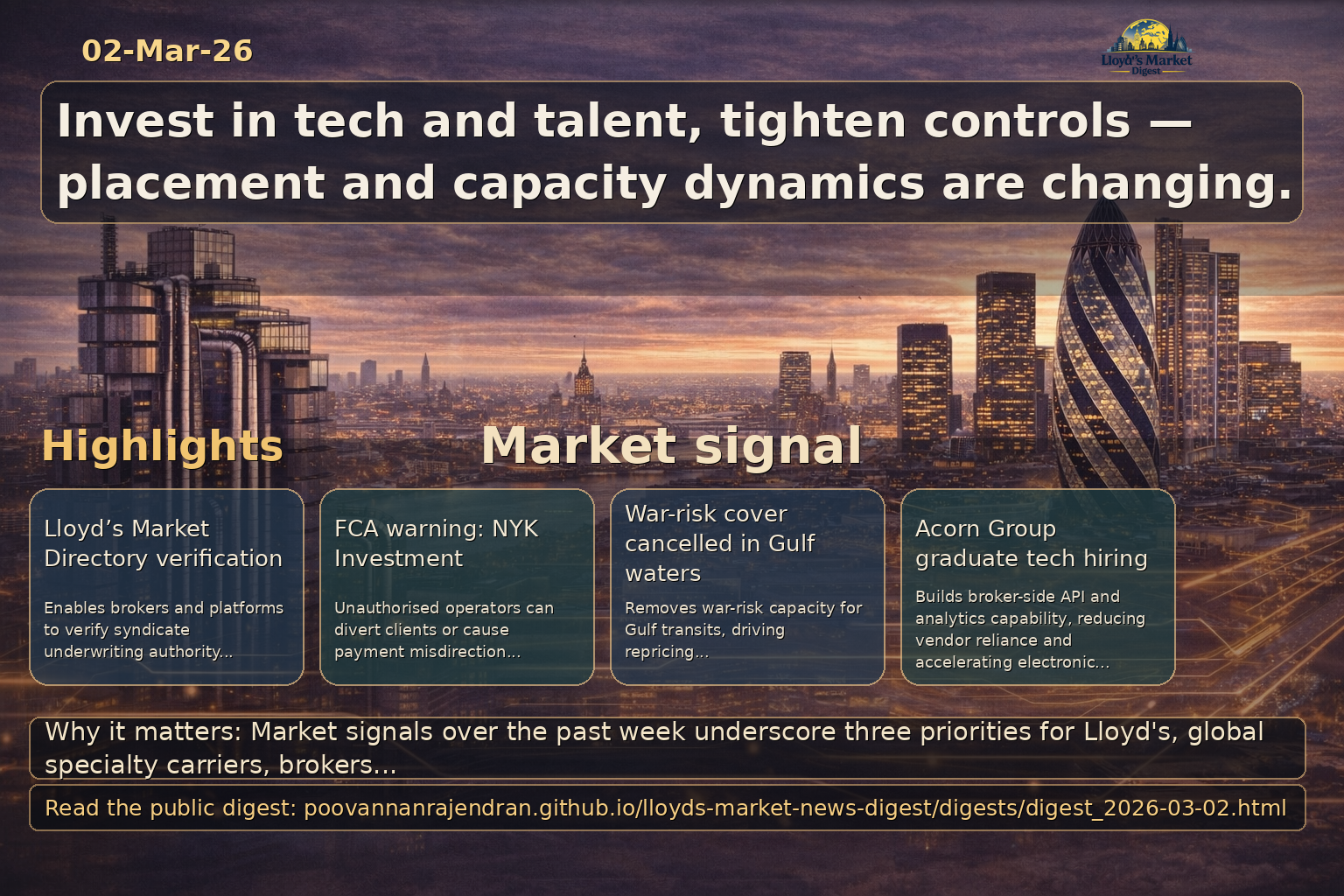
Why it matters: The Lloyd's Market Directory is the definitive source for who is authorised to underwrite at Lloyd's, making it essential for brokers and placement platforms to validate syndicate authority, manage counterparty risk, and support regulatory and client due diligence.
- Embed LMD checks into broker/placement onboarding and renewal workflows to verify underwriting authorities and managing agents before placement, reducing exposure to incorrectly bound risks.
- Use directory data to maintain a dynamic market map: track syndicate participation, lead underwriters and managing agents to inform capacity allocation, appetite matching and strategic panel decisions.
- Engage Lloyd's/third-party data providers to secure structured, timely feeds or APIs from the directory for integration with placement platforms and compliance systems—improving straight-through processing, audit trails and regulatory reporting.
Source: fca.org.uk
Why it matters: The FCA warning signals that an entity is operating without authorisation and may be masquerading as a legitimate provider. For Lloyd’s brokers, syndicates and placement platforms this creates two immediate threats: (1) clients or cedants could be diverted to a non‑regulated counterparty and lose protection or recoverability; (2) the market could suffer placement fraud, payment misdirection or reputational damage if intermediaries fail to detect impersonation or bogus counterparties.
- Immediate verification: instruct broking, underwriting and platform teams to validate counterparties and payment instructions against FCA registers and Lloyd’s/coverholder registries before any placement or premium movement.
- Client and partner communications: issue concise notices to clients and delegated authorities reminding them that only FCA‑authorised entities or properly credentialed Lloyd’s participants should be used, and outline how to verify credentials and report suspected fraud.
- Escalation and controls: escalate the warning to compliance, treasury and legal; pause suspicious transactions, strengthen KYC/AML checks for new counterparties, and log incidents with regulators and market bodies to protect recoverability and support potential investigation.
Source: insurancejournal.com
Why it matters: Appointment of a pro-business regulator to a senior UK prudential role may shift PRA emphasis on growth-friendly regulation and could influence capital and conduct expectations for Lloyd's market participants and UK-headquartered specialty carriers.
- Regulatory engagement: proactively brief the new regulator on Lloyd’s market capital models, ring-fenced arrangements and systemic risk mitigants to shape pragmatic supervisory expectations.
- Capital planning: reassess capital projections under potential easing or rebalancing of prudential stance, while retaining robust stress testing for tail events.
- Compliance and conduct: maintain high standards on operational resilience and governance to pre-empt shifts in supervisory focus from credit to growth facilitation.
Source: reinsurancene.ws
Why it matters: EPIC’s appointment to lead national real estate program development shows brokers scaling program solutions—relevant to syndicates seeking predictable, scalable property exposures.
- Syndicates should consider partnering with national broker programs to access homogeneous risk pools with lower volatility.
- Brokers can expand program authority to include delegated underwriting with clear KPIs for syndicate capital providers.
- Placement platforms must support program-level analytics and performance monitoring for both brokers and capital partners.
Source: businessinsurance.com
Why it matters: PartnerRe's decision to open a branch in India’s GIFT City signals reinsurers seeking local regulatory and tax advantages to write Indian risks directly — a structural shift affecting capacity channels for global specialty and Lloyd's-originated risks.
- Onshore presence reduces friction for local placements and can compete with Lloyd's and London-based syndicates for India-originated business; assess impact on treaty and facultative flows.
- Placement platforms need to adapt to dual-distribution strategies (cross-border vs onshore) and ensure compliance workflows for GIFT City domiciled reinsurers.
- Brokers should proactively map client appetite to available onshore capacity to optimize pricing and retention strategies for India risks.
Source: businessinsurance.com
Why it matters: Munich Re reporting robust profit reflects reinsurance market resilience and available capital, which influences pricing dynamics, capacity competition, and potential pressure on Lloyd's syndicate margins.
- Strong reinsurer profits generally support increased capacity and more aggressive appetite, which can suppress premium rate momentum for certain specialty classes.
- Syndicates and global specialty carriers should reassess treaty terms and retentions as reinsurer competitiveness could shift retrocession pricing and coverage conditions.
- Brokers must recalibrate placement strategies: leverage reinsurers' balance sheets to obtain capacity while guarding against future hardening cycles if catastrophe losses accelerate.
Source: businessinsurance.com
Why it matters: Insured bushfire losses in Australia demonstrate persistent natural catastrophe exposure that pressures specialty pricing, reinsurance purchasing and capital adequacy for syndicates underwriting Australasian risk.
- Elevated catastrophe claims drive reinsurance demand and may prompt higher premiums or stricter terms for fire-exposed portfolios; underwriters should refine exposure aggregation controls.
- Placement platforms must surface catastrophe aggregation metrics to brokers and cedants to support retro placement and cat-model validation during renewals.
- Syndicates should revisit underwriting guidelines, exposure management and diversification strategies to mitigate concentrated tail risk in the region.
Source: businessinsurance.com
Why it matters: Gallagher’s expansion in Germany via broker acquisition underscores continued consolidation among global brokers to secure European distribution scale — a dynamic that affects how Lloyd's and specialty carriers access corporate and middle-market clients.
- Increased broker scale in Germany strengthens local placement power, potentially shifting share away from smaller retail brokers and altering program architectures for EMEA-based accounts.
- Syndicates should prioritize strategic broker relationships and tailored product offerings to maintain visibility on large consolidated broker panels.
- Placement platforms need seamless cross-border capabilities and localization (language, regulatory data capture) to support larger broker networks executing complex global placements.
Source: businessinsurance.com
Why it matters: Profile entry — individual leadership profiles are monitored for potential market-impacting moves; this particular item is an informational personnel entry with limited immediate market effect.
- Track senior personnel profiles as early indicators of hiring or departures that could shift broker-client relationships or distribution channels.
- Incorporate known leaders into engagement plans for syndicates and carriers to sustain institutional relationships.
- Use profile data for succession planning and to anticipate potential shifts in regional broking influence.
Source: globalreinsurance.com
Why it matters: This acquisition gives Miller immediate DFSA‑regulated presence and an admitted Lloyd's platform in Dubai, accelerating its strategic reinsurance expansion into MENA. It strengthens Miller's ability to place facultative and treaty specialty risk locally, improves access to regional takaful and insurer clients, and creates more direct placement routes to Lloyd's syndicates and global capacity providers. Regulatory approval and integration will determine the speed at which these distribution and placement advantages are realized.
- Direct Lloyd's distribution in MENA: Shields' Lloyd's admission enables Miller to place admitted capacity locally, shortening placement cycles and improving appeal to regional insurers and takaful operators seeking admitted solutions.
- Broadened specialty reinsurance capability: Adds facultative and treaty expertise in specialty classes to Miller's product set, increasing leverage with syndicates and global reinsurers and supporting cross‑sell opportunities across EMEA and APAC relationships.
- Regulatory and operational gating: DFSA and Lloyd's approvals are required; successful integration of compliance, local teams and placement workflows will be critical to realizing synergies and to optimizing use of placement platforms and syndicate relationships.
Source: insurancejournal.com
Why it matters: Agritourism growth is creating a nascent but fast-expanding specialty risk class requiring tailored underwriting, distribution and reinsurance solutions — an opportunity for London syndicates and specialty MGAs to capture bespoke capacity and scaled broker placements.
- Underwriting: develop farm-visit/event endorsements, biosecurity and premises liability modules tailored to agritourism exposures and seasonal variability.
- Distribution: equip placement platforms and brokers with modular policy templates and data-led risk scoring to quote quickly for diverse farm-enterprise models.
- Reinsurance/Capital: structure quota-share or facultative reinsurance and parametric options to manage peak-season aggregations and weather-driven loss volatility.
Source: insurancejournal.com
Why it matters: Marine insurers’ cancellation of war risk cover in Gulf/adjacent waters materially reduces available capacity and shifts premium, routing and contractual risk for global shipping — a direct stress-test for Lloyd’s marine syndicates, brokers and P&I club interactions.
- Placement strategy: brokers and platforms must pre-negotiate buy-back options and alternate war-risk facilities, and communicate rating and routing implications to insureds immediately.
- Underwriting and pricing: syndicates to repriced exposed voyages, tighten terms for Gulf transits, and model contagion effects on related marine cargo and hull portfolios.
- Operational: coordinate with P&I clubs and reinsurance partners to manage aggregation; update clauses and voyage warranties on placement documents and run scenario liquidity checks.
Source: insurancejournal.com
Why it matters: The Fifth Circuit’s greenlight for Allstate’s RICO recovery underscores heightened enforcement against systemic fraudulent claim schemes — reinforcing the need for rigorous claims controls and recovery protocols across carriers and brokers active in U.S. casualty markets.
- Claims governance: reinforce fraud detection, documentation standards and early subrogation workflows to preserve recovery rights and evidence for litigation.
- Contracting and due diligence: brokers should require enhanced warranties and claims cooperation clauses in placement slips to protect lead and follow underwriters.
- Litigation readiness: syndicates to assess D&O/E&O exposures, allocate legal reserves for recoveries, and coordinate with reinsurers on recoverable loss recognition.
Source: insurancejournal.com
Why it matters: State-level proposals to cap insurer profits and mandate refunds indicate political pressure on insurance affordability — a contagion risk for underwriting economics and product pricing in personal lines and specialty portfolios where syndicates write U.S. exposures.
- Pricing models: undertake granular profitability stress tests by state and product; prepare tariff and filing strategies to demonstrate reasonable rates to regulators.
- Capital allocation: model potential retroactive premium adjustments and provisioning needs; reconsider capacity deployment into highly politicised jurisdictions.
- Engagement: coordinate industry-level advocacy through trade bodies and prepare consumer communications to mitigate reputational and regulatory escalation.
Source: insurancetimes.co.uk
Why it matters: Broker investment in early-career technology talent is material to market participants because it builds in-house capability required for digital placement, API integrations and analytics that syndicates and platforms increasingly expect.
- Creates a pipeline of technical capability within brokers to support API-led placements, data enrichment and automation across binding platforms
- Reduces reliance on external vendors for systems integration, accelerating platform adoption and improving data quality for underwriters
- Supports retention and cultural transformation needed to compete for digital-native clients and to service specialty, complex and cyber risks effectively
Source: insurancetimes.co.uk
Why it matters: The shift from intermediary to advisor in cyber risk has direct implications for brokers, syndicates and specialty carriers as cyber becomes embedded into client risk management and underwriting processes.
- Brokers must evolve advisory capabilities, integrating continuous security assessment and loss-mitigation services into placement conversations to stabilise underwriting outcomes
- Underwriters and syndicates will need richer, ongoing data and controls evidence from broker-led advisory relationships to price cyber risk sustainably
- Opportunity for strategic partnerships between brokers and cyber MGAs/insurers and for placement platforms to support continuous data feeds and modular cyber products
Source: insurancetimes.co.uk
Why it matters: Movo Partnership's adoption of a single applied rating hub demonstrates the operational benefits of consolidated connectivity for broker networks and points to a repeatable model for specialty distribution and placement platforms.
- A centralised rating and connectivity hub reduces integration complexity for brokers and enables faster access to insurer and MGA schemes at scale
- For syndicates and MGAs, a single ingestion point improves straight-through-processing and data consistency, lowering underwriting friction
- The model validates investment in enterprise connectivity that placement platforms and Lloyd's initiatives can emulate to expand electronic trading across specialty lines
Source: insurancetimes.co.uk
Why it matters: Senior hires and executive movement across insurers and broker groups are early indicators of strategic priorities—particularly digital transformation, distribution optimisation and reconfigured specialty leadership that affect market capacity and partnership dynamics.
- Appointments of CIOs and distribution leaders signal accelerated investment in platform strategy, data and integration across carriers and broker networks
- Broker leadership changes can realign market relationships and influence which syndicates and MGAs receive placement focus
- Executive churn may prompt short-term shifts in appetite or product strategy as organisations recalibrate for specialty growth and technology-enabled distribution
Source: insurancetimes.co.uk
Why it matters: While lighter in content, executive engagement pieces reflect culture and internal networks that matter for talent retention and relationship capital within firms that supply specialty risk advisory and placement services.
- Visible executive engagement and internal recognition help retain specialist talent critical to servicing complex and niche risks in the Lloyd's ecosystem
- Informal industry networks and executive visibility support cross-firm relationships that can facilitate placements and syndicate introductions
- Soft-skill leadership and engagement signal stability and client-facing credibility important to brokers and consultancies operating in global specialty markets
Source: reinsurancene.ws
Why it matters: Historic reinsurance commentary underscores the persistence of nat-cat-driven pricing cycles and the emergence of pricing floors relevant to current Lloyd's renewals and syndicate rate planning.
- Use archival loss and pricing signals to stress-test current portfolio assumptions at upcoming renewals and adjust attachment strategies.
- Syndicates should coordinate with distribution partners to capitalise on hard-market momentum where warranted by exposure analytics.
- Placement platforms and brokers must ensure data continuity to benchmark loss experience against long-cycle market drivers.
Source: reinsurancene.ws
Why it matters: SPG’s acquisition of ANOVA highlights the continued aggregation of marine MGAs and the strategic value of specialist distribution for global cargo and logistics risks.
- Lloyd's syndicates and global reinsurers should evaluate capacity alignments with consolidated MGAs to access diversified cargo flows.
- Brokers can leverage unified product suites to present integrated liability and cargo placements, reducing placement friction.
- Placement platforms should prioritise APIs and data interoperability to onboard merged MGA underwriting engines efficiently.
Source: reinsurancene.ws
Why it matters: SPG’s Logistiq acquisition and merger with ANOVA signals creation of end-to-end cargo & logistics platforms which will alter broker-syndicate placement dynamics for global supply-chain risk.
- Syndicates offering cargo capacity must adapt product terms to accommodate combined domestic and ocean risks under single program structures.
- Brokers should reassess panel strategies to include tech-forward MGAs that can deliver consolidated data and risk intelligence.
- Placement platforms need to support multi-segment quoting and binding workflows to capture full logistics lifecycle business.
Source: reinsurancene.ws
Why it matters: The Delos–ROAR collaboration addresses wildfire exposure strategies, reflecting the market shift toward integrated mitigation, finance and insurance solutions—critical for property appetites across Lloyd's syndicates.
- Syndicates should evaluate underwriting frameworks that incorporate mitigation credits and multi-stakeholder resilience programmes.
- Brokers can position value-added risk-reduction services alongside placement to protect capital and reduce loss volatility.
- Placement platforms ought to enable reporting of resilience measures to support differentiated pricing and capacity allocation.
Source: artemis.bm
Why it matters: Swiss Re leadership signalling a push to amplify alternative capital, reimagine the value chain and deploy AI indicates an industry pivot that will alter how syndicates, brokers and placement platforms access and price capacity.
- Strategic emphasis on alternative capital and ILS suggests increased partnership opportunities between global reinsurers and investment pools—affecting Lloyd’s syndicate capital mix.
- AI and value‑chain redesign imply faster risk selection, improved pricing granularity and potential compression of traditional broker margins where data advantages emerge.
- Disciplined cycle management from a market leader will influence pricing expectations and placement timing, pressuring brokers to demonstrate value in structuring and negotiation.
Source: artemis.bm
Why it matters: PERILS upgrading AU$ loss estimates for Queensland/NSW convective storms materially updates exposure metrics that inform reinsurance renewals, Lloyd’s syndicate portfolio stress tests and broker placement strategies for Australian business.
- Upward revision to industry losses tightens aggregate loss assumptions used by syndicates and specialty carriers for 2026 renewals.
- Brokers must reassess attachment points and retentions for AU property/motor portfolios; placement platforms should refresh modelling inputs for ILS and retro offers.
- Higher measured losses increase demand for region‑specific capacity (local reinsurers, ILS) and may accelerate use of parametric or multi‑peril cover layering for future seasons.
Source: artemis.bm
Why it matters: Everest’s significant dividend from the Mt. Logan Re structure is a tangible example that sidecars/third‑party capital can deliver cash returns to sponsors, validating this channel as a strategic capital lever for underwriters and brokers.
- Material dividend signals economic viability of sidecar structures for both sponsors and third‑party investors, encouraging more originations and renewals of similarly capitalized cells.
- Brokers should position sidecars and managed cells as viable adjuncts to traditional reinsurance programs to optimize capital efficiency for syndicates and primary carriers.
- Syndicates and placement platforms will see renewed appetite to design cell architectures that align sponsor economics with investor return expectations.
Source: artemis.bm
Why it matters: Tokio Marine’s planned $100m Kizuna Re III cat bond issued from Singapore underscores continued sponsor appetite to access global ILS for Japan earthquake risk and demonstrates cross‑jurisdictional placement strategies brokers must manage.
- Use of a Singapore SPV for Japan earthquake protection highlights jurisdictional flexibility in ILS placements and the need for brokers to coordinate cross‑border regulatory and tax considerations.
- The transaction reinforces demand for collateralised earthquake capacity among primary insurers, creating competitive pressure on traditional retrocession providers and Lloyd’s syndicates with Japan exposures.
- Placement platforms and global brokers should leverage investor networks to support tranche pricing and distribution given strong issuer pedigree and recurrent sponsor issuance.
Source: artemis.bm
Why it matters: Deal structure details of Kizuna Re III (single Class A collateralised tranche, $100m target) matter to syndicates and brokers evaluating the marginal capital contribution of ILS versus collateralised retro.
- Single‑tranche, fully collateralised issuance simplifies counterparty exposure and can be integrated as a multi‑year retro alternative for cedants managing Japan earthquake accumulations.
- Tranche sizing and simplicity make the deal attractive to a broad investor base, sustaining primary issuance channels that brokers can tap for similar programs.
- Clear collateralisation reduces basis risk for cedants and may be used by Lloyd’s syndicates as a template for securitised retro placements.
Source: insurtechnews.com
Why it matters: The referenced calendar fragment is a proxy for broken or incomplete market scheduling data. Accurate, machine-readable event and renewal calendars are essential to coordinate syndicate underwriting rhythms, broker placement strategies and platform capacity during peak market periods such as April renewals and programme placements.
- Validate and centralise event and renewal feeds: establish a single authoritative calendar for syndicate and broker stakeholders and ensure third‑party insurtech sources are reconciled daily.
- Embed monitoring and SLAs for calendar APIs: implement health checks, error alerts and contractual SLAs for any placement platform or publisher that supplies market schedules to avoid downstream workflow failures.
- Align commercial and operational calendars: require syndicates, lead brokers and electronic placement platforms to publish key dates (renewals, SLAs, market days) in machine‑readable format and integrate them into broker/placement platform workflows to minimise missed submissions and pricing delays.