Source: bankofengland.co.uk
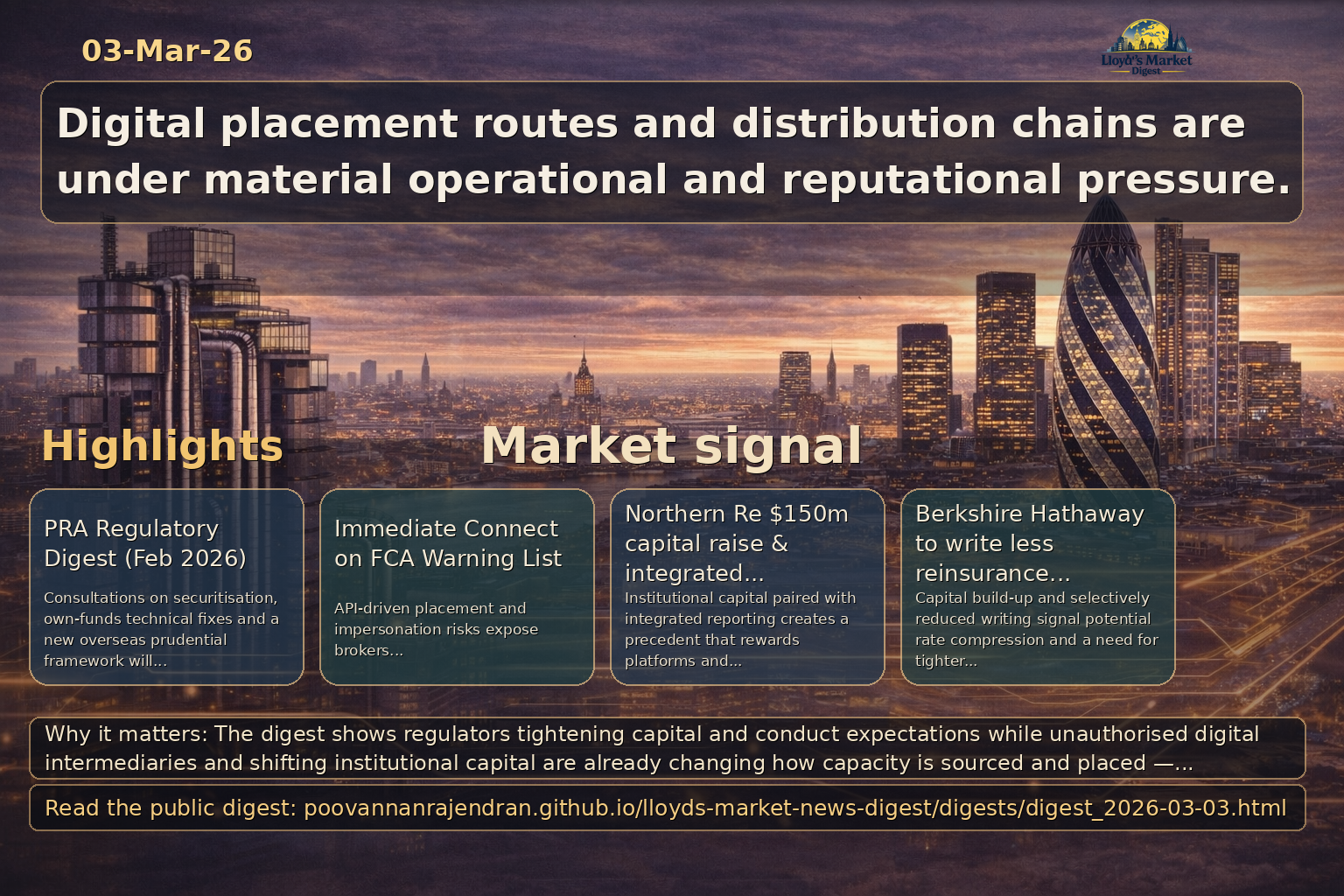
Why it matters: The PRA digest aggregates consultations and policy statements that will reshape capital and conduct requirements relevant to Lloyd's managing agents, global specialty insurers, brokers and placement platforms—specifically changes to securitisation rules, own funds technical fixes and a new overseas prudential framework that will affect how capacity is deployed and reported across jurisdictions.
- Immediate capital review: quantify exposure to securitisation and structured reinsurance (including ILS and cat bonds), test impacts of CP2/26 on capital charges and counterparty treatment, and update ICA/ORSA scenarios to reflect potential changes to securitisation credit and conduct requirements.
- Governance and balance‑sheet action: assess CP4/26 own funds adjustments against current capital structures (tiering, eligible items, ring‑fenced arrangements for syndicates) and instruct finance and actuarial teams to model transitional and ongoing compliance costs for syndicates and corporate members.
- Market, placement and data readiness: instruct brokers and platform operators to map contractual terms, data feeds and reporting workflows against CP3/26 and DP1/26 expectations—prioritise amendments to placement documentation, KYC/AML flows, and automated data exchanges to preserve cross‑border distribution and alternative capital placements.
Source: fca.org.uk
Why it matters: FCA warning on Willford & Thompson Partners LLC signals active unauthorised operators that can target brokers, cedants and placement platforms — increasing risk of misdirected premiums, false documents and reputational damage across Lloyd’s and global specialty flows.
- Immediate counterparty check: verify against the FCA Warning List and internal watchlists; block onboarding and any live trades until confirmation of authorisation.
- Platform controls: enforce mandatory KYC/AML source-of-funds checks for new introducers and require digital attestations for counterparties before any electronic placement or premium movement.
- Client and market communication: brief affected relationship teams and update client advisories and placement platform alerts to prevent clients dealing with the unauthorised entity.
Source: fca.org.uk
Why it matters: Immediate Connect appears on the FCA Warning List; firms that rely on digital connectivity and API-driven placement may be particularly exposed to actors impersonating brokers or distribution intermediaries, creating systemic onboarding and settlement vulnerabilities.
- Connectivity governance: require platform teams to implement endpoint whitelisting, mutual TLS and verified onboarding flows for any new introducer or API connection.
- Transaction monitoring: increase scrutiny on premium flows and unusual placement patterns linked to new or unverified counterparties and escalate suspicious activity to compliance immediately.
- Contractual protections: ensure distribution agreements and delegated authority contracts include express representations on regulatory status and immediate termination rights if a counterparty appears on regulator warning lists.
Source: fca.org.uk
Why it matters: EIS Compare being unauthorised highlights cross-sector risks where investment-comparison or lead-generation sites may be used to channel business or mislead retail/SME customers — a notable risk for brokers and MGAs offering integrated investment or packaged products.
- Distribution gatekeeping: review referrals, lead sources and online partners to ensure marketing channels feeding brokers or platforms are authorised and transparent.
- Reputational surveillance: monitor marketplaces and price-comparison sites for misuse of carrier or syndicate branding; issue takedown requests and client notices where impersonation is detected.
- Sales oversight: reinforce suitability and disclosure checks when leads originate from third-party comparison or referral sites to avoid downstream complaints and FSCS/OMB exposure.
Source: fca.org.uk
Why it matters: The FCA’s authorisation gateway for targeted support (effective 6 April 2026) introduces a new regulatory pathway that could affect insurers, brokers and platforms offering tailored guidance; market participants that intend to provide targeted support must be authorised and ready at launch.
- Authorisation planning: determine whether current or planned advisory features meet the definition of “targeted support” and prepare applications or amendments to permissions with clear timelines to meet the April 2026 rollout.
- Product and data segmentation: assess product design, customer segmentation and data analytics capabilities to ensure targeted suggestions comply with conduct standards and are auditable.
- Operational readiness: update governance, training, monitoring and client disclosure frameworks; integrate authorisation requirements into platform roadmaps and board-level risk reporting.
Source: fca.org.uk
Why it matters: The FCA’s new annual Regulatory Priorities (insurance sector report published 24 February 2026) replaces portfolio letters and will set the firm-level expectations for conduct, systems and controls across the insurance market — a focal point for upcoming supervisory engagement with Lloyd’s market participants.
- Gap analysis: once the insurance Regulatory Priorities report is published, run an immediate cross-functional gap analysis against conduct, data, operational resilience and distribution expectations and prioritise remediation projects.
- Resource allocation: align compliance, actuarial, technology and distribution budgets to deliver against the published priorities, and prepare concise board reporting on milestones and residual risk.
- Engagement and evidence: proactively engage with the regulator where appropriate, and assemble audit-ready evidence on how platform controls, delegated authority oversight and broker conduct map to the new priorities.
Source: artemis.bm
Why it matters: Northern Re’s $150m capital raise and integrated technology platform exemplify how institutional investors are demanding operational transparency and alignment with cedent objectives—an important precedent for how alternative capital sources will access casualty and specialty risks that are traditionally placed through Lloyd’s brokers and syndicates.
- Opportunity: Placement platforms and brokers can capture fee and distribution economics by integrating with institutional-grade reporting and loss-modelling outputs to channel ILS and institutional capital into Lloyd’s-originated specialty risks.
- Operational risk: Syndicates and managing agents must adopt standardized data and governance protocols to meet institutional underwriting, audit and collateral requirements or risk losing placements to vertically integrated capital providers.
- Recommended action: Accelerate interoperability and API-driven data exchange between syndicates, brokers and placement systems; pilot co-branded product offerings that align cedent KPIs with institutional investor reporting to demonstrate alignment and attract scale.
Source: artemis.bm
Why it matters: Berkshire Hathaway’s signal that it will write less reinsurance premium amid a capital build-up reflects a broader competitive backdrop: abundant capital can depress pricing, while disciplined global players may pare back exposure—this has material consequences for syndicate underwriting strategies and broker placement dynamics at Lloyd’s and in global specialty markets.
- Pricing and margin pressure: Increased capital availability can exacerbate rate compression in commoditised lines; underwriters at syndicates must sharpen selection criteria and pricing governance to protect returns.
- Counterparty risk and differentiation: Reliance on price-driven placements increases counterparty volatility; brokers need to demonstrate portfolio construction value and access to diversified capital sources (ILS, insurers, institutional).
- Strategic response: Emphasise underwriting discipline, portfolio-level risk controls and capital-efficient products; expand collaboration with ILS managers and institutional partners via structured platforms to retain fee pools and offset pricing cycles.
Source: globalreinsurance.com
Why it matters: Liberty's consolidation of Hong Kong operations under a single licence and the appointment of Cynthia Sze creates a centralised in-market executive responsible for unified product, pricing and distribution strategy across personal, commercial and specialty lines — a material change for brokers, Lloyd's participant distribution and placement platforms operating in APAC.
- Strategic: Single-licence operating model facilitates faster product rollout and unified appetite across lines — brokers should re-evaluate placement routing and panel concentration with Liberty as a single decision point.
- Operational: Expect changes to placement workflows, delegated authority and platform integration requirements — placement platforms and broking operations must validate connectivity, SLAs and data standards with Liberty International Insurance Limited.
- Commercial: Consolidation could increase competitive capacity in Hong Kong/Asia but also shift negotiation leverage; C-suite and lead brokers should secure written terms on capacity access and commission/fee arrangements during the transition.
Source: globalreinsurance.com
Why it matters: MS Re's CUO succession from Charles Goldie to Jörg Bruniecki represents both continuity and an inflection point for global specialty underwriting strategy. Bruniecki’s remit over global underwriting will likely influence product appetite, pricing discipline and reinsurance placement, affecting broker strategies and syndicate counterparty relationships.
- Underwriting strategy: Anticipate a revalidation of specialty portfolios and potential tightening or repricing in select classes — brokers must proactively engage MS Re underwriting teams to understand emerging priorities and criteria.
- Capacity and retrocession: New CUO leadership often triggers portfolio realignment and retrocession buying changes; syndicates and panel brokers should review exposure corridors and collateral/contract terms to mitigate abrupt capacity shifts.
- Partnership management: Maintain active dialogue with MS Re senior management and underwriting leaders; secure continuity commitments for existing placements and request early sight of any material product or appetite updates to inform renewal and syndicate allocation decisions.
Source: insurancejournal.com
Why it matters: Delaware's corporate law overhaul and Delaware Supreme Court validation changes governance risk assessments and transaction certainty relevant to D&O, M&A insurance, and syndicate capital modelling.
- Increases demand for D&O and transaction liability coverage as founders and private equity adopt permissive governance frameworks that can shift litigation dynamics.
- Affects syndicate underwriting of M&A and warranty & indemnity products due to potential shifts in litigation venues and relief outcomes.
- Brokers and placement platforms should update advisory materials and questionnaires to capture altered fiduciary standards and litigation exposure for subscription placements.
Source: insurancejournal.com
Why it matters: Class action against FedEx over tariff refunds signals litigation and contingent liability exposures in logistics and carrier-intermediary relationships, with implications for trade credit and professional lines.
- Potential mass recoveries create contingent liability scenarios for carriers and freight forwarders that affect professional indemnity and crime cover triggers.
- Reinsurers and syndicates should monitor exposures tied to tariff rulings that could cascade into trade credit claims and cargo liability adjustments.
- Brokers must reassess policy wordings and exclusions related to government-imposed duties and refund mechanisms on placement platforms handling cargo portfolios.
Source: insurancejournal.com
Why it matters: Seizure of a Russian-linked tanker underscores enforcement risk around sanctioned vessels and the growing 'shadow fleet' problem, elevating marine, war and sanctions-related underwriting scrutiny.
- Heightened sanctions enforcement increases war and political violence claims exposure and may trigger non-standard decline or cancellation of marine hull and cargo risks.
- Syndicates must enhance KYC/SME procedures and port-of-call underwriting checks to identify 'false flag' and sanctioned-vessel risks.
- Brokers and placement platforms need integrated sanctions screening and clear client advisories on coverage limitations for sanctioned shipments and sequestration events.
Source: insurancejournal.com
Why it matters: Large numbers of VLCCs idling in the Persian Gulf create concentrated marine Hull & Machinery (H&M), cargo and energy liability accumulations and elevate war risk premium dynamics.
- Concentration of tonnage increases aggregate exposure for hull, cargo and P&I portfolios; syndicates should re-evaluate accumulation models and limit structures.
- Energy underwriters need to consider disruption-driven price volatility and contingent business interruption for oil producers and traders.
- Brokers must deploy placement platforms capable of rapid aggregation of client voyage data to manage and tranche exposures across markets.
Source: insurancejournal.com
Why it matters: Widespread airport closures and suspended Gulf carrier operations increase aviation war/terrorism exposures, travel disruption claims and contingency liabilities for corporates and insurers.
- Surge in travel insurance and contingency BI claims will pressure A&H, travel and event cancellation portfolios; capacity may tighten for Gulf transit routes.
- Aviation underwriters should reassess route exclusions and pricing for operations transiting regional airspace; reinsurance buyers may seek increased facultative support.
- Brokers should advise clients on alternative routing, contingency planning and ensure placement platforms reflect real-time airspace closure overlays.
Source: reinsurancene.ws
Why it matters: Archive item signals historical Lloyd's market initiatives and the context for index/placement pauses relevant to current platform launches and regulatory focus.
- Documents precedent of Lloyd’s pausing product initiatives — informs timing and stakeholder expectations for platform launches
- Useful reference for syndicate strategists assessing market receptivity to indexed or algorithmic products
- Provides context on broker and market reaction cycles during structural market change (e.g., Brexit-era disruptions)
Source: reinsurancene.ws
Why it matters: Ki’s 2025 results demonstrate scalability and underwriting economics of an algorithmic Lloyd’s follow platform and its syndicate-led capital model.
- Validates algorithmic placement as a viable distribution route into Lloyd’s syndicates and capacity partners
- Improved combined ratios and profitability highlight how data-driven underwriting can attract reinsurance and third-party capital
- Signals syndicate managers and brokers to prioritise integration with digital follow platforms for efficient quota-share and capacity optimisation
Source: reinsurancene.ws
Why it matters: Growing gray-zone aggression elevates demand for specialty political violence and trade-interruption covers — an area relevant to Lloyd’s and specialty markets.
- Expands PVT and geopolitical risk appetite requirements for syndicates and MGAs
- Brokers should refine placement language and evidence standards for ambiguous event triggers
- Reinsurers and capital providers must reassess aggregation and scenario modelling for non-traditional operational risks
Source: reinsurancene.ws
Why it matters: Large bulk annuity transaction demonstrates demand dynamics and broker-led placement for capital-efficient pensions solutions, relevant to capacity and balance-sheet strategies.
- Illustrates how major brokers (Aon) assemble capacity and legal/advisory ecosystems to place large longevity risk parcels
- Signals opportunities for reinsurers and Lloyd’s syndicates to provide longevity or longevity reinsurance capacity
- Underlines need for placement platforms to handle complex multi-stakeholder transactions with bespoke structuring
Source: reinsurancene.ws
Why it matters: Feasibility study for a joint reinsurance/risk finance platform among development risk pools shows evolving multi-party placement and capital pooling models with parallels for syndicates and placement platforms.
- Highlights growing appetite for pooled parametric and reinsurance capacity to support sovereign climate resilience
- Opportunity for Lloyd’s syndicates and global specialty reinsurers to provide tailored capacity and retrocession solutions
- Encourages platforms that can aggregate heterogeneous sovereign risks and streamline placement across markets
Source: newsnow.co.uk
Why it matters: Global stock-market developments influence investment yields, surplus capital and pricing discipline across syndicates and managing agents — a critical driver of capacity and rate adequacy in specialty lines.
- Investment income sensitivity: stress-test syndicate portfolios for equity volatility and potential pressure on underwriting margin if yields compress.
- Capacity allocation: anticipate reallocation of capital toward higher-yielding specialty segments; brokers should map demand to capacity shifts.
- Pricing discipline: use market volatility intelligence to justify rate adequacy and re-underwriting of legacy exposures during renewals.
Source: newsnow.co.uk
Why it matters: Worldwide equity and bond-market signals inform reinsurer and retrocession strategies, influencing capacity availability for large, correlated specialty programmes placed through Lloyd’s.
- Reinsurance pricing & retention: monitor global market indicators to anticipate reinsurance rate movements and adjust ceded-retention strategy on large programmes.
- Capital stress scenarios: model tail-risk correlations between asset markets and insured catastrophe exposures to set prudent aggregate caps.
- Placement timing: coordinate multi-layer programme placements with reinsurers and platforms to exploit windows of improved pricing or capacity.
Source: artemis.bm
Why it matters: Coverage of market leaders trimming retrocession and sidecar programmes illustrates a strategic shift toward retaining economics and reducing reliance on collateralised structures—this recalibration directly affects capacity mixes available to Lloyd’s syndicates, global specialty brokers and placement platforms.
- Market implication: Reduced retrocession supply from major reinsurers compresses downstream capacity and increases the importance of alternative capital providers and ILS solutions to absorb tail and catastrophe exposures.
- Distribution impact: Brokers and platforms must broaden counterparty panels and develop bespoke structures (e.g., quota-share, fronting, collateral solutions) to replace retrocession capacity while preserving client terms.
- Recommended action: Syndicates should re-evaluate retrocession buying strategies and capital efficiency levers; brokers should prioritize advisory services that match cedent risk appetite to available capital pools, and platforms should offer transparent collateral mechanics to facilitate these trades.
Source: newsnow.co.uk
Why it matters: Saudi Arabia’s Vision 2030 and mega-project pipeline materially expand demand for specialty capacity, reinsurance and tailored political/credit risk transfer — a strategic priority for Lloyd’s syndicates and global brokers.
- Underwrite opportunity: large infrastructure, energy transition and NEOM-related programmes require layered capacity and bespoke wording; syndicates should pre-position appetite and facultative capacity.
- Regulatory & licensing: monitor Saudi regulatory reform and foreign ownership rules to design compliant placement structures and captive solutions for multinational clients.
- Placement platforms & local partners: accelerate platform integrations and on‑the‑ground broker alliances to facilitate swift placements and manage local claims protocols.
Source: newsnow.co.uk
Why it matters: Edinburgh’s role as a financial and insurance hub affects talent supply, specialist underwriting capacity and opportunities for captive domiciliation and insurtech expansion relevant to Lloyd’s distribution strategies.
- Talent & centres of excellence: leverage Edinburgh’s financial-services talent pool to bolster underwriting, analytics and claims teams remote‑first or via secondments.
- Captive and regulatory opportunity: assess Scottish legal and tax frameworks for captive domiciliation or partnership vehicles serving EMEA programmes.
- Insurtech partnerships: pursue local technology pilots with Edinburgh-based fintechs to enhance placement automation, pricing models and client portals.
Source: newsnow.co.uk
Why it matters: Developments in metropolitan policing and public-order reporting drive underwriting assumptions for crime, terrorism, event cancellation and liability lines — affecting loss frequency and operational risk for insureds and syndicates.
- Claims inflation & frequency: reassess exposure concentrations in urban portfolios for riot, political violence and commercial interruption scenarios.
- Policy wordings & exclusions: review event-cancellation, non-damage business interruption and political-violence wordings to reflect evolving law-enforcement responses and response times.
- Brokers’ advisory role: provide clients with loss-mitigation guidance and specialist risk-management services (security, cyber-physical resilience) to reduce attritional claims.