Source: businessinsurance.com
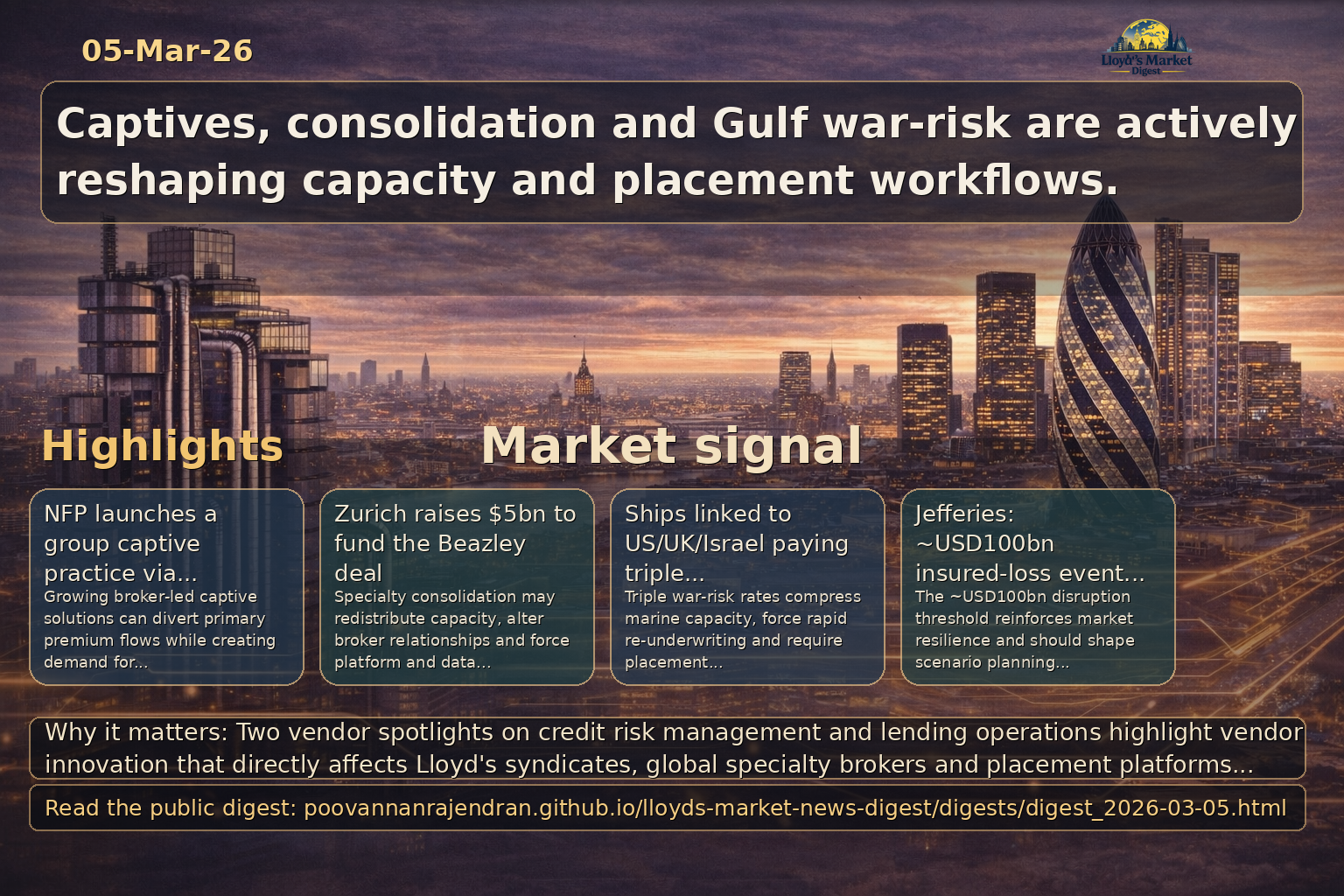
Why it matters: NFP establishing a group captive practice via acquisition reflects increased use of captives and alternative risk transfer, which competes with or complements Lloyd's offerings for structured capacity solutions.
- Consider expanding syndicate and platform offerings to include captive-friendly products and carve-outs to retain clients moving to alternative risk solutions.
- Partner with broker captive teams to provide layered reinsurance or fronting solutions that keep business within specialty markets.
- Monitor captive growth as a source of stable premium and potential retrocession demand for syndicates and reinsurers.
Source: reinsurancene.ws
Why it matters: NFP’s launch of a P&C Group Captive practice via acquisition signals growing broker-led captive solutions that influence alternative capital demand and placement of residual layers with reinsurers and syndicates.
- Alternative capacity: increased captive activity can reduce primary premium flow to traditional markets but create demand for reinsurance and excess protection.
- Advisory expansion: brokers must integrate captive design with placement strategies to optimise capital efficiency for clients.
- Syndicate implications: syndicates and placement platforms should consider tailored reinsurance and quota share structures to partner with captives.
Source: artemis.bm
Why it matters: Jefferies’ reporting of industry consensus that a ~USD100bn insured-loss event would be required to materially derail reinsurance and ILS markets underscores market resilience and has implications for capital allocation and risk appetite across Lloyd’s and specialty markets.
- Panel consensus reinforces investor confidence and persistence of demand for ILS and reinsurance absent an extreme outlier event, supporting continued capital inflows to placement platforms.
- Framing the disruption threshold around a USD100bn event (notably Florida) informs scenario planning for syndicates, tower structuring and retrocession purchasing decisions.
- This consensus supports sustained expansion of alternative capital strategies but also emphasizes the need for catastrophe aggregation controls and stress testing by underwriters.
Source: businessinsurance.com
Why it matters: Coverage of reinsurers using Bermuda-based casualty sidecars signals material shifts in alternative capital deployment that affect Lloyd's syndicate capacity and broker capital solutions.
- Implication: Bermuda sidecars can provide targeted casualty capacity faster than traditional retrocession — syndicates and brokers should reassess appetite and retro planning.
- Operational: Placement platforms must ensure documentation, jurisdictional compliance and reporting capabilities to accept sidecar-structured capital.
- Recommended action: C-suite and capital teams should map existing casualty exposures that could migrate to sidecars and engage Bermuda counsel and structuring partners proactively.
Source: businessinsurance.com
Why it matters: Significant increases in war risk rates for ships linked to certain flags/customers indicate concentrated underwriting stress in the marine line, with direct implications for Lloyd's marine syndicates and brokered placements.
- Market impact: Triple war risk rates will compress available capacity and force re-underwriting of exposures — brokers must anticipate tighter terms and seek alternative markets.
- Distribution: Placement platforms need rapid rating feeds and clause templates for war-exposed marine risks to reduce friction in re-pricing and binding.
- Tactical response: Marine desks should update voyage/risk screening, enhance client communication on premium/pass-through impacts, and consider contingency reinsurance arrangements.
Source: businessinsurance.com
Why it matters: QBE taking full control of an India JV highlights strategic emphasis on emerging-market distribution and has implications for global brokers and Lloyd's syndicates targeting growth in Asia.
- Strategic: Increased insurer ownership in-market can change broker leverage and local capacity dynamics — brokers should reassess distribution agreements and preferred partner strategies.
- Syndicate considerations: Lloyd's and specialty carriers targeting India should monitor local regulatory and capital implications that may affect cross-border placements.
- Action: Placement platforms should validate local market connectivity, regulatory reporting, and multilingual underwriting support to capitalise on growth while managing compliance risk.
Source: businessinsurance.com
Why it matters: Zurich raising capital to fund a Beazley acquisition signals consolidation in global specialty, with potential redistribution of capacity, broker relationships, and platform integration requirements.
- Market structure: Consolidation can concentrate specialty lines and change lead market behaviour — brokers should model counterparty concentration risk and client impacts.
- Integration: Placement platforms and syndicates must plan for data, policy wording and claims process harmonisation post-transaction to avoid placement friction.
- Governance: Executive teams should assess how a larger combined entity will affect appetite, delegated authority, and reinsurance treaties that support broker placements.
Source: globalreinsurance.com
Why it matters: QBE's elevation of an experienced underwriting leader to CUO for its International division materially affects underwriting strategy, product wording consistency and distributor relationships across geographies — issues directly relevant to Lloyd's syndicates, global specialty brokers and placement platforms seeking clarity on risk appetite and contractual terms.
- Strategic: Expect tighter underwriting controls and harmonised product wordings across jurisdictions, which will influence broker placement strategies and may reduce scope for transactional exceptions on platform placements.
- Market operations: Enhanced central underwriting oversight likely alters treaty and facultative purchasing patterns; reinsurance buyers and syndicates should reassess retrocession and capacity allocations in light of revised appetite.
- Talent and governance signal: Promotion underscores succession planning and the value of senior underwriting talent; brokers and platforms should capitalise on clearer points of escalation and underwriting authority for complex placements.
Source: globalreinsurance.com
Why it matters: Moody's view that the Iran conflict is, for now, a credit event transmitted mainly through GCC insurers' investment portfolios rather than claims has immediate implications for capital management, rating sensitivities and counterparty risk for syndicates and brokers operating in or with exposure to the region.
- Capital and ratings: Prolonged market disruption could erode surplus via mark-to-market losses, triggering negative rating actions and prompting capital injections or repricing by reinsurers and Lloyd's syndicates.
- Placement and counterparty risk: Brokers and platforms should stress-test client and counterparty exposure to GCC asset volatility; increased collateral, margining or revised credit terms may be required for affected placements.
- Underwriting and hedging response: Even absent elevated claims now, underwriters and asset managers must coordinate on hedging and duration management, and review war/terrorism wordings, sanctions exposure and treaty carve-outs.
Source: insurancejournal.com
Why it matters: Georgia's comprehensive property-insurance reforms signal tougher regulatory oversight, larger fines and targeted mitigation funding — developments that influence underwriting discipline, premium adequacy and broker advisory responsibilities for syndicates and capacity providers writing US property risks.
- Underwriting impact — Expect renewed scrutiny of US property exposures, higher loss adjustment costs and pressure on rate adequacy for syndicates exposed to Georgian risks; syndicates should reassess modelled losses and territorial appetite.
- Distribution and advisory role — Brokers and placement platforms must update advisory materials, filing templates and policy wordings to reflect strengthened fraud enforcement, fine regimes and mitigation incentives to avoid placement disputes.
- Precedent risk — Georgia may become a regulatory model for other states; Lloyd's and global specialty carriers should monitor for contagion that could widen pricing or capital allocation shifts in the US property segment.
Source: insurancejournal.com
Why it matters: Presidential assurances of insurance guarantees and naval escorts are a partial remedy; market participants view the plan as operationally and contractually complex, with significant implications for war-risk capacity, pricing and broker-led placement structures.
- Execution risk — Uncertainty around the scope, timing and legal architecture of any government-backed cover creates short-term coverage gaps and volatility in war-risk premia for hull, cargo and energy exposures.
- Brokers' coordinating role — Global brokers will be central to designing facility terms, appetite aggregation and reinsurance layering; syndicates must engage early to shape contract boundaries and premium mechanics.
- Market segmentation — A government backstop could segment the market between commercially priced private capacity and subsidised/limited-scope public programs, influencing long-term war-risk pricing and capital allocation decisions.
Source: insurancejournal.com
Why it matters: NATO's military action to intercept a missile evidences rapid escalation and alliance involvement — a factor that materially increases systemic state-sponsored risk and the potential for large-scale aggregations relevant to underwriting strategies across Lloyd's syndicates and specialty lines.
- Aggregation and exclusions — Syndicates should rapidly re-evaluate aggregation exposures and the application of war, hostile acts and state action exclusions across global portfolios, particularly aviation, marine and energy lines.
- Capital and liquidity planning — Elevated probability of multi-line losses requires contingency capital plans, tightened security on margin calls and rapid dialogue with reinsurers and capital providers.
- Placement platform contingency — Brokers and platforms must ensure availability of correct exclusionary wordings, expedited underwriting workflows and clear manifesting of government or P&I obligations to prevent coverage disputes.
Source: insurancejournal.com
Why it matters: The widening US–Iran conflict and paralysed Gulf shipping lanes have immediate loss potential and supply-chain exposures that will pressure marine hull, cargo, energy and political-risk books, forcing reassessment of capacity use and route-based war-risk loadings by Lloyd's syndicates and global brokers.
- Claims and latency — Large-scale cargo and hull claims, salvage and environmental liabilities may generate protracted, high-severity losses that test primary and excess layers across syndicates and reinsurance structures.
- Pricing and route risk — Expect rapid hardening of premiums for Gulf transits, re-rating of voyage-specific exposure and potential rerouting costs to be reflected in insured values and cover terms.
- Need for alternative structures — Rising demand for parametric triggers, quota-share reinsurance and government-backed facilities means brokers and platforms should model and offer hybrid placement solutions quickly.
Source: insurancejournal.com
Why it matters: The attack and abandonment of a container vessel is a concrete instance of attritional operational losses in the Strait of Hormuz, underscoring immediate hull, cargo, salvage and P&I exposures that inform war-risk appetite and premium adjustments for underwriters and brokers.
- Loss mechanics — Immediate salvage, wreck removal and cargo claims create short-term cashflow demands and potential deterioration in loss ratios for syndicates with maritime exposures.
- Wordings and evidence — Brokers must ensure precise war-risk endorsements, constructive total loss definitions and evidence protocols are in place to accelerate claim settlement and preserve coverage clarity.
- Underwriting posture — Syndicates will likely tighten underwriting criteria for container and small-vessel transits through the Gulf, increasing premiums and exclusions for high-risk voyages.
Source: insurancetimes.co.uk
Why it matters: Rising UK flood frequency stresses traditional cross-subsidisation, underwriting appetite and reinsurance capacity—requiring syndicates, brokers and placement platforms to revise pricing, risk selection and mitigation strategies.
- Re-underwriting required: syndicates must tighten terms and deploy advanced flood modelling and risk tiering to protect combined ratios.
- Distribution impact: brokers and platforms will need clearer risk‑based pricing tools and client segmentation to manage affordability and retention discussions.
- Capital and policy solutions: expect greater use of reinsurance, parametric triggers and public-private schemes; Lloyd’s syndicates should prepare to underwrite layered covers and climate adaptation products.
Source: insurancetimes.co.uk
Why it matters: Regional military escalation highlights contractual war exclusions and placement complexity for travel insurers; brokers and specialty underwriters must revisit wordings, contingency placement and crisis response protocols.
- Policy wording scrutiny: brokers must audit travel policies for acts-of-war exclusions and arrange bespoke war/P&I/ political risk capacity where necessary.
- Operational disruption: placement platforms and brokers face surge demand for alternative routing and emergency cover; syndicates should define war-risk appetites and delegated authority boundaries.
- Repricing and capacity: expect short-term capacity withdrawal or repricing for routes in affected airspace; specialty lines and Lloyd’s capacity will be key for bespoke solutions.
Source: insurancetimes.co.uk
Why it matters: Beazley’s 19% profit decline ahead of Zurich’s takeover flags near-term margin pressure in specialty lines and signals strategic consolidation that will reshape distribution and capacity for brokers and Lloyd’s syndicates.
- Margin management: weaker underwriting returns underline the need for improved pricing, loss prevention services and portfolio discipline across specialty books.
- Broker relations: acquisition may alter broker access and negotiating dynamics—brokers should assess the future placement network and product continuity.
- Market concentration risk: consolidation of specialty capacity (Zurich+Beazley) reduces counterparty diversity; Lloyd’s syndicates and MGAs must articulate differentiated value propositions.
Source: insurancetimes.co.uk
Why it matters: Zurich’s stated ambition to build a leading global specialty platform via Beazley acquisition demonstrates strategic pursuit of scale, distribution reach and complementary product sets—implicating placement flows, syndicate competition and cross-border distribution.
- Platform economics: combined scale enables enhanced risk appetite and larger line sizes—brokers should prepare for integrated global placement solutions.
- Product and cross-sell: Zurich’s distribution strength could accelerate packaged specialty products, pressuring syndicates to innovate on niche coverage.
- Regulatory and Lloyd’s interplay: a UK-based global specialty platform will interact with Lloyd’s distribution and could compete for wholesale placements across specialty classes.
Source: insurancetimes.co.uk
Why it matters: OBR’s upward IPT revision increases the effective cost of insurance, affecting demand elasticity, product design and broker pricing strategies—material for affordability discussions and public policy engagement.
- Demand sensitivity: higher expected IPT receipts imply greater premium cost for clients; brokers must quantify elasticity and advise on coverage prioritisation.
- Product redesign: carriers and MGAs may need to offer modular or higher-deductible options to retain clients without eroding underwriting profitability.
- Industry advocacy: syndicates, brokers and trade bodies should coordinate engagement with policymakers to mitigate adverse accessibility effects on essential covers.
Source: reinsurancene.ws
Why it matters: Archive content provides context on historical Lloyd's initiatives and market signals (e.g., delayed Lloyd's index) useful for benchmarking structural shifts in distribution and product launches.
- Historical reference: documents past Lloyd's strategic timing decisions that can inform expectations for platform and index launches.
- Benchmarking: useful for syndicates and platforms assessing pace of market innovation and market governance reactions.
- Advisory value: informs brokers and consultants when advising clients on timing for index-linked or structured specialty placements.
Source: reinsurancene.ws
Why it matters: Senior leadership appointments at Aon’s U.S. reinsurance business affect broker market strategy, capital advisory capability and placement execution that resonate in Lloyd's and global specialty markets.
- Strategic impact: signals Aon’s emphasis on growth and performance separation which may shift broker negotiation dynamics with syndicates and reinsurers.
- Client implications: enhanced dedicated leadership can accelerate tailored capital solutions and placement advisory for large accounts and complex specialty risks.
- Competitive positioning: syndicates and placement platforms should monitor how Aon’s capability build affects market access and pricing leverage.
Source: reinsurancene.ws
Why it matters: Florida Citizens’ target for nearly $3bn of private reinsurance impacts capacity demand, pricing in North American catastrophe treaties and collateral arrangements with global reinsurers and Lloyd’s syndicates.
- Capacity signal: large cedant demand may absorb global retro capacity, influencing catastrophe pricing and syndicate deployment strategies.
- Collateral and structure: encourages scrutiny of attachment layers and collateral mechanics—relevant for syndicates and placement platforms structuring offers.
- Procurement opportunity: brokers and placement platforms can position differentiated program structures (quota share, multi-year, ILWs) to meet this scale of demand.
Source: reinsurancene.ws
Why it matters: AM Best’s observation of softer capital quality and increased use of affiliated/offshore reinsurance has direct relevance for syndicates, Lloyd’s capital providers and brokers advising on credit and collateral risk.
- Capital scrutiny: syndicates and Lloyd’s managing agents should reassess counterparty credit exposure and reinsurance recoverable strength.
- Advisory priority: brokers must incorporate capital quality considerations into reinsurance placement recommendations and pricing expectations.
- Regulatory and rating implications: c-suite should evaluate impacts on solvency metrics and rating agency perceptions when structuring offshore reinsurance.
Source: artemis.bm
Why it matters: Guy Carpenter’s appointment of a Head of European Capital & Advisory demonstrates broker strategies to deepen capital markets, M&A and advisory capabilities — critical for syndicates and managing agents seeking bespoke capital solutions and distribution expertise.
- Strengthening capital advisory in Europe positions Guy Carpenter to drive bespoke capital structures, M&A and securitisations for Lloyd’s syndicates and global specialty clients.
- Brokers increasing investment banking capability accelerates the integration of ILS, sidecars and reinsurance capital solutions into client strategies, changing placement dynamics.
- Managing agents and syndicates will increasingly rely on broker advisory to access institutional investors and to structure innovative instruments for capital optimisation.
Source: artemis.bm
Why it matters: The Gallatin Point strategic partnership with Capital Constellation brings long-term institutional commitments into insurance/reinsurance investing, highlighting another source of durable capital that can fund sidecars, retrocessional facilities and balance-sheet investments relevant to Lloyd’s and global specialty players.
- Access to Constellation Generation V fund capital provides Gallatin with long-term commitments to support investments into insurance and reinsurance platforms, increasing available capacity for syndicates and alternative vehicles.
- Institutional funding partnerships enable scale and longevity for vehicles that underwrite longer-duration liabilities or back operating balance sheets, important for specialty lines and managing agents.
- The deal illustrates the growing ecosystem of investment platforms and private capital firms that brokers and placement platforms can tap when structuring bespoke capital solutions.
Source: artemis.bm
Why it matters: Beazley’s move toward cyber ILS securitisation and a Bermuda-based ILS fund is a signal that a major Lloyd’s-headquartered specialty carrier is shifting cyber capacity sourcing toward capital markets, with implications for syndicates, brokers and placement platforms.
- Launch of a dedicated cyber ILS fund and Bermuda platform accelerates structural capital supply for cyber risks, increasing competition for Lloyd’s syndicates that underwrite cyber.
- Securitisation of cyber risk requires bespoke modelling and investor communication – a service opportunity for brokers and placement platforms that can structure complex cyber transactions.
- The initiative will likely drive demand for cyber-specific-rated tranches and specialist distribution strategies, forcing syndicates to refine pricing, aggregation controls and retrocession strategies.
Source: artemis.bm
Why it matters: Florida Citizens’ planned call of $1.1bn Everglades Re II cat bonds and potential re-issuance demonstrates sponsor market-timing behaviour that directly affects supply/demand for ILS capacity and placement calendars relevant to brokers and syndicates with Florida exposure.
- Advance calling to take advantage of market pricing reduces outstanding collateral and can create renewed issuance windows for placement platforms to syndicate fresh capacity.
- Projected $600m potential new issuance and a reduced reinsurance requirement for 2026 will influence market appetite and pricing for US hurricane peril paper across syndicates and ILS investors.
- Sponsor actions in the US residual market (insurer of last resort) materially impact capacity needs for specialty carriers and the structuring priorities of brokers servicing state-centric business.
Source: newsnow.co.uk
Why it matters: Chinese political decision-making can affect trade flows, state intervention risk, sanctions exposure and the operating environment for international insureds — all material to underwriting, reinsurance and placement strategies in the Lloyd’s market.
- Update political-risk appetite and territory matrices to reflect Party-state policy shifts that could trigger state-backed interventions or supply-chain seizures.
- Engage China-specialist brokers and onshore partners to validate local exposure data and ensure policy enforceability under local law.
- Review sanctions screening and exclusion language across specialty lines (trade credit, D&O, political-risk) and stress-test treaties for sudden market access changes.
Source: newsnow.co.uk
Why it matters: China’s macro trajectory and financial-market policy choices drive demand for trade credit, marine, commodity and political-risk capacity; yuan moves and PBOC policy affect reinsurance collateral and currency risk for syndicates.
- Reassess exposure to Chinese counterparties across credit, commodity and energy portfolios; model scenarios for slower growth, capital controls or abrupt FX moves.
- Ensure collateral arrangements and trust/letters of credit in reinsurance and facultative placements incorporate FX and Chinese banking operational risk.
- Proactively develop China-tailored products via partnerships with global brokers and local carriers to capture underwriting opportunities while managing concentration.
Source: newsnow.co.uk
Why it matters: UK immigration trends and policy affect talent mobility for Lloyd’s brokers and placement platforms, insurable exposures for UK-based employers, and operational continuity for cross-border claims handling.
- Audit workforce contingency and visa-dependency for underwriting and claims teams; plan remote/onshore replacement strategies for critical roles.
- Advise corporate clients on employment-practices liability and cyber risk as talent reshuffles increase third-party onboarding and contractor use.
- Coordinate with compliance to ensure onboarding, right-to-work and KYC processes are robust for re-located talent and international secondees.
Source: newsnow.co.uk
Why it matters: Home Office policy, border control and enforcement measures influence migrant-related liabilities, employer exposures and reputational risk for London-market clients and service providers.
- Monitor Home Office enforcement priorities for industries (logistics, hospitality) that create insurance liability and employment-risk spikes.
- Frame advisory products for brokers addressing employer liability, human-rights due diligence, and contractual indemnities tied to migration practices.
- Ensure legal and regulatory teams update client-facing compliance covenants and claims processes where government action could affect policy coverage or defence.
Source: newsnow.co.uk
Why it matters: West Midlands economic profile — manufacturing, automotive supply chains and major industrial employers — represents material regional accumulation risk for property, marine/warehouse, and cyber exposures in Lloyd’s portfolios.
- Aggregate exposures across Midland manufacturing clusters to identify concentration in property, supply-chain and business-interruption lines.
- Work with brokers to recalibrate pricing and facultative protections for high-density industrial zones, including tailored catastrophe and BI language.
- Deploy targeted loss-prevention programmes and placement-platform alerts for clients with complex supply chains centred in the region.
Source: risk.net
Why it matters: Credit risk management solutions that deliver real‑time data integration, adaptive modelling and geopolitical scenario analysis are directly material to Lloyd's syndicates and global specialty brokers. They inform counterparty limits, premium security assessments and stressed capital calculations required by Lloyd's and other regulators.
- Integrate real‑time credit feeds and scenario outputs into underwriting platforms and capacity engines to ensure live counterparty limit checks and dynamic pricing adjustments.
- Adopt stress‑based governance and adaptive models for syndicate capital and RITC decisioning; mandate vendor transparency on model methodology and back‑testing for regulatory compliance.
- Include geopolitical risk modules in credit frameworks to assess sanction risk, country‑level default channels and concentration exposures across facultative, treaty and retrocession placements.
Source: risk.net
Why it matters: Vendor innovation in lending operations—cloud‑native, end‑to‑end platforms and lending‑as‑a‑service—translates into more efficient broker workflows, faster capacity deployment by syndicates and cleaner integration with placement and settlement platforms.
- Prioritise vendors that offer API‑first, cloud‑native solutions enabling straight‑through processing from broker slip creation to syndicate allocation and premium settlement.
- Assess operational scalability and resiliency of lending‑style platforms for peak placement cycles; require measurable SLAs, runbooks and evidence of multi‑tenant isolation for market participants.
- Define vendor integration standards with placement platforms (e.g., Xchange/market APIs) and enforce data lineage, encryption and audit capabilities to satisfy Lloyd's reporting and GDPR/AML obligations.