Source: insurancejournal.com
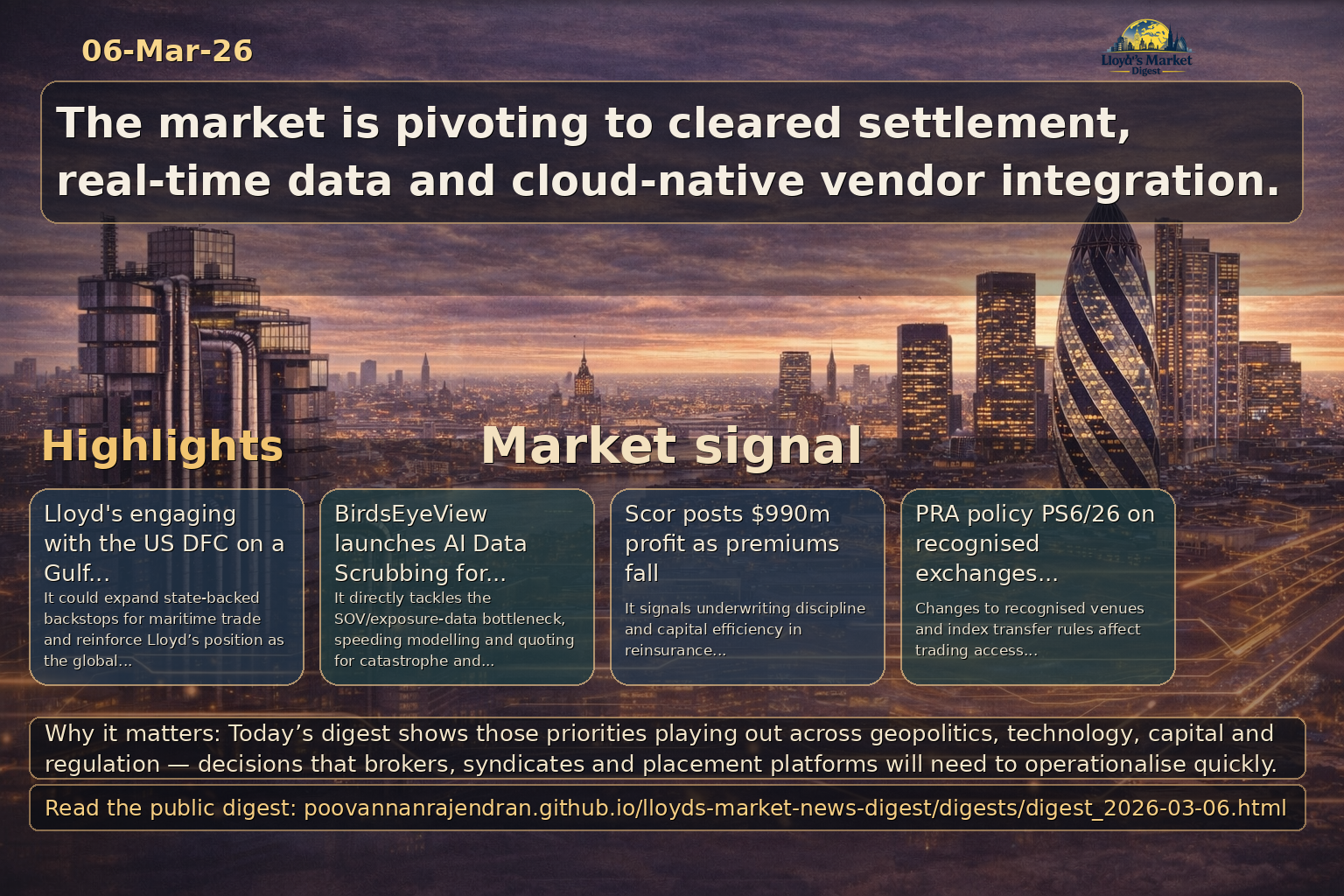
Why it matters: Lloyd's engagement with the U.S. DFC on political risk guarantees is strategically significant — it could expand backstops for maritime trade and reinforce Lloyd's position as the global center for war-risk solutions.
- Strategic opportunity: Lloyd's can secure comparative advantage by coordinating market capacity with government guarantees to underwrite routes otherwise uninsurable.
- Syndicate governance: any involvement with state-backed programmes requires robust due diligence, counterparty risk assessment and treaty reinsurance planning.
- Broker implications: brokers should ready programme structures that combine commercial war-risk capacity with DFC guarantees and be prepared to operationalise expedited documentation.
Source: reinsurancene.ws
Why it matters: BirdsEyeView's AI Data Scrubbing capability directly addresses a recurring bottleneck for brokers, syndicates and placement platforms: rapid, reliable transformation of SOVs and exposure data into modelling-ready inputs for catastrophe and specialty pricing.
- Operational: Integrate automated SOV cleaning into placement workflows to reduce lead times on modelling and quoting processes.
- Underwriting: Syndicates gain higher confidence in exposure geolocation, improving catastrophe aggregation controls across portfolios.
- Platform: Placement platforms and MGAs should consider API integration to standardise submission quality and accelerate bind-to-bind timelines.
Source: reinsurancene.ws
Why it matters: Marsh appointing a digital infrastructure senior advisor highlights rising demand for specialised contract, lifecycle and reinsurable solutions for data centres — a growing specialty class with complex liability and property exposures relevant to syndicates and placement platforms.
- Product development: syndicates should refine data-centre-specific wordings and limits to address lease, vendor and service-level contractual exposures.
- Brokers: leverage enhanced contractual expertise to structure clearer transfer of risk and align coverage with commercial terms, reducing disputes.
- Platforms: integrate lifecycle data and contract risk indicators into placement systems to support pricing, aggregation controls and client advisory services.
Source: businessinsurance.com
Why it matters: Scor's profit despite falling premiums is a signal on underwriting discipline and capital efficiency in the reinsurance sector — a useful barometer for Lloyd's syndicates and specialty underwriters on pricing sufficiency and capacity allocation.
- Market implication: evidence of tightened underwriting and expense control that could sustain capacity even as rate momentum softens.
- Broker/syndicate impact: influences negotiation leverage on facultative and treaty renewals; can depress urgency for large rate increases.
- Recommended action: monitor reinsurer capital actions and survey counterparty strength; reassess retentions, retro placements and strategic quota-share options.
Source: businessinsurance.com
Why it matters: A government directive to insure ships in the Gulf alters the marine risk-transfer landscape — shifting war-risk demand, potential state-backed capacity and broker placement mechanics for hull, cargo and war-tomarine programs.
- Market implication: possible crowding-out of private war-risk capacity or creation of parallel public-private arrangements that change pricing dynamics.
- Broker/placement impact: requires rapid re-evaluation of policy wordings, war-risk premiums and broker routing protocols for vessels in high-threat waters.
- Recommended action: engage marine underwriters and P&I clubs to clarify the interaction with private covers; update client advisories and placement checklists for Gulf transits.
Source: businessinsurance.com
Why it matters: The estimated $3.5B in France flood damage underlines ongoing nat-cat exposure in Europe and the importance of accurate modelling, reinsurance reinstatement strategies and regional underwriting discipline for property portfolios.
- Market implication: elevated claims will pressure aggregate reinsurance programmes and may accelerate regional rate hardening or tighter terms for flood-prone zones.
- Broker/syndicate impact: increased scrutiny of site-level risk mitigation, vulnerability assessments and pricing adequacy on renewals.
- Recommended action: run focused stress-tests on exposed portfolios, coordinate with modelling teams, and brief clients on mitigation and potential premium/coverage consequences.
Source: businessinsurance.com
Why it matters: Coverage uncertainty for Dubai properties following Iran strikes highlights acute policy-wording risk (war, terrorism and political violence) and potential for contested claims — a material consideration for Middle East property portfolios and Lloyd's capacity.
- Market implication: heightened disputes over exclusions could increase loss development and deter some carriers from providing unamended cover in the region.
- Broker/placement impact: market will demand clearer declarations, tailored war/terror endorsements, and potentially higher retentions or layered structures.
- Recommended action: audit existing Middle East placements for war/PD exposure, obtain explicit underwriter position statements, and prepare pre-placement risk narratives for affected accounts.
Source: businessinsurance.com
Why it matters: Named industry profiles are relevant as indicators of potential talent moves or influence within brokers, syndicates and placement platforms; tracking these individuals supports relationship continuity and market intelligence.
- Market implication: leadership and senior hires materially affect distribution strategies, carrier relationships and access to specialty capacity.
- Broker/placement impact: proactive engagement with influential individuals can secure early sight of placement preferences and syndicate appetites.
- Recommended action: maintain updated contact maps, monitor role changes, and prioritise outreach to those with material Lloyd's or global specialty influence.
Source: globalreinsurance.com
Why it matters: Aon's appointment institutionalises analytics across reinsurance broking, directly affecting broker-led placement workflows, syndicate selection and pricing dynamics in the Lloyd's and global specialty market.
- Elevates data-driven pricing and portfolio optimisation for reinsurance placements, enabling brokers to deliver more granular risk-adjusted capacity recommendations to syndicates and capital providers.
- Increases expectation that placement platforms and brokers will integrate analytics into quote aggregation, binding authority oversight and facultative placement processes, improving speed and transparency.
- Creates competitive pressure on other brokers and syndicates to invest in analytics capabilities or partner with platforms that provide real-time analytics, shifting negotiating leverage toward analytics-enabled brokers.
Source: globalreinsurance.com
Why it matters: QBE's CUO appointment is material for Lloyd's and global specialty stakeholders because underwriting leadership drives product strategy, wording harmonisation and reinsurer/broker engagement across jurisdictions.
- May lead to recalibrated underwriting appetite and product terms across international portfolios, affecting demand for reinsurance capacity and the structure of syndicate participations.
- Signals tighter alignment of product, wordings and underwriting controls with group strategy — brokers and placement platforms should anticipate changes to standard clauses and submission requirements that affect operational workflows.
- Regulatory approval and integration with group CUO priorities could alter reinsurance buying patterns, retrocession needs and collateral expectations; syndicates should proactively engage QBE and brokers on expected program design.
Source: globalreinsurance.com
Why it matters: Moody's view that the Iran conflict transmits primarily through investment portfolios highlights a systemic channel for capital erosion that can compress capacity and affect pricing across Lloyd's syndicates and global specialty insurers.
- Near-term claims exposure may be limited, but market volatility can materially reduce investment returns and capital cushions, prompting repricing or capacity withdrawal by risk carriers and reinsurers.
- Prolonged or escalatory conflict could force rating downgrades and capital remediation measures, increasing demand for reinsurance and collateral, and complicating placements handled through Lloyd's chains and platforms.
- Brokers, syndicates and placement platforms should prioritise stress-testing asset-liability scenarios, reviewing reinsurance counterparty credit exposure, and adjusting placement strategies to preserve capacity and client service continuity.
Source: insurancejournal.com
Why it matters: Travel insurers' standard war exclusions highlight product gaps and reputational risk that brokers and Lloyd's syndicates must address through differentiated travel risk solutions and clearer consumer communication.
- Immediate implications: surge in customer complaints, reputational exposure for carriers and intermediaries over perceived coverage gaps.
- Underwriting action: review and potentially design optional political/war evacuation add-ons with clear triggering language and pricing to reflect extreme tail exposures.
- Broker/placement response: educate wholesale and retail channels, develop placement workflows for emergency cover and partner with platforms to distribute expedited endorsements.
Source: insurancejournal.com
Why it matters: London marine underwriters remain active in the Gulf but are increasing war-risk premiums; this is core Lloyd's business with direct consequences for syndicate appetite, cargo flows and reinsurance purchasing.
- Market pricing: sustained hardening of war-risk and K&R premiums by vessel type, route and cargo value; syndicates must recalibrate rating models.
- Capacity management: potential for lead changes and capacity withdrawal on high-frequency routes; syndicates should coordinate via LMA guidance to avoid dislocation.
- Broker role: brokers must granularly present voyage-specific exposures, secure tailored hull/war/interest-in-freight placements and leverage platforms to speed comparative quoting.
Source: insurancejournal.com
Why it matters: An oil tanker explosion north in the Gulf signals widening peril zones and increased frequency of partial-loss and total-loss events, pressuring marine hull, cargo and P&I exposures underwritten by specialty markets.
- Exposure concentration: syndicates with energy tanker exposures need immediate exposure aggregation and stress-testing for multiple-incident scenarios.
- Policy design: review of physical damage, salvage, and pollution wording, plus consideration of parametric triggers for hull breach and evacuation costs.
- Operational response: brokers should demand updated risk surveys, consider voyage suspensions, and seek government-backed guarantees where commercial capacity is constrained.
Source: insurancejournal.com
Why it matters: Air cargo capacity contraction and freight-rate spikes directly affect cargo, logistics and contingent BI exposures — a priority for specialty underwriters at Lloyd's and global brokers advising shippers and manufacturers.
- Claims inflation: higher replacement and expedited transport costs increase cargo and contingent business interruption claims, especially for time-sensitive goods.
- Underwriting response: re-underwrite cargo programmes with dynamic routing clauses, surge pricing and explicit transhipment exclusions or endorsements.
- Broker/platform action: placement platforms must enable rapid multi-carrier options, route-based pricing, and granular cargo valuation to retain clients and capture displacement premium.
Source: insurancetimes.co.uk
Why it matters: Aviva’s acquisition-driven UK scale materially alters intermediary leverage, program structuring and capacity flows—critical for brokers, syndicates and placement platforms managing larger, more concentrated personal-lines portfolios.
- Reassess panel strategies: brokers should quantify concentration risk and renegotiate terms to reflect Aviva’s increased negotiating power.
- Syndicate response: consider capacity reallocation and vintage pricing actions for personal lines to protect margin and manage accumulated exposure.
- Placement platforms: enable larger composite placements and streamline data exchange to support high-volume, intermediated business and fast policy issuance.
Source: insurancetimes.co.uk
Why it matters: EY’s analysis highlights a widening innovation gap between the UK/Europe and Asia—forcing Lloyd’s market participants and brokers to prioritise digital ecosystems, AI adoption and faster product engineering to remain competitive.
- Prioritise investment in data & API-first placement workflows to mirror Asia’s integrated distribution models.
- Board-level imperative: establish measurable innovation KPIs and de-risk pilots to overcome governance paralysis around AI and new tech.
- Brokers and platforms should pilot Asian-style embedded distribution and partner with fintechs to accelerate product launch and customer engagement.
Source: insurancetimes.co.uk
Why it matters: Escalation in the Persian Gulf creates immediate accumulations and supply-chain exposures across marine, energy and trade credit lines—an operational and underwriting priority for Lloyd’s syndicates, global specialty carriers and placement platforms.
- Immediate exposure mapping: underwriters must stress-test war, political violence and marine accumulations across geographies and counterparties.
- Pricing & capacity shifts: expect rapid hardening in war/terror and marine hull/energy facultative, prompting reinsurance treaty adjustments.
- Operational readiness: placement platforms need updated clause libraries, expedited placement workflows and crisis communication protocols to support rapid program adjustments.
Source: insurancetimes.co.uk
Why it matters: A senior internal promotion at a regional broker underscores continuity in regional distribution and the ongoing importance of broker leadership stability for client retention and regional specialty business.
- Client retention assurance: internal promotions reduce churn risk—insurers and syndicates should capitalise by reinforcing program continuity.
- Partnership opportunities: larger carriers and placement platforms should monitor regional leadership for collaboration on rural and SME product distribution.
- Operational integration: ensure regional broker systems align with platform APIs and underwriting workflows to streamline referrals and delegated authority arrangements.
Source: insurancetimes.co.uk
Why it matters: Admiral’s exceptional UK motor profitability signals persistent underwriting strength in commoditised lines, influencing capacity allocation, pricing competition and cross-sell strategies for specialty markets and brokers.
- Capacity pressure: sustained motor profits can attract capital into UK personal lines, pressuring rates and shifting capital away from niche specialty classes—syndicates must defend margin through selective underwriting.
- Broker negotiation leverage: brokers should use insurer profitability metrics to secure better terms on bundled programs and negotiate delegated authorities.
- Platform optimisation: placement platforms must support automation for high-volume business while offering data analytics to identify cross-sell opportunities into specialty products.
Source: reinsurancene.ws
Why it matters: Analyst commentary that AI deployment remains early and underwriters wary of data-centre aggregation underscores cautious underwriting posture and the need for robust aggregation modelling at syndicates and placement platforms.
- Underwriting: Maintain conservative aggregate limits and explicit aggregation clauses while gradually expanding AI/data-centre appetites.
- Broker action: Use detailed aggregation analytics in renewals to negotiate capacity rather than purely price-based placements.
- Governance: Require syndicates to document AI-related exposure scenarios and present them to capital providers and retrocessionaires.
Source: reinsurancene.ws
Why it matters: Archive material signals long-term market context; historical volatility and cat-loss data remain essential inputs for Lloyd's syndicates and brokers when calibrating pricing and capital strategies.
- Context: Use historical market cycles archived in industry sources to stress-test syndicate portfolios and scenario planning.
- Analytics: Ensure placement platforms ingest legacy loss patterns when modelling tail-risk correlations for layered reinsurance buys.
- Risk management: Communicate historical precedent to investors and boards to justify capital buffers and pricing discipline.
Source: reinsurancene.ws
Why it matters: Ariel Re's property leadership appointments reflect reinsurance capacity management and product development activity in property/E&S—areas where Lloyd's syndicates and brokers compete for specialty placements and collaborative product innovation.
- Talent: Monitor leadership shifts at reinsurers as indicators of strategic focus and potential capacity allocation to property/E&S segments.
- Partnerships: Brokers should engage newly appointed heads to co-develop tailored treaty structures that fit Lloyd's syndicate appetites.
- Product: Syndicates can explore differentiated E&S products leveraging reinsurer appetite for strategic partnerships and innovation.
Source: bankofengland.co.uk
Why it matters: The PRA’s final policy changes determine which exchanges are recognised by UK prudential rules and set the mechanics for transfer of main indices. Lloyd’s market participants rely on CRR firms, UK banks and recognised venues for execution, collateral management and clearing. Changes to exchange recognition, eligible instruments and cross‑border recognition therefore directly affect trading access, collateral eligibility, operational continuity of index‑referenced contracts, and indirect capital/liquidity outcomes via banking counterparties.
- Conduct a counterparty and venue impact review: identify which brokers, banks, clearing members and trading venues used by syndicates and placement platforms are affected by the recognised exchanges changes; confirm continuity plans for execution and settlement of index‑referenced instruments and exchange‑traded collateral.
- Update collateral and legal frameworks: amend collateral annexes, ISDA/CSA terms and placement platform margin rules to reflect modified eligible exchange lists and index transfer mechanics; ensure transferability clauses and fallbacks for main indices are co‑ordinated across syndicates and brokers.
- Engage with CRR firms and infrastructure providers: require banks, brokers and clearing houses to quantify any capital, liquidity or operational consequences arising from the PRA’s CRR rule amendments and deletion of SS20/13; agree contingency arrangements for third‑country venue access and confirm any changes to reporting, timing or connectivity that could affect placement workflows
Source: newsnow.co.uk
Why it matters: Finland’s economic and geopolitical trajectory, including NATO integration and modest domestic growth, alters Nordic accumulation profiles and demand for political risk, cyber and specialty capacity — relevant to Lloyd’s syndicates with Nordic exposures and brokers placing pan‑European programmes.
- Reassess regional accumulation: property, supply‑chain and marine exposures across Nordic markets require updated aggregation models and reinsurer notifications.
- Product demand shift: increased appetite for political risk, defence‑adjacent liability and cyber cover among Finnish corporates and sovereign‑linked entities.
- Placement implications: brokers and platforms should update Nordic risk metrics, local legal/regulatory factors and scenario stress tests for treaty and facultative placements.
Source: newsnow.co.uk
Why it matters: NATO/Finland developments materially affect war/hostile acts triggers, sanctions dynamics and state‑level exposures — core considerations for war, political risk and treaty reinsurance capacity across Lloyd’s and specialty markets.
- War/terror wording scrutiny: syndicates must revisit war exclusions and affirmative war wording in light of alliance status changes and potential escalation scenarios.
- Sanctions and compliance: brokers need to refresh sanctions screening and claims scenarios tied to alliance‑driven state actions.
- Strategic capacity: opportunity to reprice and expand political risk and treaty layers for clients requiring NATO‑contingent protections.
Source: newsnow.co.uk
Why it matters: Appointment of a high‑profile US Homeland Security Secretary influences US border, immigration enforcement and critical infrastructure policy — factors that cascade into supply‑chain disruption, terrorism risk and cyber regulation exposures for US‑facing specialty portfolios.
- Supply‑chain and trade disruption exposure: potential policy shifts at the border can increase cargo, marine and trade‑credit claims from delayed shipments and tighter inspections.
- Cyber and infrastructure regulation: new DHS priorities may accelerate mandatory cyber standards, affecting underwriting criteria and pricing for cyber portfolios.
- US‑market monitoring: Lloyd’s syndicates and brokers should track regulatory guidance to align policy wordings, filings and client advisory services.
Source: newsnow.co.uk
Why it matters: Sri Lanka’s economic crisis elevates sovereign, commercial and marine credit risk in the Indian Ocean region — a direct concern for trade credit, political risk insurers, marine hull & cargo underwriters and syndicate aggregation strategies.
- Sovereign and counterparty risk: increased probability of sovereign default or restructuring requires recalibration of credit limits and political risk exposures.
- Marine and port operations: port congestion, stranded vessels and increased salvage claims drive higher hull/cargo and logistics interruption exposures.
- Placement and advisory: brokers and platforms must flag client concentrations, propose alternative risk transfer and reinforce clause language for credit and trade exposures.
Source: newsnow.co.uk
Why it matters: Nottinghamshire regional developments signal municipal and mid‑market commercial exposure shifts for UK property and casualty portfolios; urban regeneration and local infrastructure projects change construction risk profiles for Lloyd’s participants.
- Construction and contractor risks: local infrastructure and regeneration projects increase demand for contractors’ all‑risks, latent defect and civil engineering covers.
- Municipal and public‑sector programmes: county‑level exposures require tailored risk transfer solutions and capacity allocation for council liabilities and business interruption.
- Aggregation vigilance: syndicates should monitor regional accumulation in the Midlands and adapt underwriting guidance for brokers placing multi‑site UK exposures.
Source: risk.net
Why it matters: FX clearing and safer settlement directly affect cross-border premium flows, reinsurance settlements and currency-related counterparty exposures that are frequent in global specialty placements. Lloyd’s syndicates, managing agents and brokers should assess clearing options to reduce settlement tail risk and support faster, predictable cashflows.
- Prioritise cleared settlement for non‑major currency transactions used in premium, claims and reinsurance flows to reduce principal delivery risk and operational friction.
- Evaluate integration paths between placement platforms and central counterparties/CLS to automate FX settlement and reduce manual reconciliation burdens across brokers and managing agents.
- Assess implications of smart clearing and future LCH/CLS developments on collateral optimisation, capital modelling and counterparty credit policies for syndicates and global brokers.
Source: risk.net
Why it matters: Advances in credit risk management technology — real‑time data ingestion, stress-based governance and geopolitical overlays — are material for underwriters, syndicates and brokers underwriting specialty risks or providing credit lines and fronting services globally.
- Incorporate real‑time data and stress‑based governance into syndicate credit assessments for facultative, political risk and trade credit exposures to improve pricing and limit setting.
- Require vendor solutions to demonstrate scenario-driven capital impacts and integration with Lloyd’s internal risk platforms and placement systems for consistent counterparty evaluation.
- Elevate geopolitical risk into credit frameworks used by brokers and managing agents, ensuring vendor tools can ingest event data and produce rapid, auditable adjustments to exposure and limits.
Source: risk.net
Why it matters: Cloud‑native lending and operations platforms reshape how brokers, syndicates and coverholders manage distribution, premium financing and claims-led liquidity — key for scalable global specialty operations and faster market entry.
- Adopt modular, cloud‑native lending and operations platforms to accelerate deployment for new products, markets and delegated authority arrangements while reducing operational cost and time to scale.
- Link lending/operations vendors to placement platforms and treasury systems to streamline premium financing, collateral calls and claims advances across brokers, MGAs and syndicates.
- Validate vendor resilience, data governance and regulatory compliance (cross‑border data flows, KYC/AML) as part of procurement to ensure platforms meet Lloyd’s and global supervisory expectations.