Source: fca.org.uk
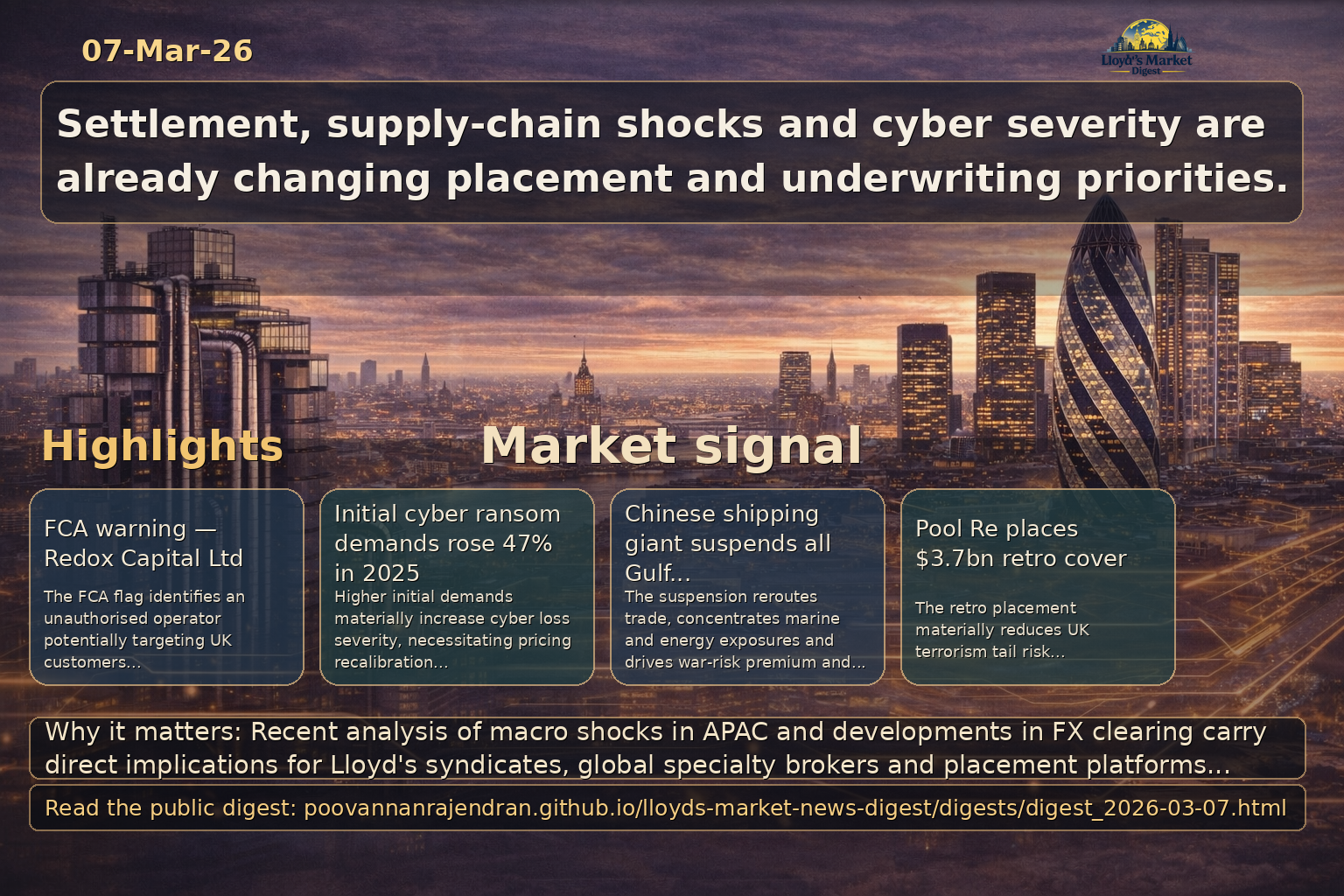
Why it matters: FCA warning identifies an unauthorised operator potentially targeting UK customers — a direct counterparty and fraud risk for brokers, syndicates and digital placement platforms with cross-border flows.
- Immediately block and flag any leads or counterparties referencing the entity in broker/placement onboarding workflows
- Require proof of FCA authorisation for intermediaries and counterparties before quote acceptance or premium movement
- Incorporate this warning into client-education materials and transaction monitoring rules for payments and premium flows
Source: fca.org.uk
Why it matters: FCA alert on SecuroomAI indicates unauthorised promotion of financial services under an AI-branded identity — raises impersonation and platform-integrity concerns for specialty distribution channels.
- Review automated intake and API integrations to ensure they do not accept business or referrals from unauthorised entities
- Enhance name‑screening rules to catch AI/brand-linked impersonation schemes and log suspected matches for compliance escalation
- Communicate with syndicate underwriters to pause placements involving the flagged entity until counterparty status is validated
Source: fca.org.uk
Why it matters: FCA warning for SELFTRADEINV signals continued proliferation of unauthorised investment promoters — a distribution-channel integrity issue that can create contingent liabilities for brokers and placements involved in referrals.
- Mandate enhanced KYC for introducers and referrers, including confirmation of regulatory permissions and proof of registration
- Update platform terms to prohibit onboarding of leads from unauthorised promoters and document refusal reasons for audit trails
- Coordinate with legal and compliance to assess whether historic referrals may have created exposure to complaints or regulatory scrutiny
Source: fca.org.uk
Why it matters: FCA action against Equity Edge Assets as an unauthorised actor highlights the persistent threat of sophisticated front companies seeking access to UK clients and premium flows, relevant to broker settlement and fiduciary arrangements.
- Require third-party verification for any firm holding client funds or conducting premium collection on behalf of syndicates
- Extend transaction monitoring to detect unusual flows associated with newly referenced investment-sounding entities
- Brief front-line brokers and client relations teams on red flags and scripted escalation steps when the name appears in enquiries
Source: fca.org.uk
Why it matters: FCA warning on Biteck Trade demonstrates the variety of non‑insurance businesses that may surface as unauthorised financial promoters; platforms must guard against onboarding such entities that could exploit placement rails.
- Implement pre‑live sandbox checks for new digital distribution partnerships to verify regulatory status and business purpose
- Integrate external FCA warning-list lookups into onboarding workflows to flag banned or suspicious entities in real time
- Escalate contractual requirements to require indemnities and representation on regulatory status from any third‑party introducers
Source: artemis.bm
Why it matters: Elementum Advisors promoting a seasoned compliance lead is evidence of continued professionalisation within ILS managers, reinforcing investor confidence and due diligence standards that Lloyd's syndicates, brokers and placement platforms must mirror when structuring ILS transactions.
- Operational resilience: Stronger compliance leadership reduces counterparty operational risk, improving attractiveness of ILS for institutional investors and reinsurers.
- Due diligence expectations: Brokers and syndicates should anticipate heightened KYC/AML and governance requirements when transacting with ILS managers.
- Competitive differentiation: Placement platforms and managers demonstrating robust compliance frameworks will win mandates from risk buyers and institutional capital.
Source: reinsurancene.ws
Why it matters: Howden's creation of a Global Financial Sponsors practice led by senior hires signals intensified broker competition in private capital and transactional liability placement — a growing source of fee and premium income for global specialty markets and Lloyd's-accessed capacity.
- Market impact: Concentrated broker capability will drive demand for bespoke transactional liability, tax and contingent risk solutions, increasing reliance on specialist syndicates and placement platforms.
- Operational implication: Placement platforms and syndicates must ensure product wording flexibility, faster turnaround and scalable capacity solutions to capture deal-flow from private equity and M&A transactions.
- Recommended action: Lloyd’s syndicates and global specialty carriers should develop targeted appetite schedules, streamline documentation for transactional covers and cultivate direct trading relationships with Howden teams and competing brokers.
Source: artemis.bm
Why it matters: Andover's $250m Locke Tavern Re renewal via a cat bond shows larger mutuals are replacing maturing reinsurance with ILS-backed collateralised capacity — a yardstick for syndicates and brokers on the competitive impact of ILS during renewals.
- Replacement risk: Collateralised ILS replacing traditional treaty capacity increases competition and may compress renewals for syndicates focused on U.S. multi-peril exposures.
- Brokers' advisory: Advisers must model ILS outcomes alongside treaty placements to optimise capital and certainty for mutuals and regional carriers.
- Execution capability: Placement platforms with proven issuer workflows and investor reach will be preferred partners for repeat sponsors.
Source: businessinsurance.com
Why it matters: Suspension of Gulf services by a major carrier materially shifts marine routing, elevates hull, cargo and P&I exposures and feeds into war-risk premium volatility that directly affects Lloyd's marine syndicates and broker placement strategies.
- Immediate reassessment of transits through high-risk waterways; syndicates should revise war-risk appetite and capacity allocations for affected lanes.
- Brokers must advise clients on rerouting, transit time impacts and cover extensions (war, delay, contingent BI) and present alternative markets quickly via placement platforms.
- Underwriters to review exposure aggregation models across marine portfolios and adjust clauses/endorsements for changed voyage profiles.
Source: businessinsurance.com
Why it matters: Lancashire's earnings decline signals continued underwriting pressure across specialty lines, a bellwether for investor sentiment and potential capacity tightening that affects Lloyd's and Bermuda-linked specialty capacity.
- Public-company profit pressures may reduce deployable capacity or increase reinsurance buying, tightening availability for large or complex risks.
- Syndicates and managing agents should communicate underwriting discipline and capital plans to brokers and clients to mitigate market uncertainty.
- Brokers need to factor potential pricing and capacity constraints into client renewal strategies and consider alternative structures (TIC, quota share, excess).
Source: businessinsurance.com
Why it matters: Escalation in the Iran theatre is disrupting global supply chains, creating acute cargo, contingent business interruption and trade credit exposures that the Lloyd's market and global specialty insurers must reprice and manage.
- Increased frequency and severity of cargo and BI claims necessitate immediate exposure and concentration analysis by underwriters and syndicates.
- Brokers should work with clients to stress-test supply chains, adjust limits and secure contingent BI and political-risk protection where available.
- Placement platforms must enable rapid aggregation of shipment-level data and provide surge capacity for bulk re-pricing and clause changes.
Source: businessinsurance.com
Why it matters: Pool Re's placement of $3.7 billion of retro cover materially reduces terrorism tail risk for the U.K. commercial property market — a stabilising development for London market underwriters and reinsurance capacity planning.
- Retro cover reduces volatility of catastrophic terrorism losses and should temper extreme rate spikes in U.K. property facultative placements.
- Syndicates and reinsurers can recalibrate capital models and pricing assumptions for U.K. property portfolios accordingly.
- Brokers should reassess clients’ terrorism limits and premium expectations in light of enhanced backstop capacity and communicate changes during renewals.
Source: businessinsurance.com
Why it matters: Executive profile pieces can signal leadership influence and network shifts that matter for relationship-driven placement flows in the Lloyd's and global specialty brokerage community.
- Visibility of senior executives helps markets assess likely strategic priorities and partnership opportunities with managing agents and platforms.
- Brokers should monitor such leadership profiles for potential shifts in underwriting focus or appetite that may affect placement negotiations.
- Placement platforms may leverage executive networks to facilitate introductions for complex or capacity-intensive risks.
Source: globalreinsurance.com
Why it matters: The crisis in the Strait of Hormuz is driving rapid contraction of tanker transits as war-risk cancellations, withdrawn reinsurance capacity and sharply higher pricing change the economics of trade and risk transfer; this has direct implications for Lloyd's marine and energy syndicates, global specialty portfolios and broker placement strategies.
- Capacity and pricing shock: Expect short‑term war‑risk capacity withdrawal from some reinsurers and insurers, forcing syndicates and MGAs to tighten terms, increase premiums, or impose exclusions; brokers must proactively aggregate capacity options and reprice accordingly to preserve placements.
- Placement and operational friction: Reduced appetite for cover and rapid policy changes will push brokers and clients toward placement platforms that support faster market canvass, real‑time quotes and conditional cover mechanisms to avoid trade disruption.
- Portfolio and capital impact: Syndicates and carriers should re‑assess exposure concentrations in Gulf transit routes and energy supply chains, update stress tests for correlated energy and marine losses, and engage reinsurers on retentions and treaty terms to manage capital strain.
Source: globalreinsurance.com
Why it matters: Aon's appointment of a global head of reinsurance analytics underscores broker-led moves to standardise analytics across the reinsurance value chain; this accelerates expectations for data-driven pricing, capital optimisation and placement transparency that will affect Lloyd's syndicates, reinsurers and placement platforms.
- Broker advantage and client advisory: Enhanced analytics capabilities enable brokers to quantify risk transfer value more precisely, pressuring syndicates to demonstrate actuarial defensibility of pricing and to offer differentiated, analytics-backed solutions.
- Placement platform integration: Syndicates and platforms must prioritise API connectivity, model standardisation and analytics outputs in placement workflows to avoid being sidelined during renewals where clients demand quantified optimisation scenarios.
- Market discipline and product evolution: Widespread analytics adoption will accelerate refined treaty structuring, parametric and alternative risk solutions, and greater focus on capital efficiency metrics—prompting syndicates to modernise modelling, governance and talent to remain competitive.
Source: insurancetimes.co.uk
Why it matters: John Lewis Money becoming an FCA regulated broker signals a major retail-distribution entrant with direct access to scale customers, altering intermediary dynamics and panel relationships for insurers and placement platforms.
- Review panel access and appetite: syndicates and carriers should decide whether to engage directly, via MGA partners or through existing brokers to capture John Lewis volumes.
- Negotiate terms and data-sharing: ensure commercial terms, underwriting data flows and delegated authority safeguards are defined for any new distribution relationship.
- Assess placement platform integration: confirm technical connectivity and straight-through processing to manage anticipated retail quote and bind volumes efficiently.
Source: insurancetimes.co.uk
Why it matters: Focus on invisible barriers to female advancement highlights retention and succession risks within broker houses, syndicates and placement platforms, with direct bearings on leadership pipelines and client continuity.
- Embed measurable D&I KPIs into talent and succession plans to retain senior female talent and reduce leadership gaps in distribution and underwriting.
- Equip managers with tools for psychological safety and sponsorship programmes to accelerate promotion of high-potential women into underwriting and broker leadership roles.
- Link diversity outcomes to remuneration and partner selection to align culture with long-term commercial resilience across syndicates and brokers.
Source: insurancetimes.co.uk
Why it matters: The strategic agreement placing Allianz Commercial’s entertainment underwriting with Reel Media MGA demonstrates continued migration of specialty capacity to MGAs, supported by rated carrier capacity — a model reshaping placement and oversight practices in Lloyd's and global specialty markets.
- Reassess delegated authority frameworks and strengthen audit, claims handling and reserving oversight for MGAs managing specialist portfolios.
- Brokers should map MGA capabilities and market access to route complex entertainment risks efficiently while preserving client service and terms.
- Placement platforms must ensure API connectivity, capacity transparency and reconciliation protocols to support seamless placements with delegated managers.
Source: insurancetimes.co.uk
Why it matters: Launch of ‘ultra HNW’ motor propositions points to growing demand for bespoke personal lines coverages that require specialist underwriting, agreed values and tailored claims handling — an area of opportunity for specialty syndicates and brokers.
- Syndicates and capacity providers should define appetite and pricing frameworks for ultra-HNW risks, including agreed-value mechanisms and bespoke endorsements.
- Brokers must develop specialist distribution and valuation capabilities to capture vehicle collections and ultra-HNW clients without exposing portfolios to concentrated volatility.
- Placement platforms should support bespoke policy wordings, valuation documentation and enhanced claims workflows to deliver differentiated client experiences.
Source: insurancetimes.co.uk
Why it matters: A 47% rise in initial ransomware demands materially alters cyber underwriting economics, increasing loss severity tail risk and necessitating product redesign, pricing recalibration and tighter risk management requirements across specialty and Lloyd's cyber lines.
- Reprice and restructure cyber cover layers and retentions to reflect higher initial ransom demands and persistent tail exposure.
- Mandate stronger pre-breach controls and incident response services; underwrite with conditional capacity and stronger cyber risk engineering criteria.
- Use placement platforms to standardise cyber declarations, evidence of controls and rapid claims escalation paths to limit settlement exposure and moral hazard.
Source: reinsurancene.ws
Why it matters: SCOR elevating a Group Chief Technology, Data & AI Officer reflects reinsurer-level commitment to integrated data and AI strategies that will accelerate pricing sophistication, portfolio management and claims analytics — pressuring brokers, syndicates and platforms to modernize data flows and tooling.
- Market impact: Advanced analytics from reinsurers will compress information asymmetries, leading to more granular risk selection and potential repricing of specialty portfolios.
- Operational implication: Brokers and placement platforms will face higher expectations for standardized, API-driven data exchange and proof points on model governance and explainability.
- Recommended action: Syndicates and platforms should prioritize API integrations, invest in data governance and collaborate with reinsurers on pilot AI-driven underwriting workflows to remain competitive.
Source: reinsurancene.ws
Why it matters: BHSI appointing a Global Head of Transactional Liability from a legal and cross-border background highlights insurer intent to expand M&A-related capacity out of London — intensifying competition for transaction placements traditionally serviced via Lloyd’s and specialty markets.
- Market impact: Increased admitted and London-market capacity for transactional risk will broaden client options and may reduce premium margins for incumbents on frequently transacted segments.
- Operational implication: Brokers must maintain deep placement panels and demonstrate execution capability for complex cross-border tax and contingent liability covers.
- Recommended action: Lloyd’s syndicates and niche carriers should clarify appetite, expedite bespoke wording approvals and promote coordinated capacity solutions to remain top-of-stack on significant transactions.
Source: reinsurancene.ws
Why it matters: Liberty Mutual's $2.75bn property catastrophe tower with raised aggregate attachment and perils coverage adjustments signals evolving reinsurance structuring at major corporate cedants — a reference point for syndicate capacity appetite and treaty pricing at the January renewals.
- Market impact: Reduction in occurrence limit and adjustment toward aggregate protections indicate cedant preference for alternative risk layering and income-volatility protection, influencing capacity deployment across markets.
- Operational implication: Syndicates and placement platforms need enhanced catastrophe modelling alignment and clarity on perils scope to compete on limited top-of-tower opportunities.
- Recommended action: Brokers should present multi-scenario modeling, support aggregate structure offers and coordinate with retrocession markets; syndicates must reassess attachment strategies against changing cedant preferences.
Source: reinsurancene.ws
Why it matters: Goldman Sachs' assessment that commercial insurers are best positioned to benefit from AI underscores a market-wide impetus to adopt machine learning across underwriting and operations — a strategic imperative for Lloyd’s, specialty carriers and broker platforms to drive efficiency and competitive differentiation.
- Market impact: Differential AI adoption will create clear winners in expense ratio and speed-to-bind, raising the bar for service and pricing in specialty lines.
- Operational implication: Placement platforms and syndicates must integrate richer data feeds and support model deployment workflows to enable AI-enabled underwriting at scale.
- Recommended action: Executive teams should prioritize vendor selection, pilot AI use-cases in high-volume commercial lines and establish governance frameworks to translate AI gains into sustainable market advantages.
Source: artemis.bm
Why it matters: Plymouth Rock's maintained $100m target combined with lowered price guidance signals sustained investor appetite and evolving pricing expectations in catastrophe bond issuance — a direct input into renewal strategies for specialty insurers and the reinsurance panels that serve them.
- Pricing signal: Lowered guidance indicates stronger investor demand and tighter spreads versus traditional reinsurance, pressuring syndicate and treaty pricing at renewal.
- Brokers' role: Placement brokers must leverage ILS channels to secure competitive terms for regional sponsors, balancing capital-market and traditional reinsurance options.
- Platform impact: Placement platforms and ILS managers will be asked to accelerate execution speed and market outreach as regional carriers continue to access capital markets.
Source: artemis.bm
Why it matters: Discussion at ILS NYC on private ILS portfolio discipline highlights the maturation of non-public ILS strategies, which creates alternative capacity for specialty risks and requires brokers and Lloyd's syndicates to adapt product design and placement approaches.
- Capital allocation: Growing private ILS pools provide longer-term, bespoke capacity that can compete with Lloyd's syndicates on complex specialty risks.
- Placement strategy: Brokers must cultivate relationships with private ILS managers and understand bespoke structuring to optimise outcomes for sponsors.
- Syndicate response: Lloyd's participants should consider co-investment, product innovation or partnership with private managers to retain distribution access and underwriting share.
Source: artemis.bm
Why it matters: The $29m ARC parametric payout to Madagascar demonstrates that pre-arranged parametric structures can deliver rapid liquidity for sovereign exposures — a template that can be adapted by global specialty insurers and brokers for emerging-market clients and humanitarian risk placements.
- Product proof-point: Successful sovereign parametric activation validates parametrics as a fast-response mechanism that specialists and syndicates can offer governments and large corporates.
- Market development: Brokers can expand advisory services to design index thresholds and basis definitions for client resilience solutions in frontier markets.
- Placement platforms: Platforms able to package parametric triggers with investor capital will capture growing demand for scalable, index-based risk transfer.
Source: newsnow.co.uk
Why it matters: US–Israel relations heighten regional escalation risk and secondary economic impacts that directly affect war, political risk and energy-related lines in the specialty markets.
- Immediate review of war/terror exclusion wording and territorial triggers across marine, energy and political-risk policies; consider temporary underwriting moratoria or enhanced premiums for exposures in or transiting affected regions.
- Anticipate commodity-price volatility and supply-chain disruption exposures for energy and trade credit portfolios; coordinate with reinsurers on capacity and retrospective aggregate limits.
- Brokers must update client advisories, duty-to-declare protocols and placement clauses; platforms should enable rapid re-pricing and real-time sanctions screening.
Source: newsnow.co.uk
Why it matters: Developments in intelligence and national security sharpen cyber and state-sponsored threat profiles that influence underwriting, claims and counterparty vetting.
- Underwriters should assume increased frequency/severity of state-linked cyber incidents and re-evaluate cyber policy aggregation and systemic exposure across syndicates.
- Enhanced KYC and intelligence-informed screening are required for placement platforms and binding authorities to prevent onboarding sanctioned entities or high-risk counterparties.
- Claims teams and brokers should establish intel-claims liaison protocols to validate attribution where state activity is suspected, supporting indemnity decisions and reinsurance recoveries.
Source: newsnow.co.uk
Why it matters: MI6-related reporting signals heightened covert state activity and geopolitical maneuvering that affect political risk underwriting and employee security covers for operations overseas.
- Reassess kidnap & ransom, political violence and contingency plans for clients operating in geopolitically sensitive theatres; consider stronger crisis-management clauses.
- Syndicates should coordinate with geopolitical risk specialists when pricing large corporate or government-exposed accounts to reflect clandestine-state operational risk.
- Brokers must refine placement transparency on security mitigations and evacuation clauses to limit moral hazard and clarify coverage triggers.
Source: newsnow.co.uk
Why it matters: High‑profile individuals and legacy estates (e.g., Mohamed Al Fayed) underscore exposures in D&O, private client, fine art, and reputational risk lines relevant to specialty underwriters and brokers.
- Private client and art underwriters should validate title, provenance and succession plans ahead of probate disputes that can trigger coverage disputes and increased claims activity.
- D&O and reputational-risk teams must monitor litigation risk and legacy corporate governance issues tied to notable individuals when providing coverage or advice.
- Brokers should employ bespoke placement strategies and enhanced due diligence for UHNWI portfolios, including bespoke exclusions, valuation clauses and tailored claim escalation routes.
Source: newsnow.co.uk
Why it matters: Regional UK developments (West Yorkshire) can influence local claims frequency, event cancellation exposures and insurer regional market portfolios relevant to delegated authorities.
- Underwriters with Lancashire/West Yorkshire exposures should review flood, property and business-interruption accumulations, and update catastrophe models where local infrastructure changes occur.
- Event and hospitality underwriters must reassess coverage for regional large-scale events (logistics, cancellation, political risk), adjusting terms and capacity as required.
- Managing agents should audit coverholder performance and local claims handling protocols to ensure consistent settlement standards and fraud controls.
Source: risk.net
Why it matters: Macro shocks in APAC change loss distributions, correlation structures and liquidity patterns that directly affect pricing, capital allocation and capacity decisions for Lloyd's syndicates and global specialty brokers operating or distributing into the region.
- Underwriting and capital: Syndicates must recalibrate models to reflect non‑linear correlation risk and second‑order effects in APAC sectors (trade, commodities, interest rate sensitivity), influencing pricing, appetite and retrocession strategy.
- Liquidity and settlement: Real‑time liquidity monitoring should be embedded into syndicate capital plans to ensure premium inflows and claim outflows can be met under stress, reducing the likelihood of forced asset sales or restricted capacity.
- Placement and platform response: Brokers and placement platforms should surface dynamic market indicators and scenario outputs to accelerate reshaping of terms, enable faster capacity reallocation and support client conversations on coverage and pricing.
Source: risk.net
Why it matters: Advances in FX clearing (eg LCH ForexClear integration) target settlement risk that affects premium receipts, claims payouts and collateral movement for internationally active syndicates, brokers and placement platforms—especially for non‑major currencies common in APAC and emerging markets.
- Settlement risk mitigation: Adopting cleared FX mechanisms reduces principal‑at‑risk on premium and claim settlement, lowering operational and capital strain for syndicates and clients transacting in non‑CLS currency pairs.
- Operational integration: Treasury, brokers and placement platforms should plan integration of cleared FX rails and collateral workflows to streamline premium flows, speed reconciliations and reduce failed settlements across jurisdictions.
- Commercial opportunity: Brokers and platforms can differentiate by offering embedded FX‑clearing options and transparent settlement solutions, enabling syndicates to quote more confidently on multi‑currency business and expand capacity in growth markets.