Source: fca.org.uk
Why it matters: FCA warning on B-Investor highlights an unauthorised actor that could target UK policyholders or intermediaries; risk for Lloyd’s occurs if brokers or platforms are used as inadvertent channels for premium diversion or fraudulent introductions.
- Immediate screen: add the domain and firm names to internal onboarding and transaction screening lists and block in broker portals.
- Broker communications: issue a market notice to brokers and coverholders to verify counterparties and refuse transactions linked to the flagged entity.
- Transaction hygiene: require certified payment routing for new counterparties, hold suspicious funds in escrow and escalate to compliance for recovery actions.
Source: fca.org.uk
Why it matters: 9M AI’s presence on the FCA warning list risks impersonation and tech-enabled scams that can be presented as insurtech or placement solutions; this can undermine trust in digital placement channels used by brokers and MGAs.
- Due diligence on tech partners: require full regulatory proof and operational evidence before integrating any AI or platform vendor into placement workflows.
- Platform controls: implement transaction validation layers and human review for AI-sourced leads or instructions to prevent automated misdirects.
- Market alert: inform syndicate underwriters and intermediary partners that AI-branded offers should be validated through firm-level authorisations.
Source: fca.org.uk
Why it matters: Walletts Connect being flagged suggests consumer-targeted payment or wallet schemes that could be used to reroute premiums or undermine broker custody arrangements; this presents operational and indemnity exposure for insurers accepting non-standard payment rails.
- Payment policy: mandate approved payment rails for premium collection and prohibit direct transfers to consumer wallet services unless pre-approved.
- Reconcile controls: enhance reconciliation and confirmation processes to detect payments sent to flagged wallets and suspend policy issuance until resolved.
- Partner training: brief distribution partners on risks of alternative payment solutions and require escalation if clients propose non-standard receivers.
Source: fca.org.uk
Why it matters: kryptoassetrecovery.com on the warning list underscores crypto-related recovery services that can prey on victims and intersect with cyber and crypto insurance placements; syndicates and brokers must avoid exposure through referrals or claims handling pathways.
- Referral policy: prohibit referrals to unverified crypto recovery services from claims teams and brokers; establish approved vendors for crypto-related incidents.
- Claims protocol: validate crypto-related claims with forensic specialists and establish chain-of-custody protocols before paying or directing claimants.
- Client advisory: include clear guidance in cyber and financial lines documentation about the limits of recovery services and the risks of engaging unauthorised providers.
Source: fca.org.uk
Why it matters: The franklinnationalreserve.com warning signals impersonation of financial firms that can be positioned as reserve or premium protection services; such schemes can create confusion for sophisticated commercial clients and intermediaries.
- Brand monitoring: implement active monitoring for impersonation of corporate counterparties and notify distribution partners when spoofed entities appear.
- Contract safeguards: include explicit clauses on authorised premium receivers and require confirmation of bank account details through validated channels.
- Reputational preparedness: prepare external communications templates and rapid response procedures in case client-facing impersonation affects syndicate reputation.
Source: artemis.bm
Why it matters: Aon Securities’ observation that reinsurance sidecars remain key through 2026 confirms that collateralised, investor‑backed vehicles continue to be a stable adjunct to conventional reinsurance and a strategic lever for syndicate capital management.
- Capital efficiency and volatility management: Sidecars enable syndicates to transfer peak risk and manage underwriting volatility without diluting core capital, preserving Lloyd’s capacity for strategic lines.
- Broker intermediation and investor access: Brokers and placement platforms must maintain and deepen investor relationships and structuring capabilities to deploy sidecar capacity swiftly.
- Operational and reporting complexity: Syndicates and platforms need robust collateral arrangements, transparency and investor reporting to sustain sidecar flows and meet institutional investor governance.
Source: businessinsurance.com
Why it matters: Leadership appointment at African Risk Capacity signals renewed focus on sovereign parametric solutions and potential scaling of capacity in African markets — relevant for syndicates and brokers seeking non-traditional growth corridors.
- Elevates opportunity for Lloyd’s syndicates and global brokers to provide capacity for sovereign and regional catastrophe programs.
- May accelerate demand for parametric structures that require bespoke modelling, sponsoring partnerships and reinsurance support.
- Placement platforms and MGAs should ready onboarding frameworks and compliance checks for cross-border sovereign business.
Source: businessinsurance.com
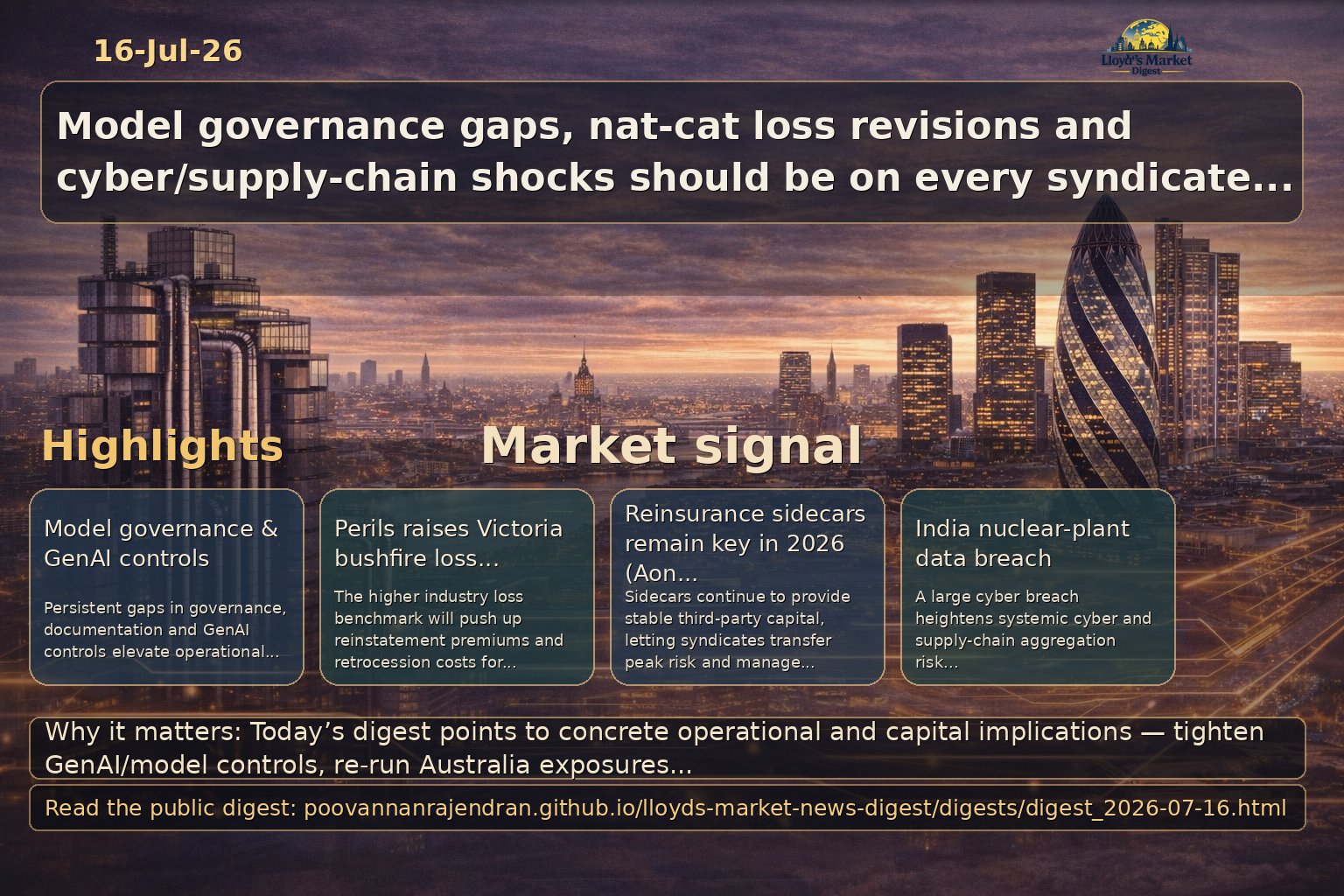
Why it matters: Perils raising the Victoria bushfire loss estimate affects industry loss benchmarks; impacts pricing, retrocession buying and capital allocation for players with Australia exposure.
- For Lloyd’s syndicates with Australia portfolios, expect reassessment of aggregate limits, reinstatement premiums and retro cover costs.
- Brokers should proactively review client aggregation reports and advise on changes to renewal expectations and risk mitigation measures.
- Placement platforms will need to update exposure dashboards and scenario analytics to reflect revised Perils metrics for accurate capacity matching.
Source: businessinsurance.com
Why it matters: Decline in piracy and armed robbery incidents provides short-term relief for marine insurers and war risk underwriters, with implications for premium momentum and capital deployment across shipping exposures.
- May prompt recalibration of hull/cargo and war & strikes pricing, with potential tightening of terms where incident frequency falls.
- Brokers could see reduced demand for emergency war risk placements but must monitor route-specific and geopolitical hotspots for re-escalation risk.
- Syndicates and platforms should balance redeploying freed capacity with caution, maintaining monitoring systems and clauses tied to incident metrics.
Source: businessinsurance.com
Why it matters: Saudi Re acquiring a material stake in a U.K. marine insurer highlights Gulf capital seeking exposure to UK specialty markets, affecting competitive dynamics and potential distribution alignments with Lloyd’s-linked entities.
- Signals continued inbound capital into UK/marine specialty that may increase capacity but also spur competitive pricing pressure.
- Creates partnership and distribution opportunities for brokers and syndicates to access Gulf-owned balance sheet support for complex marine risks.
- Placement platforms should prepare for potential integration or bespoke facility agreements and enhanced reporting expectations from strategic investors.
Source: businessinsurance.com
Why it matters: Reference to Jencap Programs underscores the ongoing importance of program business and delegated authority in specialty markets — a core area for brokers, MGAs, syndicates and placement platforms to manage growth and compliance.
- Expansion of program business increases demand for seamless placement workflows, stronger governance and real-time data sharing with syndicates.
- Brokers must enhance due diligence capabilities around underwriting authority, contract language and capital adequacy of program administrators.
- Placement platforms and syndicates should invest in integrated KYC/KYB, audit trails and performance analytics to support scalable delegated authority relationships.
Source: globalreinsurance.com
Why it matters: Aon's appointment of an APAC Strategy and Technology CEO reinforces a vendor-broker trend toward embedding analytics, advisory and platform capabilities in regional distribution — a material development for syndicates and placement platforms that rely on robust modelling and data exchange to underwrite life and annuity risk and adjacent specialty lines in Asia.
- Accelerates adoption of Aon-owned modelling suites (eg PathWise) in APAC, increasing demand for interoperable data feeds from syndicates and platforms.
- Creates competitive pressure on smaller brokers, MGAs and syndicates to upgrade analytics or to form data-partnerships to maintain access to regional risk pools.
- Suggests opportunities for placement platforms to integrate Aon-led analytics as standardised submission workflows to improve speed and precision of appetite matching.
Source: globalreinsurance.com
Why it matters: Howden Re's appointment of a North America MET treaty head signals intensified broker-led capacity building in marine, energy and terror risk — a strategic shift that influences treaty capacity flows to Lloyd's syndicates, reinsurers and specialist placement desks focused on geopolitical and trade-route volatility.
- Strengthens Howden Re's ability to aggregate and place MET treaty capacity locally, affecting how syndicates source redistributed risk in North America.
- Increases need for syndicates and reinsurers to offer integrated, fast-to-bind MET solutions and to align treaty terms with emerging geopolitical exposures.
- Creates demand for placement platforms that can efficiently handle cross-class, high-severity specialty treaty submissions and layered security structures.
Source: globalreinsurance.com
Why it matters: MSIG Asia's elevation of a regional CEO with wholesale and country leadership experience points to intensified competition for distribution and capacity across Southeast Asia, Hong Kong, India and Oceania — a development relevant to Lloyd's syndicates, global brokers and MGAs seeking regional partnerships and product distribution.
- Likely to increase appetite for strategic alliances between regional carriers, Lloyd's syndicates and global brokers to scale specialty products across jurisdictions.
- May drive product innovation and differentiated regional programs (eg trade credit, energy, catastrophe solutions) that require placement-platform support for cross-border compliance and binding.
- Signals potential reallocation of capacity and broker focus toward APAC markets, compelling syndicates to strengthen local market access and underwriting resources.
Source: globalreinsurance.com
Why it matters: The MGAA position that MGAs can trade through a softening market underscores the sector's resilience through specialist underwriting, flexible cost bases and access to risk and investment capital — a dynamic that affects how syndicates and capital providers allocate capacity and structure oversight for delegated authority.
- Reinforces the case for syndicates and reinsurers to maintain or expand disciplined MGA partnerships to access niche flows and underwriting expertise.
- Elevates the importance of enhanced oversight, data transparency and performance metrics from MGAs to satisfy capital providers during softer pricing cycles.
- Creates a strategic opportunity for placement platforms to offer streamlined, compliance-ready workflows and analytics that support rapid binding and portfolio monitoring of MGA-originated business.
Source: insurancejournal.com
Why it matters: Growth in the independent agency channel and higher surplus-lines and private-flood utilization alters placement flows and increases demand for specialty capacity and efficient broking interfaces.
- Distribution shift: Syndicates and London market brokers should reassess intermediary relationships and enhance direct-service offerings to IAs to capture incremental commercial and surplus-lines flow.
- Product implications: Increased private-flood and surplus-lines penetration creates demand for tailored specialty flood products, capacity stacking and clearer reinsurance/retro strategies.
- Platform action: Placement platforms must optimise workflows and straight-through processing for high-volume IA submissions and integrate surplus-lines compliance and tax handling.
Source: insurancejournal.com
Why it matters: Rapidly developing extreme rainfall in central Texas signals acute property-cat exposure that will test syndicate nat-cat models, claims preparedness and reinsurance programmes for US-exposed portfolios.
- Underwriting stress test: Managing agents should run near-term stress scenarios on US property books, reassess attachment points and consider retro capacity early to shore up retention.
- Broker actions: Brokers must prepare fast-placement strategies for surge demand, including contingent capital and parametric triggers to support clients and MGAs.
- Claims & Ops: Placement platforms and syndicates need streamlined claims data feeds and catastrophe response playbooks to accelerate indemnity settlement and capacity replenishment.
Source: insurancejournal.com
Why it matters: Divergent hurricane forecasts highlight model and forecaster dispersion; for Lloyd’s and specialty underwriters this increases volatility in regional exposure assessments and pricing for the Atlantic corridor.
- Modelling governance: Syndicates should reconcile alternative forecast inputs into underwriting committees, updating exposure aggregation and capital allocation where regional landfall probabilities shift.
- Hedging and reinsurance: Brokers must evaluate multi-scenario reinsurance structures and consider shorter-term, tactical retro placements to manage uncertainty.
- Client advisory: Placement platforms and brokers should offer scenario-based advisory (including parametric options) to corporate clients in high-probability impact regions.
Source: insurancejournal.com
Why it matters: UK proposals to create a captive insurance regime represent a structural change with implications for London market distribution, fronting demand, and captive-related service revenues for brokers and carriers.
- Fronting opportunity: Lloyd’s carriers and London-based insurers should market fronting solutions and bespoke capacity for captives repatriating to the UK, capturing premium flows and fees.
- Service and broking revenue: Brokers and managing general agents can expand captive advisory, risk-financing design and governance services, leveraging placement platforms for administration.
- Regulatory readiness: Syndicates must prepare for tailored PRA/FCA oversight and consider product and capital implications of increased captive activity on reinsurance and retrocession markets.
Source: insurancejournal.com
Why it matters: A large data breach tied to a nuclear plant contractor elevates systemic cyber and supply-chain aggregation risk for specialty portfolios, with potential physical-consequence exposures that challenge existing cyber coverage definitions and aggregation models.
- Aggregation re-evaluation: Underwriters should re-run cyber aggregation models including third‑party supplier and industrial control system vectors that can cascade into large property losses.
- Policy clarity: Brokers must scrutinise cyber-physical interface language, silent cyber exposures and limits; consider bespoke war/terror exclusions and contingent BI wordings for critical infrastructure.
- Risk mitigation services: Placement platforms and brokers should bundle incident-response, forensics and crisis-management resources into cyber placements for large industrial clients.
Source: insurancetimes.co.uk
Why it matters: The Applied Systems piece underscores a universal problem — bespoke, direct integrations consume scarce technology capacity and slow new distribution partnerships. In the Lloyd’s and global specialty context this manifests as delayed placements, friction for brokers and syndicates, and constrained ability to onboard partners and appetite quickly. Addressing the integration bottleneck is therefore a priority for C-suite leaders seeking to improve placement speed, reduce cost-to-serve and scale premium volume across specialty books.
- Operational risk and scalability: Direct point-to-point integrations create exponential maintenance overhead for syndicates and carriers. Move toward hub-based or platform-mediated integrations to reduce incremental onboarding time and preserve technology capacity for strategic projects.
- Placement and distribution advantage: Standardised APIs and placement-platform partnerships shorten time-to-bind for brokers and MGAs, improving quote-to-bind conversion in complex specialty lines and increasing syndicate access to diverse distribution channels.
- Governance and cost control: Establish API governance, common data schemas and a prioritized integration roadmap tied to revenue impact. This reduces duplicated engineering effort, lowers third-party integration costs and provides measurable improvements in distribution velocity for Lloyd’s market participants
Source: reinsurancene.ws
Why it matters: Historical archive underscores earlier industry capital moves and nat-cat loss context useful for benchmarking current syndicate and reinsurance strategy.
- Provides precedent on strategic disposals and capital redeployments relevant to current Lloyd’s participants
- Benchmark data for nat-cat frequency/severity that informs modelling and retro planning
- Useful background for M&A due diligence and regulatory change timelines
Source: reinsurancene.ws
Why it matters: Triple‑I analysis of Louisiana reform has direct implications for P&C pricing, loss pick assumptions and placement strategies in US state jurisdictions.
- Sustained legal reform is required to restore rate adequacy — impacts cedants and reinsurers’ exposure appetite
- Brokers should re-evaluate treaty and facultative structures for exposures in litigious jurisdictions
- Syndicates and carriers need granular claim analytics to segment risk and avoid adverse selection
Source: reinsurancene.ws
Why it matters: AM Best’s stable outlook on global cyber reinforces demand persistence despite rate pressure and highlights AI and profitability factors that affect capacity across layers.
- Confirms cyber remains a strategic line for specialty carriers and syndicates despite softening rates
- Encourages reinsurers and placement platforms to prioritise accumulation controls and model validation
- Signals brokers to emphasise loss-control, incident response and clarity on scope to protect underwriting economics
Source: reinsurancene.ws
Why it matters: CatIQ’s insured loss estimates for June 2026 Canadian storms will influence regional reinsurance pricing, retention strategy and catastrophe modelling for renewals.
- Material industry loss magnitudes will feed into 1/100 and regional accumulation assumptions for syndicates
- Brokers and placement platforms must stress-test facultative and treaty programmes for Canadian severe-weather exposure
- Opportunity for parametric and alternative risk transfer solutions to cover rapid-loss exposures
Source: reinsurancene.ws
Why it matters: Capital Bay Underwriting joining MISSION Latin America exemplifies MGU‑to‑platform integration driving program distribution and specialist capacity in LATAM.
- Platform expansion creates new conduits for Lloyd’s syndicates and global specialty carriers into Latin America
- Brokers can leverage local MGU expertise to structure compliant, scalable multinational programs
- Signals growing competition among placement platforms for first‑mile distribution and program origination
Source: artemis.bm
Why it matters: The WoodStar reciprocal launch, backed by Kilter and Blue Owl and distributed via the Accelerant Risk Exchange, exemplifies third‑party capital moving into dedicated specialty capacity and alternative insurer structures that compete with traditional Lloyd’s and syndicate capital.
- Competitive capacity: Reciprocals and sponsored capital pose direct competitive pressure on Lloyd’s syndicates for specialty lines, particularly where speed-to-market and bespoke structures are valued.
- Broker/placement implications: Brokers must expand placement playbooks to access reciprocal capacity and advise clients on capital‑structure, rating and coupon considerations.
- Investor appetite and capital structure: Rated surplus notes and AM Best ratings signal institutional investor willingness to finance carrier balance sheets, accelerating product innovation and non‑traditional distribution channels.
Source: artemis.bm
Why it matters: Q2 2026’s record catastrophe‑bond issuance marks a step‑change in capital‑markets provision of reinsurance capacity, altering supply dynamics that impact pricing, layering and retrocession for the Lloyd’s market and global specialty reinsurers.
- Capacity and pricing: Increased cat‑bond supply reduces marginal cost of reinsurance for large peril exposures, putting downward pressure on traditional retro pricing and altering negotiation leverage for syndicates.
- Structuring and placement: Brokers and placement platforms become more central to structuring hybrid solutions that blend traditional reinsurance with capital‑markets instruments.
- Investor diversification: A broader investor base for catastrophe risk increases capital resilience but raises expectations for reporting, modelling transparency and deal cadence.
Source: artemis.bm
Why it matters: PERILS’ upward revision of the Victoria bushfire insured loss to AU$860m reinforces the trend of rising catastrophe loss estimates, with immediate consequences for underwriting economics, capital allocation and reinsurance programme design at Lloyd’s syndicates and specialty carriers.
- Rate and attachment recalibration: Higher industry loss metrics increase pressure on price adequacy for property catastrophe business and may push syndicates to tighten terms or raise attachment points.
- Reinsurance programme strain: Larger loss footprints strain aggregate and facultative capacity, driving demand for retrocession and capital‑markets solutions managed by brokers and platforms.
- Model governance and diligence: Syndicates and brokers must revisit exposure modelling, accumulation controls and postcode‑level vulnerability assessments to support placement and capital decisions.
Source: artemis.bm
Why it matters: The appointment of David Maslo as CEO of African Risk Capacity Ltd signals momentum in parametric and sovereign risk solutions—an area where specialist underwriting capability, broker distribution and tailored capital solutions intersect with Lloyd’s and the global specialty market.
- Sovereign and development business growth: Reinsurers and Lloyd’s syndicates can expect expanded opportunities to provide capacity or co‑sponsor parametric programmes for governments and multilaterals.
- Distribution and advisory demand: Brokers experienced in sovereign and index‑based covers will be sought to design payout triggers, basis alignment and blended financing structures.
- Platform and data integration: Placement platforms that can integrate parametric triggers, satellite/remote sensing and rapid payout mechanisms will gain strategic advantage in structuring these mandates.
Source: newsnow.co.uk
Why it matters: European Parliament activity — including digital finance initiatives and votes affecting trade with Russia — signals heightened regulatory scrutiny and potential new trade restrictions. Lloyd’s syndicates, global specialty insurers and brokers must anticipate accelerated sanctions/regulatory change, adapt policy language and ensure placement platforms enforce updated screening and compliance workflows.
- Operationalise rapid sanctions and export‑control change management: update onboarding, screening and FTE escalation rules on placement platforms to avoid prohibited exposures.
- Review and revise policy wordings and endorsements: ensure clauses for sanctions, trade prohibitions and regulatory change are current across D&O, political risk, trade credit and cargo lines.
- Broker advisory and client communication: equip brokers with templated notices and placement checklists to manage client expectations and secure informed declinature or alternative terms where exposures are elevated.
Source: newsnow.co.uk
Why it matters: UK property market signals (mortgage rates, housebuilding and planning reform) materially affect commercial and residential portfolios underwritten by Lloyd’s syndicates and specialty carriers. Rising rates and affordability pressure increase default and vacancy risk, while construction and development trends alter contractors’ and PI appetites; brokers and platforms must reprice, re‑underwrite and expand data analytics for granular exposure management.
- Reassess portfolio concentration and collateral values: syndicates should stress‑test exposures to falling valuations, rental voids and higher tenant default rates across delegated and facultative placements.
- Tighten underwriting criteria and pricing: incorporate updated interest‑rate and construction‑cost assumptions in appetite documents and delegated authority scorecards; adjust premiums for latent defect, delay and political/planning risk.
- Enhance data‑driven placement workflows: brokers and platforms should mandate enhanced location, occupancy and mortgage/lien data for binding authority, and deploy property analytics to refine risk tiers.
Source: newsnow.co.uk
Why it matters: High‑visibility sporting fixtures generate concentrated contingent liability, event cancellation, travel, and reputational exposures for promoters, sponsors and insurers. Incidents around public order or politically charged displays amplify claims and media risk; syndicates, brokers and placement platforms must ensure event-specific wording, capacity readiness and security contingency endorsements are standard practice.
- Update contingency and cancellation coverage templates: include clear non‑appearance, civil commotion, and ingress/egress clauses; clarify limits for PR mitigation and cyber/social media response where relevant.
- Preposition capacity and delegated authority for short‑tail event risk: syndicates should pre‑approve quick‑bind limits and streamlined claims handling to support high‑frequency, time‑sensitive events.
- Strengthen broker risk‑advisory services: require event organisers to present security, travel, and crowd‑management plans; platform checklists should capture permit, ticketing and third‑party supplier risk to support accurate placement.
Source: risk.net
Why it matters: The Risk.net benchmarking study reveals weaknesses in GenAI logging, validation and controls that map directly to exposures in Lloyd’s syndicates, global specialty books and placement platforms. As brokers and syndicates adopt AI for quoting, risk selection, aggregation and claims triage, gaps in model inventories, prompt/usage logs and validation increase underwriting volatility, regulatory scrutiny and counterparty risk across facultative and treaty placements.
- Immediate remediation: implement and enforce a central model inventory and end‑to‑end logging for GenAI prompts and outputs used in pricing, exposure aggregation and placement platforms to create auditable trails for underwriters, brokers and regulators.
- Validation and control framework: require independent model validation for high‑impact models (pricing, catastrophe aggregation, portfolio optimisation) and formalise human‑in‑the‑loop decision gates for exceptions and complex placements to reduce model error propagation across syndicates.
- Market governance and vendor management: strengthen platform and broker due diligence (including third‑party GenAI vendors), harmonise controls across syndicates and brokers, and prepare for regulatory divergence by documenting test evidence, control effectiveness metrics and remediation roadmaps.