Source: globalreinsurance.com
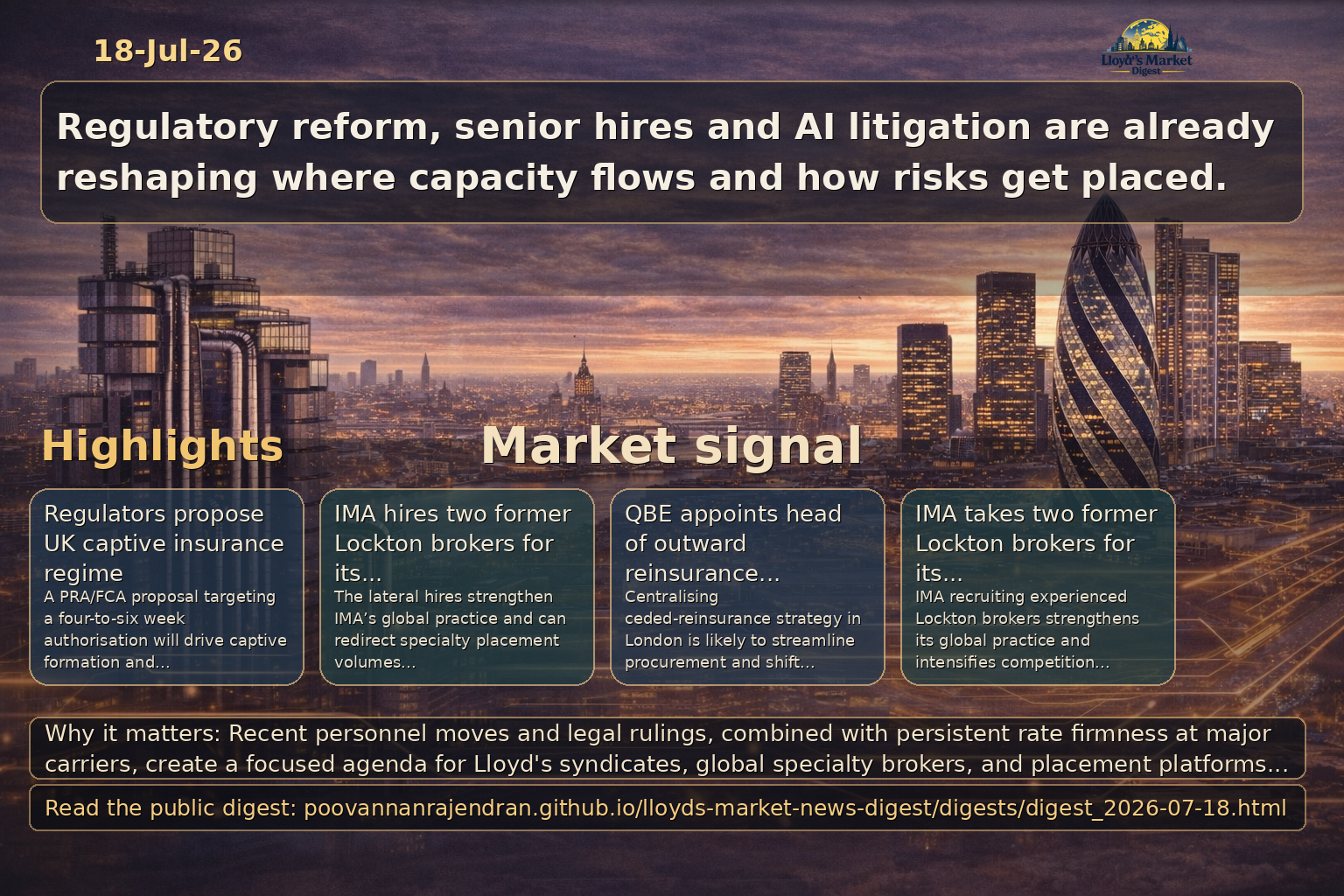
Why it matters: The PRA and FCA’s proposed UK captive regime aims to make the UK a competitive domicile by offering a tailored regulatory framework and accelerated authorisation. For Lloyd's market participants, brokers and placement platforms, the consultation creates opportunities to capture captive formation, management and reinsurance-placement work while altering retained-risk strategies and ceded-reinsurance demand.
- Faster market entry: A targeted four-to-six week authorisation objective reduces friction for businesses establishing captives, driving immediate demand for broker and advisory services around structure, governance and reinsurance placement.
- Capital and product implications: Excluding captives from certain Solvency and consumer-focused frameworks (as proposed) could alter capital-efficient retention strategies and change the volume and structure of reinsurance purchased from syndicates and global reinsurers.
- Competitive positioning: The UK’s push to attract captives intensifies competition with established domiciles; brokers, placement platforms and Lloyd's syndicates should develop captive-specialist services and propositions to capture advisory fees and ancillary reinsurance flows.
Source: businessinsurance.com
Why it matters: IMA recruiting experienced Lockton brokers strengthens its global practice and intensifies competition among brokers for specialty mandates and Lloyd's placements.
- Market share and client flow: high-profile lateral hires can reconfigure relationships with MGA/syndicate partners and redirect placement volumes.
- Placement execution risk: syndicates and platforms should reassess broker connectivity, data exchange and slip-handling processes to retain flow.
- Talent-driven differentiation: brokers leveraging senior hires will push for enhanced product breadth and tailored policy wordings, increasing demand for bespoke capacity.
Source: newsnow.co.uk
Why it matters: Human rights litigation and advocacy trends increase exposure for underwriters and distributors across political risk, supply-chain liability, D&O and ESG-linked products. For Lloyd’s syndicates and global specialty brokers this raises underwriting uncertainty, potential for contractual disputes, claims frequency and regulatory scrutiny — all of which affect capacity allocation and placement platform processes.
- Immediate review of policy wordings and exclusions for human-rights, forced labour and supply‑chain related claims; consider explicit affirmative/negative coverage language to reduce latent exposure.
- Enhance KYC and ESG due‑diligence protocols for brokers and platforms, including supplier/sponsor screening and transaction-level sanctions/human‑rights flags prior to placement.
- Coordinate syndicate, broker and platform communications to clients and capital providers about appetite changes, notification obligations and claims-handling processes; implement training for underwriters and brokers on emerging human‑rights litigation vectors.
Source: reinsurancene.ws
Why it matters: Gallagher’s expansion of tax insurance capability within PEMA demonstrates brokers’ role in deploying niche specialty products to support deal flow and cross-border M&A placements.
- Embed tax insurance solutions in M&A advisory propositions for private equity clients to accelerate deal certainty
- Coordinate with underwriters to structure bespoke policy terms for complex cross-border tax exposures
- Leverage tax insurance as a differentiator in competitive bid processes for PEMA mandates
Source: businessinsurance.com
Why it matters: Appointment of a senior executive from Arch Capital to lead Vantage signals a potential acceleration of strategic partnerships, capital access and underwriting discipline relevant to specialty capacity providers and placement platforms.
- Potential re-alignment of capacity: new leadership with Arch background may facilitate deeper reinsurer and capital-provider relationships, affecting syndicate appetite and terms.
- Distribution and platform implications: Vantage could prioritize integrations or partnerships with broker platforms to scale placements efficiently in specialty lines.
- Strategic underwriting posture: expect emphasis on disciplined pricing and selective risk acceptance that will influence broker placement strategies and client expectations.
Source: businessinsurance.com
Why it matters: A court directing claimants to pursue line-of-duty benefits in trial court highlights judicial influence on claim pathways and benefit triggers that can materially affect long-tail casualty exposures and reserving assumptions.
- Reserving and pricing impact: changes in claims adjudication routes can extend exposure timelines and affect loss emergence patterns critical to syndicate reserving.
- Policy drafting and coverage counsel: brokers must review employer liability and specialty casualty wordings to mitigate unintended gaps or overlaps with statutory benefits.
- Claim handling strategy: syndicates and carriers should align claims protocols with evolving legal pathways to control defense spend and outcomes.
Source: businessinsurance.com
Why it matters: Ruling that employers need not fund second opinions before a comp claim is proven may influence claim costs, defense posture and employer-managed risk programs relevant to commercial and specialty casualty underwriters.
- Defense cost dynamics: reduced obligation to fund second opinions could shift costs and incentives in early-stage claim resolution, affecting loss adjustment expense projections.
- Underwriting considerations: syndicates should revisit underwriting criteria for employers and occupational exposures where medical-approval processes materially change claim trajectories.
- Broker advisory role: brokers must counsel corporate clients on claims management practices and the implications for premiums, retentions and reinsurance placements.
Source: businessinsurance.com
Why it matters: Court refusal to block Meta layoffs tied to an AI-bias suit underscores growing litigation risk linked to AI deployment, with direct relevance to D&O, EPLI and cyber/manufacturing liability underwriting across specialty markets.
- Product and management liability exposure: underwriters need clearer underwriting questions and exclusions/endorsements for AI-related decisioning and bias risks.
- Broker risk assessment: brokers must integrate AI governance, vendor controls and model-risk disclosures into placement submissions to secure appropriate capacity.
- Placement complexity: layered placements and specialty capacity may be required for large AI-exposed clients, increasing demand on platforms for granular risk aggregation and terms coordination.
Source: globalreinsurance.com
Why it matters: QBE's appointment of a senior Munich Re executive to lead outward reinsurance centralises reinsurance strategy in London and signals more sophisticated and coordinated ceded-program management across the UK, Europe and Asia. This will affect broker engagement models, placement platform workflows, and reinsurer/syndicate exposure planning.
- Leadership and sourcing: An experienced ceded-reinsurance leader from Munich Re is likely to streamline QBE’s reinsurance procurement, raising expectations for broker analytics, structured solutions and digital placement support.
- Placement and capacity: Centralised outward reinsurance oversight may change the mix between treaty, facultative and alternative-capacity solutions, requiring brokers and platforms to pre-position capacity and tailored placement processes.
- Market dynamics: Syndicates and reinsurers should anticipate shifts in quota-share and facultative demand from a major international insurer, necessitating proactive underwriting and pricing responses across global specialty lines.
Source: insurancetimes.co.uk
Why it matters: Moonrock’s appointment of a chief data and actuarial officer signals MGAs and specialty underwriters prioritising in-house analytics and pricing sophistication — a direct capability bet relevant to syndicates, Lloyd’s managing agents and placement platforms seeking better risk selection and capital efficiency.
- Strengthens risk selection and pricing governance at the underwriting source, reducing reliance on external actuarial services.
- Creates potential for tighter syndicate/MGA collaboration on portfolio steering and quota share/pricing accords.
- Recommendation: C-suite should prioritise integration of these functions with distribution and placement APIs to translate analytics into faster, higher‑quality placements.
Source: insurancetimes.co.uk
Why it matters: HSB hiring a long-tenured Munich Re strategy lead highlights the importance of proposition engineering and innovation in specialty technical lines — an issue for carriers and brokers competing on differentiated solutions and loss-prevention services.
- Signals insurers are investing in proposition-led growth rather than pure commoditised underwriting.
- Elevates the role of engineering and inspection data in underwriting decisions, creating cross-sell and retained-client opportunities for brokers.
- Action: brokers and syndicates should engage on co-developed value propositions and pilot data-driven client services to protect margins.
Source: insurancetimes.co.uk
Why it matters: QBE’s appointment of a head of outward reinsurance with Munich Re credentials emphasises active ceded strategy as a lever for international specialty operations — directly affecting capacity allocation, treaty structuring and brokered reinsurance flows into Lloyd’s and global markets.
- Reinforces importance of optimised retrocession and treaty design to protect balance sheets and preserve primary capacity.
- May shift reinsurer appetite and pricing dynamics for brokered placements; brokers should expect more granular ceded requirements.
- Recommendation: insurers and syndicates must align reinsurance strategy with placement platform capabilities to ensure timely treaty compliance and reporting.
Source: insurancetimes.co.uk
Why it matters: The weekly people-moves roundup, including insurer restructuring and senior exits, indicates elevated talent churn and organisational redesign across the market — a material operational and distribution risk for brokers, managing agents and syndicates.
- Management layer restructurings create short-term disruption to distribution relationships and decision timeliness.
- Creates talent acquisition opportunities for brokers and MGAs to secure experienced leaders; also heightens counterparty due diligence for carriers.
- Boardroom priority: implement succession frameworks and maintain key-client continuity plans to mitigate revenue leakage during transitions.
Source: insurancetimes.co.uk
Why it matters: M&A activity — notably regulator-cleared deals such as Zurich’s acquisition of Beazley and regional broker consolidation — materially reshapes specialty capacity, broker leverage and syndicate distribution strategies in Lloyd’s and global specialty markets.
- Consolidation increases scale for acquirers, potentially compressing independent broker negotiating power on some lines.
- Integration timelines create windows for competitors and placement platforms to capture dislocated business.
- Strategic imperative: review counterparty concentration exposure, and accelerate platform and product differentiation to defend or grow share.
Source: reinsurancene.ws
Why it matters: Historic nat-cat loss context reminds Lloyd’s syndicates and specialty reinsurers of persistent volatility and the need for disciplined underwriting, retro strategy and catastrophe modelling updates.
- Reinforce catastrophe modelling and accumulation management across syndicates to protect capital efficiency
- Reassess retro and ILS structures to stabilise volatility after large nat-cat years
- Use historical loss analysis to validate rate adequacy and terms for forthcoming renewals
Source: reinsurancene.ws
Why it matters: Oxbow Partners’ CEO-focused AI guidance is directly relevant to brokers, syndicates and placement platforms looking to move beyond pilots to embedded underwriting and placement decisioning.
- Establish clear AI governance, data ownership and model-monitoring frameworks for underwriting and placement platforms
- Prioritise use-cases that improve high-value judgment (complex specialty risks) rather than generic automation
- Align leadership incentives and operating models to capture commercial benefit from AI investments
Source: reinsurancene.ws
Why it matters: Marsh’s survey showing continued insurer interest in private credit informs asset allocation strategies of Lloyd’s members and specialist carriers seeking yield in a low-rate environment.
- Evaluate liquidity and duration mismatch risks when increasing private credit exposure within syndicate and carrier portfolios
- Coordinate investment policy with underwriting capital needs to avoid forced asset sales after loss events
- Engage investment partners to develop tailored private credit solutions consistent with regulatory and rating requirements
Source: reinsurancene.ws
Why it matters: A UK captive framework would expand domicile options for corporates and brokers, affecting placement strategies, captive managers and syndicated reinsurance programmes tied to Lloyd’s capacity.
- Prepare client advisory materials on domiciliation choices and comparative tax/regulatory implications
- Assess captive structures as alternatives to market placements for hard-to-place specialty exposures
- Coordinate with placement platforms to integrate captive reinsurance capacity and retro protections
Source: newsnow.co.uk
Why it matters: Shifts in press regulation and media oversight increase the frequency and severity of reputational, libel/defamation and privacy claims. For carriers writing media, cyber/privacy and management liability, and for brokers placing capacity via platforms, this elevates aggregation risk and regulatory compliance demands, with potential for rapid reputational contagion across markets.
- Audit media, cyber/privacy and D&O product overlaps and clarify sublimits, retentions and aggregation management for press‑related incidents; update crisis-trigger definitions and notification timelines.
- Stress‑test placements for concentration of media and platform exposures, and require enhanced disclosure from cedants and brokers where regulatory change may drive claim clusters.
- Engage actively with placement platforms and brokers to ensure consistent clawback/indemnity positions, rapid claims escalation protocols and market‑level monitoring of press regulation developments.