Source: fca.org.uk
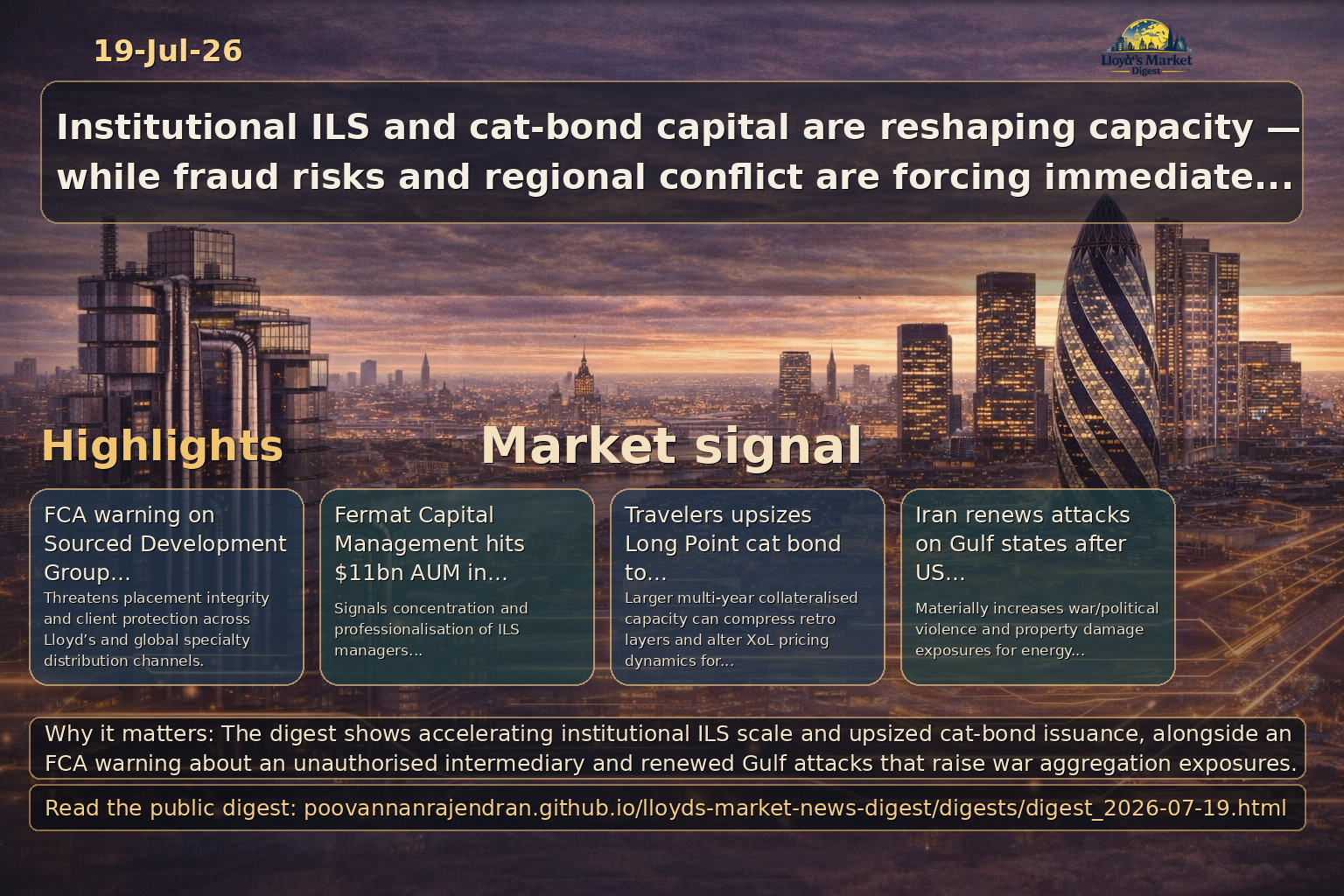
Why it matters: FCA warning on Sourced Development Group indicates an unauthorised intermediary potentially soliciting UK clients — a direct threat to placement integrity and client protection across Lloyd’s and global specialty distribution channels.
- Immediate verification: require written evidence of FCA registration for any intermediary and confirm via the FCA Register before acceptance of new business or forwarding slips.
- Client protection and communication: proactively notify affected clients and counterparties that business placed through unauthorised entities may lack FSCS and Ombudsman protections; instruct clients to confirm cover directly with underwriters.
- Platform and syndicate controls: update onboarding rules for e-placement platforms and broker panels to block entities flagged on FCA Warning List and enhance real‑time screening for unauthorized firm indicators.
Source: fca.org.uk
Why it matters: The FairPCP clone alert demonstrates how fraudsters mimic authorised firm identities to misdirect premiums and information flows — a vector that can disrupt premium remittance, slip confirmation and claims notification for specialty business.
- Authentication protocols: mandate multi‑factor verification (including Firm Reference Number validation and direct contact with the genuine firm) before accepting communications or premium instructions from a named broker.
- Premium/settlement controls: disallow changes to bank account or payment instructions via email without signed confirmation from verified authorised representatives; route any change requests through escrowed or known account channels.
- Brand protection and monitoring: instruct compliance teams and platform operators to monitor domain registrations and brand impersonation, and establish a rapid takedown/reporting workflow in coordination with market associations and the FCA.
Source: fca.org.uk
Why it matters: The m2recoveries family of domains (crypto/asset recovery clone) highlights targeted scams around crypto asset recovery — an acute risk for cyber lines, financial institutions covers and any placements involving digital asset exposures.
- Claims channel integrity: require claimants and brokers to confirm claims and recovery arrangements directly with the insurer before engaging third‑party recovery firms; treat unsolicited recovery services as high‑risk.
- Cyber incident playbooks: update cyber claims protocols to include vendor due‑diligence steps for recovery providers, and instruct claims teams to escalate any crypto recovery approaches to market claims leads and legal counsel.
- Market education and exclusions: advise brokers and clients on the prevalence of recovery scams, consider contractual limits or pre‑approved provider lists for recovery services, and coordinate disclosures on platforms to prevent onboarding of such vendors.
Source: fca.org.uk
Why it matters: Anthony Jones (UK) Limited has agreed to stop regulated activity — creating immediate uncertainty about policy validity, renewals and claims handling for business placed through that broker; a material operational concern for syndicates and placement platforms handling affected slips.
- Confirm policy status: require underwriters and syndicate managing agents to confirm directly whether policies placed through the broker remain valid, and communicate status to cedants and insureds without delay.
- Continuity planning: for at‑risk business, activate contingency placement and servicing workflows (re‑allocate servicing brokers, confirm premium handling, and document any endorsements or novations required to preserve coverage).
- Regulatory and market notification: instruct platform operators and broker panels to flag business from the broker, freeze new submissions from the entity, and coordinate with market wide bodies to ensure consistent messaging and reduce client confusion.
Source: businessinsurance.com
Why it matters: IMA’s recruitment of senior brokers from Lockton strengthens its global practice and intensifies competition among broking houses; lateral moves of experienced brokers materially influence placement origination, client relationships and access to Lloyd’s capacity.
- Protect key client relationships through targeted retention strategies and proactive communication of placement advantages.
- Review placement platform feeds and broker panels to quantify potential flow diversion and prioritize high‑value accounts.
- Assess implications for commission structures, referral networks and cross‑border placement strategies in core specialty lines.
Source: newsnow.co.uk
Why it matters: Human rights category pages can surface litigation and policy changes that materially affect reputational risk, sanctions screening and client acceptance in specialty lines.
- Underwriting: Integrate human-rights litigation trackers and NGO reporting into due-diligence for political-risk, D&O and financial lines underwriting.
- Compliance: Ensure sanctions and adverse media screening workflows ingest legal and human-rights feeds to avoid onboarding prohibited parties.
- Broker engagement: Require brokers and placement platforms to provide enhanced client reputational dossiers for large or sensitive placements.
Source: businessinsurance.com
Why it matters: China warning on escalating weather disasters is directly relevant to Lloyd’s syndicates and global specialty reinsurers as it drives demand for nat‑cat capacity and challenges modelling and capital allocation.
- Pressure on pricing and capacity for Asian windstorm and flood covers; syndicates should review modelled loss exceedance and stress scenarios
- Brokers and placement platforms must prepare client communications and placement strategies for tightening capacity and potential coverage exclusions
- Action: accelerate regional catastrophe modelling updates, review reinsurance renewals and retrocession terms, and reassess portfolio concentration in China exposures
Source: businessinsurance.com
Why it matters: PartnerRe appointing a new India CEO signals reinsurer commitment to growth in India — a market of increasing relevance for specialty and treaty placement and Lloyd’s underwriting partners.
- Potential increase in India‑focused capacity and bespoke treaty solutions as reinsurer strengthens local leadership
- Brokers should evaluate distribution pathways and placement platforms to leverage expanded reinsurer presence
- Action: engage with PartnerRe India leadership on product development for nat‑cat, infrastructure, and specialty lines; reassess cedant appetite for localised reinsurers
Source: businessinsurance.com
Why it matters: Lockton’s expansion in New Zealand underscores broker consolidation and distribution reach in APAC, affecting placement flow to Lloyd’s syndicates and global carriers.
- Greater local broking scale will channel more commercial and specialty placements through international markets, increasing demand on syndicates for regional capacity
- Placement platforms and Lloyd’s brokers should optimise digital submission workflows to capture accelerated flow from regional broker hubs
- Action: syndicate distribution teams to strengthen NZ broker relationships, streamline local appetite guidance and enhance platform connectivity for faster placements
Source: businessinsurance.com
Why it matters: TT Club’s planned merger with a UK P&I Club signals consolidation in marine mutuals, with implications for marine liability capacity, reinsurance programmes and interactions with Lloyd’s marine syndicates.
- Potential rebalancing of marine insurance capacity between mutuals and commercial insurers; syndicates should reassess treaty retrocession and facultative appetites
- Brokers and MGAs may need to reprice placements and adjust placement strategies for cargo, P&I and logistics risks
- Action: monitor merger milestones, engage with marine underwriters on capacity commitments, and review reinsurance and claims-handling arrangements
Source: insurancejournal.com
Why it matters: Renewed Iranian attacks on Gulf states and strikes on military/logistics infrastructure materially increase war, political violence and property damage exposures for energy, marine and aviation assets concentrated in the region.
- Reassess war and terrorism policy triggers and exclusions for hull war, K&R, energy property and offshore platforms; consider demand for contingent business interruption and war reinstatement premiums.
- Quantify accumulation potential for cargo, hull and energy risks transiting the Strait of Hormuz; syndicates should run scenario losses and review aggregate limits on automated placement platforms.
- Coordinate with brokers on sanction compliance, insureds’ routeing changes, and war-risk premium recalibration; confirm claims handling protocols for infrastructure and port closure events.
Source: insurancejournal.com
Why it matters: Ohio’s tougher criminalisation and scrap-dealer controls for catalytic converters signal regulatory intervention to reduce theft-driven motor claims frequency and salvage market impacts relevant to motor insurers and brokers handling fleet and retail motor placements.
- Expect downward pressure on claim frequency over time but short-term administrative claim costs and salvage processing changes; syndicates should review motor telematics and theft cover wordings.
- Brokers and placement platforms need to adapt submission questions and attach policy conditions requiring documented disposal chains for catalytic converters and salvage.
- Underwrite motor pools and fleet risks with attention to geographic hotspots and potential premium adjustments; consider partnering with repair networks to control inflated replacement costs.
Source: insurancejournal.com
Why it matters: Widespread infrastructure strain from extreme heat in Europe raises frequency of property damage, business interruption and transport disruption claims, and drives demand for new resilience-linked products from specialty insurers and syndicates.
- Update vulnerability models and BCP endorsements for infrastructure-exposed accounts (rail, airports, utilities); price BI and contingent BI accordingly on placement platforms.
- Create or expand parametric and resilience-linked propositions tied to temperature, rail downtime and power disruption to support corporate clients and brokers.
- Syndicates should increase engineering capacity for post-event loss adjustment and fund investments in AI/drone inspection partnerships that reduce loss-acceptance timelines.
Source: insurancejournal.com
Why it matters: A partial ejection through an aircraft window is a high-severity aviation liability and hull event that will focus underwriters on maintenance practices, regulatory oversight, and airline liability limits—affecting aviation hull & liability, passenger A&H and broker-led pooled placements.
- Re-evaluate hull waring and manufacturer/component failure exposures; syndicates should request enhanced maintenance and inspection records from carriers via brokers.
- Review airline liability wordings and limits; consider tightening sub-limits for window/structural failure and re-assessing reinsurance attachment points for catastrophic passenger claims.
- Placement platforms and brokers should flag carriers with elevated operational risk, require enhanced warranties, and facilitate rapid information sharing for global insurers to coordinate claims response.
Source: insurancejournal.com
Why it matters: Howden’s planned multibillion capital raise and IPO pathway will shift broker market structure, distribution economics and negotiating power—implications for commission models, MGA partnerships and capacity sourcing on Lloyd’s platforms.
- Expect intensified competition for corporate and specialty placements as Howden scales; syndicates should reassess broker panels and diversify distribution to avoid concentration risk.
- Placement platforms must prepare for potential product innovation and accelerated broker-led M&A that could change slip flow and delegated authority volumes.
- Monitor compensation and fee structures; underwriters should negotiate clearer fee transparency and performance KPIs when pricing business placed through large consolidated brokers.
Source: insurancetimes.co.uk
Why it matters: Moonrock MGA's appointment of a chief data and actuarial officer signals a strategic shift toward data‑led pricing and portfolio analytics, directly relevant to syndicates and platforms evaluating capacity allocation and automated placement.
- Strengthens underwriting selection and pricing discipline—important for syndicates assessing delegated authority and quota share terms.
- Increases need for integration between MGA analytics stacks and placement platforms to enable efficient real‑time risk transfer.
- Raises competitive bar for brokers when sourcing specialist capacity: more sophisticated risk segmentation and evidence expectations from underwriters.
Source: insurancetimes.co.uk
Why it matters: HSB’s hire from Munich Re to lead strategy and value propositions reflects carriers’ focus on proposition differentiation—especially in engineering, inspection and green technology lines that intersect with global specialty demand.
- Signals product innovation and differentiated service propositions that brokers will market to technical clients, changing placement conversations.
- Potential to accelerate partnerships with syndicates and MGAs on niche engineering and warranty products, affecting capacity allocation.
- Emphasises green/tech risk expertise—an area of expanding reinsurance and specialty appetite that impacts treaty structuring.
Source: insurancetimes.co.uk
Why it matters: QBE’s appointment to head outward reinsurance for international operations is material for ceded capacity flows and treaty strategy across UK, Europe and Asia, with direct implications for brokers arranging multi‑jurisdictional reinsurance placements and syndicate exposure management.
- May recalibrate ceded programme structures and reinsurance buying strategies, influencing broker negotiation and panel choices.
- Reinforces the importance of coordinated treaty placements across regions—relevant to syndicates monitoring net retained exposures.
- Signals potential for closer alignment between global specialty underwriting strategy and reinsurance product design.
Source: insurancetimes.co.uk
Why it matters: Weekly people‑move roundup highlights ongoing leadership changes and restructurings across carriers and brokers, an operational risk for distribution continuity and strategic execution within Lloyd’s and the wider specialty market.
- Restructuring at major insurers can disrupt broker relationships and distribution channels, affecting short‑term placement certainty.
- Turnover in senior roles may accelerate shifts in underwriting appetites and delegated authority frameworks used by MGAs and syndicates.
- Market should anticipate transitional governance and continuity plans from affected firms to reassure counterparties and platforms.
Source: insurancetimes.co.uk
Why it matters: The week's M&A activity, notably Zurich’s clearance to acquire Beazley and smaller broker consolidation, materially impacts capacity concentration, distribution leverage and the competitive landscape for Lloyd’s syndicates and global specialty brokers.
- Large-scale consolidation shifts negotiating power with brokers and could compress market options for specialty risks and excess capacity.
- Creates potential for integration of specialty underwriting expertise with broader carrier balance sheets—affecting syndicate co‑writing and reinsurance demand.
- Increases need for counterparty due diligence and concentration monitoring by placement platforms and capital providers.
Source: artemis.bm
Why it matters: Fermat reaching $11bn AUM signals concentration and professionalisation of ILS management, reinforcing the persistence of institutional capacity and potential competition for structured deals.
- Large ILS managers can underwrite or invest at scale in sponsor-led transactions, influencing pricing and collateral expectations for syndicates and brokers.
- Syndicates and placement platforms should cultivate strategic relationships with top-tier ILS managers for co-investment and distribution of structured risk.
- Market participants must monitor manager flows and product innovations as sources of both capacity and competitive pressure.
Source: artemis.bm
Why it matters: Beazley's study linking ILS to energy transition financing underscores an expanding use-case for ILS to underwrite project and transition risks, relevant to specialty syndicates and brokers structuring corporate risk solutions.
- ILS and ALT structures can mobilise risk capital for energy transition projects, creating new underwriting opportunities for specialty syndicates.
- Brokers should position ILS-based risk transfer as part of project financing solutions, aligning insurance cover to investor risk appetites.
- Placement platforms and legal teams must adapt to hybrid instruments combining insurance payoffs and project finance covenants.
Source: artemis.bm
Why it matters: Establishment of a Bermuda SPI for a pension-backed quota share highlights institutional investors using bespoke reinsurance structures to access ILS returns — a strategic shift that affects retrocession demand and brokered placements.
- Signals growing appetite from large institutional investors to take quota-share positions via dedicated SPIs, creating direct capital lines into reinsurance programmes.
- Creates structuring and placement opportunities for brokers and Lloyd's syndicates to design quota-share products that meet investor governance and collateral requirements.
- Requires placement platforms and legal teams to standardise documentation and due-diligence workflows for private quota-share and SPI conduits.
Source: artemis.bm
Why it matters: Travelers' upsized $750m cat bond demonstrates carriers' willingness to source larger multi-year collateralised capacity, impacting XoL layering and retrocession markets relevant to syndicates and brokers.
- Large single-issuer cat bonds compress traditional retro layers and can alter pricing dynamics for syndicates offering similar excess cover.
- Brokers should assess how multi-year collateralised structures affect renewal dialogues and contingency planning for primary insurers.
- Placement platforms must support multi-peril, multi-year documentation and investor reporting to scale comparable issuances for other carriers.
Source: artemis.bm
Why it matters: Investor commentary from Sage Advisory reaffirming diversification benefits of cat bonds reinforces institutional demand narratives that brokers and syndicates must incorporate in capital strategy discussions.
- Positive investor research strengthens the case for packaging cat bond exposures within wider fixed-income allocations, encouraging more ILS supply.
- Syndicates and managing agents can leverage such investor endorsements when marketing rated or platform-sponsored cat bond opportunities.
- Brokers and placement platforms should highlight risk-adjusted, correlation benefits to institutional counterparties when structuring offerings.
Source: newsnow.co.uk
Why it matters: Search query returned no content and a sign-in prompt — indicative of access-restricted or poorly indexed aggregator results that create blind spots in market intelligence.
- Risk: Aggregator access restrictions can hide market-moving announcements from syndicates and brokers, impacting pricing and exposure assessment.
- Action: Validate aggregator credentials and API access as part of market intelligence SLAs; acquire direct feeds for critical Lloyd’s, syndicate and broker communications.
- Operational: Implement fallback monitoring (direct RSS, wire services, regulator feeds) to close gaps when aggregators return no data.
Source: newsnow.co.uk
Why it matters: Sports-related results appearing in a feed intended for industry monitoring illustrates high false-positive rates that distract analysts and inflate alert volumes.
- Efficiency: High false-positive volume increases analyst triage time and delays actionable insights for underwriters and fronting brokers.
- Technical: Re-tune search taxonomy with entity recognition for Lloyd’s, syndicates, broker firm names and insurance product keywords to reduce noise.
- Governance: Define alert thresholds and automated classification rules on placement platforms and broker dashboards to prioritise industry-relevant items.
Source: newsnow.co.uk
Why it matters: Press regulation coverage is directly relevant for media liability, reputational loss products and for assessing the regulatory environment affecting insureds and market participants.
- Product risk: Syndicates writing media, reputational and liability lines should monitor press-regulation developments to update policy wordings and exclusions.
- Placement platforms: Ensure platforms support rapid dissemination of market notices and revised clauses when press-regulation reforms occur, preserving placement speed and compliance.
- Strategy: Coordinate with corporate communications and legal teams to develop response playbooks for regulatory changes that could trigger elevated claims or reputational fallout.