Source: insurancetimes.co.uk
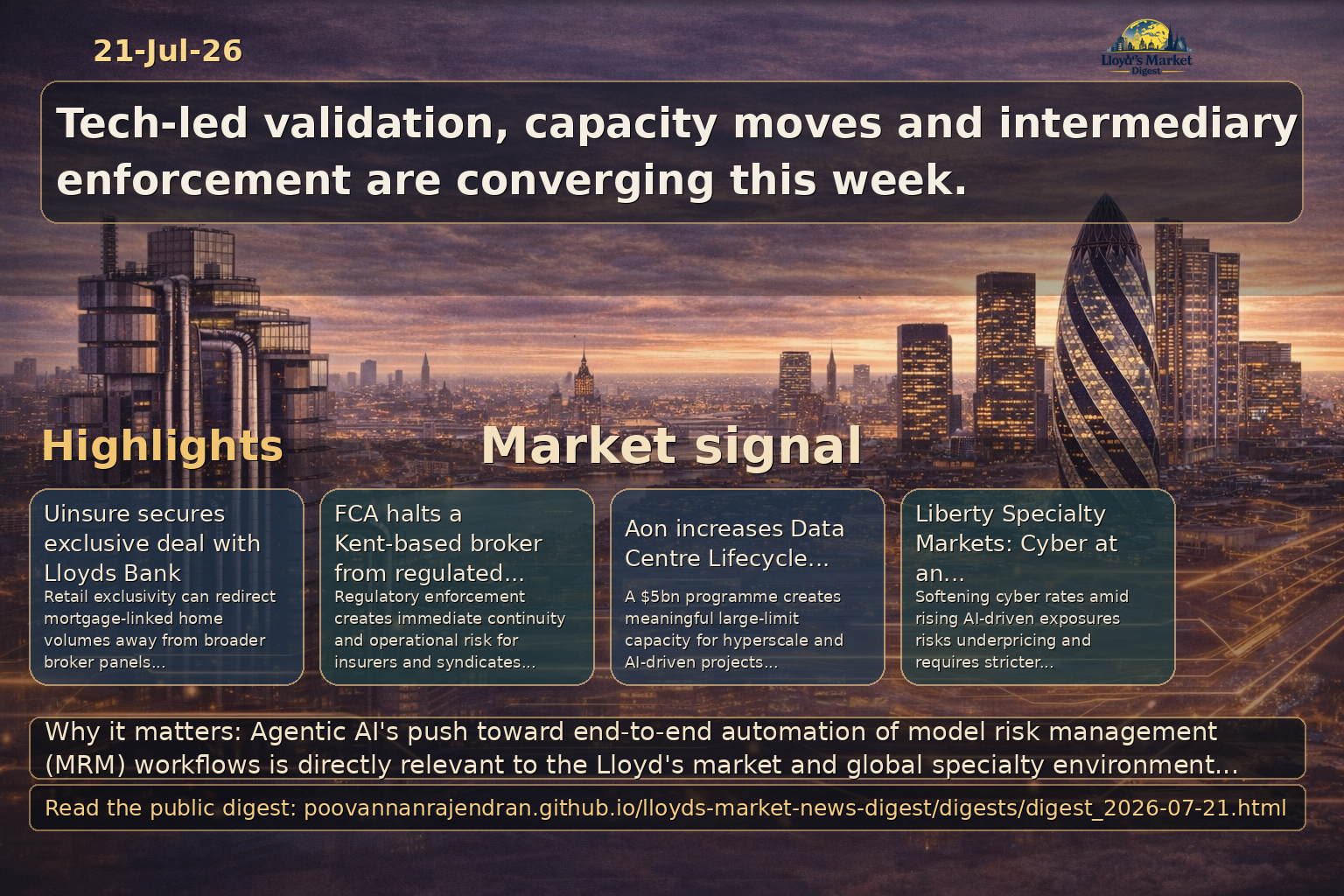
Why it matters: Uinsure’s exclusive deal with Lloyds Bank demonstrates how distribution exclusivity can reshape access to capacity and retail referrals — a model relevant to brokers, MGAs and syndicates assessing partner concentration risks.
- Distribution dependency: Evaluate concentration risk when retail exclusivity redirects mortgage‑linked home business away from broader broker panels.
- Negotiation leverage: Syndicates and MGAs should quantify the value of exclusive retail channels when pricing capacity and setting referral terms.
- Channel strategy: Broking firms and placement platforms must diversify distribution partnerships to avoid single‑partner exposure and preserve bargaining power.
Source: reinsurancene.ws
Why it matters: Rokstone's Autotransporter solution backed by Lloyd's capacity is a direct example of MGAs leveraging Lloyd's to fill niche marine/trucking coverage gaps and expand specialty inland marine offerings.
- Syndicates should evaluate tailored inland marine appetite and limit/deductible constructs to support MGAs seeking Lloyd's capacity.
- Brokers can route specialised trucking/autotransporter risks to Lloyd's-backed MGAs to access bespoke wordings and flexible terms.
- Prioritise underwriting data capture and telematics integration to refine pricing for frequency-prone transport portfolios.
Source: insurancetimes.co.uk
Why it matters: The FCA’s halt on a broker’s regulated activity is a salient example of operational and continuity risk in the intermediary channel, with direct consequences for insurers, syndicates and placement platforms reliant on that broker’s flow.
- Continuity planning: Syndicates and insurers must require contingency arrangements and clear policy of arrangements with intermediaries to prevent coverage gaps on enforcement actions.
- Enhanced KYC and oversight: Platforms should increase ongoing due diligence on intermediaries to detect conduct issues early and protect capacity from reputational and operational contagion.
- Claims and client communication: Underwriters and brokers need playbooks for rapid client outreach to confirm cover validity and minimise lapse risk when intermediaries are suspended.
Source: globalreinsurance.com
Why it matters: Aon’s appointment of an experienced Hong Kong-based executive reinforces broker commitment to Greater China, enhancing local placement capability for complex reinsurance needs and strengthening relationships with regional carriers and Lloyd’s syndicates.
- Improves placement effectiveness: senior regional leadership will accelerate broking of complex treaty and facultative placements into Lloyd’s and global specialty markets.
- Client advisory and product development: enhances Aon’s ability to tailor reinsurance and retro solutions for Chinese insurers and multinational clients operating in Greater China.
- Competitive positioning: signals increased broker investment in Asia Pacific, likely intensifying competition for regional mandates and influencing syndicate appetite for Greater China exposures.
Source: globalreinsurance.com
Why it matters: Expanding the Data Centre Lifecycle Insurance Program to $5bn creates meaningful large-limit capacity for hyperscale and AI-driven projects, presenting placement and capacity-allocation opportunities for Lloyd’s syndicates and specialty reinsurers.
- Enables larger placements: increased program capacity supports underwriting of multi-billion-dollar development and operational risks, prompting syndicates to consider larger line sizes or co-participation.
- Product and wording demand: broader lifecycle coverage will drive need for specialized wordings, accumulation controls and tailored reinsurance structures across placement platforms.
- Distribution and platform impact: brokers and placement platforms will be central to aggregating capacity and coordinating multi-carrier placements, influencing how syndicates access digital infrastructure business.
Source: globalreinsurance.com
Why it matters: Liberty Mutual Re’s appointment of a seasoned London-based cyber lead signals reinsurer intent to scale cyber capacity and structured solutions, affecting pricing, facultative appetite and broker engagement in the Lloyd’s and global specialty space.
- Strategic growth in cyber: a senior hire with London market profile indicates increased LM Re emphasis on cyber reinsurance, potentially expanding available capacity and product sophistication.
- Broker-reinsurer collaboration: expect closer partnership on structured solutions and accumulation modelling, with brokers leveraging reinsurer expertise when placing large or complex cyber programs.
- Market signalling: appointment may prompt peers to sharpen cyber capabilities, which could accelerate capacity growth even as underlying AI-driven exposures increase.
Source: globalreinsurance.com
Why it matters: Liberty Specialty Markets’ analysis that cyber is at an inflection point—softening pricing despite rising AI and regulatory exposures—highlights a potential misalignment between risk and premium that should concern syndicates, brokers and placement platforms.
- Pricing and capital adequacy risk: persistent rate softening amid growing AI-enabled threats increases the risk of underpricing and adverse loss experience for syndicates and reinsurers.
- Underwriting discipline and wording review: executives should prioritise stricter underwriting criteria, strengthened exclusions/limits and enhanced accumulation controls to mitigate latent aggregation risks.
- Data, modelling and platform use: greater reliance on robust exposure modelling and placement platform analytics is needed to inform capacity allocation, reinsurance purchasing and strategic portfolio decisions.
Source: insurancejournal.com
Why it matters: Large voluntary utility settlement volumes from the Eaton Fire highlight elevated wildfire severity and potential reserve strain for insurers and reinsurers participating in California property pools; significant implications for subrogation, allocation disputes and modeling assumptions used by Lloyd's syndicates and specialty brokers.
- Reserve and loss‑creep risk: Sets a benchmark for settlement quantum that can drive reassessment of modeled loss expectations and catastrophe loadings across U.S. wildfire-exposed portfolios.
- Subrogation and allocation exposure: Voluntary programs can complicate reinsurance recoveries and causation disputes — brokers must document exposure and support reinsurer recoveries.
- Placement implications: Heightened appetite for parametric and bespoke wildfire facilities; placement platforms should prepare to aggregate submission data and evidence to accelerate facultative and retrocession placements.
Source: insurancejournal.com
Why it matters: Unexpected CEO exit at a newly formed Florida reinsurer introduces counterparty and continuity risk for cedants and brokers that relied on that capacity; potential for disruption in regional reinsurance capacity or for rapid market consolidation that may reallocate risk across syndicates and global specialty carriers.
- Counterparty stability: Syndicates and brokers should reassess credit exposure and collateral arrangements tied to Florida Re placements.
- Capacity reallocation: Loss of executive leadership may trigger reduced appetite or delay in capacity deployment — brokers must identify alternative reinsurers and structure fallback layers.
- Strategic opportunity and M&A watch: Market participants should monitor for recapitalization or acquisition approaches that could create new capacity or change risk appetite profiles.
Source: insurancejournal.com
Why it matters: New Jersey's reclassification and insurance requirement for higher‑speed e-bikes creates immediate premium base and distribution opportunities for motor, micro-mobility and specialty lines; brokers and platforms must adapt underwriting criteria, pricing models and claims handling protocols for a two‑tier product set.
- Product segmentation and pricing: Differentiate underwriting and premiums between low‑speed (no insurance) and motorized e-bikes (mandatory liability) with data-driven urban risk rating.
- Distribution and embedded insurance: Placement platforms and MGAs can capture market share by providing streamlined registration-linked or rental business coverage solutions.
- Claims and exposures: Anticipate elevated bodily injury and third‑party property exposures in urban environments — refine policy wordings, limits and rider options for fleet/rental operators.
Source: insurancejournal.com
Why it matters: A withdrawn positive lab result in a cyclospora investigation underscores scientific uncertainty in contamination attribution that influences recall scope, product‑liability claims, and reinsurer recovery prospects; specialty lines and brokers must monitor evidence chains for liability allocation and subrogation potential.
- Claim scope volatility: False positives and evolving laboratory conclusions can abruptly narrow or expand recall footprints, affecting contingent BI and product recall claims.
- Subrogation and forensic evidence: Insurers should prioritize robust laboratory validation and chain‑of‑custody to support recovery efforts and limit indemnity uncertainty.
- Placement and wording review: Underwriters need clarity on contamination triggers and exclusion language; brokers should secure clear wording around recall, contaminant detection and BI coverage.
Source: insurancejournal.com
Why it matters: The UK’s tightened misconduct regime raises operational, D&O and professional indemnity risk for insurers, brokers and placement platforms — increasing compliance costs, potential claims for failure of governance, and the need for enhanced vetting for senior personnel in syndicates and MGAs.
- Elevated professional liability exposures: Greater scrutiny of non‑financial misconduct can drive D&O and PI claims stemming from governance failings and inadequate HR processes.
- Operational compliance costs: Insurers and platforms must invest in enhanced vetting, reporting systems and training to meet FCA expectations and avoid regulatory sanctions.
- Recruitment and retention risk: Stricter fitness‑for‑office tests may constrain talent mobility; syndicates should incorporate personnel risk into capacity planning and onboarding checks.
Source: insurancetimes.co.uk
Why it matters: The Genasys simulator reflects an emerging channel for talent attraction and industry understanding, relevant to brokers, syndicates and placement platforms seeking to strengthen future underwriting and broking capability.
- Branding and recruitment: Use immersive simulators as a low‑cost tool to showcase Lloyd’s/syndicate career pathways to early talent and lateral hires.
- Operational readiness: Incorporate simulator outputs into onboarding to reduce time‑to‑productivity for junior underwriters and brokers on complex specialty lines.
- Market positioning: Syndicates and placement platforms should consider sponsorship or integration to signal innovation and improve candidate pipelines for technical specialties.
Source: insurancetimes.co.uk
Why it matters: The Backchat column highlights industry culture and competition that influence broker rankings, client perception and platform reputation — factors that affect placement choices and market share for brokers and syndicates.
- Reputation management: Maintain visibility in industry rankings and thought leadership to support broker and platform referrals from retail and wholesale channels.
- Client engagement: Leverage industry narratives to differentiate advisory value — especially for complex specialty placements where trust drives referral flows.
- Competitive intelligence: Monitor market sentiment and peer benchmarking to anticipate distribution shifts and respond to threats to placement volumes.
Source: insurancetimes.co.uk
Why it matters: Clear Group’s material revenue and GWP growth underlines the continuing consolidation and platform build‑out across retail, MGAs and the London market, affecting placement volumes and competition for specialist capacity.
- Scale economics: Consolidators with multi‑channel platforms can outcompete smaller brokers for capacity and talent; syndicates should monitor aggregation risk when allocating lines.
- Platform integration: Investment in placement and distribution tech should be a priority to retain intermediary relationships and drive cross‑sell into specialty lines.
- M&A vigilance: Syndicates and large brokers need proactive counter‑strategies (preferred terms, technical service) to protect pipeline where aggregators expand into London market placements.
Source: reinsurancene.ws
Why it matters: Historical reporting on pricing and margin dynamics provides context for current underwriting strategy and scenario planning across syndicates and brokers.
- Use archival pricing and margin trends to stress-test syndicate business plans and loss-cost assumptions.
- Incorporate historical cycle indicators into broker advisory materials for long-term client placement strategies.
- Benchmark contemporary rate momentum against past attrition periods to inform reserve and capacity allocation decisions.
Source: reinsurancene.ws
Why it matters: Aon increasing Data Center Lifecycle Programme capacity to $5bn highlights structural demand for large, lifecycle insurance solutions and the need for scaled capacity across placement platforms.
- Evaluate syndicate and Lloyd's appetite to provide layered capacity for end-to-end digital infrastructure risks.
- Design lifecycle wordings and services (construction to operations) that syndicates can underwrite alongside brokers and MGAs.
- Prioritise platform features enabling multi-year placements and aggregated exposure monitoring for large data-centre portfolios.
Source: reinsurancene.ws
Why it matters: Consilium's partnership with CyberCube demonstrates brokers embedding advanced cyber analytics into placement workflows to improve risk selection and pricing precision.
- Integrate cyber analytics into submission protocols to shorten placement cycles and justify capacity requests to syndicates.
- Use model outputs to quantify client exposures, inform limits selection and structure layered/reinsurance solutions.
- Require placement platforms to support probabilistic cyber metrics and benchmarking for underwriter review.
Source: reinsurancene.ws
Why it matters: Clear Group's strong revenue and EBITDA growth underscores the strategic value of combining retail distribution with specialist wholesale and underwriting capabilities relevant to Lloyd's distribution pathways.
- Monitor platform and broker consolidation as a source of stable premium flow for syndicates seeking diversified distribution.
- Consider partnerships or quota-share arrangements with fast-scaling distribution platforms to secure access to retail-originated specialty volumes.
- Assess M&A and organic growth among distributors as a factor in competitive pricing and terms for syndicate placements.
Source: artemis.bm
Why it matters: The appointment of a senior actuary to Korra (Ledger Investing) signals maturation of casualty-focused SaaS ILS platforms; this strengthens actuarial governance for casualty ILS transactions, improves credibility with institutional investors and creates new distribution/placement pathways relevant to brokers and Lloyd's syndicates.
- Enhances technical capability to underwrite and price casualty ILS products—syndicates should reassess appetite for partnering with platform-originated risks.
- Creates an alternative placement channel for brokers and MGAs; evaluate integration and API connectivity to capture deal flow and increase placement efficiency.
- Encourages Lloyd's and syndicates to proactively engage with insurtech platforms for co-development, due diligence and potential capital provision to scalable casualty ILS pools.
Source: artemis.bm
Why it matters: The near-miss parametric trigger on Mexico's cat bond demonstrates sensitivity of parametric structures to event location and parameterisation, highlighting basis risk and operational-data dependencies that are critical for sovereign programmes, brokers and market participants structuring parametric placements.
- Reassess parametric trigger thresholds and monitoring protocols to reduce near-miss probability and manage stakeholder expectations on payout frequency.
- Placement platforms and syndicates must ensure robust real-time data feeds, independent verification and governance to preserve market confidence in parametric instruments.
- Brokers should advise clients on blended solutions (parametric plus indemnity/contingent cover) and enhanced disclosure around model uncertainty and basis risk.
Source: artemis.bm
Why it matters: Bermuda's renewed influx of first-time cat bond and ILS sponsors in H1 2026 reinforces its role as a primary domicile for alternative reinsurance capital, affecting where syndicates and brokers domicile vehicles and source capital for sidecars, cat bonds and collateralised reinsurance.
- Syndicates and brokers should evaluate Bermuda-registered vehicles for capital efficiency, governance and speed-to-market when structuring sidecars and ILS placements.
- Placement platforms must streamline cross-jurisdiction onboarding, regulatory compliance and investor reporting to capture first-time sponsors seeking Bermuda registration.
- Lloyd's market participants should monitor domicile flows to assess competition for global ILS capital and potential regulatory or tax-driven shifts impacting capital availability.
Source: artemis.bm
Why it matters: Heightened ILW interest at mid-year renewals and an expected surge in cat bond issuance in Q4 indicate shifting demand for retrocessional capacity and capital-market solutions; this affects pricing, capacity allocation and the execution calendar for brokers, syndicates and placement platforms.
- Syndicates should incorporate ILWs into retro and capital plans as a flexible, cost-efficient hedge during peak exposure periods and reassess pricing frameworks accordingly.
- Brokers and placement platforms must prepare execution capacity and investor engagement strategies ahead of Q4 issuance windows to meet accelerated demand and compressive timelines.
- Operational teams (legal, modelling, investor relations) need to scale to support increased volume of transactions and expedite due diligence for timely placement.
Source: artemis.bm
Why it matters: Evidence of growing severe thunderstorm losses in ILS portfolios shifts the peril profile away from predominantly wind/quake-focused stress tests; this alters accumulation, modelling and claims-severity assumptions for syndicates, reinsurers, brokers and placement platforms.
- Update catastrophe models and aggregation analytics to reflect increased frequency and severity of convective storm losses and their spatial correlation patterns.
- Underwriters and portfolio managers should reassess limits, attachment strategies and cross-peril accumulation controls to avoid unintended concentration of thunderstorm exposure.
- Brokers and placement platforms must demand higher-resolution PCS/Verisk data integration and scenario testing as a prerequisite for structuring and pricing ILS and cat bond transactions.
Source: newsnow.co.uk
Why it matters: Ed Miliband’s elevated foreign-policy role and prior responsibility for energy and net-zero policy alter the risk calculus for energy, political-risk and trade-exposed underwriters.
- Reassess energy-transition exposures: syndicates should reprice and stress-test portfolios tied to UK energy policy and renewables investments given potential shifts in subsidy and permitting regimes.
- Sanctions and trade risk: brokers and placement platforms must strengthen KYC and sanctions screening workflows for international placements tied to regions affected by evolving diplomatic stances.
- Engage in policy dialogue: market leaders should coordinate with trade bodies and underwriters to clarify coverage boundaries for state-driven actions, sanctions, and politically motivated asset restrictions.
Source: newsnow.co.uk
Why it matters: High-profile sporting figures and legacy events concentrate demand for event cancellation, personal accident, and reputational-liability products and create short-term spikes in claims and PR risk for carriers and brokers.
- Event and memorial coverage: brokers should pre-position placement capacity and standardized wordings for one-off tributes and gatherings to avoid last-minute capacity gaps.
- Reputational and media-liability exposure: syndicates need clearer terms for celebrity-related endorsements and sponsorships given amplified social and media scrutiny.
- Claims-readiness and contingency planning: placement platforms should enable rapid notifications and delegated authority workflows to manage surges in small- to mid-sized claims tied to public events.
Source: newsnow.co.uk
Why it matters: Liverpool’s role as a major port and cultural hub concentrates marine, cargo, property, and event-related insurance exposures — with additional climate-related flood and urban-concentration risk to consider.
- Port and marine concentration: underwriters should quantify exposures across the port complex and consider aggregate limits or programmatic placements to manage peak loss scenarios.
- Urban flood and infrastructure risk: syndicates must incorporate updated flood modelling for Merseyside into pricing and capital allocation decisions, particularly for commercial and residential portfolios.
- Event and leisure demand: brokers should develop tailored packages for music, sports and tourism clients that reflect evolving cancellation, liability and business-interruption triggers.
Source: newsnow.co.uk
Why it matters: Andy Burnham’s prominence and regional political influence signal potential shifts in northern economic policy, infrastructure investment and devolution, which will affect municipal exposures and public-sector risk-transfer opportunities.
- Regional economic policy impact: placement platforms and brokers should model how northern infrastructure spending and devolved powers alter public-sector procurement and insurance needs (P3s, liability, construction).
- Municipal and flood risk focus: syndicates must reassess underwriting appetite for local authority portfolios exposed to social infrastructure and climate adaptation projects.
- Partnership and distribution opportunities: brokers should pursue structured-risk solutions and program placements for public-private partnerships arising from targeted regional investment.
Source: risk.net
Why it matters: Although focused on banking MRM, the article signals a broader shift: agentic AI can automate continuous validation, documentation and challenge workflows that underpin underwriting, pricing and capital models in the Lloyd's and global specialty ecosystem. Brokers, syndicates and placement platforms should treat this as a wake-up call to reassess model governance, integration architecture and vendor controls before competitors or regulators set expectations.
- Governance imperative — implement layered controls (policy, technical guardrails, audit trails) and a clear human-in-the-loop regime to retain accountability as agentic agents automate validation and remediations.
- Platform integration — accelerate proof-of-concepts to embed automated validation into placement and broking workflows (pricing checks, appetite filters, aggregation) to reduce time-to-bind and improve quote consistency.
- Regulatory and vendor risk — update third-party risk frameworks and regulatory engagement strategies to demonstrate explainability, reproducibility and continuous monitoring of models automated by agentic AI.