Source: bankofengland.co.uk
Why it matters: The Bank of England’s Payments Innovation page signals strategic direction on modernising payment rails and supporting new payment technologies — material for placement platforms, brokers and syndicates seeking faster, lower-cost, and more-transparent premium and claims flows.
- Assess integration opportunities: evaluate APIs, straight-through processing and vendor roadmaps to align placement platforms with evolving BoE-endorsed innovations.
- Drive pilot programmes: engage selective broker/syndicate partners and fintech providers to pilot tokenised or API-based premium collection and claims disbursement workflows.
- Monitor regulatory posture: maintain active dialogue with banking partners and trade bodies to anticipate standards, data requirements and compliance implications arising from BoE-led innovation initiatives.
Source: fca.org.uk
Why it matters: FCA warning about an unauthorised online entity that may be impersonating regulated firms; relevant to brokers, placement platforms and syndicates because such scams can intercept client funds, spoof broker credentials and create false placement activity.
- Operational response: instruct compliance and front‑office teams to blacklist the domain, update intake scripts and alert placement desks and delegated authorities to the specific URL.
- Due diligence: require verification of FCA registration (FRN) and legal entity identifiers for any new digital counterparties or platforms before onboarding; escalate to senior underwriter for any exceptions.
- Client protection: deploy targeted client communications to intermediaries and insureds that may be exposed; confirm payment routing controls (trusted beneficiary lists, dual approvals) before any premium or deposit movements.
Source: fca.org.uk
Why it matters: FCA notice on an unauthorised firm (Valorabitnex) that may offer financial services without permission; presents a fraud and compliance risk to global specialty distribution channels and digital placement ecosystems.
- Market surveillance: add the entity to internal watchlists used by brokers, syndicates and platform onboarding teams and share with third‑party vendors for real‑time blocking.
- Controls: tighten verification on counterparties purporting to act as brokers, MGAs or coverholders — require certified contracts, indemnities and proof of regulated status.
- Risk communication: brief syndicate CM/finance teams and managing agents on the warning to prevent misdirected premium flows and ensure underwriting teams confirm counterparties through established broker panels.
Source: fca.org.uk
Why it matters: FCA warning for Orbitrade Capital indicating unauthorised activity; relevant because unauthorised entities can be used to launder premiums, mislead cedants or impersonate placement platforms in specialty markets.
- Payment control: mandate verified escrow or trustee arrangements for any non‑standard premium flows and enforce multi‑party confirmation for unusual settlements.
- Broker governance: require brokers and MGAs to provide documented evidence of counterparties’ regulatory status before executing facultative or treaty placements.
- Escalation: ensure corporate security and legal teams are prepared to notify clients and regulatory contacts if any historic interactions with the entity are discovered.
Source: fca.org.uk
Why it matters: FCA alert regarding an unauthorised domain that may target UK clients; such actors increase fraud exposure for placement platforms, global brokers and syndicates that rely on digital distribution and API‑enabled workflows.
- Technical mitigation: coordinate with IT and platform providers to block the domain at network and application levels and verify API partner identities before issuing binding lines.
- Contractual hygiene: insert representations and warranties into distribution and third‑party platform agreements that require proof of regulatory status and immediate notification of warnings or sanctions.
- Training and detection: refresh fraud‑awareness training for placement and broking teams to recognise spoofed communications and ensure transaction monitoring flags anomalous placement requests.
Source: fca.org.uk
Why it matters: FCA warning for netfxassets.org as an unauthorised operator; relevant to the market because unauthorised financial actors can create knock‑on exposure across broker networks, syndicate capital flows and alternative distribution channels.
- Onboarding gates: require KYC/AML and FCA register checks as non‑waivable prerequisites for any new digital distribution partner or fintech integrator.
- Reconcile and audit: perform a rapid review of recent wire and premium transactions to detect any misdirected funds or vendor invoices referencing the domain.
- Stakeholder notification: inform key syndicate partners, Lloyd’s market security and platform providers to prevent upstream propagation of the scam.
Source: businessinsurance.com
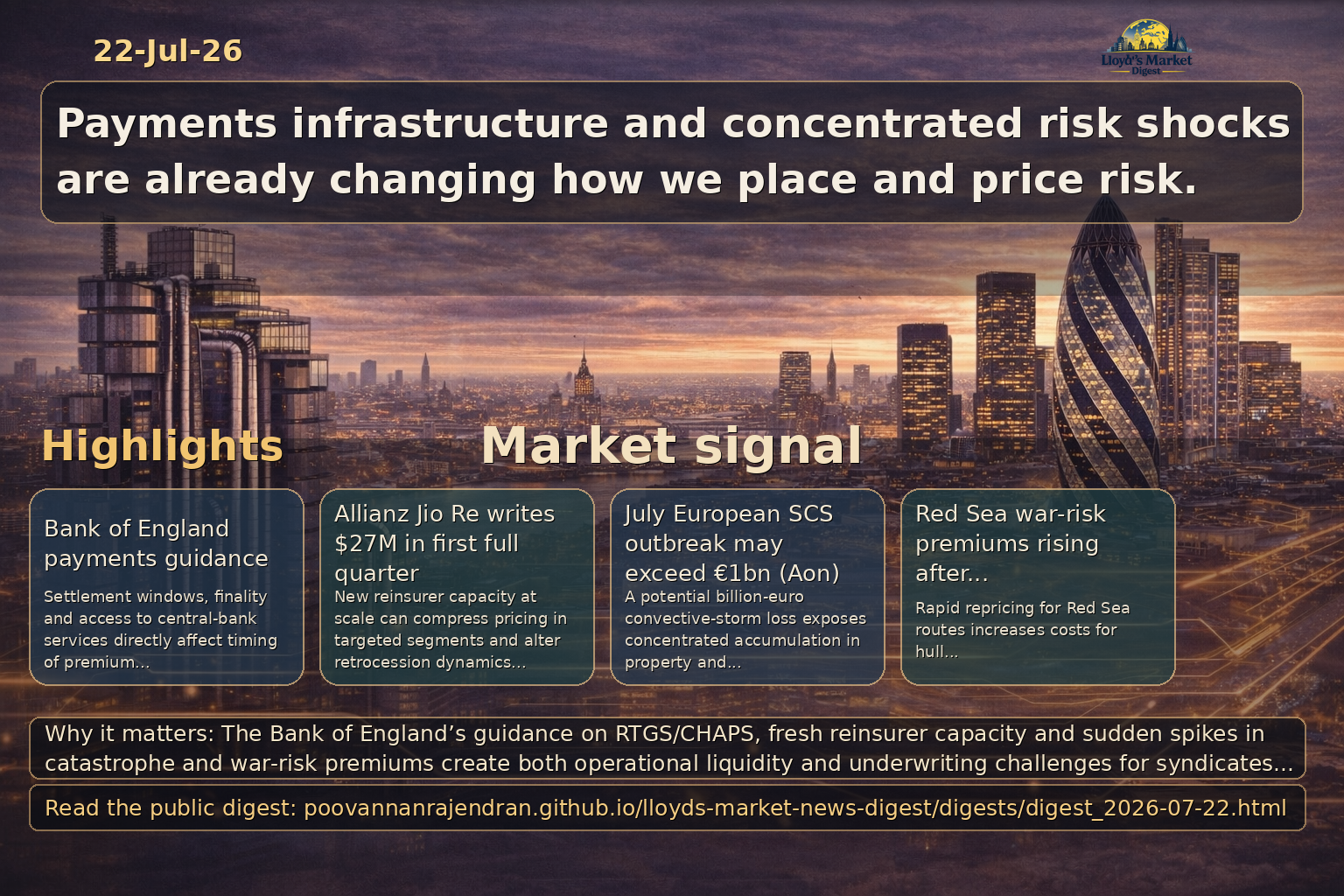
Why it matters: Allianz Jio Re reporting meaningful premium flow in its first full quarter highlights new reinsurance capacity and the competitive implications for syndicates and brokers placing large-layer business.
- Market impact: Additional reinsurer capacity can compress pricing in targeted segments and alter retrocession dynamics for Lloyd’s syndicates.
- Underwriting implication: Broking teams must reassess attachment strategies and pro rata versus excess of loss placements where new capacity is active.
- Recommended action: Syndicates and placement platforms should re-evaluate panel selection, update capacity maps and engage directly with new reinsurers to understand appetite and terms.
Source: businessinsurance.com
Why it matters: Marsh analysis that declining rates widen the underinsurance gap is a strategic warning for specialty underwriters and brokers: softening market conditions can mask accumulation and adequacy issues across portfolios.
- Portfolio risk: Rate softening increases the probability of inadequately priced policies and higher frequency of underinsured losses impacting profitability.
- Operational focus: Brokers should intensify client risk valuation services to close the underinsurance gap and preserve long‑term placement quality.
- Recommended action: Implement granular exposure analytics across syndicates, stress-test rate scenarios and adjust renewal disciplines and minimum pricing guidelines.
Source: businessinsurance.com
Why it matters: A government decision to assume a large fire claim signals potential sovereign intervention in major property losses, with direct implications for claim recovery patterns and political risk exposures relevant to global specialty portfolios.
- Claims precedent: State involvement can change recovery expectations, trigger policywording disputes and affect reinsurer recoveries for affected jurisdictions.
- Exposure aggregation: Large municipal and residential property claims underscore the need to map concentration risk in geographic portfolios placed by brokers and syndicates.
- Recommended action: Review policy wordings for government involvement clauses, revisit reinsurance recoverables assumptions and brief placement platforms on potential sovereign-risk scenarios.
Source: businessinsurance.com
Why it matters: The EU fine against AliExpress is significant for underwriters and brokers because it raises the frequency and quantum of regulatory and operational exposures for e-commerce and cross-border platforms, affecting D&O, cyber and contingent business interruption lines.
- Underwriting consequence: Large regulatory fines increase underwriting scrutiny on compliance frameworks for e-commerce clients and third‑party vendors.
- Product design: Syndicates should examine exclusions, limits and aggregate caps for regulatory‑action and fines exposures in tech and retail portfolios.
- Recommended action: Require enhanced due diligence on regulatory compliance for placements, update appetite guidance for technology/marketplace risks and coordinate with placement platforms on supplemental underwriting data.
Source: businessinsurance.com
Why it matters: Executive profiles in industry outlets (example: Rob Erfurt) provide signals on leadership moves and distribution strategy shifts that matter to brokers and Lloyd’s franchise owners assessing partnership and placement relationships.
- Talent intelligence: Senior hires and role changes can presage strategic realignment at brokerages, MGAs or carrier platforms affecting distribution flows.
- Commercial impact: Leadership changes may alter appetite, product priorities or underwriting authority that influence syndicate placement volumes.
- Recommended action: Maintain executive tracking as part of business development to anticipate shifts in panels, referral routes and strategic relationships.
Source: insurancejournal.com
Why it matters: A federal ruling denying coverage where an advertising/personal-injury exclusion applied underscores litigation risk from narrow but determinative policy language and the exposure of third‑party assignees. Syndicates and placing brokers must reassess advertising/personal injury wording and assignment mechanics when underwriting hospitality, entertainment and consumer-facing accounts.
- Immediate review of advertising and personal-injury exclusions across relevant wordings to identify potential coverage gaps for club/hospitality risks
- Adopt standardised assignment and subrogation clauses usable by brokers to preserve claim rights for insureds and assignees
- Train placement teams to capture marketing/use-of‑image exposures during submission and price/limit accordingly or offer bespoke endorsements
Source: insurancejournal.com
Why it matters: A class action alleging greenwashing and PFAS residues on produce highlights growing product, environmental and brand-liability exposures for global specialty carriers. Lloyd’s syndicates writing product recall, environmental impairment and D&O exposures need enhanced supply-chain due diligence and chemical-contamination underwriting standards.
- Require documented supplier testing and disclosure of agrochemical use for agribusiness and food clients before offering product liability or recall capacity
- Reassess aggregation of PFAS and long-tail contamination exposure in facultative/reinsurance treaties and adjust retentions or exclusions where necessary
- Advise brokers and corporate clients on reputational risk mitigation, crisis response clauses and potential warranty/representation endorsements
Source: insurancejournal.com
Why it matters: The NJ Supreme Court affirming a jury trial for insurer RICO/fraud claims — and declining arbitration compulsion — affects dispute-resolution strategy for carriers pursuing recovery against providers and suppliers. Syndicates and brokers should reassess the enforceability and operational impact of arbitration clauses tied to coverage disputes and fraud litigation.
- Review policy and settlement language to ensure clear forum selection and dispute-resolution mechanisms aligned with recovery objectives
- Counsel claims teams to evaluate the litigation-versus-arbitration trade-offs in fraud/racketeering recovery efforts, particularly where public jury precedent may be advantageous
- Brokers should flag arbitration and anti‑assignment terms during placement negotiations to avoid post‑claim surprises and preserve recovery pathways
Source: insurancejournal.com
Why it matters: Difficulty securing insurance for airlines flying into Dubai highlights acute placement frictions for aviation war and political risk coverage amid regional hostilities. This constrains carrier schedules, elevates market demand for specialist aviation war capacity and pressures placement platforms and wholesale brokers to source alternative solutions.
- Mobilise specialist aviation war and political risk panels and establish pre‑negotiated facultative facilities for at‑risk routes
- Engage government export credit/market‑stabilisation schemes where commercial capacity is unavailable to preserve client operations
- Update airline clients and brokers on temporary coverage solutions, premium loadings and operational contingencies (route changes, reduced frequencies)
Source: insurancejournal.com
Why it matters: Rapid increases in Red Sea war-risk premiums for shipping demonstrate how concentrated geopolitical shocks reprice maritime hull, cargo and P&I exposures, with immediate downstream impacts on supply chains and energy logistics. Lloyd’s syndicates and brokers must react with disciplined capacity allocation and agile facultative placement.
- Reprice and re-underwrite Red Sea and adjacent route exposures with updated war premium matrixes and voyage‑specific underwriting criteria
- Coordinate with P&I clubs and reinsurers to determine capacity sharing, and communicate premium pass‑throughs to charterers and shippers
- Offer clients route‑risk advisory and alternative logistics solutions, including contingent BI and increased war limits where commercially justified
Source: reinsurancene.ws
Why it matters: AXA's global roll‑out of Microsoft 365 Copilot (building on an internal Secure GPT) signals accelerating enterprise LLM adoption across carriers. This will alter broker workflows, placement platform integrations and syndicate underwriting analytics while raising vendor, data security and regulatory considerations relevant to Lloyd's market participants.
- Assess platform integration roadmap: pilots for Copilot/LLM features across broker desks and placement platforms to quantify productivity gains and interoperability with Syndicate systems.
- Elevate LLM governance and data classification: define what policyholder and underwriting data can be processed, logging/audit requirements, and vendor assurance standards to satisfy Lloyd's regulatory and client confidentiality expectations.
- Mitigate vendor and operational risk: evaluate vendor lock‑in, continuity, and incident response; require SLAs and security attestations before embedding LLM tools into placement or MGA workflows.
Source: reinsurancene.ws
Why it matters: Guy Carpenter's Q2 revenue decline highlights the impact of a softer reinsurance market on broker economics and placement dynamics. For syndicates and managing agents, this affects negotiation leverage, distribution strategies and the need to demonstrate value beyond price through analytics and risk advisory.
- Reassess renewal and capacity deployment strategies: anticipate tighter broker origination and use targeted retention incentives for high‑value clients and programs.
- Revisit broker remuneration and value proposition: engage brokers on outcome‑based fees or enhanced advisory services that justify commissions as margins compress.
- Monitor broker financial and market positioning: track leading brokers' performance and consolidation risks to anticipate distribution concentration or shifts in access to capacity.
Source: reinsurancene.ws
Why it matters: Aon's estimate that the July European severe convective storms could become a billion‑euro event underscores concentrated accumulation risk in property and agricultural lines. Lloyd's syndicates, global specialty insurers and brokers must review aggregation exposures, retrocession cover and client communications.
- Re‑run accumulation and aggregation models: validate intra‑portfolio and cross‑line exposures for hail, wind and flood, especially across France and Germany concentrations.
- Stress retrocession and capital plans: quantify likely knock‑on effects on collateral requirements, aggregate reinstatements and pricing for treaty renewals.
- Coordinate claims‑and‑placement messaging with brokers: ensure transparent client communications and preparatory placement steps to protect relationships and manage reputational risk.
Source: reinsurancene.ws
Why it matters: W. R. Berkley CEO commentary about a 'false sense of comfort' in property markets highlights emerging underwriting deterioration and imprudent risk layering. Shared and layered programs are a focal point for potential losses and margin erosion across syndicates and placement platforms.
- Tighten underwriting discipline on property and layered programmes: reinforce granular risk selection, up‑to‑date asset valuation and stricter attachment point analysis.
- Reprice and redesign shared/layered structures: require clearer sub‑limits, aggregation clauses and transparent exposure reporting to limit moral hazard and accumulation surprises.
- Enhance capital contingency planning: prepare for underwriting deterioration by updating catastrophe models, reserve adequacy checks and reinsurance purchasing triggers.
Source: reinsurancene.ws
Why it matters: The legacy market's shift from reactive runoff to a strategic instrument presents Lloyd's syndicates and specialty managers with options for balance‑sheet optimisation, capital release and risk transfer. Mature legacy solutions can be integrated into broader capital and distribution strategies.
- Embed legacy transactions into capital planning: use targeted run‑off or reinsurance‑to‑close strategies to manage volatility and free capital for core underwriting growth.
- Partner with specialist brokers and advisors: leverage market expertise to execute vintage sales, reinsurance commutations and portfolio transfers with robust pricing governance.
- Invest in data and analytics for vintage performance: improve loss triangulation, forensic underwriting analytics and post‑transaction monitoring to ensure expected economic outcomes.
Source: bankofengland.co.uk
Why it matters: The Bank’s Payment and Settlement overview — including the 2016 extension of CHAPS/CREST hours and review outcomes — highlights how settlement-window changes materially affect balance-sheet management, counterparty risk and timing of intermediation across the Lloyd’s value chain.
- Incorporate settlement windows into treasury models: update premium, claims and reinsurance cashflow timing assumptions to reflect extended operating hours and their liquidity benefits.
- Negotiate operational SLAs: ensure banking and platform providers document cut-off times and intraday liquidity treatments that align with syndicate settlement needs.
- Reassess counterparty exposures: use extended settlement hours to reduce intraday credit exposures and to optimise intraday collateral movements between brokers, MGAs and syndicates.
Source: bankofengland.co.uk
Why it matters: CHAPS is the UK’s high-value payment system providing irrevocable, real-time settlement — critical for timely premium remittances, reinsurance placements and large claims settlements involving Lloyd’s participants and international cedants.
- Align large-value flows to CHAPS windows: schedule critical premium and reinsurance payments inside CHAPS operating hours to guarantee finality and minimise settlement risk.
- Ensure direct or correspondent access clarity: confirm which banks act as CHAPS direct participants for principal brokers and syndicates to avoid routing delays or additional correspondent fees.
- Embed CHAPS contingency plans: develop operational playbooks for settlement failure scenarios, including alternative timing, pre-funded accounts or temporary escrow arrangements.
Source: bankofengland.co.uk
Why it matters: The Bank’s Banking Services description — who can hold accounts and the nature of central-bank facilities — underlines structural access constraints and the privileged nature of central-bank services, which affects settlement certainty and custody strategies for market participants.
- Review custodial and account architecture: evaluate whether prime brokers, custodians or banking partners provide the necessary credit and settlement pathways given limited direct access to BoE accounts.
- Optimise use of sterling facilities: coordinate with treasury and capital managers to make tactical use of near risk-free sterling facilities offered through participant banks for liquidity smoothing.
- Plan for regulatory intermediation: factor in KYC, participant eligibility and governance requirements when selecting banking partners to ensure uninterrupted access to key settlement services.
Source: bankofengland.co.uk
Why it matters: The Bank’s Payments overview explains RTGS and the role of central settlement in achieving final, risk-free transfers — foundational for designing premium flows, reinsurance settlements and platform connectivity across Lloyd’s international marketplace.
- Integrate RTGS finality into contractual terms: explicitly define payment finality cut-offs in placement agreements, reinsurance treaties and broker contracts to reduce disputes and liquidity mismatches.
- Upgrade platform connectivity to RTGS-aware workflows: ensure placement platforms and broker systems capture settlement timestamps and reconcile against RTGS records for auditability and faster reconciliation.
- Strengthen operational resilience: implement real-time reconciliation, fall-back payment rails and crisis playbooks to mitigate risks from RTGS or CHAPS service interruptions.
Source: newsnow.co.uk
Why it matters: DESNZ centralises UK energy policy and Net Zero delivery, directly influencing the risk landscape for energy assets and infrastructure that Lloyd’s syndicates and global specialty brokers underwrite. Policy-driven shifts in generation mix, state support for infrastructure and regulatory change create new underwriting classes, alter peril frequency/severity and raise political/credit exposures that require tailored capacity, pricing and placement approaches.
- Underwriting implications: Acceleration toward renewables, hydrogen and grid upgrades increases demand for tailored products (construction/operational all risks, commissioning, EPC, project finance wrap) while raising transition-related exposures and potential for stranded assets in fossil sectors.
- Placement and distribution: Brokers and placement platforms must enhance data integration, parametric triggers and digital workflow to place capacity efficiently across distributed renewable projects and to manage complex multilayered placements for state-backed infrastructure.
- Capital and risk transfer: Syndicates and reinsurers need to reassess capital models for long-tail vs short-tail energy risks, factor in political and policy risk for UK-centric projects, and develop reinsurance/ILW structures to protect against systemic transition, supply-chain and energy-security incidents