Source: insurancejournal.com
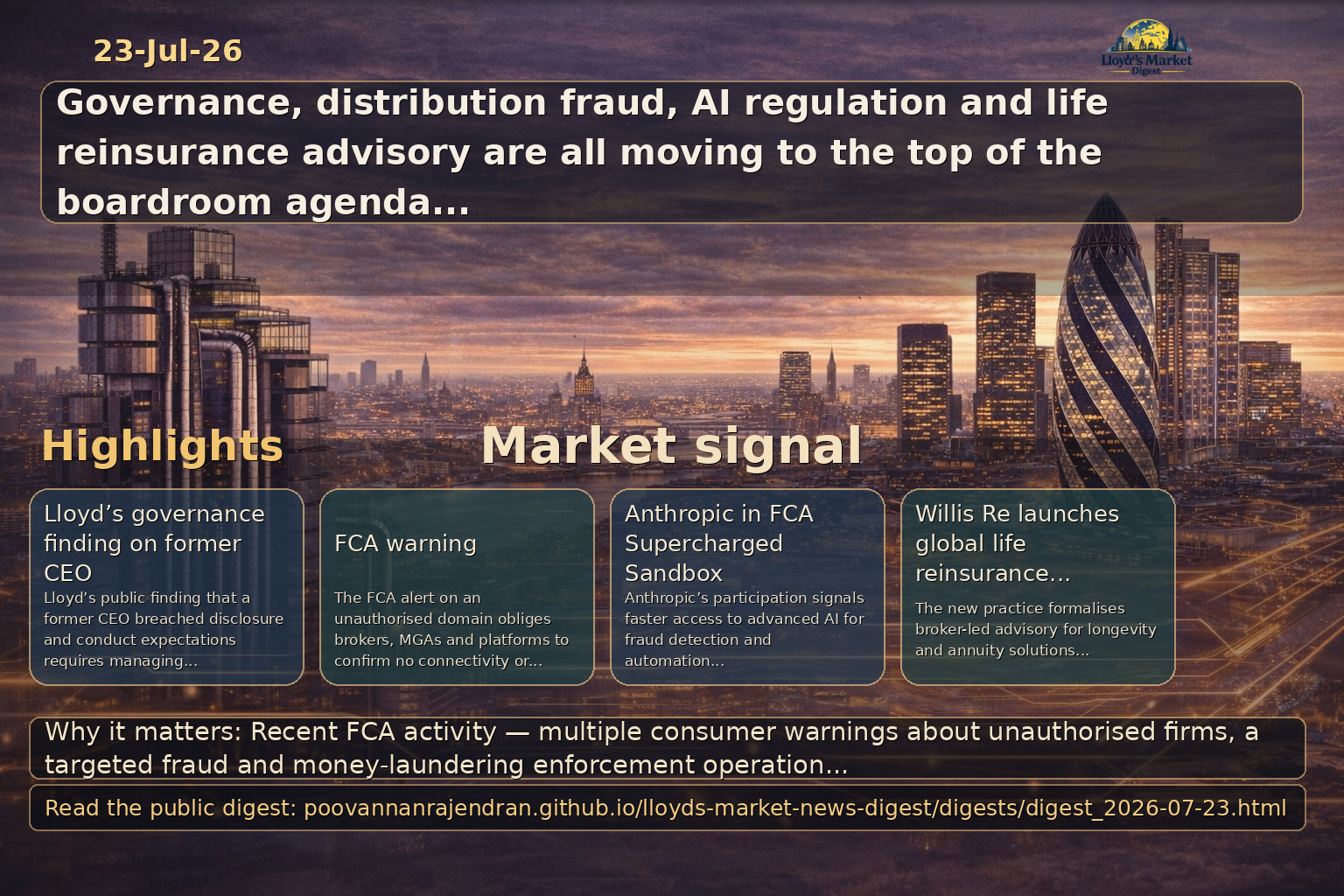
Why it matters: Lloyd's public finding that a former CEO breached compliance rules elevates governance and conduct risk considerations across the market, affecting market trust, broker-syndicate relationships and regulatory scrutiny of internal controls.
- Urgent need for syndicates and managing agents to revalidate whistleblowing and conflict-of-interest procedures and communicate remediation plans to brokers and capital providers.
- Brokers and placement platforms should reinforce counterparty due diligence and confirm unchanged authority levels for underwriting and claims to avoid placement disruption.
- Reputational risk may tighten market capacity and pricing; executives should prepare client and investor briefings, and accelerate transparency initiatives to preserve confidence.
Source: insurancetimes.co.uk
Why it matters: The Lloyd's finding that a former CEO breached disclosure expectations is a material governance event for the marketplace: it elevates scrutiny on senior conduct, control environments and the reputational risk borne by syndicates and intermediaries.
- Expect tightened governance, enhanced vetting of senior hires and possibly more granular market-wide conduct rules affecting Lloyd's managing agents and syndicates.
- Brokers and placement platforms should increase diligence on counterparty governance and executive oversight when allocating large or long-tail risks.
- Reputational contagion risk advises proactive communication strategies and strengthened internal compliance to reassure clients and reinsurers.
Source: reinsurancene.ws
Why it matters: The Council of Lloyd’s findings and subsequent governance overhaul materially affect market trust, oversight expectations and operational controls for managing agents, syndicates and intermediaries; the reforms will drive changes in leadership accountability, whistleblowing processes and platform compliance obligations.
- Regulatory and reputational risk: Accelerated governance reforms increase scrutiny from regulators, capital providers and global clients; syndicates and brokers should expect heightened disclosure, board-level oversight and formalised whistleblowing pathways.
- Operational response: Managing agents must embed stronger conduct controls, escalation protocols and independent oversight into syndicate governance, with implications for recruitment, training and senior leadership continuity.
- Market conduct and placement platforms: Brokers and electronic placement platforms will need enhanced due diligence, transparency and records management to align with Lloyd’s reforms and to reassure institutional clients and capital partners.
Source: fca.org.uk
Why it matters: FCA warning on an unauthorised firm highlights distribution and client‑protection risks that can affect brokers, syndicates and platform reputations and exposures.
- Immediate review: confirm no broker, MGA or platform connectivity or referrals involving the domain; update client notices and distributor due‑diligence lists.
- Client protection: instruct broking teams to escalate inbound leads tied to the domain and to document attempts to engage clients or intermediaries.
- Prevent contagion: coordinate with platform operators and syndicate underwriting teams to block any account openings or attachments linked to the entity and report fraud attempts to FCA/market bodies.
Source: fca.org.uk
Why it matters: FCA warning on an alleged unauthorised bank signals deposit, payment and promo‑fraud exposure that could be used to mislead insureds or launder premium flows via intermediaries.
- Payments control: verify premium collection and disbursement rails to ensure no routing or client diversion to the flagged domain.
- Broker guidance: issue immediate advisory to brokers and coverholders to reject new business referencing the domain and to confirm counterparty legitimacy.
- Monitoring and reporting: enhance detection rules for unusual payment counterparty names and escalate suspicious activity reports to AML teams and authorities.
Source: fca.org.uk
Why it matters: FCA warning on an unauthorised solutions provider risks impersonation of legitimate service suppliers to brokers and placement platforms, undermining operational integrity.
- Third‑party verification: require platforms and MGAs to validate vendor identities and maintain an updated blocklist for known fraudulent domains.
- Operational resilience: test vendor onboarding and change‑of‑bank controls to prevent spoofed supplier invoices or portal access.
- Stakeholder communication: alert syndicates and major brokers to the warning and request confirmation that no integrations exist with the domain.
Source: fca.org.uk
Why it matters: Arrests and searches in an FCA‑led fraud and money‑laundering probe demonstrate active regulatory enforcement and increased scrutiny on brokerage and payment flows in the UK market.
- AML review: accelerate transaction monitoring and retrospective premium flow reviews for high‑risk accounts and geographic corridors.
- Compliance posture: prepare data and case summaries for potential regulatory enquiries and reassess MLRO escalation protocols across broker and platform operations.
- Market coordination: engage industry groups (eg. LMA, BIBA) and placement platforms to share indicators of compromise and harmonise suspicious activity reporting.
Source: fca.org.uk
Why it matters: Anthropic’s participation in the FCA Supercharged Sandbox signals accelerating availability of advanced AI tools for fraud detection, underwriting automation and compliance — with material operational and governance implications for syndicates, brokers and platforms.
- Strategic pilots: consider selective sandbox participation or vendor trials to evaluate AI use cases for fraud detection, claims triage and broker workflow automation.
- Model governance: establish clear policies for data handling, explainability, validation, and third‑party model risk before deployment in placement or underwriting processes.
- Regulatory alignment: define supervisory and audit trails for AI decisions, and coordinate with compliance and legal teams to satisfy FCA expectations on safety, accountability and consumer protection.
Source: insurancejournal.com
Why it matters: EIOPA's admonition that private equity buyers must demonstrate long-term commitment signals heightened regulatory scrutiny of alternative capital participating in insurance markets, directly relevant to Lloyd's capital structures and syndicate investors.
- Syndicates with private-equity-backed capital should prepare enhanced documentation demonstrating long-term policyholder support and capital plans to satisfy EU and home-state supervisors.
- Brokers and placement platforms must assess counterparty stability and potential exit risk when arranging capacity; include covenant and continuity clauses in placement documentation.
- Potential slowdown or repricing of PE capital could tighten capacity for specialty lines — underwriters should model scenarios where alternative capital withdraws and pre-position reinsurance solutions.
Source: globalreinsurance.com
Why it matters: Willis Re’s launch formalises broker-led life reinsurance advisory capacity that directly affects distribution dynamics, capital solutions and syndicate appetite for longevity and annuity risk.
- Opportunity for syndicates: Lloyd’s syndicates can partner or syndicate life/annuity solutions, but must demonstrate actuarial capability, capital resilience and long-term liability management to win mandates.
- Broker-led capital structuring: Expect brokers to drive bespoke capital optimisation (reinsurance, longevity swaps, quota shares, sidecars), increasing demand for alternative capacity and tailored placement mechanics.
- Platform and regulatory readiness: Placement platforms and MGAs must upgrade underwriting workflows, data, longevity modelling and compliance controls to support complex life-reinsurance transactions and institutional investor counterparties.
Source: reinsurancene.ws
Why it matters: Willis Re’s establishment of a Global Life Reinsurance Practice led by an experienced head underscores growing advisory demand in life, longevity and pension risk transfer.
- Creates a specialist advisory and broking channel for complex life reinsurance, impacting syndicates writing longevity/mortality risk
- Leverages WTW analytics to deliver integrated solutions across morbidity, mortality and pension transfers
- Expected to influence pricing transparency and structuring for large life reinsurance transactions
Source: bankofengland.co.uk
Why it matters: Although CP12/26 specifically addresses friendly societies, its prescriptions on statutory sequencing, documentation, member safeguards and adviser roles establish a regulatory playbook that Lloyd’s syndicates, brokers and placement platforms must monitor and adapt to when handling transfers, run-off acquisitions or mutual restructurings. The guidance signals heightened PRA expectations for governance and transparency that will affect due diligence, pricing, and platform-enabled migrations.
- Operational/compliance: Update transaction playbooks and due-diligence protocols to reflect PRA expectations on sequencing, member protections and adviser involvement; ensure internal legal, actuarial and compliance teams can evidence steps required by the PRA.
- Commercial/opportunity: Brokers and syndicates should identify closed-book and mutual transfer opportunities where clarified regulatory processes reduce execution risk; develop tailored product, pricing and reinsurance strategies for acquired portfolios.
- Platform and data readiness: Placement and administration platforms must prioritise migration tooling, standardized data templates and integrated regulatory reporting to support efficient policy transfers and to demonstrate auditability to the PRA.
Source: globalreinsurance.com
Why it matters: Aon’s H1 report shows aggregate catastrophe metrics can conceal acute regional extremes and modelled peaks—creating concentrated exposure risk that affects pricing, capacity and portfolio construction across Lloyd’s and global specialty markets.
- Underwriting and capacity reallocation: Syndicates will reassess regional appetite and pricing for convective storm and regional catastrophe exposures, potentially tightening terms or withdrawing capacity where aggregation risk is unacceptable.
- Placement and analytics demand: Brokers and placement platforms must supply granular aggregation analytics, scenario testing and bespoke placement structures (facultative, layered programmes) to match carrier risk tolerances and capital constraints.
- Risk-transfer innovation and retrocession buying: Insurers will intensify buying of retrocession and alternative risk-transfer (parametrics, multi-year covers, ILS) to close protection gaps and stabilise loss volatility amid regional concentration.
Source: insurancejournal.com
Why it matters: Significant local flood losses in Texas highlight exposure accumulation and claims volatility for property portfolios underwritten by global specialty carriers and Lloyd's syndicates, with implications for reinsurance purchasing and placement timing.
- Immediate claims and loss-notification surge will pressure syndicate reserving and cashflow; coordinate with brokers to prioritise fast-track claims channels and catastrophe teams.
- Potential reassessment of flood mapping and modelling inputs for US inland waterways — update accumulation controls on placement platforms to prevent unintended concentration.
- Opportunity for brokers to design resilience and rebuilding-linked solutions (parametric triggers, contingent business interruption, retrofit incentives) to retain clients and reduce future loss costs.
Source: insurancejournal.com
Why it matters: Red Sea tanker rerouting after Houthi warnings increases marine and political violence exposures, driving demand for war, hull, and cargo cover and elevating brokerage activity around route/risk advisory and supplemental war-risk programmes.
- Immediate repricing and war-risk premium uplift for transits in the region; syndicates and reinsurers should reassess limits and aggregate exposure for marine books.
- Brokers and placement platforms should deliver dynamic routing intelligence and contingency wordings (e.g., extended cover for longer transits) to clients managing supply-chain disruption.
- Potential knock-on effects to energy and commodity markets create secondary exposures (supply-chain interruption, energy price spikes) that specialty underwriters must model for correlated portfolios.
Source: insurancejournal.com
Why it matters: Operational cyber attack on a major logistics and food distributor underscores third-party supply-chain cyber risk and the potential for broad business interruption losses that aggregate across policyholders and lines.
- Syndicates must revisit aggregation scenarios for third-party suppliers in critical sectors and tighten policy wordings on business interruption triggers linked to supplier cyber incidents.
- Brokers should intensify vendor-risk assessments for clients, incorporate supply-chain cyber questionnaires into placements, and promote layered cyber response and contingent coverage solutions.
- Placement platforms can differentiate by integrating third-party risk insights and attack surface scoring to better price and allocate cyber capacity.
Source: insurancetimes.co.uk
Why it matters: The UK launch of Lassie's preventative pet-insurance platform illustrates platform-first insurtech models that combine data-driven underwriting, AI-enabled claims handling and direct-to-consumer distribution—factors that reshape specialty product flows, affinity partnerships and placement requirements for brokers and syndicates.
- Data-rich preventative models create new underwriting signals and lifetime-value opportunities—syndicates should evaluate appetite and pricing models for pet morbidity trends.
- AI-assisted claims processing reduces cycle time but raises model governance and regulatory transparency needs for placement platforms and brokers handling claims referrals.
- Brokers and placement platforms must assess API/connectivity and partner strategies to capture affinity flows or risk disintermediation by consumer-facing insurtechs.
Source: insurancetimes.co.uk
Why it matters: Senior industry testimony to the House of Lords on Consumer Duty highlights intensified regulatory focus on measurable customer outcomes and senior accountability—affecting product governance, distributor oversight and board reporting across the Lloyd's market and global specialty firms.
- Boards and senior executives must evidence robust outcome metrics and governance for products placed through brokers and platforms to withstand regulator scrutiny.
- Brokers require enhanced compliance, suitability and disclosure workflows integrated into placement platforms to demonstrate fair customer outcomes.
- Syndicates should incorporate Consumer Duty considerations into product design, policy wordings and reinsurance structures to avoid future remediation costs.
Source: insurancetimes.co.uk
Why it matters: Allianz's digital Complete Mini Fleet roll-out into Northern Ireland expands digital insurer-broker distribution and demonstrates the geographic extension of insurer direct-trade capabilities that compete for small fleet placements traditionally handled by brokers and specialty syndicates.
- Digital fleet products targeting smaller fleets compress intermediary margins and shift placement volumes—brokers should differentiate via service, bespoke cover and bundling.
- Syndicates and underwriters must reassess appetite for small/micro-fleet business and adapt pricing, terms and claims handling to digital distribution expectations.
- Placement platforms need multi-jurisdictional quoting, renewal automation and integration with insurer digital trading tools to retain broker workflows.
Source: insurancetimes.co.uk
Why it matters: Atrium's appointment of a senior head of specialty reinsurance signals ongoing competition for senior reinsurance talent and the strategic importance of sophisticated reinsurance structuring for specialty lines—implications for capacity, retrocession and broker-led placements.
- Enhanced in-house structuring capability can expand capacity and bespoke product offers for complex risks, altering broker placement strategies and syndicate retrocession needs.
- Senior hires focused on complex reinsurance indicate pressure on pricing and a focus on differentiated solutions—brokers should leverage this for tailored client propositions.
- Syndicates must monitor shifts in reinsurance capacity and structuring that could affect cover terms, attachment points and volatility management.
Source: reinsurancene.ws
Why it matters: Historical archive items underscore prior cyclical dynamics and pricing-floor debate — useful context for current rate moves and renewal positioning.
- Provides precedent on catastrophe-driven pricing floors and how market sentiment shifted post-losses
- Useful for benchmarking cyclical duration and informing syndicate planning assumptions
- Caveat: archival snapshots should be combined with current exposure and model updates before decision-making
Source: reinsurancene.ws
Why it matters: Autonomous analysis highlights sustained, broad-based reinsurance price deterioration with direct implications for underwriting margins and broker revenues.
- Documents successive renewal declines (mid-teens to 20%+) with material impact on cedant cost of capital and cover procurement
- Signals pressure on syndicate profitability and potential for stricter underwriting or alternative capacity deployment
- Requires brokers and placement platforms to redesign deal structuring, layered programmes and multi-year covers
Source: reinsurancene.ws
Why it matters: Neptune’s growth in flood insurance illustrates how specialist insurers leverage technology and distribution to scale a specialty line relevant to Lloyd’s and syndicates exploring flood capacity.
- Record revenue reflects successful agent engagement and tech-enabled distribution (agent portals, digital tools)
- Demonstrates market appetite for targeted flood products and potential for reinsurance programmes supporting growth
- Highlights sensitivity to broader real‑estate market trends and the need for modular reinsurance structures
Source: artemis.bm
Why it matters: Artex Axcell Re (Series FE0004) is material to the Lloyd’s and global specialty ecosystem because it exemplifies how placement platforms and segregated-account transformers are being used to channel private ILS capital into reinsurance solutions. The structure offers an alternative route to capacity that affects broker distribution strategy, syndicate capital optimisation and the competitive dynamics between traditional Lloyd’s placements and platform-based deals.
- Expands alternative capacity: Adds a private-cat bond channel that can supplement or substitute Lloyd’s syndicate capacity and traditional reinsurance lines, enabling cedants and brokers to diversify counterparty and concentration risk.
- For brokers and distribution: Strengthens demand for integrated advisory and placement capabilities; brokers must develop ILS structuring expertise and platform relationships to retain mandate on specialty placements.
- Platform and operational impact: The transformer/segregated-accounts model speeds access to collateralised capital, enforces tighter documentation/collateral standards and increases competition between placement platforms and London Market intermediaries, with implications for syndicates seeking efficient retrocession or quota-share solutions.
Source: newsnow.co.uk
Why it matters: Red Sea attacks and Saudi oil shipping disruption directly affect marine hull, cargo, energy and war/terror coverage; pricing, capacity and voyage risk assessments for Lloyd's syndicates and brokers must be recalibrated.
- Immediate need to reprice or restrict war/terror and kidnap & ransom exposures for transits through the Red Sea and adjacent choke points; coordinate with reinsurers on retrocession capacity.
- Brokers should update voyage risk matrices and propose temporary clause amendments (routing warranties, additional premiums, contingency loadings) to protect syndicate appetite.
- Placement platforms must ensure rapid access to clause libraries and evidence-of-security data to accelerate binding and minimise exposure windows for insureds in energy/logistics sectors.
Source: newsnow.co.uk
Why it matters: Broader law-industry developments signal heightened regulatory scrutiny and increasing demand for specialist legal advice across transactions, disputes and regulatory compliance — a direct input into underwriting and claims strategy for specialty lines.
- Underwriters should factor increased litigation and regulatory enforcement risk into pricing and terms for D&O, professional indemnity and transactional risk products.
- Brokers need formal legal escalation paths with recognised law firms to support complex claims and coverage disputes, preserving settlement timelines and limiting precedent risk.
- Syndicates and platforms should review panel counsel arrangements and contracting frameworks to ensure rapid, expert response that aligns with policy wordings.
Source: newsnow.co.uk
Why it matters: Reporting on Freshfields Bruckhaus Deringer highlights partner moves, pay model changes and regulatory interactions at a top-tier firm — indicators of legal market consolidation and counsel availability affecting large corporate placements and disputes.
- High-profile law-firm reshaping can produce short-term counsel capacity constraints for material claims and complex transactional work; syndicates should pre-qualify alternative panels.
- Changes in law-firm economics and partner structures may increase hourly rates or drive fixed-fee innovation; pricing models for legal expenses cover should be revisited.
- Brokers and placement platforms should deepen relationships with multiple elite and specialist boutiques to mitigate single-firm concentration for cross-border matters.
Source: newsnow.co.uk
Why it matters: Macro developments in England (political, economic and regulatory) influence London market operating conditions, regulatory expectations and the talent pipeline for specialty insurance roles.
- Political or fiscal shifts can change corporate risk profiles and insurance demand; underwriters should stress-test portfolios against potential economic scenarios in the UK.
- Regulatory developments originating in Westminster may drive changes to market conduct rules or cross-border distribution — legal and compliance teams must monitor and prepare implementation plans.
- Talent and relocation dynamics within England affect availability of underwriting, claims and broking specialists; firms should prioritise retention, remote-working capability and succession planning.
Source: newsnow.co.uk
Why it matters: London-specific news reflects the immediate operating environment for Lloyd's market participants — impacting regulatory liaison, talent recruitment and the market's reputation as a global specialty hub.
- Reputational events or policy shifts in London have outsized impacts on global placement flows; market leaders should coordinate messaging and stakeholder engagement strategies.
- Concentration of specialty expertise in the capital underscores the need for contingency planning (office disruption, travel restrictions) to preserve placement and claims continuity.
- Placement platforms must ensure UK regulatory alignment (FSMA/TPRM expectations) and provide audit trails to support brokers and syndicates operating from London.