Source: businessinsurance.com
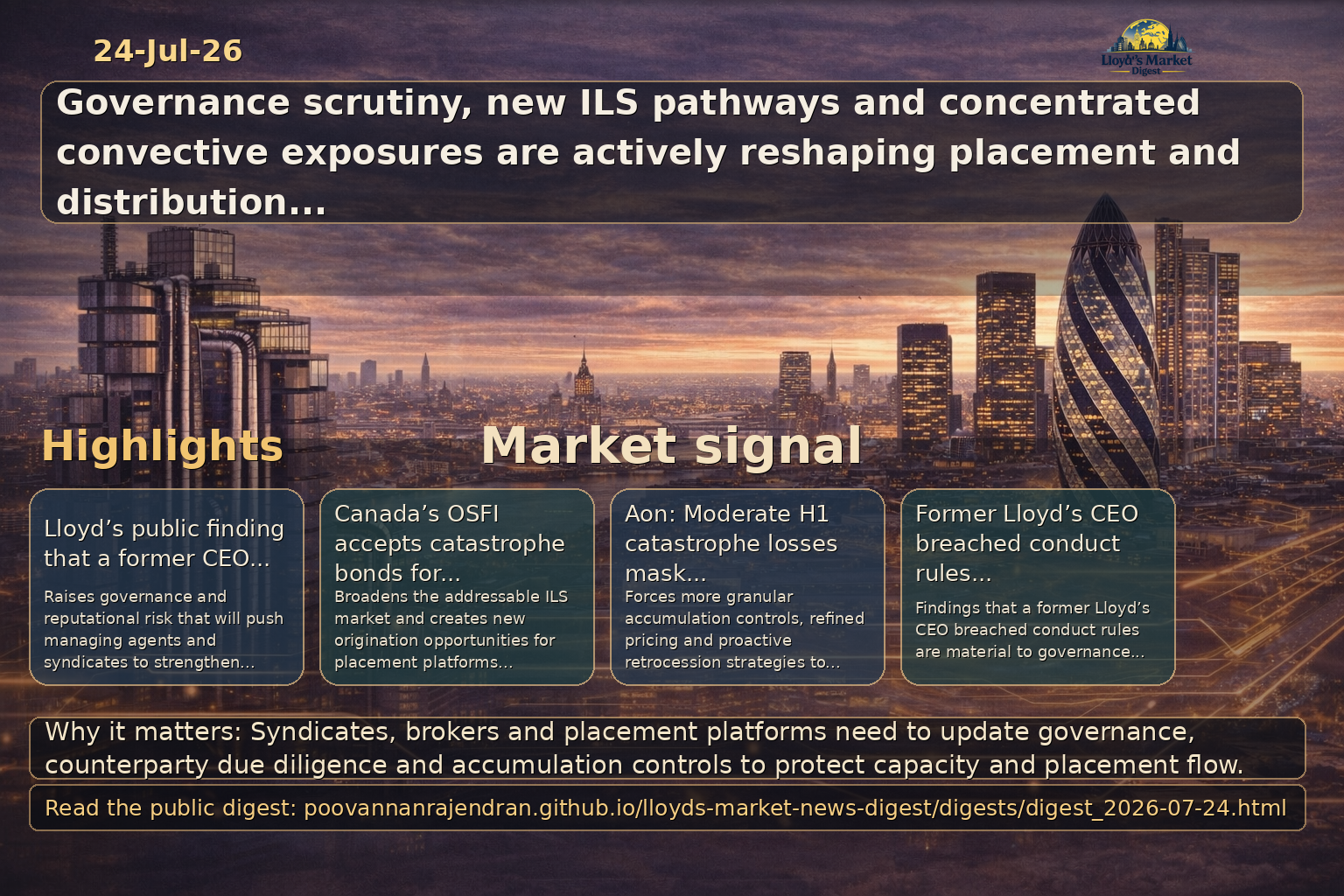
Why it matters: Findings that a former Lloyd’s CEO breached conduct rules are material to governance, market confidence and oversight expectations for syndicates and the central market.
- Reinforce conduct, whistleblowing and investigation protocols across syndicates and managing agents to protect market integrity.
- Communicate strengthened governance measures to brokers and capital providers to restore confidence in Lloyd's market management.
- Anticipate regulatory scrutiny and potential changes to fit-and-proper assessments affecting senior appointments and platform integrations.
Source: insurancejournal.com
Why it matters: Lloyd's public finding against a former CEO for compliance breaches elevates governance and reputational risk considerations across managing agents, syndicates and broker relationships.
- Governance scrutiny: managing agents and syndicates should strengthen disclosures, conflict-of-interest protocols and whistleblowing processes.
- Market confidence: brokers and capital providers will demand demonstrable compliance frameworks when selecting Lloyd's counterparties.
- Reputational management: coordinated comms and transparent remediation are essential to maintain placement flow and investor trust.
Source: insurancetimes.co.uk
Why it matters: Support for Lloyd's governance reforms following the Neal investigation directly affects market governance, director conduct standards and whistleblowing frameworks for managing conflicts at syndicate and managing agent level.
- Accelerate review of board and senior management disclosures, conflict policies and declaration processes at managing agents and syndicates.
- Enhance independent whistleblowing channels and assurance mechanisms aligned with Lloyd's recommendations.
- Communicate governance upgrades to brokers and capacity partners to protect market reputation and maintain placement confidence.
Source: artemis.bm
Why it matters: OSFI’s acceptance of catastrophe bonds for capital credit materially lowers barriers for Canadian cedants to use ILS, expanding the addressable market for placement platforms, brokers and syndicates seeking North American origination.
- Enables Canadian insurers to achieve capital relief with ILS, increasing potential sponsor flow for placement platforms and syndicates.
- Creates a more level competitive field between traditional reinsurance and ILS—brokers should revise placement strategies to include ILS solutions.
- Operational and documentation implications for platforms and syndicates: collateralisation, legal form and regulatory reporting will require harmonisation with Canadian capital rules.
Source: insurancejournal.com
Why it matters: EIOPA's insistence that private equity buyers demonstrate long-term commitment affects M&A valuation, capital strategy and counterparty due diligence for European insurers and those with Lloyd's market links.
- Capital planning: potential buyers and existing managing agents should articulate multi-decade capital and policyholder support plans to satisfy regulators.
- Counterparty risk: brokers and reinsurance partners must re-evaluate counterparties' ownership structures when underwriting long-duration liabilities.
- Deal structuring: syndicates may need governance covenants and ring-fencing measures to preserve policyholder interests under PE ownership.
Source: insurancetimes.co.uk
Why it matters: Broker commentary on regulatory overload reflects market sentiment that compliance complexity is increasing distribution friction and operational cost for intermediaries and syndicates reliant on broker networks.
- Assess broker engagement models and outsourcing arrangements to ensure compliance costs are transparent and allocated appropriately.
- Engage with trade bodies and Lloyd's policy teams to seek pragmatic regulatory implementation timelines and clarified guidance.
- Streamline internal compliance workflows and automated controls on placement platforms to reduce broker administrative burden.
Source: insurancetimes.co.uk
Why it matters: FCA bans for broker misconduct underline heightened regulatory enforcement risk that can impair broker credibility and downstream insurer exposure to conduct failures and client money misuse.
- Strengthen oversight of appointed representatives, introductions and client money processes to reduce conduct and AML exposure.
- Require enhanced due diligence and periodic audits of broker counterparties before appetite acceptance by syndicates.
- Escalate information-sharing with regulators and trade associations following enforcement actions to benchmark conduct standards.
Source: globalreinsurance.com
Why it matters: Willis Re's launch signals a broker-driven push into global life risk advisory and transactional broking that will affect how Lloyd's syndicates, global specialty carriers and placement platforms access and structure life-capital solutions. Expect greater demand for balance-sheet optimisation, longevity risk transfer and bespoke reinsurance placements where brokers coordinate capital across traditional syndicates and alternative capital providers.
- Capital-management demand: Syndicates and carriers should prepare for increased appetite from cedants seeking balance-sheet optimisation and longevity transfers, creating cross-market placement opportunities (Lloyd's syndicates, reinsurers, ILS).
- Placement and distribution: Brokers will act as aggregators of life capacity — platforms and syndicates must strengthen life-specific distribution capabilities and documentation standards to compete for curated, large-case placements.
- Product and analytics investment: Underwriters and platforms will need enhanced life‑risk analytics, cash‑flow modeling and regulatory/compliance capabilities to support structured solutions (longevity swaps, coinsurance, longevity bonds).
Source: artemis.bm
Why it matters: Chubb’s increased reinsurance purchases reflect opportunistic capacity acquisition in a softened market, signalling tactical buying behaviour that impacts supply dynamics, pricing discipline and broker sourcing strategies across Lloyd’s and specialty markets.
- Opportunistic cedant buying can compress available primary capacity and shift risk to reinsurers and retrocession markets—syndicates must assess appetite and pricing sensitivity.
- May spur increased use of placement platforms and brokers to secure tailored reinsurance coverage as cedants optimise capital and catastrophe protection.
- Heightens focus on underwriting discipline and loss‑cost adequacy; brokers should prepare evidence‑based placement arguments to maintain pricing integrity.
Source: businessinsurance.com
Why it matters: A compensation-focused video interview (workers' comp) signals broker and MGAs' continuing emphasis on specialty product differentiation and distribution effectiveness — relevant to syndicates underwriting affinity and platform-led distribution.
- Assess affinity and sector-specific comp models for syndicate appetite — workers' comp differentiation influences facultative demand.
- Leverage video and digital content on placement platforms to support specialty product marketing and broker engagement.
- Monitor claims-cost controls highlighted by carriers to refine pricing and loss-sensitive wording for specialty delegations.
Source: businessinsurance.com
Why it matters: AXA XL hiring an E&S executive from an AIG unit signals competition for senior specialty underwriting/talent and strategic capacity shifts that affect syndicate and broker placement decisions.
- Re-evaluate capacity relationships with global carriers as senior hires reshape underwriting appetite and portfolio steerage.
- Anticipate product realignment in E&S lines; adjust syndicate exposure limits and co‑insurance strategies accordingly.
- Prioritize retention and succession planning for underwriting talent on platforms to maintain broker confidence and placement continuity.
Source: businessinsurance.com
Why it matters: Hub's noncompete allegation underscores legal and commercial risks from broker mobility — critical for syndicates and placement platforms reliant on key brokers and producer networks.
- Review contractual protections and non‑solicit clauses in broker and distribution agreements to protect syndicate pipelines.
- Develop contingency plans for client retention and policy servicing if producers depart to rival brokers/platforms.
- Use placement platforms to codify relationship intelligence and migration risk indicators for early detection of broker movement.
Source: businessinsurance.com
Why it matters: The Hartford's improved Q2 profit from underwriting demand and investment income provides capacity and pricing signals that affect specialty risk placement and reinsurance purchasing strategies.
- Interpret carrier earnings as indicators of available capacity and potential pricing pressure or relief across specialty classes.
- Align syndicate reinsurance buying to expected market liquidity and investment return environment.
- Communicate carrier stability and earnings trends to brokers to influence placement sequencing and capital allocation.
Source: globalreinsurance.com
Why it matters: Aon’s H1 recap shows aggregate global catastrophe losses were moderate but conceals severe regional events and US SCS storm dominance. For Lloyd's syndicates, brokers and placement platforms this reinforces the need for granular accumulation controls, refined pricing and proactive retrocession/alternative capital strategies to manage concentrated exposures.
- Portfolio and pricing discipline: Syndicates must reassess regional appetite and repricing strategies where concentrated losses (notably US severe convective storms) drive volatility despite moderate headline totals.
- Exposure management and placement tooling: Brokers and platforms should accelerate investment in real‑time exposure aggregation, probabilistic accumulation modeling and binding‑authority controls to reduce unexpected concentration on placement.
- Alternative capital and retro optimisation: The protection gap and shifting regional loss patterns increase demand for structured retrocession, ILS issuance and tailored facultative placements to stabilise capacity and protect syndicate balance sheets.
Source: insurancejournal.com
Why it matters: The large US flood insurance gap signals both a market opportunity for specialty capacity (including Lloyd's syndicates) and a risk of political/regulatory intervention that could alter segmentation, pricing and exposure aggregation.
- Opportunity: design layered flood solutions, parametrics and private-public partnerships to capture underserved demand while managing accumulation.
- Exposure management: syndicates and reinsurers must reassess flood accumulation models and retrofit catastrophe scenarios into underwriting limits.
- Distribution: brokers and placement platforms should develop advisory propositions and standardized documentation to reduce client coverage gaps and claims disputes.
Source: insurancejournal.com
Why it matters: Cyclone Harry exposed misalignment between mandatory coverage frameworks and actual perils faced by coastal businesses — a product-design and wording issue with direct implications for global specialty insurers and brokers.
- Product clarity: syndicates and managing agents must revisit perils definitions (cyclone, storm surge vs river flood) to prevent disputed claims and reputational loss.
- Regulatory risk: governments expanding mandatory schemes may mandate standard wordings or state-backed backstops that change competitive dynamics.
- Broker advisory: brokers need to audit client portfolios for peril mismatches and package endorsements or parametric riders for coastal exposures.
Source: insurancejournal.com
Why it matters: Marsh's Q2 rate data showing continued global rate softening (except US casualty) underscores capacity-driven competition that impacts Lloyd's syndicates' margin management and brokers' negotiating leverage.
- Underwriting discipline: syndicates must balance market share goals with stricter risk selection and enhanced pricing for deteriorating lines like US casualty.
- Reinsurance and capital planning: prolonged soft markets require stress-testing of retrocession layers and capital adequacy under adverse loss scenarios.
- Broker strategy: brokers will increasingly compete on service, analytics and portfolio optimisation rather than price alone; placement platforms should enable differentiated analytics.
Source: insurancetimes.co.uk
Why it matters: Fabricated claims overtaking ghost broking materially raises loss severity and increases moral hazard for underwriters and brokers. It signals a shift from intermediary fraud to policyholder-driven misrepresentation that will affect pricing, reserving and fraud prevention investments across specialty lines.
- Prioritise investments in advanced claims analytics and first‑party fraud detection for syndicates and delegated underwriters.
- Require brokers and MGAs to enhance application-stage validation and attestations to reduce misrepresentation risk.
- Coordinate industry data-sharing with market platforms and Lloyd's to identify emerging fraud patterns and refine underwriting appetite.
Source: insurancetimes.co.uk
Why it matters: Launch of embedded landlord products via a lettings platform exemplifies the shift toward embedded distribution and partnership-led placement — a model relevant to specialty lines and syndicates seeking scalable retail access.
- Evaluate API and platform partnerships to offer white‑label or embedded specialty products through distribution ecosystems.
- Adapt underwriting and data ingestion processes to accept platform-originated risk information and speed up placement cycles.
- Negotiate clear service-level and claims-handling protocols with platforms to protect loss ratios and brand control.
Source: reinsurancene.ws
Why it matters: The Reinsurance News archive provides historical context on cycle behaviours and underwriting outcomes — useful for syndicates and brokers conducting cross-cycle performance analysis and scenario testing.
- Use archived market outcomes to stress-test underwriting playbooks and reserve strategies across prior soft/hard transitions.
- Inform capital allocation and retrocession decisions with historical loss and profitability patterns.
- Maintain an accessible historical repository for actuarial teams and placement strategists when calibrating models or advising clients.
Source: reinsurancene.ws
Why it matters: RLI’s Q2 2026 results highlight resilience within niche specialty segments; relevant to brokers and Lloyd’s syndicates assessing demand and pricing dynamics in casualty, property and surety.
- Specialty portfolios can sustain growth even in softer pricing; syndicates should prioritise technical underwriting over volume.
- Brokers can leverage steady specialty performance to negotiate product-specific terms and continuity of capacity.
- Use RLI’s segmental data as a benchmark when evaluating counterparties and redistribution of risk across platforms.
Source: reinsurancene.ws
Why it matters: Oxbow Partners’ guidance to use the soft market proactively is directly applicable to reinsurers, Lloyd’s syndicates and brokers planning for the next hardening of rates.
- Maintain disciplined underwriting while selectively investing in growth areas that offer durable margins and data advantage.
- Allocate capital to enhance analytics, distribution relationships and technology to improve cross-cycle returns.
- Brokers and placement platforms should identify and preserve profitable client relationships that will command terms in a hardening market.
Source: reinsurancene.ws
Why it matters: Morningstar DBRS’s assessment of limited wildfire impact in Canada informs underwriting and retrocession assumptions for North American property portfolios and syndicate exposure management.
- Reassess regional wildfire exposures using updated event data rather than relying solely on year-to-date burn area metrics.
- Syndicates should calibrate catastrophe models and attachment points to reflect current loss expectations and portfolio concentration.
- Brokers should communicate nuanced wildfire risk views to clients and explore tailored risk-transfer or mitigation solutions.
Source: reinsurancene.ws
Why it matters: KCC’s projection of below-average US severe convective storm losses affects US P&C reinsurance demand and pricing assumptions relevant to Lloyd’s syndicates and global brokers.
- Lower-than-average SCS losses may weigh on short-term reinsurance pricing—syndicates should avoid over-expansion based on soft conditions.
- Adjust aggregate modelling and quota-share negotiations to reflect updated SCS loss projections.
- Brokers can advise clients on opportunistic retrocession purchases or alternative risk structures while capacity is available.
Source: artemis.bm
Why it matters: Ascot’s appointment of a seasoned ILS and capital markets executive to lead Leadline Capital Partners indicates strategic scaling of third‑party capital capabilities, relevant for syndicates and brokers seeking managed capital partnerships.
- Strengthens Ascot’s ability to raise and deploy third‑party capital—creating potential new capital partnerships for Lloyd’s syndicates and global specialty desks.
- Demonstrates continued convergence between underwriting groups and asset managers; brokers should evaluate partnership models that integrate managed capital.
- Placement platforms may see increased volume of sponsored ILS transactions as underwriters institutionalise third‑party capital programmes.
Source: artemis.bm
Why it matters: Material growth in mutual fund allocations to ILS underscores broadening institutional investor demand and deepening liquidity pools that syndicates and brokers can access for alternative capacity and structured reinsurance.
- Significant AUM increases point to sustained investor appetite, supporting larger and more frequent ILS placements and private cat bond issuance.
- Allocations into structures linked to established reinsurers (Arch, PartnerRe, QBE) indicate appetite for counterparty‑diversified ILS instruments—beneficial for syndicates seeking retrocession partners.
- Brokers and placement platforms should intensify investor engagement and product transparency to translate asset manager demand into stable funding for specialty lines.
Source: artemis.bm
Why it matters: Moody’s dual role as rater and modelling provider on a flood cat bond exemplifies consolidation of analytical services—an important governance and stewardship issue for syndicates, brokers and placement platforms relying on third‑party models.
- Concentration of rating and modelling services may speed issuance but raises potential conflict and governance scrutiny—underwriters should strengthen independent validation processes.
- Highlights an expanding pipeline for flood and specialty peril ILS; brokers can leverage enhanced modelling capabilities to structure bespoke placements.
- Placement platforms and syndicates must ensure transparency on model assumptions and third‑party roles to satisfy investors and regulators.
Source: newsnow.co.uk
Why it matters: Escalating Red Sea attacks materially affect marine war risk, cargo rerouting, voyage durations and supply‑chain exposures—core underwriting and broker negotiation issues for Lloyd’s syndicates.
- Immediate underwriting impact: review and reprice war/terror endorsements, voyage risk assessments and premium loadings for transits through Suez/Red Sea corridors.
- Placement strategy: brokers should seek layered capacity, explicit war risk cover and alternative markets; consider parametric or contingency clauses for rerouting costs.
- Operational/claims: expect higher frequency of delay and diversion claims; syndicates must validate aggregation models for correlated marine and cargo exposures.
Source: newsnow.co.uk
Why it matters: The 2026 Commonwealth Games represents concentrated event cancellation, liability and contingency exposure that can require specialty capacity from Lloyd’s syndicates and bespoke broker placements.
- Underwriting action: reassess event cancellation, non‑appearance and contingent business interruption wording and pricing given budget/staging changes.
- Distribution: brokers should structure multi‑layered programmes combining traditional cover, parametric triggers and reinsurance to protect against schedule or host changes.
- Operational: syndicates must map accumulation across concurrent events and sponsor portfolios to avoid unintended concentration.
Source: newsnow.co.uk
Why it matters: A null/no‑content search result highlights monitoring and intelligence gaps; for Lloyd’s market participants, data integrity is critical for KYC, sanctions screening and emerging‑risk surveillance.
- Data governance: validate news and watchlist ingestion pipelines to avoid false negatives in reputational and sanctions screening.
- Placement platforms: require proof of robust third‑party feeds and reconciliation to prevent missed flags during placements and binding authority acceptance.
- Compliance: update escalation protocols to handle gaps in open‑source intelligence and ensure manual review triggers for sensitive counterparties.
Source: newsnow.co.uk
Why it matters: Reports of strikes on Saudi oil tankers and related price volatility directly affect energy portfolios, marine war risk exposure and commodity‑linked liabilities underwritten by Lloyd’s syndicates.
- Pricing & capacity: syndicates should reprice energy and marine war exposures, and consider tightened terms for shipments in high‑risk corridors.
- Hedging & capital: review commodity exposure correlations and consider capital market solutions (ILS, cat bonds) for tail energy risk.
- Broker strategy: structure protections for clients via layered reinsurance and explicit cover for rerouting, salvage and contamination risks.
Source: newsnow.co.uk
Why it matters: Ongoing legal sector activity and regulatory scrutiny affects claims handling, professional indemnity for brokers and law firms, and potentially increases litigation costs for market participants.
- Regulatory monitoring: track SRA/Legal Services Board developments that may change intermediary obligations and disclosure requirements.
- Claims exposure: anticipate increased professional indemnity and D&O claims stemming from regulatory action or firm restructures; update reserves assumptions.
- Market conduct: brokers and syndicates should refresh contractual governance, conflicts policies and legal hold procedures to limit downstream liability.