Source: businessinsurance.com
Why it matters: Potential cancellation of cover by Lloyd's insurers over Hormuz toll payments signals heightened underwriter sensitivity to sanction, war-risk and trade-route liabilities—material for syndicates underwriting marine and energy risks.
- Syndicates must review policy wordings for express exclusions tied to tolls, transits and third-party payments to avoid unintended exposures.
- Brokers should counsel marine clients on contractual routing and indemnity exposures and seek written insurer position to pre-empt disputes.
- Compliance and platform teams need to implement toll-payment screening and require enhanced voyage declarations at placement.
Source: fca.org.uk
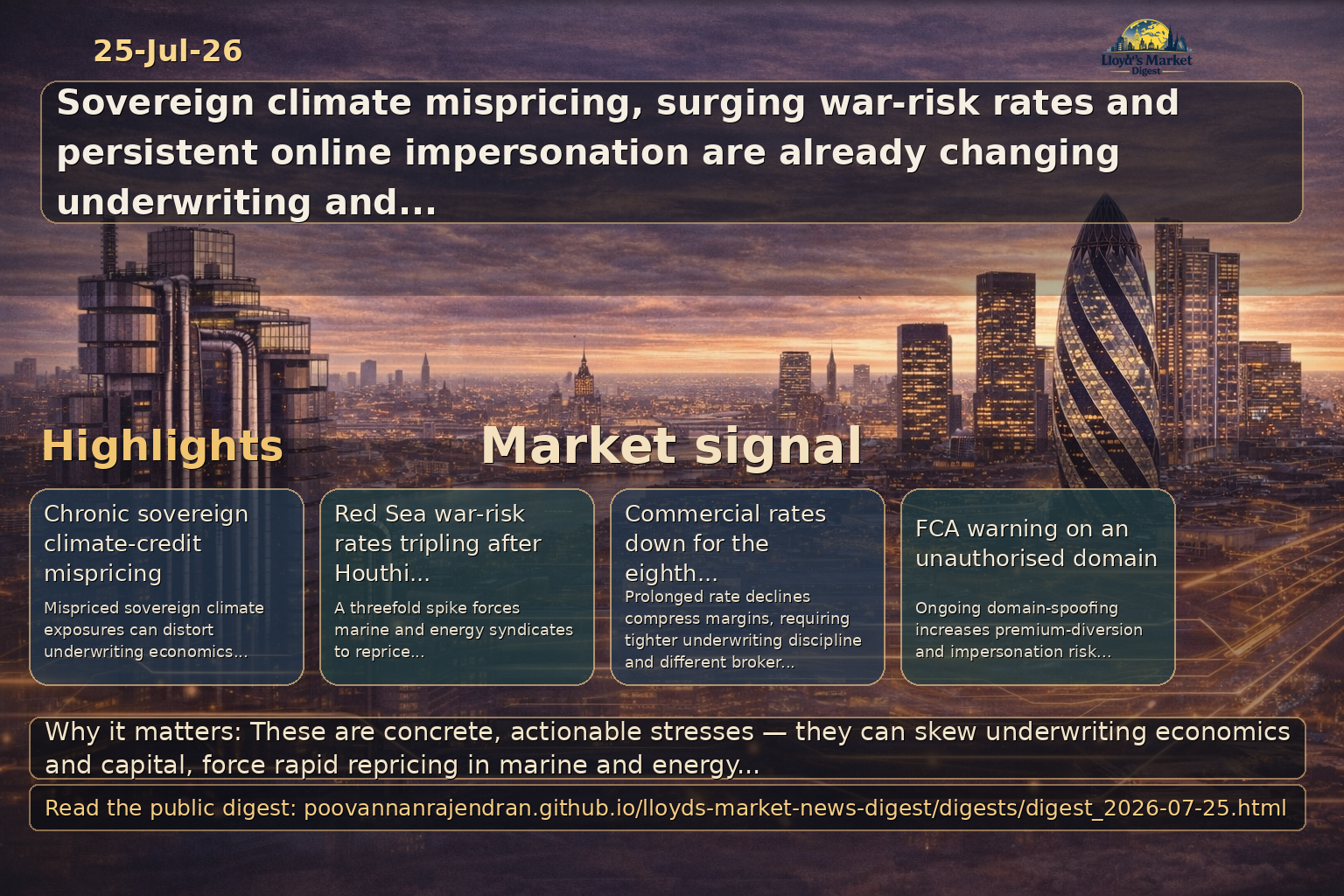
Why it matters: FCA warning about an unauthorised domain highlights persistent fraud vectors that can impersonate brokers or placement platforms and mislead cedants or insureds. This elevates placement and onboarding risk for Lloyd's participants working with new or offshore counterparties.
- Tighten onboarding: require regulator-verifiable credentials for any new broker/agent and enforce domain/brand verification in onboarding checklists.
- Platform monitoring: implement automated domain and brand-monitoring for spoof sites and trigger immediate takedown/notification protocols when detected.
- Client communication: update policyholder and distribution channel guidance on authorised channels and publish a shortlist of verified platforms and broker contacts to reduce diversion risk.
Source: fca.org.uk
Why it matters: Another FCA alert on an unauthorised website demonstrates recurring domain-spoofing tactics that can facilitate premium diversion, false counterparty representation and phishing against brokers and syndicates.
- Phishing resilience: mandate multi-factor authentication and out-of-band confirmation for premium payments and material placement instructions.
- Payment controls: require irrevocable payment routing rules (approved bank details lists/confirmation-of-payee) for all new relationships to reduce diversion risk.
- Information sharing: participate in market-wide blacklists and rapid alert systems so brokers and syndicates can block known fraudulent domains.
Source: fca.org.uk
Why it matters: Warning on an entity using an international-sounding domain underscores the risk of offshore entities posing as legitimate insurers or intermediaries, complicating due diligence and cross-border enforcement for Lloyd's market participants.
- Enhanced cross-border due diligence: expand checks to include international regulator registries, beneficial ownership and sanctions screening for offshore counterparties.
- Contractual safeguards: require choice-of-law, jurisdiction clauses and escrow arrangements where counterparties are outside primary regulator jurisdictions.
- Placement vetting: limit initial exposures with new offshore partners through phased placements and caps until due diligence and compliance checks are completed.
Source: fca.org.uk
Why it matters: The 'Unity Trust Offshore' alert highlights name similarity and brand spoofing risk that can confuse cedants and brokers, eroding trust in legitimate institutions and creating opportunities for fraud in specialty placements.
- Brand-monitoring and clearance: proactively monitor for name-similar registrations and coordinate with legal teams to protect critical market brand names and reduce impersonation risk.
- Counterparty confirmation: require corroboration of counterparties through multiple independent sources (regulatory registers, corporate filings, direct phone verification).
- Client money segregation: insist on use of regulated escrow or Lloyd's-approved trust arrangements when counterparties present ambiguous provenance or name-similarity concerns.
Source: fca.org.uk
Why it matters: The FCA notice for gfvestltd.com reinforces the scale of unauthorised online activity targeting consumers and commercial buyers; such activity can affect distribution channels relied upon by specialty brokers and syndicates.
- Market education: coordinate sector communications to brokers and coverholders about specific unauthorised domains and recommended countermeasures.
- Operational controls: require placement platforms to implement stricter onboarding thresholds and continuous monitoring for counterparties engaged in electronic distribution.
- Insurance product design: re-evaluate wording and fraud exclusions to address losses arising from deception by unauthorised intermediaries.
Source: insurancetimes.co.uk
Why it matters: Public criticism of regulatory complexity underscores ongoing friction between compliance burden and commercial agility for brokers and syndicates operating across multiple jurisdictions.
- Executives should balance compliance investment with process simplification and advocate for clearer guidance to reduce operational drag on placements.
- Brokers may consolidate technology and governance to manage regulatory cost while preserving advisory and placement capabilities.
- Syndicates and placement platforms should document proportionality of controls and engage regulators to align practical standards with business realities, protecting capacity and market competitiveness.
Source: businessinsurance.com
Why it matters: An Ohio Supreme Court decision siding with an insurer over an appraisal award is material for property underwriters and claims precision, influencing reserve practices across Lloyd's property exposures.
- Property syndicates should reassess appraisal clause triggers and dispute resolution language to protect loss adjustment outcomes.
- Brokers ought to advise clients on appraisal mechanics and ensure policy wordings include clear methodologies to avoid protracted litigation.
- Platforms should capture policy clause variants and past appraisal outcomes to inform underwriter decisioning and pricing.
Source: businessinsurance.com
Why it matters: Marsh reporting of an eighth consecutive quarter of commercial rate declines underscores pressure on primary and specialty pricing, affecting syndicate underwriting profitability and broker placement strategies.
- Syndicates should reassess portfolio mix and tighten underwriting discipline on underperforming commercial books to protect combined ratios.
- Brokers need to prioritise value-added advisory and alternative capacity solutions as margins compress and buyer price-sensitivity increases.
- Platforms must enable faster comparative quoting and risk segmentation tools to support differentiated placement and preserve broker commissions.
Source: businessinsurance.com
Why it matters: Tripling of Red Sea war risk rates after Houthi attacks highlights acute marine and energy exposure volatility, directly impacting Lloyd's marine syndicates and wholesale broker war-risk placement practices.
- Marine syndicates should reprice exposures, tighten NAV clauses and reassess accumulations for energy and shipping portfolios.
- Brokers must expedite client notification and re-route placement strategies, including leveraging specialist war-risk capacity and POA structures.
- Placement platforms should integrate dynamic war-risk pricing feeds and clause libraries to accelerate live adjustments in bound cover.
Source: businessinsurance.com
Why it matters: $1.1B cyclone damage revealing mandatory insurance gaps is relevant to Lloyd's and specialty insurers writing natural catastrophe and parametric solutions in exposed jurisdictions.
- Underwriters should reassess product design and consider parametric or blended solutions where mandatory schemes leave protection gaps.
- Brokers must map client exposures against local mandatory requirements and identify coverage shortfalls to structure tailored placements.
- Placement platforms can differentiate by offering catastrophe modelling outputs and pre-bind client questionnaires to speed underwriting decisions.
Source: insurancetimes.co.uk
Why it matters: Acquisition of a specialist liability loss-adjusting firm increases market capability that directly affects syndicate claims outcomes and broker routing decisions.
- Improves claims expertise available to brokers and syndicates for complex liability files, improving loss containment and underwriting defensibility.
- Brokers should reassess adjuster panels and preferred-provider arrangements to leverage enhanced expertise for specialty placements.
- Placement platforms and underwriters must plan for operational and data integration to preserve service levels and evidence trails for complex claims.
Source: insurancetimes.co.uk
Why it matters: Protests targeting an insurer over contractor relationships highlight reputational risk that can constrain market access and mobilise stakeholder scrutiny across Lloyd’s and global specialty placements.
- Underwriters and syndicates should review exposures to contentious sectors and prepare clear appetite statements to support brokers during placements.
- Brokers must bolster counterparty screening and client-acceptance policies to avoid placement disruption and reputational contagion.
- Placement platforms should surface ESG and third-party relationship data in submissions to enable rapid underwriter decisions and continuity planning.
Source: insurancetimes.co.uk
Why it matters: Expansion of a medical insurance trade body executive reflects intermediary-led evolution in health-related distribution and advisory, relevant to specialty health products and broker capabilities.
- Signals growing intermediary influence and niche specialism that syndicates underwriting health and wellbeing risks should engage with for product design and distribution.
- Brokers can leverage trade-body insight to accelerate specialist product uptake and enhance advisory credentials to clients.
- Placement platforms should incorporate product-specific fields and referral pathways for health PI to streamline specialist submissions and capacity matching.
Source: insurancetimes.co.uk
Why it matters: Concentrated senior appointments across insurers, intermediaries and regulators alters relationship dynamics, negotiation leverage and strategic priorities in broking and syndicate networks.
- New leadership changes can redirect underwriting strategies and distribution preferences — update stakeholder engagement and account plans accordingly.
- Brokers and syndicates should map new decision-makers and adapt governance and escalation routes to maintain market access.
- Placement platforms must be prepared for shifting demand profiles and potential integration or procurement initiatives led by incoming executives.
Source: reinsurancene.ws
Why it matters: Archive snapshot reinforces structural themes — catastrophe exposures, market discipline and historical loss cycles — that remain central to pricing and capital allocation decisions for reinsurers, syndicates and brokers.
- Contextual takeaway: historical nat-cat loss episodes inform current capital modelling and retrocession strategies for syndicates writing catastrophe-exposed portfolios.
- Risk management: brokers should leverage archive insights to counsel clients on long-term volatility and capacity structuring, including ILS placements.
- Operational use: syndicates should maintain documentation of past market cycles to support scenario testing and reserve planning amid evolving peril patterns.
Source: reinsurancene.ws
Why it matters: RenaissanceRe's caution that AI is not a 'silver bullet' is directly relevant to Lloyd's market participants deploying AI for underwriting and automation — it underscores the need for measured, value-driven implementation.
- Governance imperative: deploy AI with clear KPIs, human-in-loop controls and validation to avoid degraded decision quality in automated underwriting or claims triage.
- Capital consequence: syndicates should factor AI deployment risk into capital models and consider staging investments to validate ROI before broad roll-out.
- Broker guidance: advise clients on realistic capabilities and limitations of AI-enabled solutions to set appropriate expectations during placement.
Source: reinsurancene.ws
Why it matters: CyberCube's warning on agentic autonomous AI attacks highlights a rising systemic cyber threat vector that specialty underwriters and cyber capacity providers within Lloyd's must incorporate into modelling and policy terms.
- Underwriting impact: update cyber wordings and exclusions to address autonomous exploit-chaining and emergent attack modalities.
- Modelling priority: enhance scenario analysis for agentic threats and consider re-pricing or capacity limits for clients with high automation risk profiles.
- Placement strategy: brokers should seek enhanced cyber controls and attestations from clients and explore layered structures to protect core balance sheets.
Source: reinsurancene.ws
Why it matters: Goosehead's revenue growth reflects distribution momentum in personal lines agency models — a signal for brokers and syndicates about distribution channel strength and franchise-based expansion opportunities.
- Distribution insight: growth underscores value of scalable agent/franchise models for expanding retail placement of specialty products.
- Broker response: evaluate partnerships or feeder arrangements with high-retention platforms to expand reach into profitable personal lines segments.
- Capital consideration: syndicates should monitor distribution inflows as a source of premium stability when assessing appetite for retail-oriented specialty strips.
Source: reinsurancene.ws
Why it matters: LexisNexis' US Home Trends Report documenting rising claim severity and shifting loss patterns is material for Lloyd's and global specialty players writing US property risks and for pricing decisions across placement platforms.
- Underwriting action: reassess state-by-state rates and exposure concentrations in light of sustained claims-severity inflation.
- Portfolio management: syndicates and reinsurers should stress-test portfolios against higher loss-cost scenarios and adjust reinsurance purchasing accordingly.
- Broker engagement: use granular claims analytics to negotiate rate adequacy and coverage terms with carriers and clients during renewals.
Source: newsnow.co.uk
Why it matters: Domestic political developments in India can rapidly alter regulatory regimes, stimulus and nationalisation rhetoric, affecting political risk, credit and trade credit exposures as well as demand for D&O, PI and contingent BI products across Lloyd's and global specialty carriers.
- Review political‑risk appetite for India-exposed syndicates; consider short‑term limits and pricing adjustments for new/renewal business in high‑volatility sectors.
- Engage major brokers to stress test supply‑chain and BI extensions tied to protest, detention or regulatory clampdowns affecting multinational clients.
- Ensure placement platforms and delegated authority workflows flag India jurisdictional triggers for enhanced due diligence and escalation to underwriting committees.
Source: newsnow.co.uk
Why it matters: The H‑1B search returned no matching content, signalling either limited media focus or a gap in monitoring. Immigration and specialist talent mobility remain material to claims handling, cross‑border placements and international broker staffing models.
- Audit intelligence feeds and platform search functions to close blind spots on migration and labour policy that affect expatriate cover and local claims servicing.
- For brokers and syndicates, map critical skills (underwriting, forensic, catastrophe response) tied to H‑1B and equivalent visa pools; build contingency pipelines and localised vendor rosters.
- Assess product exposure where workforce mobility restrictions could trigger increased claims frequency (e.g., project delay, construction all risks, professional indemnity).
Source: newsnow.co.uk
Why it matters: The River Thames search likewise produced no matches, but riverine and urban flooding remain core property and casualty drivers in the UK — a principal Lloyd's market exposure and distribution focus for climate‑adjusted underwriting.
- Mandate modelling refresh for UK riverine flood scenarios across syndicates; incorporate updated hydrology and inflation in reconstruction costs to protect capacity adequacy.
- Prioritise broker engagement to refine sub‑limit and aggregate structures for river/urban flood, and promote parametric products for rapid pay‑outs.
- Enhance placement platforms with geospatial flood overlays and automated flood-zone flags during quoting/placement to reduce submission friction and mispricing.
Source: newsnow.co.uk
Why it matters: Far‑right extremism coverage is a direct indicator of heightened political violence and terrorism exposures that impact specialty lines (terrorism, kidnap & ransom, political violence, D&O) and pose reputational risk to brokers and syndicates involved with contentious clients.
- Reassess aggregation modelling for political violence and extremism scenarios; check reinsurance treaties and facultative capacity for correlated event risk.
- Update client onboarding and AUM/KYC filters on placement platforms to detect associations that could create reputational or sanctions risks.
- Advise brokers to insert clearer exclusions, war/terror endorsements and rapid response protocols in wordings where extremism exposure is rising.
Source: newsnow.co.uk
Why it matters: Agriculture sector coverage is material for global specialty capacity — crop, livestock, commodity trade credit and supply‑chain products — and is increasingly influenced by climate, policy and trade shifts relevant to Lloyd's syndicates and broker placement strategies.
- Accelerate development of parametric and index‑based agricultural products to address basis risk and speed claims in volatile weather years.
- Coordinate with brokers to map counterparty concentration in agro‑commodities and ensure reinsurance structures reflect seasonality and tail correlations.
- Invest in agri‑data partnerships (satellite, IoT) and integrate outputs into placement platforms to improve pricing granularity and reduce moral hazard.
Source: risk.net
Why it matters: The article identifies a market blind spot — sovereign-level physical climate risk is not consistently priced into sovereign spreads — that has direct implications for Lloyd's syndicates, global specialty insurers and brokers. Mispricing drives poor fixed-income investment decisions, undermines collateralised reinsurance and political-risk products, and creates basis and model risk across placements and platforms. Addressing this is essential to preserve capacity, meet regulatory expectations on climate risk, and advise clients with credible, forward-looking risk-adjusted pricing.
- Balance-sheet and counterparty impact: Mispriced sovereign climate risk can impair investment portfolios and affect the value of sovereign-linked collateral used in reinsurance, ILS and retro arrangements; syndicates must stress-test sovereign holdings and treaty counterparties under climate scenarios.
- Underwriting and capacity consequences: Specialty lines exposed to political, trade credit and infrastructure risks may be under- or over-priced if sovereign climate vulnerability is ignored; underwriters should recalibrate appetite, rates and aggregation limits using climate-adjusted sovereign spreads.
- Placement and broking actions: Brokers and placement platforms must integrate standardized, auditable climate metrics and scenario outputs into RFPs, placement analytics and due diligence workflows to reduce basis risk, meet client/regulatory expectations, and enable consistent pricing across markets.