Source: insurancetimes.co.uk
Why it matters: Senior actuarial talent moving from Lloyd's into a major personal lines CUO role illustrates cross‑market skill migration, with implications for pricing sophistication, reserving practices and competitive dynamics between syndicates and composite insurers.
- Elevates personal lines pricing and reserving capability at a major insurer, increasing head‑to‑head competition for capacity and talent with Lloyd's syndicates and MGAs.
- Signals retention and succession risk for Lloyd's actuarial and technical functions; syndicates should accelerate internal development and external recruitment strategies.
- May prompt re‑examination of reinsurance buying and capital models as transferred expertise influences loss modelling and appetite on the insurer side.
Source: insurancetimes.co.uk
Why it matters: A Lloyd's syndicate entering run‑off with an MGA acquiring exclusive renewal rights is a direct example of portfolio lifecycle management shifting distribution control to MGAs, affecting broker continuity and placement relationships.
- Provides brokers with continuity but moves underwriting and renewal economics from the syndicate balance sheet to MGA platform controls, changing broker negotiation dynamics.
- Shifts claims and reserving exposure off the syndicate, with potential implications for market solvency metrics and run‑off reserves disclosure.
- Reinforces the role of MGAs as stewardship vehicles for specialist portfolios; capacity providers must reassess alignment, governance and information flows at renewal.
Source: fca.org.uk
Why it matters: FCA warning on an unauthorised crypto/financial promoter underscores elevated fraud and unauthorised activity risk that can contaminate distribution chains and platform flows.
- Immediate enhancement of counterparty screening: integrate FCA warning lists into broker and platform onboarding and real‑time screening workflows.
- Protect placement and execution: block or quarantine introductions from unauthorised entities and require confirmed authorisation status before accepting placements.
- Reputational and operational controls: update contractual warranties, require indemnities from introducers and maintain incident playbooks for suspected fraud exposures.
Source: fca.org.uk
Why it matters: Similar FCA alert on an unauthorised firm focused on faith‑based branding highlights targeted marketing approaches that can evade standard checks and attract vulnerable client segments relevant to retail distribution and affinity schemes.
- Strengthen thematic screening: add brand‑specific, language and affinity indicators to automated KYC/AML screening used by brokers and platforms.
- Review distribution channels for affinity products: require enhanced due diligence and documented proof of authorisation for partners marketing into niche communities.
- Customer protection and remediation planning: ensure governance includes review of potential client losses arising from frauds and a communications protocol for affected distribution channels.
Source: fca.org.uk
Why it matters: FCA warning on a purported market analysis firm indicates persistence of misleading firms offering investment/market services without authorisation — a contagion risk to intermediated placement and advisory models.
- Tighten adviser and introducer verification: require documentary proof of FCA authorisation/registration before accepting market intelligence or placements from third parties.
- Maintain forensic trail: record sourcing and approval of market analysis used in pricing or client advice to defend against later enforcement claims.
- Operational monitoring: deploy continuous monitoring of providers and automated alerts for FCA list changes to remove risky counterparties promptly.
Source: fca.org.uk
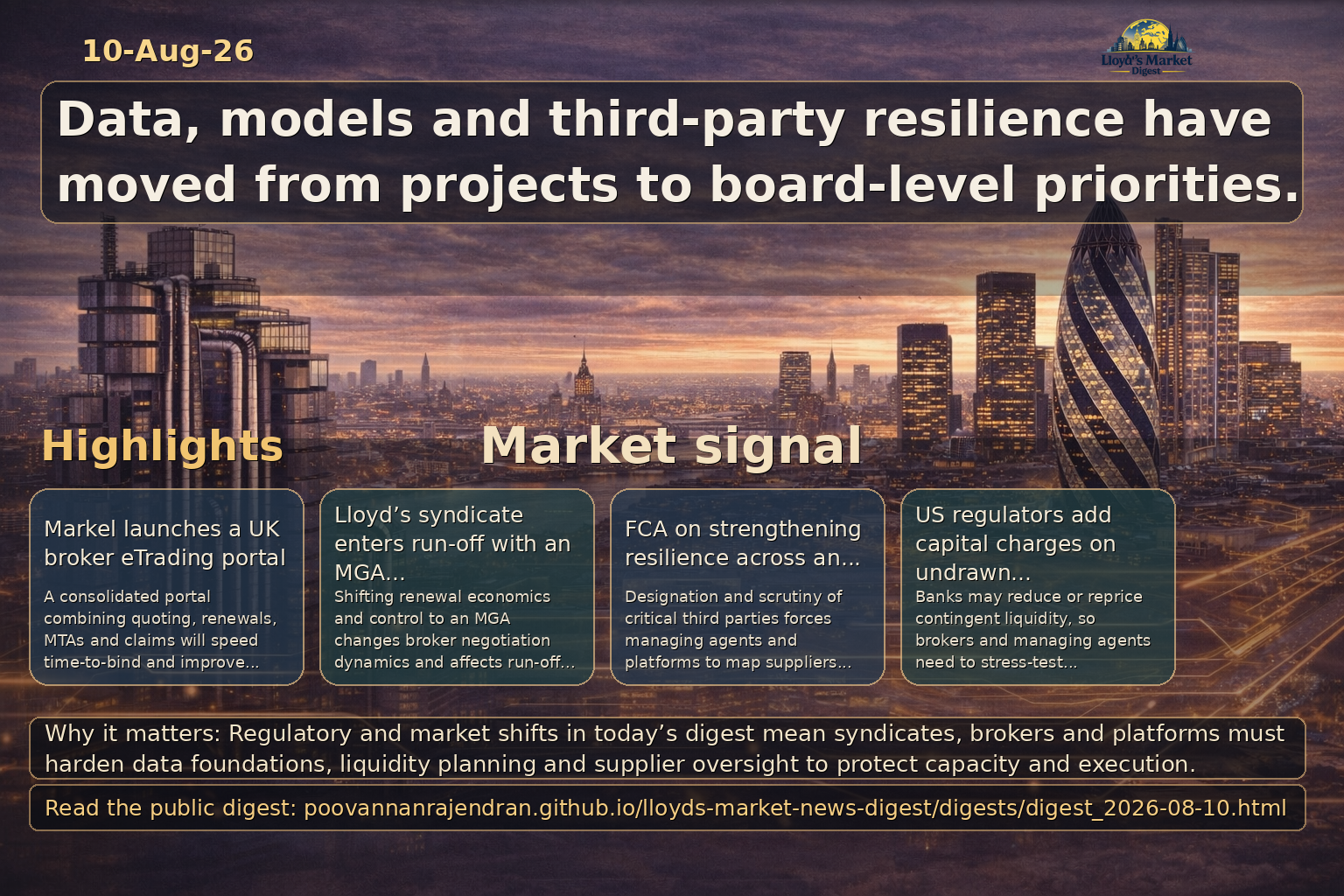
Why it matters: FCA emphasis on resilience and designation of critical third parties (CTPs) signals direct supervisory exposure for tech, data and operations providers used by insurers, brokers and placement platforms.
- Map and prioritise CTPs: perform an enterprise‑level criticality assessment of third parties (platforms, data vendors, cloud providers) and identify single points of failure across syndicates and MGAs.
- Strengthen contractual and testing regimes: negotiate enhanced SLAs, access to continuity evidence and participate in supplier resilience testing and escalation exercises.
- Elevate governance and response capability: establish board‑level reporting, crisis response playbooks, and targeted investment in redundancy, cyber and incident management.
Source: fca.org.uk
Why it matters: Censure for misleading financial promotions and undisclosed commissions demonstrates enforcement focus on disclosure failures in distribution chains — directly relevant to brokers, MGA relationships and commission structures in specialty lines.
- Immediate distribution audit: review commission, fee disclosures and appointed representative arrangements to ensure transparency to clients and clear allocation of responsibilities.
- Tighten approval workflows: implement mandatory compliance sign‑off and audit trails for all financial promotions and marketing material used in syndicate/broker channels.
- Reassess remuneration models: ensure compensation structures do not incentivise inappropriate sales and that all fees are accurately disclosed to end clients.
Source: risk.net
Why it matters: Scalable, cloud-based capital calculation engines designed for complex regulatory regimes address the same challenges insurers face with granular capital modelling, scenario testing and regulatory submissions.
- Reduce manual aggregation and model risk in syndicate capital calculations, accelerating board-level capital adequacy insights
- Support more frequent stress-testing and sensitivity analysis relevant to Solvency II, UK regimes and third-country equivalence assessments
- Facilitate integration with placement data to give brokers and managing agents near-real-time views of capacity and capital utilisation
Source: risk.net
Why it matters: New capital charges on undrawn committed facilities in the US could reduce banks' willingness to provide contingent liquidity, affecting multinational brokers, managing agents and placement platforms.
- Stress-test scenarios where bank credit lines are reduced or repriced, and identify alternative liquidity sources for claims and settlement cycles
- Renegotiate facility terms and collateral arrangements proactively with banking partners to protect capacity during regulatory transitions
- Design contingency funding playbooks and central treasury strategies at the managing-agent level to mitigate sudden liquidity impairment
Source: businessinsurance.com
Why it matters: Commentary on compliance culture; indirectly relevant as operational and conduct risk affects brokers, platform providers and syndicates.
- Implication: Weak compliance culture increases operational and regulatory risk for placement platforms and broker networks transacting with Lloyd’s.
- Action: Elevate compliance and conduct reviews during counterparty diligence and tighten platform onboarding standards.
- Watch: Regulatory guidance or enforcement actions that could compel changes to distribution agreements or platform controls.
Source: businessinsurance.com
Why it matters: Zurich's robust first-half profit signals continued primary market strength and available capacity for specialty placements, influencing pricing and negotiating leverage for brokers and syndicates.
- Reinforces capital availability for capacity-hungry specialty classes at Lloyd's and global markets, reducing near-term capital pressure.
- Gives brokers leverage when negotiating terms and can slow rate hardening in select product lines.
- May prompt syndicates to reassess capital deployment, expanding appetite for profitable specialty segments or increasing pro rata capacity on placement platforms.
Source: businessinsurance.com
Why it matters: Industry backlash to a proposed Hormuz toll elevates marine and political risk exposures, with direct consequences for war, hull and cargo underwriting and brokered placement strategies.
- Anticipate upward pressure on war and contingent marine premiums as underwriters reprice transits through strategic chokepoints.
- Brokers will need to design bespoke routing and cover packages, including enhanced political violence and kidnapping/extortion wording where applicable.
- Placement platforms must support rapid repricing and alternative risk sourcing, enabling syndicates to respond to concentrated exposure scenarios.
Source: businessinsurance.com
Why it matters: Swiss Re's profit growth indicates reinsurance market resilience, affecting retrocession pricing, capacity allocations to Lloyd's syndicates and the economics of large specialty programs.
- Positive reinsurer results can relieve retrocession scarcity, facilitating larger limits for complex specialty placements.
- Syndicates may secure more favorable reinsurance terms, improving capacity for underwriting multi-year and catastrophe-exposed business.
- Brokers should reassess program structures to capture improved terms while monitoring reinsurer appetite for emerging risks.
Source: businessinsurance.com
Why it matters: Everest's sale of its Mexican unit to Fairfax reflects targeted portfolio rationalisation and highlights opportunities and risks in regional market consolidation relevant to global specialty distribution.
- Signals continued strategic exits/entries in regional markets; syndicates and brokers should evaluate gaps and growth opportunities in Latin America.
- Creates transition risks for existing programs and demands careful stewardship of client relationships during transfer of service and terms.
- Placement platforms and brokers must ensure data, claims continuity and policy documentation integrity to preserve client experience post-transaction.
Source: insurancetimes.co.uk
Why it matters: Markel describing eTrading as a future core distribution channel highlights the acceleration of electronic placement as a volume and efficiency lever in specialty lines and for syndicates seeking scale.
- ETrading adoption will drive volume growth and lower acquisition cost per risk for specialist insurers, reshaping broker workflows and commission structures.
- Investment in AI, talent and product breadth positions the insurer to capture algorithmically priced, high‑throughput business — a model syndicates must match or risk distribution displacement.
- Broader eTrading penetration increases the importance of platform interoperability and data standards between brokers, MGAs and Lloyd's placement systems.
Source: insurancetimes.co.uk
Why it matters: The launch of a consolidated broker portal that combines quoting, renewals, MTAs and claims exemplifies the market shift toward single‑login placement and servicing platforms that reduce friction and improve data capture for specialty lines.
- Streamlined broker experience reduces manual handoffs and accelerates placement cycles, benefitting capacity deployment and time‑to‑bind for syndicates and carriers.
- Centralised data capture supports richer underwriting analytics and post‑bind performance monitoring, improving loss ratio management over time.
- Sets a competitive benchmark for other specialty insurers and syndicates to invest in broker‑centric portals or risk losing share on digitally enabled lines.
Source: insurancetimes.co.uk
Why it matters: Recent M&A activity across MGAs, brokers and specialist underwriters — including private equity investment into MGAs — is reshaping distribution, capacity aggregation and platform concentration in global specialty markets.
- Private capital flows into MGAs accelerate scale, product breadth and international expansion, increasing competition for legacy syndicates and carriers.
- Broker consolidations create regional hubs and concentrated distribution partners; syndicates and platforms must re‑evaluate counterparty exposure and distribution agreements.
- Consolidation raises counterparty concentration risk for reinsurers and placement platforms, necessitating strengthened due diligence and continuity planning.
Source: risk.net
Why it matters: Operationalising AI within capital and risk infrastructures highlights the need for mature model risk management, data governance and explainability in insurance capital workflows.
- Establish robust MRM frameworks for AI used in pricing, reserving and capital calculations to meet regulator scrutiny
- Address data latency and integration gaps between underwriting systems, placement platforms and risk aggregation engines
- Move from batch to more frequent risk aggregation where commercially and technically feasible to improve intra-period capital awareness
Source: risk.net
Why it matters: The growth of structured ETF and autocall products changes portfolio tail exposures and can affect valuation and capital requirements for insurers that hold these instruments.
- Reassess stress scenarios and concentration limits where structured products are present in investment portfolios backing syndicate liabilities
- Evaluate counterparty, liquidity and model-risk implications when using structured instruments for hedging or yield enhancement
- Require clearer disclosure and governance around structured product holdings for board oversight and regulatory reporting
Source: insurtechnews.com
Why it matters: The AJAX calendar endpoint signals concentrated industry events in September 2026 that matter for Lloyd's syndicates, global specialty brokers and placement platforms as opportunities for distribution, client engagement and syndicate visibility; however the returned HTML is malformed, indicating a risk for automated ingestion and missed commercial opportunities unless corrected.
- Treat the calendar as a prioritized planning input: coordinate syndicate underwriting schedules, broker roadshows and placement-platform demos for September 2026 to maximize limited in-person engagement windows.
- Validate and remediate the feed before automated ingestion: implement schema checks, HTML sanitisation and alerts so CRMs, placement platforms and marketing teams do not ingest broken data.
- Convert events into measurable actions: allocate sponsorship budgets, assign senior underwriting and distribution attendees, and create lead-capture workflows between brokers, syndicates and platform partners.
Source: risk.net
Why it matters: Cloud-native prudential reporting platforms signal a shift to unified data foundations that can materially improve regulatory transparency, capital planning and portfolio-level risk analysis for Lloyd's managing agents and syndicates.
- Enable a single source of truth across underwriting, finance and risk to speed regulatory returns and ORSA submissions for syndicates
- Improve data lineage and auditability to meet PRA/FCA expectations and support cross-border regulatory reconciliation for global placements
- Create interoperable data feeds into placement platforms and broker systems to shorten reporting cycles and support forward-looking capital decisions