Source: fca.org.uk
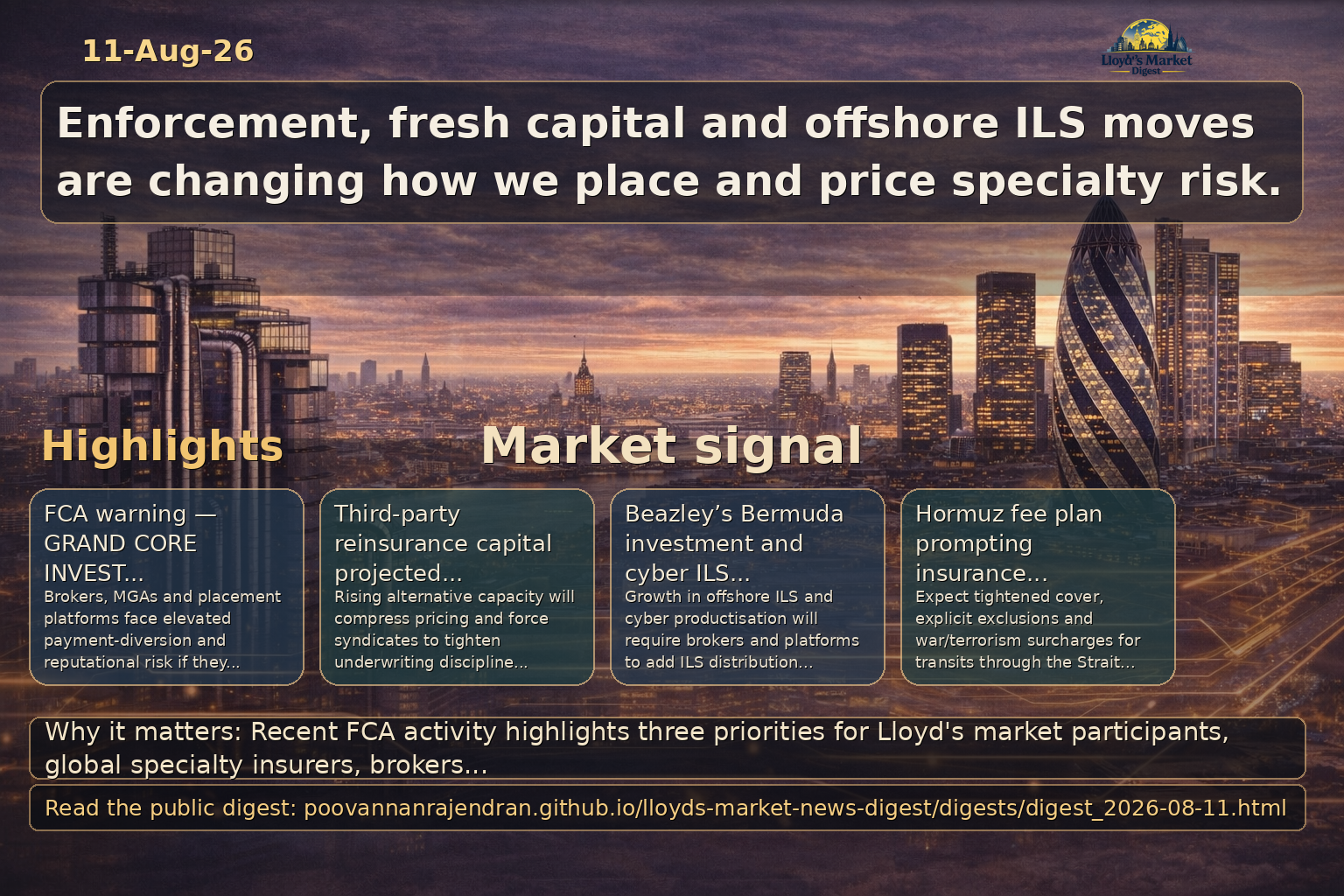
Why it matters: FCA warning on an unauthorised firm underscores direct exposure to fraud and payment diversion risks for brokers, MGAs and placement platforms that on‑board clients or counterparties without robust verification.
- Review and harden client/counterparty onboarding checks — require FCA reference checks, corporate registry validation and proof of regulated status before binding or placing business.
- Update placement-platform blocklists and alert feeds to capture emerging unauthorised actors and propagate alerts to brokers and underwriters in real time.
- Communicate to brokers and coverholders the consumer protection consequences (no FOS/FSCS) and require written confirmation of client awareness where onboarding risk is elevated.
Source: fca.org.uk
Why it matters: Clone‑firm scam alert highlights increasing sophistication of fraudsters impersonating regulated firms — a specific threat to broker relationship networks, placement workflows and client trust.
- Mandate independent verification of counterparties’ FCA Firm Reference Numbers (FRNs) and cross‑check firm contact details against official registers prior to sharing market documents or premium payments.
- Educate brokers and clients on identifying cloned communications (lookalike domains, spoofed emails) and require use of secure payment channels (escrow or verified bank details).
- Integrate monitoring of domain registrations and look‑alike websites into vendor risk or cyber threat intelligence programmes used by syndicates and platforms.
Source: fca.org.uk
Why it matters: Another clone‑firm notice reinforcing pattern — risk to distribution intermediaries and placement platforms that depend on digital onboarding and remote attestations from network partners.
- Require enhanced due diligence for new introducers and appointed representatives, including site visits for high value or speciality lines.
- Implement contractual indemnities and termination rights for breaches by intermediaries who rely on unauthorised third parties or false credentials.
- Increase frequency of periodic re‑checks for active counterparties and include clone‑firm indicators in compliance dashboards used by underwriters and compliance teams.
Source: fca.org.uk
Why it matters: FCA Scale‑up Unit support for high‑growth fintech/insurtech firms signals regulatory encouragement for innovation — relevant to placement platforms, digital brokers and syndicates seeking vendor partnerships or strategic investment.
- Assess strategic engagement with insurtechs in light of FCA support — consider pilot partnerships with Scale‑up Unit participants for distribution efficiency or data enrichment.
- Ensure any accelerator or investment activity includes rigorous regulatory‑readiness assessments (governance, AML, consumer‑outcomes testing) before integration with placement platforms.
- Leverage FCA guidance to inform internal product governance for digital offerings, ensuring scalable controls are in place as firms and platform volumes grow.
Source: fca.org.uk
Why it matters: Warning on crypto‑related unauthorised firm increases risk of illicit fund flows and reputational contagion for brokers and syndicates dealing with fintech or digital asset clients.
- Treat enquiries from crypto‑facing counterparties as higher risk — apply enhanced KYC, source‑of‑fund checks and AML transaction monitoring for payments tied to digital asset businesses.
- Confirm payment routing policies on placement platforms explicitly prohibit transfers to unverified crypto wallets and require bank account verification for premium flows.
- Coordinate with legal and compliance to update sanctions/AML screening rules and provide targeted training for underwriters and brokers handling crypto‑adjacent risks.
Source: artemis.bm
Why it matters: Projected 6% growth to ~$130bn of third‑party reinsurance capital materially raises the supply of alternative capacity, impacting pricing, contract terms and the strategic positioning of Lloyd’s syndicates, global specialty carriers and broker capital‑markets practices.
- Increased capital compresses pricing and softens negotiated terms: syndicates must sharpen underwriting discipline, refine risk selection and demonstrate differentiated data and models to defend margins.
- ILS and manager growth requires governance and distribution scale: underwriters and brokers should evaluate partnerships with established ILS managers and invest in product structuring to access scalable third‑party capital.
- Platform and placement differentiation: electronic and hybrid placement platforms that can handle structured ILS issuance, collateral management and investor reporting will be decisive competitive advantages for brokers and syndicates alike.
Source: businessinsurance.com
Why it matters: A decline in quarterly profit at a market participant signals underwriting margin pressure and cost headwinds that can be symptomatic across specialty brokers, MGAs and syndicate-facing distribution channels.
- Indicative of margin compression—may precede tighter terms and reduced appetite on specialty lines
- Potential push for operational cost controls and adjusted commission/fee arrangements with carriers
- Brokers should review portfolio profitability and refine placement strategy to protect margins
Source: businessinsurance.com
Why it matters: Swiss Re’s decision to underwrite multinationals in India and Mexico expands reinsurance and global specialty capacity in emerging markets, affecting cross-border programme design and broker placement options.
- Increases capacity for multinational programmes—could lower premiums for complex cross-border cover
- Heightens competitive pressure among reinsurers, potentially shifting terms for syndicates and carriers
- Brokers should engage Swiss Re capacity in negotiations for large MNC placements and reassess placement platforms for cross-border efficiency
Source: businessinsurance.com
Why it matters: Allianz posting a 15% net income rise signals robust capital and profit generation among large commercial carriers, with implications for available capacity and pricing dynamics in specialty classes.
- Stronger capital position can translate into increased line sizes and competitive quoting for syndicates and placement platforms
- May exert downward pressure on rates in non-disrupted classes as carriers seek growth
- Syndicates and brokers should monitor Allianz’s appetite shifts and line limits when allocating risk
Source: businessinsurance.com
Why it matters: Policy and market reactions to proposed Hormuz fees are creating insurance restrictions and underwriting uncertainty—directly relevant to marine, cargo, energy and war-risk classes central to Lloyd’s and specialty markets.
- Anticipate tightened cover, explicit exclusions and war/terrorism surcharges for transits through the Strait of Hormuz
- Brokers must proactively review voyage clauses, notify carriers and consider alternative routings or contingency cover
- Placement platforms and syndicates should update underwriting questions and stress-test portfolios for related exposures
Source: businessinsurance.com
Why it matters: Leadership change at a major broker (Brown & Brown executive resignation) can influence distribution strategy, client retention and carrier relationships—key drivers for syndicate access and platform partnerships.
- Potential strategic or cultural shifts that could affect product prioritization and client servicing models
- Short-term relationship risk with carriers and syndicates; monitor continuity plans for key accounts
- Syndicates and placement platforms should engage remaining leadership to reaffirm bilateral underwriting/distribution arrangements
Source: globalreinsurance.com
Why it matters: Catastrophe model selection must be governed as a technical, decision-focused process to support underwriting, portfolio aggregation and capital allocation across specialty lines.
- Adopt model selection criteria that emphasise decision relevance (pricing, accumulation, capital) rather than operational fit alone
- Ensure multi-model ensembles and expert judgement are integrated into syndicate-level aggregation and Lloyd’s reporting
- Strengthen model governance for placement platforms and broking advice to reduce model-driven mispricing and accumulation surprises
Source: globalreinsurance.com
Why it matters: Recent events in the Middle East exposed protection gaps and underline the need for pre-event resilience, specialised capital and closer industry-government coordination.
- Prioritise pre-event resilience investments and underwriting terms for regional exposures to limit post-event protection gaps
- Broking platforms should develop specialist capital solutions (treaty, facultative, ILWs) aligned to geopolitical tail risks
- Lloyd’s syndicates and reinsurers must engage in structured public-private dialogue to develop scalable backstops and bespoke capacity
Source: globalreinsurance.com
Why it matters: AM Best’s stable outlook for the GCC reflects healthy capitalisation but highlights vulnerability to prolonged conflict, inflation and shifting reinsurance conditions that matter to specialty underwriters and brokers.
- Monitor reinsurance pricing and capacity tightening as secondary conflict effects (inflation, energy volatility) can compress syndicate margins
- Leverage healthy regional balance sheets to expand specialty placements where reinsurance conditions remain constructive
- Position placement platforms to manage volatility through multi-year programs and alternative capital solutions
Source: globalreinsurance.com
Why it matters: LSM’s hires in London and Dubai strengthen technical risk engineering capability for energy, power and construction portfolios—an operational differentiator for syndicates and brokers.
- Embed on-the-ground risk engineering into underwriting to support tighter terms and accurate pricing for complex energy and construction risks
- Use regional risk engineers to support MENA placements and to evidence risk mitigation for Lloyd’s and panel reinsurers
- Elevate technical talent in broking propositions to secure larger facultative and treaty placements
Source: globalreinsurance.com
Why it matters: Verisk’s insured loss estimate for the Kumamoto quake underscores the importance of calibrated industry loss estimates for syndicate accumulation, ILW triggers and semiconductor BI exposure management.
- Reassess portfolio exposure to supply-chain concentrations (semiconductors) and incorporate BI restart scenarios into facultative and treaty buying
- Use independent industry loss indices to design transparent ILW and parametric triggers for capital providers
- Adjust syndicate accumulation limits and aggregation models in light of updated seismic loss footprints
Source: insurancejournal.com
Why it matters: State-level authority to overturn personal-lines rate filings raises precedent for broader regulatory oversight that can affect risk appetite, pricing strategies and distribution approaches for carriers and brokers operating in or placing U.S. business.
- Reassess U.S. placement strategies: brokers and syndicates should model potential product withdrawal or repricing in regulated jurisdictions and identify alternative distribution channels or product structures.
- Compliance and actuarial readiness: placement platforms and underwriting teams must enhance filing governance and actuarial substantiation to reduce successful objections and speed approval cycles.
- Client advisory and retention: brokers should prepare scenario-based communications for retail clients and wholesale partners explaining impacts on coverage availability and cost, and identify mitigants (e.g., underwriting changes, product design).
Source: insurancejournal.com
Why it matters: Judicial clarification on insurers’ duty to defend municipal entities highlights litigation risk and uncertainty over coverage obligations for public entity portfolios — an exposure relevant to syndicates and reinsurers writing municipal and casualty lines.
- Cover trigger and defence-cost exposure analysis: underwriters and reinsurers should re-evaluate policy wordings and reserves for municipal casualty programmes to reflect potential declaratory judgment outcomes.
- Claims-handling and litigation strategy: insurers and delegated platforms must coordinate legal strategies and allocation protocols with brokers to limit unexpected defence spend and preserve reinsurance recovery positions.
- Broker advisory on contractual risk transfer: brokers should counsel public-sector clients on risk mitigation (maintenance, service contracts) and structure placements that clarify defence obligations and indemnity limits.
Source: insurancejournal.com
Why it matters: AIG’s CEO framing of a selective market transition underscores the line-by-line nature of current pricing and the competitive impact of capacity from E&S and delegated authority — directly relevant to Lloyd’s syndicates, MGAs and brokers shaping placement and capital strategies.
- Line-level profitability focus: C-suite and syndicate leads must prioritize granular P&L discipline, reallocating capital away from structurally loss-making lines toward specialties with defensible pricing.
- Strategic use of delegated authority: evaluate partnerships with MGAs/DUAs to access specialized niches while tightening governance over algorithmic underwriting and exposure aggregation.
- Distribution and client segmentation: brokers should align placement recommendations with carriers demonstrating sustainable underwriting, leveraging data to negotiate improved terms where capacity is abundant.
Source: insurancejournal.com
Why it matters: Severe European heatwaves and attendant economic impacts increase natural peril losses and secondary business interruption exposures, elevating accumulation risk for property and specialty portfolios placed through Lloyd’s and global brokers.
- Aggregation and accumulation management: syndicates and brokers must update heat- and drought-driven accumulation models (power, transport, supply chains) and stress-test reinsurance programmes against higher-frequency events.
- Product redesign for systemic exposures: consider refined BI clauses, parametric offerings and explicit contingent business interruption limits to address insureds’ new loss patterns.
- Renewal discipline and client engagement: communicate likely premium adjustments and underwriting conditions to large corporate clients and coordinate resilience advice (hardening/contingency planning).
Source: insurancejournal.com
Why it matters: Low Rhine water levels threaten inland shipping and supply chains, exposing cargo, marine liability and contingent business interruption risks that could cascade through global trade exposures supported by specialty markets and placement platforms.
- Supply-chain mapping and exposure concentration: brokers and underwriters should identify accounts with Rhine-dependent logistics and quantify contingent BI exposure for accumulation control.
- Short-tail vs long-tail product adjustments: cargo and transit underwriters may need to revise voyage clauses, adjust deductibles and re-evaluate war/POA exposures for logistical disruption scenarios.
- Client continuity solutions: develop tailored products (parametric water-level triggers, alternative logistics coverage) and proactive placement strategies for affected sectors (chemicals, agriculture, manufacturing).
Source: reinsurancene.ws
Why it matters: AXA XL Re's London hires strengthen technical capability in Marine & Energy at a time when Lloyd's and global specialty players are competing for differentiated expertise. This move affects syndicate competition, broker access to capacity and placement strategies for complex war and piracy exposures.
- Expect increased appetite and more granular capacity for complex marine war, cargo war and marine piracy covers; brokers should proactively test AXA XL Re's terms and appetite on key renewals.
- Senior underwriters with Lloyd's experience improve negotiation leverage with London brokers and syndicates, accelerating decisions on lead placements and follow capacity across proportional and non-proportional treaties.
- Managing agents and syndicate leaders should monitor competitive product moves and consider retention, clause and pricing discipline to avoid erosion of margins as top reinsurers expand capabilities.
Source: reinsurancene.ws
Why it matters: AM Best's assessment that global reinsurance sits at a critical inflection point highlights elevated capital levels and the attendant risk of weakening discipline. For Lloyd's, syndicates and brokers this elevates the priority of underwriting governance, pricing integrity and platform-enabled transparency during placement.
- Record capital and intensifying competition increase downside risk to pricing and terms in property and specialty lines; brokers must be prepared to justify rate adequacy and advocate structured risk transfers that protect clients and spread volatility.
- Syndicate executives should reinforce underwriting controls, stress testing and risk appetite articulation to prevent margin erosion and limit exposure to a potential soft market cycle.
- Placement platforms and broking analytics will become decisive in capacity allocation and price discovery; invest in data and workflow enhancements to demonstrate risk differentiation and secure lead underwriter commitments.
Source: artemis.bm
Why it matters: Beazley’s Bermuda investment and active cyber ILS JV materially signal a strategic pivot to offshore capacity and investor capital mobilisation for cyber risk — a model other global specialty underwriters and syndicates may emulate. This affects placement strategy, Lloyd’s competitiveness, and broker capital‑markets advisory services.
- Reallocation of underwriting footprints: expect reinsurers and some Lloyd’s syndicates to reassess domicile mix to access streamlined ILS issuance and investor pools in Bermuda.
- Cyber ILS productisation: accelerated development of cyber-linked structures will require rapid enhancement of modelling, exposure aggregation controls and disclosable triggers to attract institutional ILS investors.
- Placement and platform implications: brokers and electronic placement platforms must integrate ILS distribution workflows, standardised documentation and cross‑jurisdictional compliance to support joint‑venture transactions and Bermuda‑domiciled capacity.
Source: artemis.bm
Why it matters: The weekly roundup highlights market priorities — notably bespoke quota shares for complex classes (data centres) and continued visibility of catastrophe bonds — underscoring evolving risk appetites and the need for specialised placement solutions among brokers and syndicates.
- Data‑centre quota shares as a growth vector: underwriters should prioritise structured quota‑share offerings and tailored loss‑controls to capture enterprise demand for cyber/physical convergence risks.
- Cat bond and structured reinsurance remain distribution priorities: placement platforms and broker capital‑markets teams must maintain capacity to execute multi‑tranche, peak‑peril solutions efficiently.
- Market intelligence and client advisory: brokers should convert insights from high‑read content into proactive origination — advising clients on tower design, investor appetite and comparative pricing across traditional and ILS channels.
Source: insurtechnews.com
Why it matters: Even as a fragmentary calendar snippet, the September 2026 events signal a concentrated period when brokers, MGAs and syndicates converge—creating spikes in placement requests, marketing opportunities and competitor visibility. For Lloyd's and global specialty players, that timing affects capacity allocation, platform performance risk and targeted broker outreach.
- Map September events to key underwriting and renewal dates to prioritise syndicate capacity and avoid over-commitments during peak placement windows.
- Validate placement platform scalability and end-to-end integrations now: schedule load tests, contingency routing and real-time support for broker/RFP traffic during event dates.
- Coordinate broker and syndicate engagement plans — tailored thought leadership, targeted meetings, and pre-scheduled placement clinics — to convert elevated event attention into measurable pipeline and renewals.
Source: newsnow.co.uk
Why it matters: Coverage and concentration risk: high-profile governance controversies tied to major sports bodies can trigger claims across D&O, media/PI, event cancellation and contingent business interruption lines, and can affect counterparties (sponsors, broadcasters, host cities) that Lloyd's syndicates and specialty brokers insure or place for.
- Underwriting and aggregation: Syndicates should reassess aggregation scenarios for major sporting events and related counterparties, validate limits applied to D&O and media liabilities, and consider potential correlation between reputational events and event-cancellation or non-performance losses.
- Broker and client advisory: Brokers must proactively notify and advise sports, sponsor and rights-holder clients on potential coverage gaps, recommend targeted wording (eg. explicit D&O, media/PR costs, cancellation triggers) and escalate placement reviews on large or concentrated programmes.
- Placement platform and compliance implications: Platforms and MGAs should ensure real‑time exposure feeds, enhanced KYC/sanctions checks for counterparties, and rapid amendment/control of facultative or treaty terms where governance scrutiny could change risk profiles or lead to regulatory action.