Source: insurancetimes.co.uk
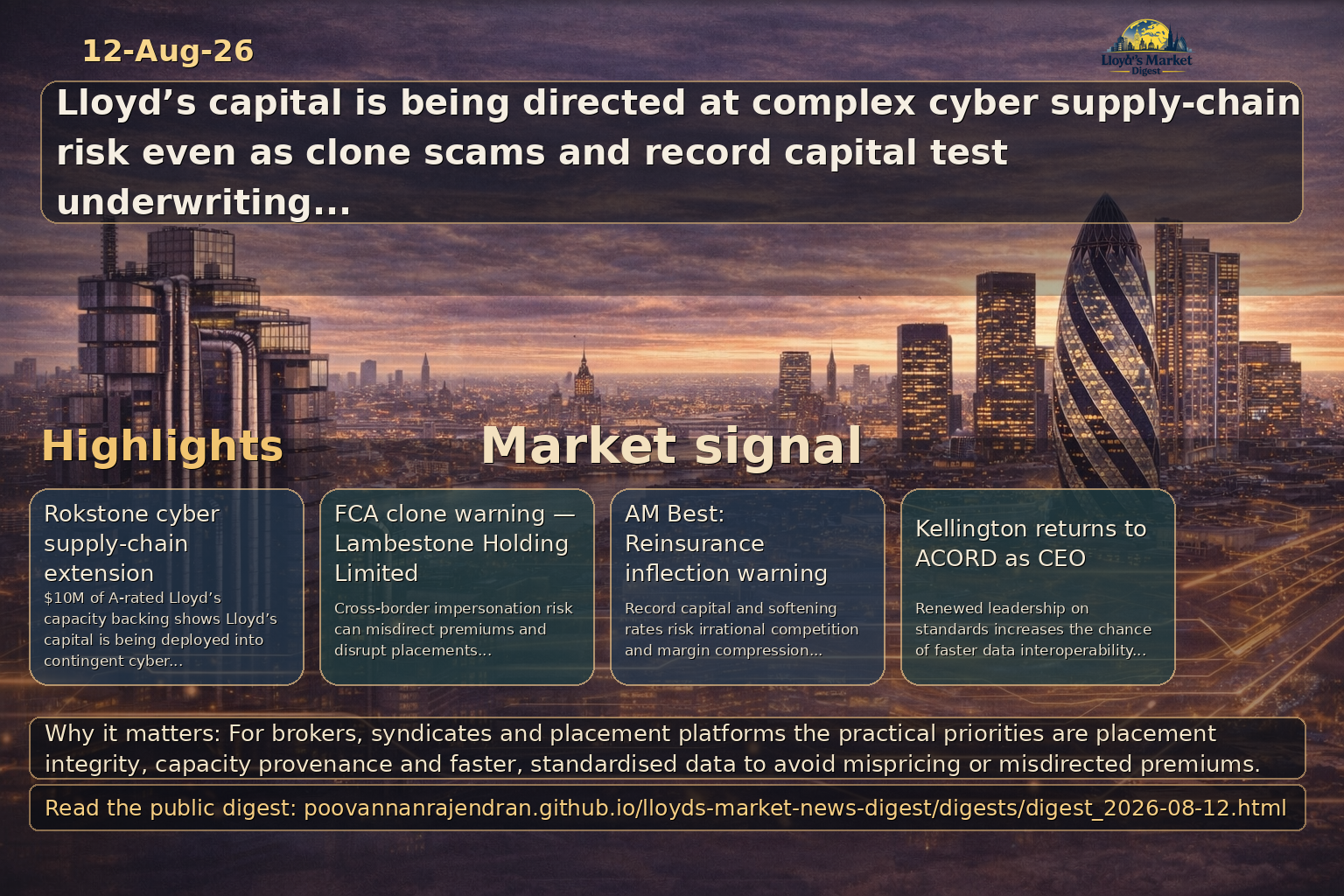
Why it matters: Rokstone’s cyber supply chain extension, backed by $10m of A‑rated Lloyd’s capacity, is a direct example of Lloyd’s capital being deployed to underwrite emerging, complex cyber-contingent risks.
- Evaluate syndicate appetite for cyber supply-chain risks and ensure underwriting teams have loss‑modelling capability for contingent exposures
- Support brokers with clear wordings and claims triggers to facilitate placement and avoid ambiguity in supply‑chain scenarios
- Consider partnership models between MGAs and Lloyd’s capacity to scale specialist cyber offerings rapidly
Source: fca.org.uk
Why it matters: Clone of an Ireland-incorporated company signals cross-border impersonation risk affecting international placements, premium flows and reinsurer correspondence.
- Validate counterparties on the FCA Register and relevant Irish registers independently before any premium movement or document exchange.
- Enforce multi-factor confirmation for payment instructions (out-of-band confirmation to named signatories) and hold funds in controlled trust/escrow where possible.
- Share intelligence with Lloyd’s Market Services, intermediaries and placement platforms to block known impersonators and update onboarding controls.
Source: fca.org.uk
Why it matters: Unauthorised entity warning (IC Unity) highlights persistent risk of firms operating without permission and the threat to broker-client relationships and placement validity.
- Require proof of authorisation and confirm permissions directly with the FCA before contracting or placing business.
- Integrate sanctions/authorisation checks into placement platforms and broker CRMs to flag unauthorised entities automatically.
- Communicate client protections clearly (FOS, FSCS limitations) when third parties cannot demonstrate FCA authorisation.
Source: fca.org.uk
Why it matters: Clone of an FCA-authorised firm (6 Trinity Street Investment Club) with active phone numbers indicates use of cloned identity to mislead clients and intermediaries in the UK market.
- Mandate verification of firm reference numbers and authorised contact channels before sharing placement documents or premiums.
- Implement broker/underwriter playbooks to treat unexpected contact changes (phone, email) as red flags and require secondary verification.
- Train front-office and operations teams to recognise clone tactics (slight name variations, spoofed numbers) and escalate through compliance immediately.
Source: fca.org.uk
Why it matters: Warning on GRAND CORE INVEST underscores the breadth of unauthorised actors that can target institutional and retail channels, with potential spillover to specialty lines and captive arrangements.
- Segregate client funds and require detailed beneficiary verification for any investment-linked premium handling.
- Review captive and MGA onboarding rules to ensure counterparties demonstrate appropriate permissions and solvency transparency.
- Coordinate with market auditors and compliance teams to run targeted sweeps for third-party investment propositions tied to underwriting flows.
Source: fca.org.uk
Why it matters: cairnloan.com clone activity—complete with telephone, email and website—illustrates how full-service impersonation can be used to insert fraudulent intermediaries into placement chains.
- Blocklisted domains and contact details should be fed into broker platforms, syndicate portals and email filters to prevent inbound engagement.
- Require web domain ownership and SSL certification checks as part of digital onboarding for new counterparties and referral partners.
- Establish a rapid takedown and client-alert protocol in coordination with legal and market communications teams when impersonation is detected.
Source: artemis.bm
Why it matters: AM Best’s warning about a reinsurance inflection underscores the market risk that record capital levels could produce irrational competition and margin compression—critical for Lloyd’s managing agents, global specialty underwriters and brokers.
- Underwriting teams and syndicate boards must reinforce discipline triggers and appetite frameworks to avoid erosion of rate adequacy.
- Brokers need to anticipate softer negotiation leverage and protect client pricing by diversifying counterparties and emphasising contract structure quality.
- Placement platforms should enhance analytics and transparency on capacity provenance to help market participants identify durable vs. opportunistic capital.
Source: businessinsurance.com
Why it matters: ACORD leadership directly affects data standards and interoperability for placement platforms — critical for faster, lower-cost Lloyd's and brokered specialty placements.
- Potential acceleration of industry data and messaging standards that reduce manual slip handling and speed syndicate access to risks
- Opportunities for Lloyd’s syndicates and MGAs to integrate digital placement workflows with brokers and global platforms
- C-suite should prioritize participation in standards initiatives to protect distribution efficiency and reduce operational friction
Source: businessinsurance.com
Why it matters: A broad slowing in renewal rate increases signals pressure on underwriting margins and the need for syndicates and brokers to pursue alternative risk selection and expense discipline.
- Syndicates should tighten appetite and selectively redeploy capacity to better-priced specialty niches
- Brokers must prepare enhanced value propositions beyond price — risk engineering and claims engagement
- Placement platforms can differentiate by enabling richer risk data capture to justify rate adequacy
Source: businessinsurance.com
Why it matters: Court decisions limiting alternate tort claims against employers reinforce workers’ compensation exclusivity but also highlight evolving litigation risks that specialty insurers and Lloyd’s syndicates must monitor for coverage exposure.
- Claims teams should review policy wordings and jurisdictional carve-ins to manage unexpected third‑party exposures
- Brokers must advise clients on potential litigation gaps and tailor excess & specialty placements accordingly
- Underwriters should incorporate litigation trend analysis into loss picks and reinsurance buying strategy
Source: businessinsurance.com
Why it matters: NFP’s acquisition of Frontier’s retail cannabis business underscores accelerating broker consolidation in emerging specialty segments and the growing need for tailored placement solutions for cannabis exposures.
- Consolidation increases distribution scale for niche product specialists, affecting how syndicates access cannabis risks
- Syndicates and MGAs should develop compliance frameworks and underwriting metrics specific to regulated cannabis markets
- Placement platforms must support complex risk profiles and jurisdictional variations to facilitate efficient placements
Source: businessinsurance.com
Why it matters: Renewed litigation over defense cover in stalking-related claims highlights exposure ambiguity in professional and medical liability — a key consideration for Lloyd’s syndicates and specialty PL underwriters.
- Policy wordings for professional liability need clearer defense vs indemnity triggers and conduct exclusions
- Brokers should pre-empt coverage disputes by obtaining tailored endorsements and documenting client risk controls
- Insurers must align claims reserving and litigation management strategies to limit long-tail surprise costs
Source: globalreinsurance.com
Why it matters: The appointment signals a broker strategic push to expand complex placement capability and parametric solutions across London and international platforms, relevant to syndicates and placement ecosystems.
- Prioritise integrated placement workflows: align broking growth mandates with platform connectivity to Lloyd’s syndicates and global capacity providers to shorten time-to-market on complex placements.
- Leverage parametric IP as a market differentiator: institutionalise parametric product development and client advisory to capture clients seeking balance-sheet efficient, rapid-loss solutions.
- Coordinate talent and go-to-market across hubs: ensure leadership transitions (London/Miami) transfer client relationships and underwriting intelligence to optimise cross-jurisdictional placements and reinsurer engagement.
Source: globalreinsurance.com
Why it matters: AM Best’s view that record capital and softening rates will test underwriting discipline directly impacts Lloyd’s syndicates, global specialty reinsurers and brokers’ placement strategies.
- Reinforce selective underwriting and risk-adjusted pricing: syndicate and carrier leadership must codify discipline thresholds and allocation frameworks to avoid margin erosion as competition intensifies.
- Reassess capacity sourcing and placement levers: brokers and placement platforms should diversify capacity channels (traditional reinsurers, ILS, retrocession, syndicates) and emphasise value-added structuring to justify rates.
- Invest in analytics and stress-testing: deploy loss-model scenarios and capital-efficiency metrics to quantify suitability of deploying or absorbing incremental capital, and to support negotiation of sustainable terms with capital providers.
Source: insurancejournal.com
Why it matters: A seven-figure construction settlement signals sustained large casualty and construction-defect exposures that affect capacity allocation, excess layers and claims handling strategies across specialty markets.
- Underwriting: Increased scrutiny on construction and contractors’ liability placements; tighter terms on builder’s risk and wrap-up programmes for large, urban projects.
- Reserving & reinsurance: Syndicates and reinsurers should reassess attritional vs. large loss frequency assumptions; potential upward pressure on excess attachment points and aggregate protections.
- Brokering & placements: Demand for clear subrogation strategies and defense-allocation clauses will rise; brokers and electronic platforms must streamline documentation for complex consolidated lawsuits.
Source: insurancejournal.com
Why it matters: A nationwide cyclospora outbreak with proposed class actions creates significant product liability exposure for food manufacturers, restaurants and distributors — a space often placed in the specialty casualty market with layered excess programmes.
- Coverage complexity: Expect disputes over contamination, recall and coverage triggers across GL, product liability and umbrella/excess policies; reinsurers will revisit aggregate limits for foodborne events.
- Claims & litigation costs: Large class actions amplify defense spend and settlement risk; syndicates should stress-test accumulation from nationwide retail distribution networks.
- Broker advice: Brokers must coordinate multi-jurisdictional defence and allocation strategies, and consider captive/alternative risk solutions for clients in high-exposure food supply chains.
Source: insurancejournal.com
Why it matters: The shift from rental to private e-scooters changes the risk profile for personal mobility exposures and affects how specialty motor and micromobility products are designed, priced and distributed through MGAs and broker platforms.
- Product redesign: Insurers and MGAs need tailored private-owner micromobility endorsements, clear liability boundaries and coverage for battery/fire and theft risks.
- Distribution & data: Brokers and platforms should integrate telematics and proof-of-use data to underwrite private units versus fleet exposures and to segment pricing.
- Regulatory & claims trends: Anticipate divergent municipal regulations and claims patterns; syndicates should model increased small-claim frequency with lower severity but wider geographic dispersion.
Source: insurancejournal.com
Why it matters: A large tanker oil spill in environmentally sensitive waters creates substantial P&I, environmental liability and cargo exposure with complex jurisdictional recovery and potential sanctions complications given the cargo origin.
- Liability & environmental claims: Significant cleanup costs and third-party damages will exert pressure on P&I clubs and specialty environmental liability markets; long-tail monitoring and remediation reserves are required.
- Sanctions & cargo complications: Russian-origin cargo introduces sanctions and cargo-owner recovery complexities; brokers must flag sanctions-screening and holdback language in placements.
- Reinsurance & market capacity: Syndicates should reassess exposure to single-vessel catastrophic losses and pollution aggregation, potentially increasing demand for terrorism/pollution covers and market-wide coordination.
Source: insurancejournal.com
Why it matters: Swiss Re’s warning on chronic heat underscores systemic, non-catastrophic climate impacts (mortality, productivity, gradual property degradation) that shift underwriting horizons and product design for specialty lines.
- Underwriting horizon: Syndicates must incorporate chronic heat exposures into longevity of property services, business interruption frequency and workers’ compensation modelling.
- Product innovation: Opportunity for bespoke resilience products, parametric covers and temperature-linked BI products for supply-chain sensitive sectors.
- Capital & pricing: Expect progressive repricing across property and casualty portfolios as climate-driven steady-state losses erode profitability; reinsurance structures may adapt to long-duration attritional layers.
Source: insurancetimes.co.uk
Why it matters: Zurich's P&C margin expansion and accelerated specialty premium growth, alongside a Beazley takeover dynamic, signal competitive shifts in global specialty capacity and potential redistribution of syndicate-facing business.
- Assess implications of large insurer consolidation on Lloyd’s market capacity and panel concentration for key specialty lines
- Revisit placement strategies and appetite with brokers to capture displaced or reallocated specialty business
- Monitor combined operating ratio trends to anticipate pricing cycles and reserve adequacy across specialty portfolios
Source: insurancetimes.co.uk
Why it matters: The CII warning on an AI fluency gap highlights governance and operational risk for boards, syndicates and brokers as AI moves from tools to decision drivers in underwriting and claims placement.
- Invest in role-specific AI training for boards, underwriters and broking teams to ensure professional scepticism of automated outputs
- Embed transparent, auditable model documentation and human-review checkpoints in placement workflows
- Require vendors and platform partners to demonstrate explainability and governance controls before integration
Source: insurancetimes.co.uk
Why it matters: ACORD’s appointment of an experienced standards leader underscores renewed momentum in data standards — a prerequisite for efficient electronic placement, syndicate connectivity and straight-through processing.
- Prioritise ACORD alignment in vendor selection and integration roadmaps for placement platforms and broker systems
- Direct syndicate and MGA tech investments to enable structured data exchange and reduce manual placement frictions
- Encourage participation in standards forums to influence templates for specialty and complex placements
Source: insurancetimes.co.uk
Why it matters: Markel UK’s fluid talent development approach illustrates a practical response to specialist skill shortages that affect underwriting depth and broker‑carrier relationships in niche classes.
- Implement rotational and cross-functional programmes to retain underwriting expertise and broaden bench strength for specialty lines
- Leverage apprenticeships and targeted graduate schemes to feed technical roles supporting syndicates and broking desks
- Use internal mobility metrics as an early-warning indicator of capability gaps affecting placement performance
Source: reinsurancene.ws
Why it matters: Archive content provides historical benchmarking for cycles, cat-loss impacts and market responses—critical context for syndicates and brokers assessing current pricing and capacity trends.
- Use archival earnings and cat-event reporting to benchmark current catastrophe loss ratios against previous market cycles for syndicate portfolio stress-testing.
- Historical rate-change evidence informs broker negotiation strategies with Lloyd's delegating or lead syndicates on ceded and facultative placements.
- Maintaining a structured archive aids actuarial and reserving teams in detecting emerging long-tail patterns that could presage casualty development shifts.
Source: reinsurancene.ws
Why it matters: Progressive's blended 2026-27 property cat tower (traditional reinsurance + cat bonds + FHCF) exemplifies multi-source capacity strategies that impact pricing, placement platform design and syndicate participation in US hurricane risk.
- Demonstrates continued demand for hybrid towers; Lloyd's syndicates and Bermuda reinsurers should assess appetite for top-of-tower placements versus primary layers.
- Brokers must coordinate multi-instrument placement (cat bonds, private reinsurance, governmental pools) to optimize capital efficiency and policyholder protection.
- Implications for modeling vendors and underwriting teams: need for consistent nat-cat exposure aggregation across platforms to support layered capacity negotiations.
Source: reinsurancene.ws
Why it matters: AM Best's assessment that casualty is hard to price and threatens reinsurer discipline is a strategic red flag for Lloyd's syndicates and brokers managing long-tail exposures and legacy portfolios.
- Insurers and syndicates must tighten actuarial surveillance and scenario testing for casualty lines to avoid underpricing multi-decade development.
- Brokers should push for enhanced data sharing and loss-development metrics in placement conversations to justify rate adequacy to carriers and reinsurers.
- Potential for reinsurance product innovation (long-term casualty programs, tailored loss portfolio transfers) to manage litigation and social-inflation risk.
Source: reinsurancene.ws
Why it matters: James River's mixed Q2 performance highlights profitability pressure in excess & surplus and specialty lines—informative for syndicates and brokers evaluating capacity allocation to E&S carriers.
- E&S combined-ratio movement signals expense and underwriting-pressure trends that could constrain appetite for commoditized or underpriced business.
- Brokers should re-evaluate program structures and attachment points with carriers to protect margins as primary carriers rebalance portfolios.
- Syndicates and reinsurers assessing retro risk must account for rising expense ratios when modelling return on capital for treaty placements.
Source: reinsurancene.ws
Why it matters: Ivans Index renewal-rate dynamics offer near-term pricing intelligence across commercial lines, directly relevant to brokers, Lloyd's corporate-facing syndicates and placement strategy.
- Year-on-year increases across major commercial lines indicate persistently firm market segments where syndicates can sustain rate improvements.
- Month-on-month easing in several lines suggests tactical opportunities for brokers to secure capacity or negotiate terms ahead of potential softening.
- Workers' Compensation variance underscores line-specific risk drivers; syndicates should apply granular segmentation in pricing and appetite statements.
Source: artemis.bm
Why it matters: Hiscox Capital Partners hiring a senior ILS actuary signals the premium on in-house technical capability to manage ILS and quota-share partnerships—an operational priority for syndicates and brokers arranging bespoke capital solutions.
- Syndicates and managing agents must invest in actuarial and capital modelling skills to price and administer ILS-linked deals and quota shares accurately.
- Brokers arranging capital solutions should expect deeper technical engagement and provide higher-quality data to support sophisticated structuring.
- Placement platforms will be asked to support richer valuation and reserving data feeds to meet growing internal analytic capabilities at insurers and asset managers.
Source: artemis.bm
Why it matters: White Mountains’ capital return from Ark’s Outrigger Re sidecar illustrates how collateralised vehicles can be a significant cash-flow source even when ownership choices change—affecting sponsor capital strategy and the supply dynamics of alternative capacity.
- Syndicate sponsors should consider sidecars not only as risk-transfer instruments but also as contributors to liquidity and shareholder returns, influencing capital allocation.
- Brokers arranging sidecar capacity must factor in sponsor and investor incentive alignment to ensure continuity of capacity across renewals.
- Placement platforms should track distribution and capital-return mechanics as these influence investor appetite and the effective cost of collateralised reinsurance.
Source: artemis.bm
Why it matters: GAM’s Swiss Re-linked UCITS cat bond fund surpassing $2bn signals scaled institutional demand for liquid ILS products; higher fee income reflects commercialisation that affects how brokers and syndicates source alternative capacity.
- Brokers should prioritise relationships with larger ILS managers to access liquid UCITS allocations that can supplement treaty placements.
- Syndicates must factor increased ILS uptake into capital planning and pricing models, recognising a growing substitute for traditional reinsurance capital.
- Placement platforms need to standardise due diligence and collateral protocols to integrate UCITS-driven capacity efficiently and transparently.
Source: artemis.bm
Why it matters: UCITS cat bond funds remain an important liquidity conduit for ILS capital, but recent 12-month return moderation highlights seasonality and performance volatility that underwriters, brokers and platforms must consider when relying on these funds for capacity.
- Syndicates should stress-test treaty renewals against lower expected UCITS returns and adjust retentions or blended reinsurance accordingly.
- Brokers must articulate fund performance risks to clients, aligning placement timing to product seasonality and managers’ liquidity profiles.
- Platforms ought to provide performance scenario modelling for fund-based capacity to inform strategic placement decisions and collateral needs.
Source: newsnow.co.uk
Why it matters: New Zealand developments matter for Lloyd’s and specialty markets because of seismic and climate-driven nat-cat exposures, a high tourism economy, and regulatory environment that affects capacity placement and reinsurance strategies.
- Seismic and weather aggregation: Syndicates must stress-test portfolios for NZ earthquake and storm scenarios and review reinsurance and retrocession layers.
- Product demand: Brokers should position parametric and business-interruption covers tailored to tourism, agriculture and marine sectors.
- Market access & compliance: Placement platforms need NZ-compliant placement capability and data-rich underwriting submissions to speed binding for regional risks.
Source: newsnow.co.uk
Why it matters: Political leadership changes (Christopher Luxon) influence fiscal policy, infrastructure investment and regulatory settings—factors that alter corporate risk profiles, political-risk demand and local market appetite for Lloyd’s capacity.
- Policy-driven exposure shifts: Underwriters should model how fiscal and trade policy changes affect corporate credit and political-risk insurance demand in New Zealand.
- Opportunity for structured cover: Brokers can develop sovereign/political-risk and investment-protection solutions around major infrastructure projects.
- Regulatory and market-entry implications: Placement platforms must adapt KYC, compliance and distribution workflows to reflect any regulatory or licensing changes under new leadership.
Source: newsnow.co.uk
Why it matters: Bali is a high-volume tourism exposure with concentrated catastrophe (volcano, tsunami) and operational risks for travel carriers and hospitality portfolios—relevant for specialty lines, parametrics and travel-interruption placement.
- Concentrated leisure exposure: Syndicates should reassess capacity limits for hotel, aviation and tour-operator programmes during peak seasons and volcanic alerts.
- Parametric and cancellation solutions: Brokers can scale parametric products and contingency liability programmes for eruption, ash-cloud and infrastructure disruption.
- Real-time placement needs: Platforms must support fast issuance, multilingual documentation and rapid claims triggers to service inbound travel and corporate clients.
Source: newsnow.co.uk
Why it matters: US–Turkey dynamics drive defence procurement, regional security tension and potential sanctions implications—this raises marine, aviation, trade-credit and political-risk exposures for specialty underwriters and brokers.
- Elevated political and trade risk: Syndicates should price for increased war, kidnap & ransom, and political-violence exposures in affected corridors.
- Sanctions and compliance impact: Brokers and platforms must enforce enhanced sanctions screening and contract clauses for arms and defence-related supply chains.
- Supply-chain and marine exposures: Underwriters need scenario analysis for supply-chain disruption, increased premiums for contested routes and tailored cargo war-risk coverage.
Source: newsnow.co.uk
Why it matters: High-profile entertainment franchises (Harry Potter) concentrate production, IP, distribution and reputational risk—driving demand for large multi-line programmes across jurisdictions and stressing capacity placement and wording consistency.
- Complex multi-territory programmes: Brokers must coordinate global placements that combine cast/crew, production, E&O, IP and contingent BI layers.
- Concentration and aggregation: Syndicates should model aggregation risk across successive productions and streaming releases to avoid capacity shortfalls.
- Digital and reputational exposures: Placement platforms should support bespoke wordings for digital distribution, rights licensing and rapid claims handling for reputational loss.