Source: fca.org.uk
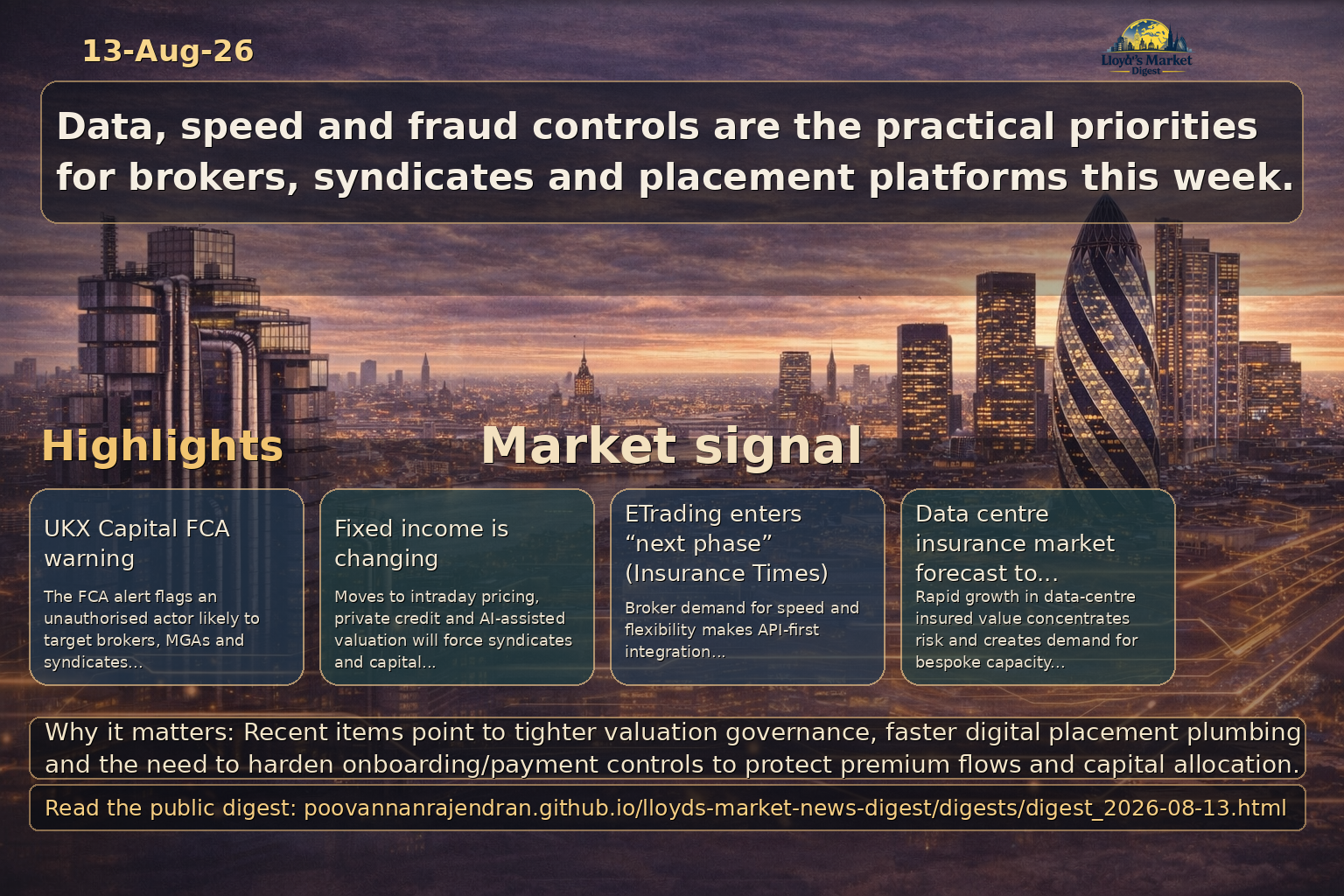
Why it matters: The UKX Capital FCA warning signals an unauthorised actor that could target brokers, MGAs, corporates and syndicates with fraud schemes or impersonation attempts. For Lloyd's participants and placement platforms this raises the risk of misdirected premiums, undermined client protections and potential contagion to trusted distribution chains.
- Immediate verification: Cross-check counterparty details against the FCA Warning List and internal watchlists before engaging; suspend or flag any onboarding or payment instructions linked to the name until validated.
- Payment and transaction controls: Enforce dual-authorisation for premium flows, validate bank account beneficiary changes via independent channels, and require payment confirmations on platform-integrated settlements.
- Market communications and remediation: Notify broking partners and affected clients of the warning, update platform alerts, and document mitigation steps to preserve conduct records and limit reputational impact.
Source: fca.org.uk
Why it matters: The Neu Finances warning demonstrates continued proliferation of unauthorised promoters that can disrupt specialty placements and create exposure for brokers and syndicates through false intermediaries or sham distribution entities. This matters for Lloyd's operations and placement platforms that rely on trusted intermediary networks and digital onboarding.
- Enhance onboarding and KYC: Require brokers and MGAs to record and share FCA authorisation references for third parties, escalate exceptions to compliance, and integrate automated checks of regulator warning feeds into platform workflows.
- Platform access and vendor controls: Review and tighten access permissions for third-party integrations, enforce supplier due diligence for distribution partners, and conduct periodic audits of onboarding activity logs to detect anomalous sign-ups.
- Client protection and remediation planning: Update client advisory language about the limits of FSCS and FOS protection for unauthorised firms, prepare templated notifications for affected clients, and coordinate with legal and claims teams for potential recovery or escalation.
Source: artemis.bm
Why it matters: Progressive's maintenance of multi‑billion dollar per‑occurrence CAT XoL towers demonstrates continued reliance on traditional excess‑of‑loss structures alongside selective capital‑market solutions, a template relevant to brokers and syndicates at renewals.
- Placement strategy: Large XoL towers remain available, so brokers should balance competition between bilateral reinsurers, Lloyd's syndicates and alternative capital when structuring programs.
- Blended capital: Progressive's simultaneous use of a $400m catastrophe bond highlights hybrid protection strategies — opportunity for placement platforms to package layered solutions.
- Negotiation levers: Stable tower sizing year‑on‑year suggests emphasis on retention, aggregate protections and attachment points as key negotiation variables for cedants.
Source: businessinsurance.com
Why it matters: Captive owners taking a disciplined approach to adding risks alters the risk transfer landscape for Lloyd’s syndicates and global specialty insurers by changing demand for reinsurance, shifting retention behaviour, and creating new aggregation and pricing considerations for brokers and placement platforms.
- Refine appetite and underwriting filters: Syndicates and managing agents should formalize guidelines to assess risks that sit behind or alongside captive retentions to avoid unintended accumulation and adverse selection.
- Enhance platform capabilities for aggregation analytics: Placement platforms and brokers must integrate captive exposure data and scenario modelling so underwriters can quantify accumulation and tail correlations before committing capacity.
- Revisit treaty and capital strategies: Reinsurers, syndicates and corporate capital providers should factor captive growth into treaty design, attachment levels and capital allocation to protect solvency metrics and preserve profitable rate adequacy.
Source: businessinsurance.com
Why it matters: Recognition of emerging female leaders in the industry signals momentum on talent and governance that matters directly to brokers, syndicates and placement platforms seeking to strengthen client relationships, accelerate innovation and improve decision‑making in complex specialty lines.
- Embed diversity into succession and retention plans: Executive teams and brokerages should make diversity metrics and leadership pathways part of performance and strategic workforce planning to secure institutional knowledge in specialty disciplines.
- Leverage leadership visibility to win distribution and trust: Syndicates and lead brokers can use visible, diverse leadership as a differentiator when pursuing global clients and complex placements that value relationship and advisory capability.
- Invest in sponsorship and capability-building on platforms: Placement platforms and brokers should operationalize mentorship, sponsorship and training programs to convert recognition into a deeper pipeline of technical underwriting, claims and broking talent.
Source: insurancejournal.com
Why it matters: The tentative denial of summary disposition to hold Southern California Edison strictly liable heightens litigation uncertainty for utility-related wildfires, affecting underwriting, subrogation prospects and reserving for large loss aggregations relevant to Lloyd's syndicates and global specialty brokers.
- Underwriting impact: expect tighter underwriting scrutiny, higher pricing and revised exclusions or sub-limits for utility and wildfire-exposed accounts.
- Subrogation and recoveries: a precedent denying straightforward liability increases claims handling complexity and may reduce recoveries; brokers should renegotiate indemnity expectations and allocation protocols.
- Reinsurance and capacity: syndicates must reassess aggregation models and treaty attachment points; reinsurers may demand more granular peril attribution and stronger loss mitigation conditions.
Source: insurancejournal.com
Why it matters: A high-court direction that Mag Mutual must defend a physician accused of alleged non-professional misconduct underscores duty-to-defend exposure and the potential for defense costs to be triggered in contested boundary cases—material for professional lines underwriters, syndicate reserving and broker placement strategy.
- Policy drafting: syndicates and MGAs should re-evaluate insuring clauses and exclusions for non-professional acts to reduce ambiguity that creates defense obligations.
- Reserve and loss-cost pressure: increased frequency of defense triggers will push syndicates to review reserving practices and possibly adjust pricing for med-mal portfolios.
- Broker advisory role: brokers must counsel insureds on defense cost allocation, collaring agreements and captive use; placement platforms should surface policy comparability for defense triggers.
Source: insurancejournal.com
Why it matters: Volatile power demand from AI data centres is accelerating equipment wear and unexpected outages, creating a concentrated operational and property/business-interruption exposure that challenges traditional underwriting assumptions and aggregation modelling across specialty property lines.
- Underwriting discipline: immediate demand for engineering surveys, dynamic load profiles and contractual operational mitigants (redundant power/cooling) as standard submission requirements.
- Coverage design: opportunity and need to develop tailored endorsements or parametric options addressing power volatility, ramp events and short-duration high-severity outages.
- Portfolio aggregation: syndicates and placement platforms must model correlated exposures to grid instability and hyperscaler tenancy concentration to avoid underestimated accumulation risk.
Source: insurancejournal.com
Why it matters: The imminent departure of HSBC's global head of insurance signals potential shifts in bancassurance strategy and distribution in Asia, with implications for treaty flows, delegated authority arrangements and broker-syndicate relationships in key growth markets.
- Distribution risk: a leadership change may produce strategic reallocation of business, creating opportunities or gaps for brokers and Lloyd's syndicates depending on successor priorities.
- Treaty and capacity impact: anticipated reassessment of bancassurance partnerships could affect quota-share and facultative placements originating from HSBC channels in Asia.
- Engagement strategy: brokers and managing agents should proactively engage HSBC leadership to protect existing placements, and evaluate alternative distribution partnerships where concentration risk is identified.
Source: insurancejournal.com
Why it matters: Calls to rethink the 'secondary-peril' label reflect an industry inflection point: storms, floods, hail and wildfire are producing material insured losses that warrant reclassification, with direct consequences for catastrophe modelling, pricing, capacity allocation and treaty architecture across the Lloyd's market.
- Model and pricing updates: managing agents must accelerate incorporation of intensified secondary perils into loss models and repricing frameworks to protect margin and capital adequacy.
- Reinsurance treaty design: brokers and cedants should renegotiate attachment points and multilayer structures to reflect evolving frequency/severity of these perils.
- Client advisory: placement platforms should support brokers with analytics and product templates that address blended-peril exposures and resiliency incentives.
Source: insurancetimes.co.uk
Why it matters: The eTrading market is moving from basic SME placements to support for complex risks and higher broker expectations for speed and flexibility — directly impacting how Lloyd's brokers and syndicates conduct digital placements.
- Prioritise API-first integration between syndicates, MGAs and major placement platforms to support instant quotes and real‑time capacity binding
- Develop productised, pre‑configured offering templates for complex classes to reduce manual handling and accelerate placement
- Invest in platform UX and data standards to capture nuanced risk information required for specialty underwriting and facultative referrals
Source: insurancetimes.co.uk
Why it matters: AI is proving to be a productivity multiplier for specialist brokers — enabling rapid analysis and intelligence generation — and will differentiate market leaders rather than replace human expertise.
- Sponsor targeted AI pilots that automate time‑consuming intelligence/generation tasks while retaining human oversight for placement strategy and negotiation
- Ensure data governance, model validation and explainability frameworks before embedding AI into placement or underwriting workflows
- Leverage AI outputs to redeploy broker and underwriter capacity towards complex, high‑margin risks and relationship management
Source: insurancetimes.co.uk
Why it matters: A rising proportion of vulnerable road users is changing the motor casualty mix, with modelling suggesting up to a mid‑single digit uplift in claims costs — a material input for motor underwriting and reserving strategies.
- Reassess motor pricing models and inflation assumptions to reflect shifting casualty severity and exposure patterns in urban mobility
- Work with brokers and telematics/data providers to improve exposure granularity for platform‑led motor placements
- Consider product redesign and alternative capacity structures (e.g., layered programmes) to protect syndicate loss ratios from evolving severity
Source: insurancetimes.co.uk
Why it matters: Continued growth in chartered status among insurance professionals signals rising standards in technical capability and advisory expectations across brokers and underwriting teams in specialty markets.
- Incorporate chartered designations into talent and procurement criteria when selecting broker partners for complex placements
- Use higher professional standards as a competitive differentiator for syndicates seeking to win placements via specialist brokers
- Invest in ongoing training and credentialing to retain technical underwriters capable of handling sophisticated global specialty risks
Source: insurancetimes.co.uk
Why it matters: The launch of a pension trustee liability (Roobi) product with extended policy periods addresses a growing need for long‑tail financial lines cover and creates placement opportunities for specialty capacity.
- Syndicates should evaluate long‑tail reserving and reinsurance structures before deploying significant capacity into extended‑term pension trustee liabilities
- Brokers must be enabled on placement platforms to manage long policy periods and aggregate limits efficiently
- Consider collaboration between MGAs, syndicates and reinsurers to structure capacity with commensurate pricing and long‑term claims handling commitments
Source: reinsurancene.ws
Why it matters: The Allianz forecast that the global data centre insurance market could more than double to over $24bn by 2030 directly affects Lloyd's syndicates and global specialty brokers: it represents a sizeable growth avenue but concentrates insured value and operational complexity, increasing demand for bespoke capacity, refined valuation and aggregation controls.
- Underwriting and product development: Syndicates must develop tailored covers (physical damage, business interruption, contingent business interruption, dependent business interruption, civil authority, technology failure and supply‑chain nuances) and limit/wording standards for ultra‑high asset values.
- Broker placement and capacity management: Brokers and platforms will need to pool multi‑syndicate capacity, coordinate layered placements and secure leading limits while managing cross‑line aggregation with reinsurers and retrocession backing.
- Aggregation and modelling: Market participants must invest in robust site‑level aggregation analytics, scenario modelling (including multi‑site failure and correlated supply chain impacts) and clause standardisation to quantify concentration and set appetite.
Source: reinsurancene.ws
Why it matters: Hannover Re's statement that it is comfortable growing and expects property catastrophe rate reductions to decelerate into the 1/1/2027 renewals is a directional signal for price momentum and reinsurance strategy. This affects Lloyd's syndicates and brokers as they calibrate retention levels, reinsurance buying patterns and competitive positioning for large property and specialty accounts.
- Renewal strategy and placement timing: Brokers should prepare staged placement strategies (early market engagement, tranche structuring) to capture limited but competitive capacity while protecting margin as rate softening decelerates.
- Reinsurance and retrocession demand: Syndicates may maintain or modestly expand capacity supported by reinsurer appetite, but must optimise retrocession to control tail‑risk volatility given slower price deterioration.
- Underwriting discipline and portfolio steering: Expect continued selective growth; syndicates and managing agents should emphasise exposure management, underwriting profitability metrics and stricter terms for peak per risk concentrations.
Source: reinsurancene.ws
Why it matters: Hannover Re's improved H1 profitability and an 83.2% P&C combined ratio demonstrate available capital and underwriting strength. For Lloyd's and global specialty markets this confirms capacity willingness to grow selectively, underpins competitive supply into specialty classes and reinforces the need for brokers to demonstrate risk selection and pricing discipline.
- Capital deployment and competition: Strong reinsurer results enable continued capacity into specialty and large account placements; syndicates should expect disciplined but substantive competition for attractive risks.
- Market signalling and pricing expectations: Positive earnings can encourage measured rate compression in non‑cat lines; brokers must use performance data and loss narratives to defend pricing on complex, high‑value placements.
- Sponsor and investor considerations: Managing agents and syndicates should communicate tightened underwriting standards and performance metrics to capital providers, ensuring continued access to capital while preserving return on line.
Source: artemis.bm
Why it matters: Vantage Partnership Capital's disclosed fee income confirms commercial viability of third‑party reinsurance platforms and underscores investor appetite for managed ILS‑style partnerships, relevant to brokers, placement platforms and syndicates seeking capital diversification.
- Platform economics: Demonstrable fee revenue validates scalable revenue models for placement platforms and supports further investment in distribution and risk selection capabilities.
- Broker opportunity: Brokers can leverage platform capacity to offer alternative placement routes and bespoke structures that compete with traditional reinsurance towers.
- Regulatory and collateral design: Growth in third‑party platforms demands clear collateralisation frameworks and governance to satisfy syndicates, investors and Lloyd's oversight.
Source: artemis.bm
Why it matters: Swiss Re's H1 2026 estimate of materially lower insured nat‑cat losses signals reduced near‑term claims pressure, influencing reinsurance pricing, capacity and renewal dynamics across Lloyd's and global specialty markets.
- Renewal expectations: Lower losses create downward pressure on reinsurance rates and less urgency for buyers to increase limits at renewal.
- Capital and capacity: Reduced loss experience can free up capital and expand capacity for syndicates and ILS investors, altering supply dynamics for brokers to leverage.
- Underwriting focus: Severe convective storms remain a key driver — syndicates and brokers should prioritise targeted exposure management and model recalibration for SCS risk.
Source: artemis.bm
Why it matters: Brookmont's view that AI will expand the cat bond market into sectors like data centres highlights a near‑term innovation vector: AI‑driven predictive analytics enabling ILS penetration into non‑traditional perils, directly affecting product strategy for Lloyd's, brokers and placement platforms.
- Model sophistication: Advanced AI can improve risk segmentation and pricing accuracy, unlocking new insured pools (eg. data centres) for syndicates and ILS investors.
- Product development: Brokers and platforms should pilot AI‑enabled underwriting products and data partnerships to capture emerging demand and attract capital.
- Governance & validation: Adoption requires robust model governance, explainability and third‑party validation to satisfy reinsurers, syndicates and institutional ILS allocators.
Source: artemis.bm
Why it matters: Hannover Re's H1 performance — higher income despite price declines and minimal sharing of catastrophe losses with ILS — indicates incumbent reinsurer resilience and a nuanced role for ILS in overall loss absorption, with implications for competition and capital allocation across Lloyd's and global specialty markets.
- Market positioning: Reinsurer profitability amid rate softening suggests incumbents can compete on capacity and service, pressuring syndicate underwriting discipline.
- ILS dynamics: Limited loss sharing with ILS in H1 implies variability in ILS exposure and returns — brokers should assess when ILS is value‑accretive versus traditional reinsurance.
- Strategic responses: Syndicates and brokers must calibrate product offering, protection strategies and capital mix to remain competitive with diversified reinsurance groups.
Source: risk.net
Why it matters: Shifts in fixed-income markets toward private credit, securitisation and intraday pricing directly affect insurers' investment portfolios, collateral and capital allocation practices. Lloyd's syndicates, capital providers and brokers need data strategies that support more frequent valuation, transparent pricing inputs and governance of AI-assisted workflows.
- Move beyond end-of-day feeds for assets that materially affect solvency, collateral and margining — prioritise intraday price, liquidity and behavioural data for these holdings.
- Define and enforce data lineage and provenance standards across investment, actuarial and underwriting systems to enable audit-ready valuations and consistent pricing guidance to brokers and clients.
- Assess vendor and platform partnerships for AI-assisted valuation tools; require explainability, back-testing standards and controls before integrating outputs into pricing or reserve decisions.
Source: risk.net
Why it matters: Internal reporting and whistleblowing data are becoming more than compliance checkboxes; they are a source of leading indicators for conduct, fraud, claims leakage and governance weaknesses. For Lloyd's managing agents, brokers and platforms, structured capture and analytics of this data improve oversight, speed remediation and strengthen board-level risk visibility.
- Create a standard taxonomy and data model for internal reports across group entities and distribution partners to enable cross-firm aggregation, trend analysis and early detection of systemic issues.
- Embed disclosure data into enterprise risk management and MI dashboards with defined escalation thresholds so risk committees and boards receive timely, action-oriented intelligence.
- Protect data integrity and reporter confidentiality while applying analytics and natural language processing to surface recurring themes, correlated operational risks and potential impacts on underwriting and claims.