Source: fca.org.uk
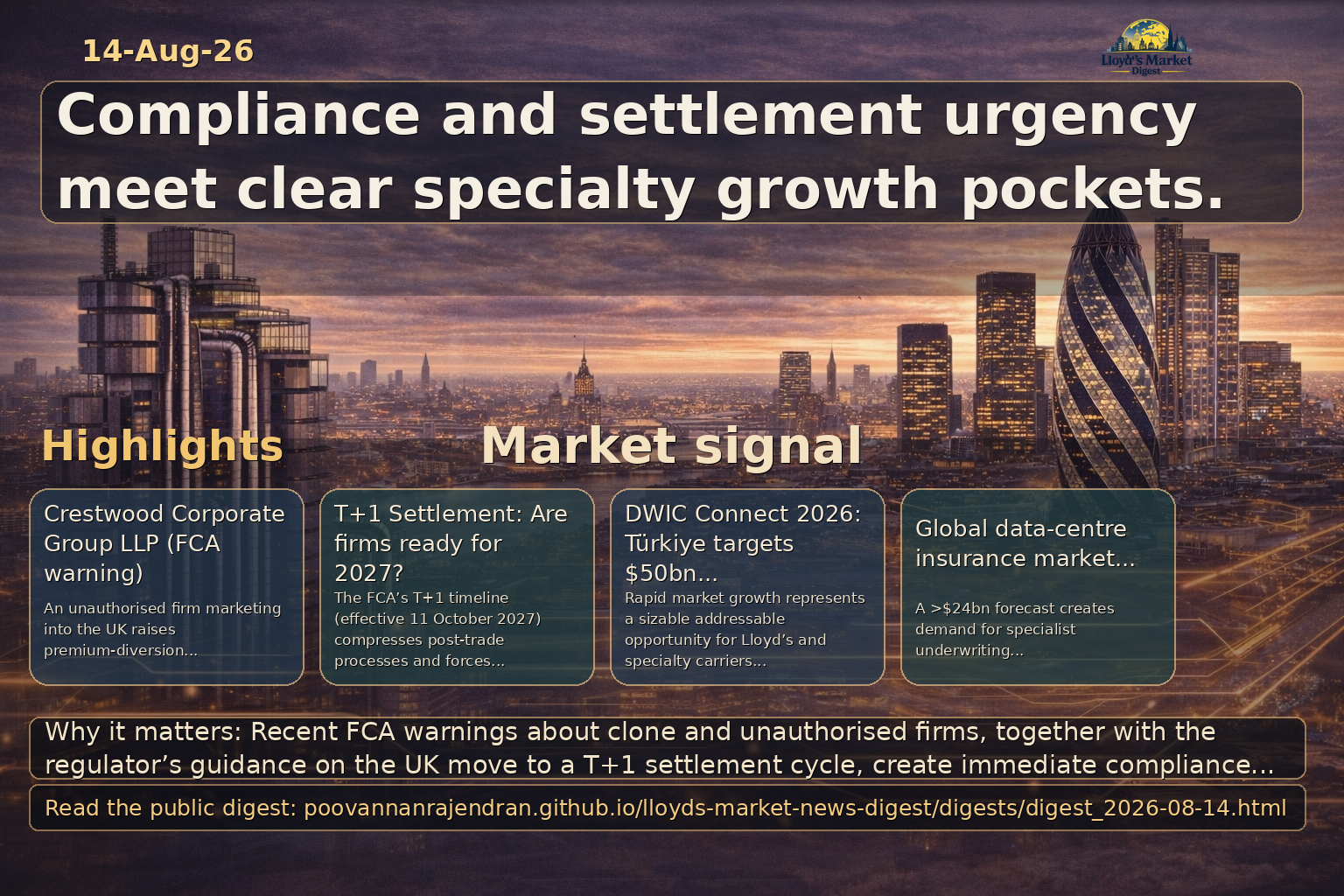
Why it matters: An unauthorised firm marketing financial products into the UK undermines market conduct safeguards and can expose brokers and syndicates to distribution channels that lack regulatory oversight, FSCS protection or FOS recourse—heightening counterparty and reputational risk.
- Restrict placement and distribution to counterparties with verifiable regulatory status; require evidence of authorisation and named regulatory contact points during onboarding
- Add contractual protections and indemnities for dealings with third parties, and insist on escrow or broker-controlled accounts for initial premium collection where appropriate
- Integrate periodic automated re-checks of authorised status for intermediaries and alert placement platforms to delist or flag non-compliant entities
Source: fca.org.uk
Why it matters: Cross-border entities presenting as advisors or intermediaries can exploit international complexity in reinsurances and specialty placements; gaps in jurisdictional checks create exposures in premium routing, reinsurance recoverables and AML compliance for Lloyd’s market participants.
- Require enhanced due diligence for cross-border intermediaries: local regulatory confirmation, beneficial ownership, and AML controls before any ceding or placement activity
- Placement platforms should maintain a verified directory of authorised intermediaries and surface jurisdictional licensing flags to underwriters and trading desks
- Strengthen reinsurance counterparty credit checks and require pre-transaction confirmation of custodial and settlement arrangements to protect recoverables
Source: fca.org.uk
Why it matters: The FCA’s T+1 guidance signals a material operational change by 11 October 2027 that will compress post-trade timelines. For Lloyd’s syndicates, global brokers and placement platforms, this increases the need for straight-through-processing, faster reconciliations, and more robust liquidity and collateral management across subscription and cross-border trades.
- Accelerate automation of post-trade workflows (trade capture to settlement): eliminate manual touchpoints, adopt ISO 20022 messaging where applicable, and validate STP across platform-to-custodian links
- Reassess liquidity and collateral strategies to support accelerated settlement windows, including intraday funding lines and real-time reconciliation capabilities for syndicates and carriers
- Coordinate market testing with platform vendors, custodians and brokers; create a Lloyd’s-specific implementation forum for connectivity, exception handling and contingency procedures
Source: fca.org.uk
Why it matters: Warnings about firms like this highlight persistent attempts to penetrate the UK market using unregulated entities. Such actors can solicit business that appears legitimate to underwriters and MGAs but lacks statutory protections, creating latent financial and legal liabilities for brokers and syndicates.
- Implement mandatory frontline training for brokers and platform client-facing teams to recognise unauthorised solicitations and spoofed communications
- Deploy domain and brand-monitoring services and integrate real-time alerts into platform onboarding workflows to detect impersonation attempts
- Update client contracts and onboarding terms to require confirmation of regulatory status and make clear that agents must be FCA-authorised to accept risk or handle client money
Source: fca.org.uk
Why it matters: Another unauthorised operation targeting UK clients reinforces the need for continuous monitoring of counterparties and proactive communications to the distribution chain. Failure to act increases the chance of fraud incidents that can erode broker and syndicate trust and complicate claims handling and recovery.
- Publish and circulate an updated list of authorised brokers and coverholders to underwriters and placement platforms; require reliance only on those entities for direct placement
- Implement transaction monitoring focused on unusual premium routing, rapid request-to-bind sequences, and new beneficiary accounts to detect diversion attempts early
- Coordinate incident reporting with the FCA and market bodies and run tabletop exercises to validate response playbooks across syndicates, brokers and platforms
Source: artemis.bm
Why it matters: The Bermuda Stock Exchange streamlining of repeat ILS listings materially speeds issuance post-settlement — improving time-to-market and operational certainty for catastrophe bond repeat issuers and placement advisors.
- Issuers and sponsors benefit from faster execution windows for renewals and top-ups, reducing basis and timing risk.
- Brokers and structurers can design repeat issuance strategies with tighter settlement-to-listing timelines.
- Placement platforms should operationalise the faster listing capability in client workflows and roadmaps to win repeat business.
Source: artemis.bm
Why it matters: Allianz projects rapid growth in the global data centre insurance market to 2030 — this identifies a large, high-value specialty line that intersects with technology risk, complex accumulations and opportunity for bespoke covers and ILS structures.
- Syndicates must develop underwriting competence and aggregation controls for data-centre portfolios to manage systemic accumulation risk.
- Brokers should build specialist placement desks and market-standard wording for AI campus and high-performance computing exposures.
- Placement platforms and reinsurers can explore parametric triggers and ILS instruments tailored to data-centre operational outage and construction risks.
Source: artemis.bm
Why it matters: Progressive’s renewal of sizeable CAT XoL towers underscores sustained demand for structured excess-of-loss capacity in U.S. hurricane exposures and the ongoing role of broker-led placements and capital layering.
- Brokers should structure multi-layer towers combining traditional reinsurers, retro and ILS triggers to optimise cost and attachment points.
- Syndicates and reinsurers must evaluate appetite for specific U.S. hurricane layers and adjust pricing to selective exposures.
- Placement platforms can expand capabilities to automate documentation, expedite due diligence and support cross-market syndication.
Source: businessinsurance.com
Why it matters: A workers' compensation ruling clarifies limits of constitutional arguments in coverage disputes, informing claims strategy and policy wording for occupational exposures placed by brokers with specialty syndicates.
- Implication: Reinforces that coverage disputes will be resolved within statutory workers' comp frameworks — reduces prospect of broader constitutional claims against insurers.
- Action for brokers/syndicates: Review policy language and endorsements for employee training/operational exposures to avoid allocation disputes.
- Placement platforms: Ensure intake workflows capture training-related exposures and indemnity arrangements to align with syndicate underwriting appetite.
Source: businessinsurance.com
Why it matters: A judge's refusal to extend a duty to defend for a cash lender in a $1bn fraud suit underscores litigation risk allocation and the importance of clear contractual protections — material for specialty lenders' liability placements and professional indemnity capacity at Lloyd's.
- Implication: Heightened clarity needed on contractual indemnities and insurer defense obligations where fraud or intentional conduct is alleged.
- Underwriting action: Syndicates should reassess KYC, representation warranties and exclusion drafting for financial institutions and fintech-related placements.
- Broker guidance: Negotiate precise policy triggers and allocate defense-cost burdens across layers to protect capital and limit protracted coverage disputes.
Source: businessinsurance.com
Why it matters: A forecasted boom in global data center insurance to 2030 represents a substantial specialty growth market for Lloyd's and international syndicates seeking capacity deployment and new product design.
- Market opportunity: Significant premium growth potential across physical damage, BI, contingent business interruption and cyber coverage for data center operators.
- Product implications: Syndicates and MGAs should develop tailored multi-peril programs combining engineering, cyber and resilience warranties/clauses.
- Distribution: Brokers and placement platforms must build technical placement capabilities and capacity aggregation tools to service large, global exposures efficiently.
Source: businessinsurance.com
Why it matters: Amynta Group's acquisition of Southern States signals ongoing consolidation in wholesale/broker distribution, with direct consequences for market access to Lloyd's syndicates and placement dynamics.
- Strategic impact: Aggregation of broker networks can centralize flow to preferred syndicates and shift negotiating leverage on commissions and terms.
- Syndicate response: Re-evaluate appetite and service-level commitments to integrated broker groups; consider exclusive or preferred arrangements.
- Platform implication: Placement systems must support consolidated broking operations, data-sharing and unified reporting across acquired entities.
Source: businessinsurance.com
Why it matters: Risk managers increasing use of captives for control and flexibility affects demand for fronting capacity, facultative placements and reinsurance relationships central to Lloyd's and specialty markets.
- Capacity shift: Growth in captives reduces some ceded volumes but creates steady demand for fronting and reinsurance solutions from syndicates.
- Product design: Syndicates should offer bespoke fronting arrangements, collateralized programs and pro-rata reinsurance to serve captive strategies.
- Broker advisory: Brokers need to provide integrated captive structuring, capital modelling and placement execution across London and global markets.
Source: globalreinsurance.com
Why it matters: Rapid premium growth and solid asset accumulation in Türkiye create a significant addressable market for Lloyd’s syndicates, global specialty carriers and brokers, especially in property, commercial lines and catastrophe-related products. However, sustained opportunities depend on managing earthquake exposure, inflation-linked claims and FX risk while leveraging local distribution and placement platforms to scale efficiently.
- Targeted market entry: prioritise property, commercial earthquake-exposed lines and specialty commercial risks; establish distribution alliances with large Turkish carriers and brokers to access established retail and corporate channels.
- Underwriting and modelling discipline: invest in updated nat‑cat models, granular exposure management and pricing that incorporates inflation and currency risk; consider parametric structures and retrocession to protect balance sheets.
- Placement and execution: use electronic placement platforms, delegated authority and binding authorities to scale capacity quickly; structure reinsurance and collateral arrangements to mitigate FX and regulatory capital volatility.
Source: insurancejournal.com
Why it matters: Australia’s minimum pay and required injury cover for gig delivery workers creates new employer-related liability and personal accident exposures relevant to specialty lines and placement strategies in global programs.
- Rewording and pricing: Syndicates and MGAs will need bespoke wordings for gig-worker occupational injury and wage-related liability cover, plus recalibrated pricing for elevated frequency of small BI/PAC claims.
- Placement friction: Brokers will face increased demand for micro‑policy or platform-integrated covers; placement platforms must support high-volume, low-premium transactions and automated endorsements.
- Capacity and reinsurance: Aggregation modelling should account for rapid scaling across jurisdictions; reinsurers will seek clarity on cover limits, exclusions for third-party auto liability and regulatory compliance clauses.
Source: insurancejournal.com
Why it matters: The Qeshm oil spill highlights escalation of maritime environmental loss from tanker attacks and shadow-fleet activity, directly affecting marine hull, P&I, cargo and environmental impairment exposures for Lloyd's syndicates and brokers.
- Environmental liability uncertainty: Syndicates must scrutinise war/terrorism vs. pollution exclusions and consider explicit coverage for state-attributed incidents and salvage costs.
- Claims and salvage costs: Expect elevated P&I and hull claims plus costly shoreline remediation; adjust retention strategies and escalation clauses in facultative placements.
- Sanctions and sanctions-avoidance risk: Brokers must enforce robust KYC on vessels and counterparties; placement platforms should flag exposures tied to shadow fleets and sanctioned entities.
Source: insurancejournal.com
Why it matters: The Caroline Bezengi salvage and large slick off Oman stresses immediate marine casualty response, salvage liability, and potential major pollution claims that impact specialty marine underwriting and facultative placement activity.
- Immediate cash drain and contingency planning: Syndicates and P&I clubs should price for high salvage and response costs and may need to fund emergency loss-control operations.
- War/terror and W&I exposures: Clarify breach attribution and origin of loss for coverage triggers; consider market guidance on handling losses in monsoon/operationally challenged environments.
- Broker advisory and placement speed: Brokers must coordinate fast facultative capacity with clear salvage, salvage-lien and remediation cost-sharing clauses; digital placement tools should support rapid evidence capture and claim notifications.
Source: insurancejournal.com
Why it matters: Intelligence warnings of sabotage and hybrid attacks in Europe increase political violence and terrorism aggregation concerns across specialty portfolios, influencing war-risk offerings, cyber-physical aggregation and placement diligence.
- Aggregation and concentration: Syndicates need updated scenario modelling for infrastructure sabotage across regions to avoid unexpected accumulation in property, energy and marine portfolios.
- War and sabotage wordings: Brokers should review war/terror endorsements, denial-of-service and sabotage triggers, and demand clarity on state-linked hybrid operations.
- Distribution and pricing: Placement platforms must surface geopolitical risk overlays and support rapid re-pricing; capacity providers may tighten terms or require co‑participations for exposed accounts.
Source: insurancejournal.com
Why it matters: Record low Rhine levels disrupting German industry signal inland-marine, supply-chain and business-interruption exposures that affect global specialty portfolios and treaty loss projections for European-focused books.
- Inland-marine and cargo risk: Increased trans-shipment to road/rail elevates physical loss and theft risk; underwriters should adjust rates and minimum transit conditions.
- BI and contingent BI: Downtime and alternate-transport costs will drive complex contingent BI claims; brokers must ensure extension wordings and sublimits reflect modal changes.
- Treaty and aggregation impact: Reinsurers and syndicates should incorporate inland-waterway stress scenarios into treaty exhaustion modelling and collateral planning.
Source: insurancetimes.co.uk
Why it matters: AI-led consumer discovery is emerging as a parallel channel to brokers and call centres, forcing carriers, MGAs and placement platforms to re-evaluate how appetites and quoting are exposed to automated agents and comparison tools.
- Audit distribution strategy to define where AI-driven channels should be supported vs where broker advisory remains primary
- Expose controlled appetite, rules and API-based quoting to authorised AI endpoints to capture incremental flows at point of discovery
- Ensure governance and audit trails for AI-driven quotes to preserve underwriting discipline and compliance across Lloyd’s and global specialty placements
Source: insurancetimes.co.uk
Why it matters: The commentary on spreadsheets versus storytelling highlights a capability gap: quantitative models must be complemented by commercial narrative to win complex placements and retain broker relationships.
- Embed commercial narrative skills in underwriting training to improve pitch quality and broker engagement in complex lines
- Combine model outputs with executive summaries and scenario narratives on placement platforms to aid broker decision-making
- Maintain governance that balances model integrity with pragmatic underwriting judgment for specialty, bespoke risks
Source: insurancetimes.co.uk
Why it matters: Marsh’s appointment of a global chief claims officer underscores claims advocacy as a broker differentiator and a strategic lever for client retention in complex international loss scenarios.
- Treat claims advocacy as a strategic product: strengthen triage, settlement speed and communication protocols with syndicates
- Syndicates should map broker claims advocacy capabilities when negotiating capacity for complex risks
- Integrate claims performance metrics into placement platforms so brokers and underwriters can assess claims alignment pre-bind
Source: insurancetimes.co.uk
Why it matters: A £120m capacity extension to an MGA signals continued appetite from rated carriers to deploy capital via delegated authority for property portfolios, increasing available capacity for brokers.
- Syndicates must monitor capital allocations to MGAs and adjust co-insurance or lead-follow strategies accordingly
- Brokers should leverage expanded MGA capacity to place larger and more complex property programmes quickly
- Placement platforms must support delegated authority workflows, capacity-tracking and compliance checks for MGAs and carriers
Source: insurancetimes.co.uk
Why it matters: The acquisition of a specialist power and construction claims adjuster reflects consolidation in loss-adjusting and the need for sector-specific expertise in complex, technical losses.
- Syndicates and MGAs should reassess their preferred adjuster panels and contractual SLAs for technical sectors
- Consider strategic partnerships or exclusivity arrangements to secure fast, expert on-site adjusting for high-severity sectors
- Ensure eTrading and claims platforms accommodate specialist adjuster data feeds to accelerate reserve setting and recovery workflows
Source: reinsurancene.ws
Why it matters: Historical reporting highlights early market interest in parametrics and illustrates Lloyd's product-development sensitivities; useful context for syndicates and brokers assessing innovation timing and stakeholder priorities.
- Reference point for parametric launches backed by global reinsurers, informing current parametric adoption strategies
- Example of Lloyd’s deliberate product timing—relevant when modelling new index or exchange initiatives
- Helps brokers position client conversations about index and alternative risk-transfer options given regulatory and market priorities
Source: reinsurancene.ws
Why it matters: IAG's FY26 results demonstrate how natural perils materially affect insurer earnings and drive reinsurance purchasing and treaty structuring decisions relevant to global specialty and Lloyd's capacity providers.
- Increased net perils costs highlight the need for catastrophe capacity and appropriate attachment structures for syndicates
- Improved underlying insurance margin signals selective underwriting resilience—useful when negotiating facultative and treaty terms
- Brokers should adjust placement strategy to reflect heightened perils volatility and reserve expectations
Source: reinsurancene.ws
Why it matters: Guy Carpenter's loss estimate for the US Midwest convective outbreak emphasizes aggregation risks from severe convective storms and the potential for multi-state insured loss events that affect reinsurance pricing and capacity placement.
- Event could rank among top SCS insured loss events—pressure on short-tail lines and proportional treaties
- Syndicates and reinsurers must review accumulation analytics and collateral requirements for metro-centric exposures
- Brokers need to provide granular loss modeling and policy-level aggregation analysis to clients and markets
Source: reinsurancene.ws
Why it matters: LM Re and Safehub’s parametric earthquake payout in Peru is a material proof point for sensor-enabled, event-triggered cover—directly relevant to Lloyd's syndicates, reinsurers and placement platforms exploring parametrics.
- Demonstrates operational viability of sensor networks and ShakeNet-triggered parametric products for localized earthquake risk
- Brokered placement (Price Forbes Latam) confirms intermediary role in scaling parametrics in LatAm and beyond
- Encourages syndicates to integrate parametric capacity alongside traditional indemnity offerings to improve speed of settlement and client retention
Source: reinsurancene.ws
Why it matters: Cotality’s property-level wildfire data reshapes underwriting, mitigation incentives and pricing for exposed portfolios—critical for Lloyd's syndicates writing US wildfire risk and for brokers advising clients on mitigation-linked terms.
- Property-level spread analysis enables differentiated pricing and targeted mitigation endorsements at policy inception
- Highlights the scale of exposure (2.5m properties; ~$1.4tn RCV) — imperative for treaty capacity planning and accumulation controls
- Placement platforms and MGAs can leverage these data sets to create bespoke wildfire products and risk-transfer structures
Source: artemis.bm
Why it matters: AM Best highlights that maturing partnerships with alternative capital allow reinsurers to exceed cost of capital — a core signal that ILS and structured capital are becoming durable, strategically relevant capacity sources for syndicates, brokers and placement platforms.
- Syndicates and carriers should reassess capital mix and cost-of-capital targets to incorporate stable third-party partnerships.
- Brokers must position clients to access diversified capacity solutions, blending traditional retrocession and ILS placements.
- Placement platforms and ILS managers can market partnership structures as repeatable solutions to investors seeking predictable returns.
Source: artemis.bm
Why it matters: Arch’s 27% drop in net property cat premiums and higher cessions to third-party capital evidences carriers shifting risk to external capital — a tactical dynamic reshaping supply for syndicates and brokers.
- Carriers and syndicates should formalise allocation frameworks for risk-retention versus transfer to third-party capital.
- Brokers must present comprehensive reinsurance/retro options that incorporate third-party capital and evaluate counterparty concentration.
- Placement platforms have an opening to capture ceded flows through managed-capital solutions and white-label reinsurance products.
Source: c.newsnow.co.uk
Why it matters: A dead NewsNow link signals broader risk: reliance on ephemeral aggregator content can erode underwriting/claims evidence, impede placement transparency and expose brokers, syndicates and platforms to regulatory scrutiny and client disputes. For the Lloyd's market and global specialty players, persistent access to source material and provable timestamps are essential for governance, auditability and reputational management.
- Institute mandatory capture and secure archival of third‑party content used in placements and client communications (PDF snapshots, timestamped hashes, central evidence repository).
- Contractually require data providers and aggregators to meet retention SLAs, provide notice of removals, and grant audit rights to brokers/syndicates; include indemnities for lost or altered content.
- Deploy continuous link‑integrity monitoring and alerting integrated with placement platforms and compliance workflows; escalate broken links to legal, underwriting and client‑communications teams for corrective action.
Source: risk.net
Why it matters: The white paper's emphasis on intraday pricing, valuation governance and private-credit/securitisation growth is material for Lloyd’s syndicates and global speciality brokers. These changes affect how exposures are priced, how capital and reserves are validated, and how placement platforms must support richer, time-sensitive data flows.
- Review valuation engines and market data feeds used for syndicate underwriting and collateral schedules; prioritise intraday refresh where exposures are mark-to-market sensitive.
- Embed vendor and model governance into syndicate sign-off processes; require documented data lineage and independent validation for securitised and private-credit positions.
- Mandate placement-platform support for enriched instrument metadata and timestamped valuations to enable brokers and underwriters to reconcile pricing and audit placement decisions.
Source: risk.net
Why it matters: The article on internal reporting demonstrates the strategic value of whistleblowing and internal-reporting datasets for governance and emerging-risk detection. Lloyd’s participants, brokers and platforms must incorporate these signals into risk oversight to meet rising regulatory expectations and to detect conduct, placement or operational issues earlier.
- Integrate internal-reporting feeds into the ERM and compliance dashboards used by syndicates and brokers; prioritise analytics to surface themes and repeat offenders across portfolios.
- Establish clear governance for how whistleblower data informs underwriting, remuneration and remediation decisions, ensuring confidentiality and regulatory-compliant handling.
- Design placement-platform workflows to capture and escalate conduct-related anomalies (eg irregular broker commission structures, non-disclosed conflicts) linked to internal-reporting outcomes for audit and regulator response.