Source: fca.org.uk
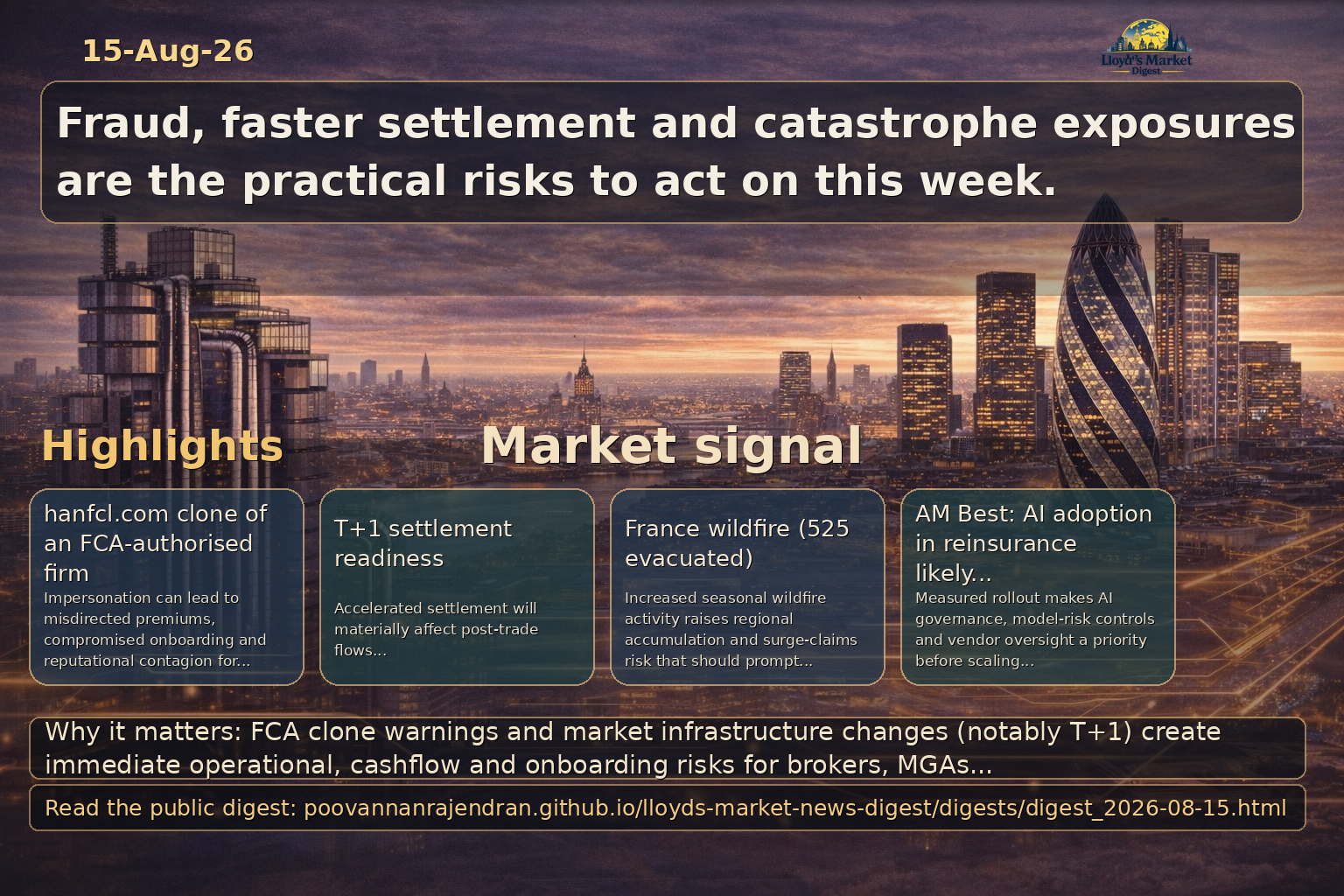
Why it matters: Clone sites impersonating FCA‑authorised firms create direct exposure for brokers, MGAs, syndicates and placement platforms through misdirected premiums, compromised customer onboarding and reputational contagion.
- Ensure all broker and scheme counterparties validate FCA status by FRN checks and certificate/domain verification before premium routing.
- Mandate trusted payment channels and multi‑party confirmation for large premium or deposit transactions to prevent funds diversion.
- Instruct placement platforms and syndicates to monitor market notices and implement incident response steps (client notification, freeze of suspicious accounts).
Source: fca.org.uk
Why it matters: Unauthorised investment or advisory brands can be used to solicit premium investments, captive funding or reinsurance collateral, exposing syndicates and assets under management to legal and recovery challenges.
- Require proof of FCA authorisation or equivalent regulatory licence for any asset manager, adviser or counterparty handling syndicate capital or collateral.
- Assess contractual protections and reserve the right to suspend transfers pending regulatory confirmation for unfamiliar counterparties.
- Communicate to placement platforms that dealings with unauthorised firms must be blocked and escalated to compliance for rapid remediation.
Source: fca.org.uk
Why it matters: Warnings about unauthorised promoters signal distribution-channel risk: brokers and syndicates may be targeted for cross‑border solicitation or fraudulent product placement without regulatory protections.
- Embed regulatory‑status checks into onboarding workflows for introducers and product providers, with automated flagging for non‑UK entities.
- Reinforce client disclosure and confirmation steps where products originate from jurisdictions outside established Lloyd's distribution networks.
- Coordinate with market associations and placement platforms to share intelligence on recurring unauthorised promoters.
Source: fca.org.uk
Why it matters: The banning and fining of senior executives for falsified documents and misleading statements is a salient reminder that third‑party due diligence and documentary validation must be heightened for M&A, capital injections and strategic partnerships affecting syndicates and brokers.
- Introduce forensic verification for critical documents (ownership, bonds, audited statements) in any syndicate M&A or capital-raising transaction.
- Strengthen pre‑deal reputational and regulatory checks on counterparty leadership and require warranties/indemnities tied to document accuracy.
- Report lessons learned to board-level conduct committees and integrate strengthened controls into governance and vendor selection policies.
Source: fca.org.uk
Why it matters: Unauthorised corporate entities presenting as legitimate advisory or corporate groups create counterparty, payment and contractual exposure for managing agents, syndicates and wholesale brokers.
- Insist on company registration checks, beneficial‑ownership verification and board member ID validation before executing contracts.
- Place contractual notice and suspension rights in placement and broking agreements to immediately halt dealings with suspected unauthorised entities.
- Coordinate with market intelligence teams and the FCA Warning List to dynamically update blocked-entity lists on placement platforms.
Source: reinsurancene.ws
Why it matters: MS Amlin's improved profitability and tightened combined ratio highlight disciplined underwriting in a London-headquartered specialty competitor — a signal for Lloyd's market dynamics and broker negotiation leverage.
- Improved COR suggests underwriting discipline that could sustain tighter pricing and selective capacity deployment in specialty lines.
- Brokers should anticipate stronger underwriting terms and prepare to demonstrate differentiated risk profiles to secure placement.
- Syndicates should stress-test exposure strategies versus competitors like MS Amlin when calibrating appetite for casualty and specialty lines.
Source: globalreinsurance.com
Why it matters: The report signals substantial premium expansion in Türkiye that will drive demand for international specialty capacity, create broker-led placement opportunities and necessitate enhanced catastrophe and currency risk management — all directly relevant to Lloyd's syndicates, global brokers and placement platforms planning market entry or capacity scaling.
- Capacity and product strategy: Syndicates should evaluate proportional and excess casualty/cat capacity deployments, and consider targeted facultative underwriting for earthquake and construction lines to capture growth while protecting balance sheets.
- Broker and distribution engagement: Global and Lloyd's-aligned brokers must deepen local partnerships, expand MGA panels and offer placement solutions that combine local distribution with international capacity to secure share of incremental premiums.
- Operational & risk controls: Invest in improved catastrophe modelling, currency hedging/reserving practices and streamlined digital placement connectivity to support faster quoting, clearer risk appetite communication and efficient retrocession purchasing.
Source: insurancejournal.com
Why it matters: The Top 100 agencies ranking informs distribution concentration and where syndicates and specialty insurers should prioritise broker relationships, referral flows and platform integrations for 2026–27 placements.
- Identify top-producing retail brokers for targeted authority agreements, delegation strategies and placement-platform onboarding to secure differentiated flow for syndicates.
- Assess potential consolidation or market-share shifts that could alter submission volumes to Lloyd's managing agents and affect quota-share planning.
- Caveat: ranked data are self-reported; underwrite relationship validation and independent market intelligence before capacity commitments.
Source: insurancejournal.com
Why it matters: A large wildfire in southwest France signals elevated seasonal catastrophe activity in Europe with implications for accumulation at-issue, parametric triggers and local claims exposure for property and specialty lines.
- Reassess regional accumulation models and policy wordings (eg. wildfire perils, defended-home clauses) when underwriting EU retail and specialty portfolios.
- Prepare rapid-response deployment with broker partners and placement platforms to manage surge in FNOL, alternative accommodation and business interruption claims.
- Consider tightening facultative referral thresholds and renewing reinsurance corridor terms where modelling shows correlated exposures across syndicates.
Source: insurancejournal.com
Why it matters: Cross-border wildfire near the Belgian border demonstrates geographic spread risk in temperate Europe and raises concerns about local authority evacuations, supply-chain interruption and cumulative insured losses.
- Evaluate cross-border accumulation—particularly for portfolios writing contiguous inland forested regions—and update exposure concentration controls.
- Coordinate with wholesale brokers to ensure clear claims escalation paths and pre-agreed indemnity solutions for evacuation and BI claims.
- Review catastrophe response clauses and parametric solutions as alternative mechanisms for rapid policyholder relief and capacity management.
Source: insurancejournal.com
Why it matters: Aviva's statement on maintaining profit targets despite wildfire impacts is a market signal on pricing adequacy, reserving discipline and competitive positioning relevant to Lloyd's syndicates and reinsurance counterparties.
- Use public commentary as a benchmark for competitor loss-absorption and to calibrate rate-on-line, especially for personal lines exposed to wildfire perils.
- Anticipate renewed scrutiny from capital providers and consider stress-testing syndicate portfolios against higher-loss scenarios for upcoming renewals.
- Leverage broker relationships to communicate underwriting discipline and justify pricing/restrictive terms to cedants and retail partners.
Source: insurancejournal.com
Why it matters: A third-party logistics/shipping provider data breach affecting a hardware crypto vendor highlights supplier cyber risk and the potential for attritional cyber-liability claims across diverse insureds.
- Require enhanced vendor due-diligence and cyber controls evidence for insureds with material third-party supply chains as part of placement acceptance criteria.
- Review policy triggers, notification obligations and crisis-management support in cyber wordings to ensure coverage clarity where vendor breaches lead to phishing and fraud losses.
- Encourage brokers to collect supplier security attestations and to use placement platforms to standardise evidence submission during placement.
Source: insurancetimes.co.uk
Why it matters: The Partners& hires deepen W&I and tax insurance advisory capability — a direct driver of placement volume and complexity for brokers, Lloyd's syndicates and lead insurers that provide transaction-related insurance capacity.
- Anticipate increased demand for W&I and tax insurance placements; syndicates should review appetite and capacity allocation for mid-market and sponsor-driven deals.
- Brokers and placement platforms must streamline documentation and turnaround times to capture incremental deal flow driven by specialist advisers.
- Competitive dynamic: former Gallagher hires suggest redistribution of intermediary relationships; underwriters should monitor broker conflicts and pricing leverage.
Source: insurancetimes.co.uk
Why it matters: Simply Business’s partnership with MGA Elevate Specialty to launch pet damage cover for landlords highlights continued product innovation via MGAs and digital channels — an addressable niche for specialty capacity and delegated authority models.
- Opportunity for syndicates to provide small-ticket specialty capacity via delegated authority frameworks to capture landlord/pet niche growth.
- Distribution-led products require clear claims protocols and legal-support features; underwriters should set measurable loss-adjustment guidelines and premium adequacy tests.
- Placement platforms and brokers should evaluate API integration and onboarding speed to scale distribution while preserving underwriting controls.
Source: insurancetimes.co.uk
Why it matters: Significant broker and claims leadership moves (Lockton, Marsh Risks, Bspoke, others) will reweight distribution relationships and influence how large placements and real-estate, specialty and claims-heavy accounts are handled.
- Shifts in senior broker coverage can redirect large and specialty placements; syndicates should reassess origination sources and panel exposure.
- Appointment of a global chief claims officer at a major broker/insurer group can alter settlement patterns and reserves — monitor for changing claims strategies affecting loss ratios.
- Underwriters and platforms should proactively engage incoming leaders to secure preferred access and align on data/claims reporting standards.
Source: insurancetimes.co.uk
Why it matters: The Insurance Times Fantasy Football League is a sector engagement initiative with relevance to broker/insurer relationship-building, talent retention and informal networking across distribution channels.
- Low-cost engagement platforms foster cross-firm relationships that can translate into referral and placement opportunities in the medium term.
- Employee engagement initiatives support talent retention at brokers and MGAs during a competitive hiring market; HR stability reduces client-churn risk for syndicates.
- While not a strategic channel for placements, such programs matter for brand and cultural affinity when negotiating panels and distribution agreements.
Source: insurancetimes.co.uk
Why it matters: Allegations of industry surveillance of activists and the broker-market support example (James Hallam stepping in for Anthony Jones clients) underscore reputational, compliance and rapid-onboarding risks that matter to syndicates, brokers and platforms.
- Activism and reputational incidents increase scrutiny of privacy practices and events/public-liability underwriting — review event-risk and privacy exclusions and cyber-physical exposure.
- Rapid client transfers between brokers highlight the need for placement platforms and capacity providers to support emergency onboarding and continuity-of-cover protocols.
- Regulatory and public scrutiny from such incidents can accelerate calls for greater transparency; market participants should coordinate through trade bodies and compliance teams.
Source: reinsurancene.ws
Why it matters: MS Reinsurance's H1 2026 growth and improved combined ratio demonstrate the competitive role of global reinsurers in providing capacity and earnings stability, relevant to syndicates and brokers seeking strategic partners.
- Stronger GWP and improved combined ratio enhance MS Re's capacity to support syndicates and large specialty placements.
- Brokers should position MS Re as a prospective lead or co-lead for specialty and treaty placements given its expanding footprint.
- Lloyd's syndicates and placement platforms can explore strategic retrocession and quota-share arrangements to optimize capital efficiency.
Source: reinsurancene.ws
Why it matters: Korean Re's uplift in underwriting and investment returns underscores the influence of non-traditional reinsurance capital and FX-linked investment returns on global capacity provision.
- Korean Re's healthier COR positions it as a credible source of capacity for Asia‑centric specialty placements and cross-border treaty business.
- Brokers should factor currency and investment volatility into pricing when placing with reinsurers exposed to foreign‑bond valuations.
- Syndicates can leverage relationships with well‑capitalised Asian reinsurers for regional risks and to diversify retrocession.
Source: reinsurancene.ws
Why it matters: IRB(Re)'s increased profit and improved underwriting result, despite top-line contraction, illustrate that disciplined underwriting can restore profitability in regional markets — a relevant precedent for syndicates and brokers in emerging markets.
- Regional reinsurers demonstrating underwriting discipline can continue to provide competitive capacity on tailored terms for local specialty risks.
- Brokers should highlight loss prevention and portfolio segmentation to negotiate improved terms with regional reinsurers.
- Syndicates writing emerging-market exposures should monitor regional reinsurers' appetite as potential partners for co‑reinsurance or facultative support.
Source: reinsurancene.ws
Why it matters: AM Best's analysis that AI adoption in reinsurance will be gradual but differentiating underscores the need for measured investment in analytics, model governance, and vendor oversight across Lloyd's participants and placement platforms.
- Insurers and syndicates should prioritise AI governance frameworks and model risk controls before scaling underwriting automation.
- Brokers and placement platforms must evaluate AI tools that enhance risk selection and pricing while ensuring explainability for underwriters.
- C-suite should balance investment in AI for efficiency gains against regulatory and operational risk exposures.
Source: artemis.bm
Why it matters: Guy Carpenter’s commentary on the rise of alternative capital underscores an irreversible structural shift: financial investors are creating incremental capacity but also increasing competitive pressure on traditional reinsurance, shaping syndicate capital strategies and broker placement approaches.
- Formalise an institutional engagement strategy to attract ILS and alternative capital, including tailored governance, reporting and liquidity profiles acceptable to financial investors.
- Innovate product design—layered collateralised solutions, sidecars, and parametrics—to capture financial investor demand while preserving underwriting discipline.
- Align placement platform capabilities and broker incentives to ensure efficient distribution of hybrid solutions that meet investor risk/return expectations and syndicate capital plans.
Source: artemis.bm
Why it matters: The August 9–11 US Midwest severe convective storm event risks ranking as a top‑10 industry loss, creating immediate implications for reinsurance programme design, pricing, and capacity across North American exposures held by global specialty carriers and Lloyd’s syndicates.
- Conduct an expedited aggregation of US severe convective storm exposure across syndicates and delegated authorities to quantify potential attachment and accumulation concentrations.
- Engage reinsurers and retrocession counterparties now to assess pricing and capacity changes; consider layering timing to preserve program continuity.
- Mobilise claims and catastrophe response teams, and prepare client communications and broker briefings to mitigate operational friction and reputational risk.
Source: artemis.bm
Why it matters: Liberty Mutual Re’s sensor‑triggered parametric payout in Peru demonstrates a scalable model for rapid indemnity using distributed seismic networks—relevant to syndicates, brokers and placement platforms seeking faster claims outcomes and reduced model risk.
- Assess parametric structures for seismic portfolios and pilot integrations with verified sensor networks to shorten settlement timelines and reduce claims handling costs.
- Develop standardised documentation and placement workflows with brokers and platforms to streamline distribution and investor due diligence for parametric risk placements.
- Review capital modelling to reflect lower liquidity drag and accelerated payout profiles from parametrics when evaluating collateralised capacity and ILS allocations.
Source: artemis.bm
Why it matters: PERILS’ downward revision of insured market loss for windstorm Nils highlights material uncertainty in catastrophe estimates and the importance of reconciled industry benchmarks for pricing, reserving and contract design.
- Reconcile in-house model outputs with third‑party industry loss estimates (e.g., PERILS) to validate loss picks used for pricing and reserving decisions ahead of renewals.
- Use estimate revisions to challenge assumptions around secondary perils and accumulation risk, and adjust retrocession strategies where warranted.
- Communicate divergence drivers to distribution partners and capital providers to maintain credibility and explain potential volatility in reserve and underwriting results.
Source: newsnow.co.uk
Why it matters: Indian higher-education headlines are low direct underwriting drivers for Lloyd’s but can create talent, reputational and regulatory risk for international insurers and brokers placing coverage for universities and education-related operations.
- Monitor regulatory actions and high-profile disputes at universities — potential triggers for D&O, employment practices liability and reputational harm claims.
- Brokers should inventory education-sector clients and consider tailored crisis-response clauses or PR-cost coverage in management liability placements.
- Placement platforms should tag education-sector counterparties to enable rapid exposure analysis if systemic issues escalate across multiple institutions.
Source: newsnow.co.uk
Why it matters: A failed or empty search result for “Cambridge” indicates data-feed/search quality issues; this is an operational intelligence signal for market platforms rather than an insurance risk itself.
- Immediate IT/BI action: validate feed ingestion and keyword mapping to avoid blind spots in market surveillance and client alerts.
- For placement platforms: ensure search accuracy to maintain broker trust and to surface locale-specific risks that underwriters need.
- Establish monitoring KPIs for news-feed completeness and implement fallbacks (alternate sources or alerts) when queries return no content.
Source: newsnow.co.uk
Why it matters: Farmers/grocers coverage flags agricultural and food-supply-chain stress — directly relevant to specialty lines (crop, product contamination, business interruption, commodity credit) and to syndicates evaluating climate-driven exposures.
- Underwriters should reassess parametric and crop policies in regions facing drought or labour/skills shortages that threaten yields and claims frequency.
- Brokers can develop advisory products linking risk-mitigation services (weather analytics, logistics resilience) with insurance placement to protect grocery chains and suppliers.
- Capacity managers should model correlated losses across commodity processors and grocery retailers to adjust appetite and retrocession needs.
Source: newsnow.co.uk
Why it matters: Local Cambridge news may have limited direct market impact but can produce reputational and talent-supply signals for insurers engaged with universities, tech spinouts, or talent recruitment for underwriting and platform engineering teams.
- Track notable incidents at academic institutions for potential D&O and reputational exposures if matters attract regulatory or legal attention.
- Syndicates recruiting technical talent from university hubs should assess retention/reputational risks and factor into HR and continuity planning.
- Brokers should maintain stakeholder mapping for university-linked clients to expedite advisory and crisis cover placements if incidents escalate.
Source: newsnow.co.uk
Why it matters: Coverage of the Jason Arday case is a reputational and governance signal; high-profile academic controversies can generate legal, employment and reputational liability claims that concern specialty D&O and media-liability underwriters.
- D&O underwriters should monitor developments for litigation triggers, allegations of misconduct, and potential regulatory investigations involving institutions.
- Brokers should brief university clients on crisis-management endorsements, reputation-protection expenses and employment-practices cover limits.
- Placement teams must be ready to provide rapid capacity for media, reputational and legal-cost exposures should claims or inquiries spread across multiple institutions.