Source: fca.org.uk
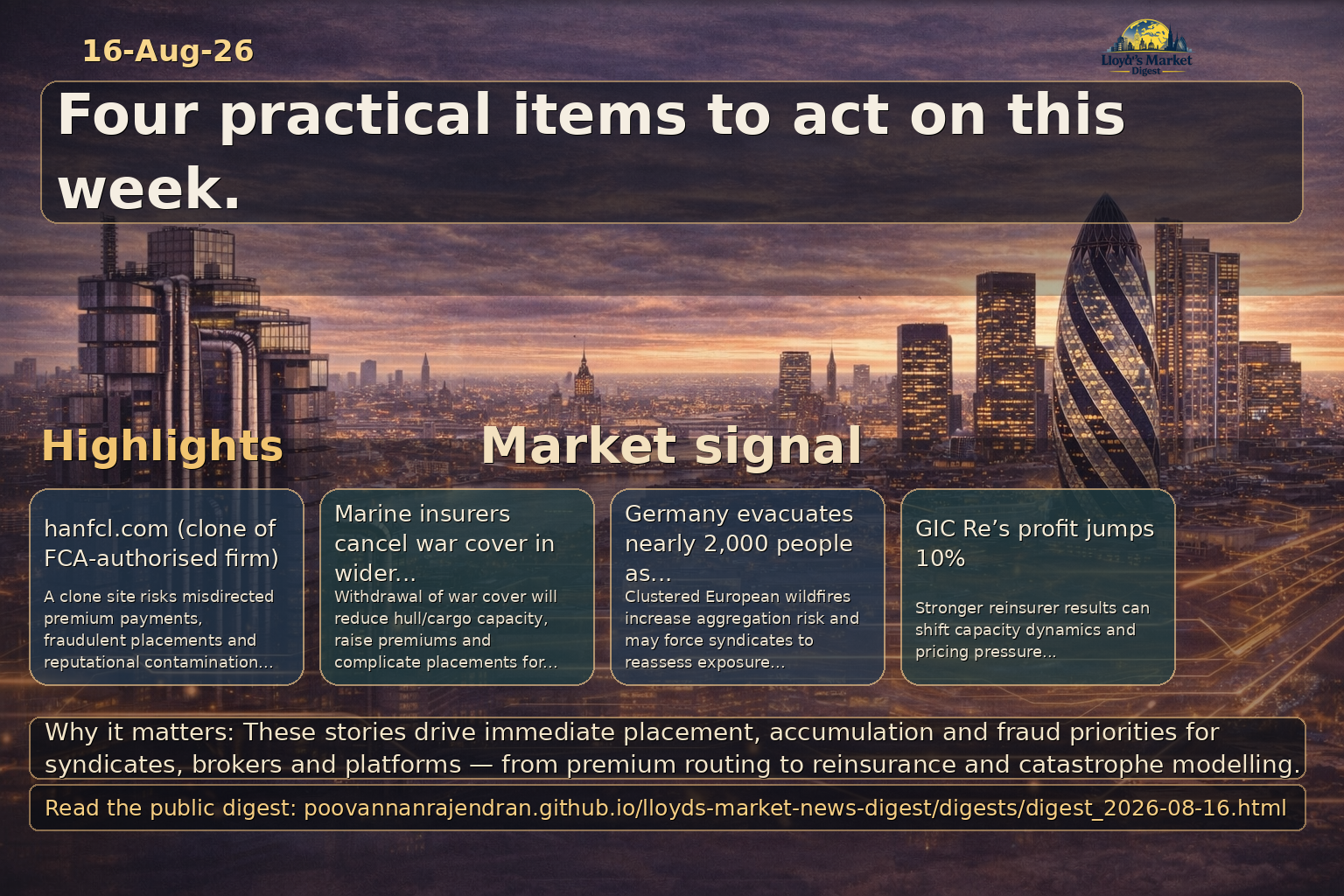
Why it matters: A clone site impersonating an FCA‑authorised firm creates direct exposure for brokers, syndicates and placement platforms via misdirected premium payments, fraudulent placements and reputational contamination that can undermine Lloyd’s distribution chains.
- Validate counterparties against the FCA register and use multi‑factor verification before accepting instructions or changing bank details.
- Block inbound payments or placement instructions from suspicious domains and require confirmation through pre‑agreed director level contact points.
- Integrate automated watchlist alerts into platform onboarding and operations and mandate immediate reporting to compliance and the FCA if impersonation is suspected.
Source: fca.org.uk
Why it matters: An unauthorised entity offering financial services presents customer protection, payment and credit risk; brokers and syndicates may be exposed if business or premiums are processed through or influenced by such operators.
- Treat unauthorised firms as high‑risk counterparties—bar them from direct placement activity and refuse policy or premium routing until regulatory status is confirmed.
- Issue client advisories and training to front‑line brokers to prevent redirection of client funds and ensure clients understand lack of FSCS/FOS protection.
- Require platforms to enforce third‑party validation of payees and implement transaction limits and escalation workflows for payments to previously unvetted recipients.
Source: fca.org.uk
Why it matters: Another unauthorised actor targeting UK customers signals a pattern of cross‑border solicitation risk that can bypass traditional Lloyd’s broking controls and expose capacity to non‑compliant intermediaries.
- Enhance KYC for international counterparties and require proof of regulatory permission in the target jurisdiction before accepting business or referrals.
- Synchronise platform onboarding checks with global regulator lists and deny access where a party is flagged as unauthorised or suspicious.
- Escalate suspicious approaches to group compliance, restrict access to placement platforms and document all client communications to preserve audit trails.
Source: fca.org.uk
Why it matters: The FCA ban and fines for senior executives who falsified documents underscore systemic risk from management misconduct: false representations of assets or ownership can distort capacity decisions, counterparty credit assessments and M&A activity across specialty markets.
- Require enhanced verification of audited financials, bond ownership and capital representations from counterparties—use independent confirmations or custodian checks for high‑value transactions.
- Introduce senior management attestations and targetted due diligence for counterparties involved in acquisitions, significant capital movements or bank interactions.
- Conduct a portfolio review of prior placements and exposures linked to the implicated firm; instruct legal and risk teams to assess remediation, recovery and regulatory notification needs.
Source: businessinsurance.com
Why it matters: GIC Re's improved profitability signals reinsurance market dynamics that influence capacity, pricing and capital allocation decisions across Lloyd's syndicates and global specialty reinsurers.
- Reassess retrocession purchasing and capital deployment given stronger reinsurer results and potential competitive price pressure
- Monitor alternative capacity entrants and adjust syndicate appetite to protect margin
- Ensure brokers factor reinsurer strength into renewal negotiations and placement strategy
Source: businessinsurance.com
Why it matters: Guy Carpenter's note on LatAm quake losses highlights regional nat-cat exposure that can cascade into higher reinsurance costs and placement complexity for London Market participants with Latin American portfolios.
- Conduct immediate exposure aggregation and concentration analysis for LatAm-exposed lines across syndicates
- Engage local brokers to verify policy wordings, claims protocols and recovery timelines
- Stress-test reinsurance layers and consider facultative/contingent capacity to protect earnings
Source: businessinsurance.com
Why it matters: IAG's profit decline from nat-cat losses is an indicator of underwriting and pricing stress that should prompt syndicates and brokers to revisit catastrophe assumptions and rate adequacy at upcoming renewals.
- Recalibrate catastrophe models and loading assumptions used for underwriting and pricing
- Push for improved rate adequacy and terms at renewal, especially in exposed segments
- Incentivise clients for loss mitigation to reduce frequency/severity and protect underwriting performance
Source: businessinsurance.com
Why it matters: Marine insurers withdrawing war cover in an expanded Red Sea zone materially affects marine hull/cargo capacity, premium levels and the complexity of placing risks that transit the route—relevant to London Market hull, commodity and freight business.
- Coordinate with P&I clubs, underwriters and brokers to define acceptable clause language and premium loadings
- Evaluate alternative coverage structures (private war, higher deductibles, voyage-specific placements) and update clause libraries on placement platforms
- Communicate routing/war-risk exposures to clients and adjust underwriting appetite for maritime cargo and energy-linked business
Source: businessinsurance.com
Why it matters: Executive profiles can signal shifts in distribution or underwriting strategy; leadership changes among brokers and industry figures may affect account handling, market access and negotiation dynamics with Lloyd's syndicates.
- Map leadership changes against distribution and client-servicing implications to anticipate shifts in flow or strategy
- Engage identified individuals early to preserve relationships and ensure continuity on key placements
- Monitor for consequential changes in broker appetite, product focus or alliance structures
Source: insurancejournal.com
Why it matters: The Top 100 independent P/C agencies ranking signals consolidation and scale among retail distributors, directly affecting access to retail flow, bargaining power with carriers and the design of distribution-led products relevant to Lloyd's syndicates and specialty insurers.
- Broker consolidation concentrates placement flow — syndicates must prioritize strategic broker relationships and tailor appetite documents to maintain market share.
- Larger retail agencies accelerate demand for delegated authority (MGAs) and integrated placement-platform workflows; syndicates should tighten governance and data requirements.
- Placement platforms and API-enabled connectivity become leverage points for speed-to-bind and real-time exposure aggregation to support risk selection and accumulation control.
Source: insurancejournal.com
Why it matters: A significant wildfire in southwest France with mass evacuations elevates near-term property loss potential and highlights exposure concentration in flammable forested regions — an immediate focus for European property writers and reinsurance buyers.
- Underwriters and modelers should reassess wildfire footprint and secondary perils for exposed portfolios, updating accumulation and reserving assumptions for Lloyd's syndicates.
- Claims operations and catastrophe response teams must be readied for household, commercial and business-interruption claims in affected regions; reinsurers should monitor early loss notifications.
- Brokers and placement platforms need to flag at-risk accounts and expedite facultative placements or risk-transfer solutions where primary capacity or terms are inadequate.
Source: insurancejournal.com
Why it matters: A large wildfire in western Germany with mass evacuations reinforces the potential for clustered European wildfire losses and cross-border accumulation — a material event for catastrophe modelling, exposure management and capacity deployment across specialty portfolios.
- Aggregation risk across European book of business should be re-evaluated; syndicates must ensure exposure collars and accumulation controls remain effective under correlated inland fire scenarios.
- Potential spike in BI and community recovery claims can pressure combined ratios; proactive reinsurance purchasing and retro adjustments may be required by carriers.
- Brokers should review client risk mitigation and place short-term excess capacity where policyholders face acute vulnerability, leveraging placement platforms for speed and documentation.
Source: insurancejournal.com
Why it matters: Aviva's public assurance that profitability targets remain intact despite wildfire exposure provides market signalling on capacity resilience and pricing dynamics, influencing competitor behaviour, reinsurance negotiations and Lloyd's syndicate strategies.
- Carrier statements of resilience can temper rate-hardening momentum; Lloyd's syndicates should avoid complacency and validate pricing adequacy against modeled and emerging losses.
- Stable profitability messaging may affect reinsurance terms and timing of treaty renewals — underwriters must stress-test scenarios to defend margin.
- Brokers should use insurer stability data as leverage to negotiate disciplined terms for specialty risks while pushing for appropriate risk-adjusted pricing.
Source: insurancejournal.com
Why it matters: A data breach at a shipping provider exposing thousands of customer records highlights third-party supply-chain vulnerabilities that create increased social-engineering and privacy-liability exposure for insureds and potential claims pathways for cyber policies.
- Underwriters must broaden cyber underwriting to capture vendor and logistics-chain exposures, and refine exclusions/endorsements for supply-chain incidents.
- Expect an uptick in phishing and social-engineering losses tied to exposed PII; claims teams and cyber carriers should prepare for increased incident response demand.
- Brokers and placement platforms should require proof of vendor security controls in submissions and incorporate vendor-risk screening in placement workflows.
Source: insurancetimes.co.uk
Why it matters: Expansion of Partners&' M&A and W&I advisory capabilities signals growing broker-led demand for specialist warranty & indemnity and tax insurance placements; this will affect how Lloyd's syndicates and specialty carriers allocate capacity to mid-market transactions.
- Increases volumes of bespoke W&I and tax risk placements, pressuring syndicates to develop underwriting appetite and streamlined slips
- Enhances competition among brokers for corporate M&A mandates, strengthening large brokers' leverage with Lloyd's and global specialty carriers
- Creates opportunity for placement platforms and MGAs to offer accelerated binding workflows and delegated authority for standardised W&I exposures
Source: insurancetimes.co.uk
Why it matters: Simply Business' pet damage landlord product — underwritten with MGA Elevate Specialty — exemplifies distribution-led niche product innovation; it requires tailored capacity and efficient placement via MGAs and digital platforms rather than broad-market treaty capacity.
- Drives demand for capacity from specialty carriers and Lloyd's syndicates willing to underwrite narrow, high-frequency landlord exposures
- Highlights role of MGAs and digital brokers in product design, pricing and claims handling — necessitating placement platform integration
- Regulatory change (renters' rights) will increase product uptake and requires underwriters to re-evaluate appetite and aggregation modelling
Source: insurancetimes.co.uk
Why it matters: Concentration of senior hires across brokers and claims leadership (including Marsh Risks) will materially affect market relationships, negotiating dynamics with syndicates and the strategic deployment of placement technology and reinsurance arrangements.
- Senior broker appointments strengthen negotiating position with Lloyd's and specialty carriers, potentially compressing margins for syndicates and improving terms for clients
- New claims leadership elevates expectations on loss mitigation, reserving and syndicate collaboration — influencing underwriting profitability metrics
- Regional real estate and specialist distribution hires signal incremental demand for targeted capacity and bespoke placement solutions
Source: insurancetimes.co.uk
Why it matters: Although consumer-focused and cultural in nature, sector initiatives like the Insurance Times fantasy league have limited direct market impact but serve as low-cost engagement tools that support broker-client networks and internal relationship capital important for referral and placement activity.
- Supports informal relationship-building among intermediaries and carriers that can facilitate introductions on complex placements
- Reinforces broker brand and client engagement, indirectly supporting retention in an environment of distribution consolidation
- Minimal underwriting or syndicate impact, but a useful cultural tool for regional and sectoral networking
Source: insurancetimes.co.uk
Why it matters: Weekly market roundups highlighting protester allegations and intermediary failures underscore mounting reputational and operational risks; Lloyd's, syndicates and brokers must factor stakeholder activism and distribution continuity into governance and placement practices.
- Activist claims increase reputation risk for carriers and may prompt underwriters to review policy wordings and surveillance exposures
- Intermediary failures and trade-body interventions heighten the importance of distribution resilience and contingency planning for capacity continuity
- Market communications and proactive engagement with trade bodies will be essential to defend underwriting practices and maintain access to institutional clients
Source: reinsurancene.ws
Why it matters: The Westfield update is material for market stakeholders because it demonstrates profitable top-line expansion in specialty lines, which affects broker placement strategies, competition for capacity with Lloyd’s syndicates, and reinsurer appetite. The combination of strong new-business momentum and a sub-95% combined ratio signals operational leverage that informs competitor benchmarking, distribution negotiations, and capital deployment decisions.
- Distribution impact: Rising, profitable capacity from a global specialty carrier increases leverage with brokers and placement platforms—brokers may steer more flows to carriers offering disciplined pricing and execution, pressuring some Lloyd’s syndicates to sharpen propositions or collaborate via delegated authority/platform agreements.
- Underwriting and reinsurance: A 94.3% combined ratio alongside 25% GWP growth indicates sustainable underwriting margins; syndicates and reinsurers should reassess treaty structures, attachment points and pricing to reflect improved carrier economics and potential changes in cedant behaviour.
- Strategic responses: Market participants (syndicate leaders, brokers, platform operators) should evaluate product differentiation, selective capacity deployment, and potential partnerships or M&A to retain access to profitable business lines and to compete for broker-sourced flows.
Source: newsnow.co.uk
Why it matters: Search endpoint returning no content indicates feed or ingestion issues; impacts market intelligence, client portals and placement platform UX.
- Implement automated validation to detect empty or error search endpoints before content reaches broker/syndicate dashboards
- Adjust aggregator filters to suppress zero-content results and reduce noise in market intelligence feeds
- Engage the data provider to resolve root-cause and update SLAs for feed integrity and alerting
Source: newsnow.co.uk
Why it matters: Indian higher education developments are not core Lloyd's business but can influence talent pipelines, D&O/professional indemnity exposures and regional regulatory risk for underwriters and brokers operating in India.
- Direct brokers and local market intelligence teams to monitor regulatory or high-profile academic disputes that could trigger professional liability or reputational claims
- Assess appetite for education sector PI, campuses and related cyber exposures within Asia-focused syndicates
- Incorporate targeted India-education filters into placement-platform newsfeeds to surface pertinent items for underwriting and renewals teams
Source: newsnow.co.uk
Why it matters: Another empty search page for the term ‘Cambridge’ signals recurring feed/search hygiene issues that degrade platform reliability for brokers and syndicates relying on curated intelligence.
- Strengthen ingestion rules to identify and quarantine empty search results from external aggregators
- Log and trend empty-query occurrences to prioritise remediation with the content provider
- Ensure broker-facing platforms present clear fallback messaging rather than blank search screens to preserve trust and UX
Source: newsnow.co.uk
Why it matters: Farmers/grocers coverage is directly relevant to global specialty underwriters: agriculture supply-chain risk, parametric products, business interruption and food fraud exposures are active market opportunities for Lloyd's syndicates and brokers.
- Flag agricultural and food-chain volatility as a priority sector for syndicates developing parametric and hybrid risk-transfer solutions
- Direct broking teams to package supply-chain intelligence into tailored panels for retail and wholesale clients, emphasising climate and drought scenarios
- Use placement-platform analytics to track regional crop/stable commodity news to inform pricing, appetites and facultative referrals
Source: newsnow.co.uk
Why it matters: Local Cambridge news can affect university-related liabilities, campus property exposures and reputational risk — relevant for underwriters of higher education, cyber and D&O lines.
- Monitor significant Cambridge developments for potential D&O, professional indemnity or campus liability triggers that affect syndicate portfolios
- Coordinate with academic institution clients and brokers to review existing policies and controls following high-profile local incidents
- Ingest geofenced local news into syndicate exposure maps to refine accumulation management for education sector risks