Source: fca.org.uk
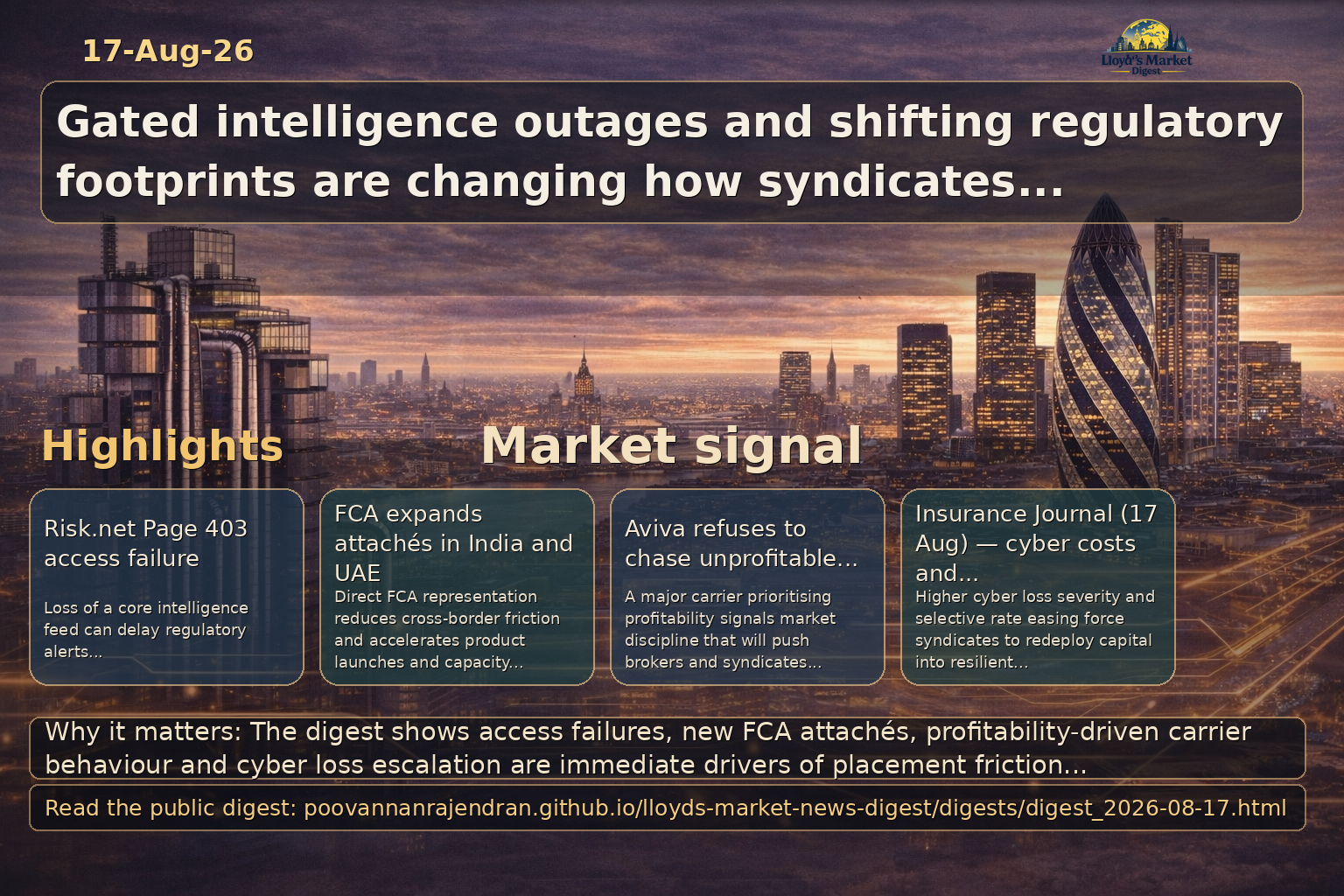
Why it matters: Direct FCA representation in India and the UAE materially affects the Lloyd's ecosystem by improving channels for regulatory dialogue, supporting UK market exports and reducing friction for cross-border placements — all of which influence syndicate capacity, broker distribution and platform operations.
- Commercial opportunity: Attachés can help address licensing, market access and distribution barriers, enabling brokers and syndicates to accelerate product launches and capacity deployment into India and the Gulf.
- Placement platform and operational impact: Increased regulatory dialogue is likely to prioritise interoperability, data standards and cross‑border reporting — platforms should fast‑track governance, API readiness and local market integrations.
- Heightened supervisory expectations: Closer FCA presence increases scrutiny on conduct, AML/CTF, outsourcing and claims handling; market participants must deepen regulatory engagement, enhance record‑keeping and align policy wordings to local regulatory expectations.
Source: insurancejournal.com
Why it matters: The August 17 Insurance Journal issue aggregates market indicators—rate movements, cyber loss escalation, M&A slowdown and distribution rankings—that directly inform underwriting strategy, capital allocation and placement decisions across Lloyd's syndicates, global specialty insurers, brokers and digital platforms.
- Pricing and portfolio: Continued global commercial rate easing (except casualty) requires syndicates to proactively redeploy capital into resilient classes, refine exposure limits and tighten underwriting to protect combined ratios.
- Cyber and AI exposures: Record average data breach costs (~$5M) plus insurer interest in AI exclusions demand upgraded cyber underwriting, clearer policy wordings, and targeted capacity from specialty cyber syndicates and broker markets.
- Distribution and M&A dynamics: A 15% slowdown in M&A and Top 100 agency insights change broker bargaining power and consolidator behavior—placement platforms should prioritize seamless integration and value‑added analytics to retain broker flow.
Source: insurancejournal.com
Why it matters: Regional West edition highlights operational CAT risk (wildfires affecting power infrastructure), targeted product launches (life‑sciences product liability, condo/flood), and stability in certain commercial lines—information critical for syndicates, specialty underwriters, brokers and placement platforms assessing regional appetite and product distribution.
- Concentration and accumulation: Wildfire risk to the power sector elevates aggregation risk for Lloyd's syndicates and international reinsurers; immediate actions should include exposure mapping, increased third‑party engineer engagement and tightened attachment terms.
- Specialty product growth: Travelers’ life‑sciences product liability expansion and Kin’s condo/flood launches signal niche opportunities—brokers and platforms should position tailored placement solutions and specialized underwriting capacity to capture payroll and retail distribution growth.
- Regional pricing signals: Stabilization in California comp premiums and targeted product launches indicate selective underwriting stability; syndicates and brokers should balance regional appetite with catastrophe capital modelling and seek strategic partnerships with MGAs and platforms for speed to market.
Source: insurancetimes.co.uk
Why it matters: Aviva’s public refusal to pursue unprofitable commercial lines in a soft market is a high‑profile example of rate and profitability prioritisation that will influence broker behaviour, redeploy capacity within specialty markets (including Lloyd’s syndicates), and accelerate demand for smarter placement platforms and analytics.
- Market discipline signal: A major insurer openly prioritising technical rate strength reinforces a broader pricing correction. Syndicates and specialty carriers can justify selective appetite expansion, but must maintain underwriting standards to avoid repeating prior margin compression.
- Broker and client implications: Brokers will need to intensify risk‑selection advisory, reprice renewals proactively, and prepare for elevated client churn and placement friction—requiring strengthened client communication, alternative capacity sourcing and fee/commission model reviews.
- Platform and capacity dynamics: Placement platforms and MGA/distribution technology providers should prioritise appetite transparency, real‑time pricing feeds and analytics to capture flows leaving generalist carriers. Reinsurers and capital providers will reassess deployment, favoring well‑underwritten syndicated business over volume growth.
Source: reinsurancene.ws
Why it matters: The historical Reinsurance News archive entry (H1 catastrophe losses and commentary on market discipline) provides a benchmark and behavioural insight relevant to syndicate capital planning, catastrophe modelling and renewal positioning at Lloyd's and in global specialty markets.
- Use historical catastrophe-loss benchmarks to stress-test syndicate capital models and validate loss estimation assumptions at renewal.
- Reinforce reinsurance and retrocession programme design—price adequacy and attachment points should reflect the memory of large-loss periods to avoid margin erosion.
- Embed market-discipline measures (underwriting limits, exposure aggregation controls) and communicate them to brokers and placement platforms to preserve capacity and reduce adverse selection.
Source: reinsurancene.ws
Why it matters: Kin's Q2 2026 growth highlights the momentum of direct-to-consumer models and insurtech distribution in personal lines, a trend that impacts broker market share, data availability for underwriting and the need for syndicates and placement platforms to integrate digitally with MGAs and insurtech partners.
- Syndicates should evaluate strategic capacity partnerships or delegated authority facilities with high-growth insurtech MGAs to secure profitable volume and diversify distribution.
- Brokers must accelerate digitisation of placement workflows (API connectivity, real-time quoting) to remain relevant and to capture referral flows from D2C channels.
- Placement platforms should prioritise data ingestion, automated binding and performance metrics to support rapid partner onboarding and to provide underwriters with the telemetry needed for pricing and portfolio management.
Source: reinsurancene.ws
Why it matters: The appointment of a senior lead for private equity and transactional risk at a brokerage underscores growing demand for specialised transactional insurance solutions. This trend is directly relevant to Lloyd's syndicates and global specialty carriers seeking to scale M&A-related and financial-institutions lines.
- Syndicates should broaden product suites and capacity for transactional risk (representations & warranties, tax, contingent liabilities) to capture fee-accretive, short-tenor business tied to deals.
- Brokers need to invest in specialist teams and advisor relationships to originate mandates and to structure bespoke placement strategies for private equity clients.
- Placement platforms must offer deal-centric workflow features (timed binding, tranche management, document exchange) to support the cadence and confidentiality requirements of transactional risk placements.
Source: newsnow.co.uk
Why it matters: Coverage implications from Israeli domestic politics: named far‑right political actors can drive elevated political violence, civil unrest and targeted sanctions risk that materially affects war, terrorism and political risk lines placed through Lloyd's syndicates and global brokers.
- Immediate review of war/terrorism wordings and political violence exclusions for Middle East portfolios; refresh accumulation modelling for affected geographies.
- Brokers to flag clients and counterparties for enhanced sanctions and KYC screening; syndicates to assess potential reputational and sanctions contagion to appetite.
- Placement platforms to implement near‑real‑time alerts for quotes bound in affected jurisdictions and enable swift redeployment of capacity or attachment amendments.
Source: newsnow.co.uk
Why it matters: High‑profile U.S. political figures can influence foreign policy and negotiation dynamics in the Middle East, with downstream effects on sanctions regimes, treaty exposures and D&O/EML litigation risk relevant to specialty underwriters and brokers.
- Assess treaty and facultative reinsurance exposures to shifts in U.S. policy that could change sanctions or trade restrictions affecting insured risks.
- Underwriters of D&O/EML and political risk should flag increased litigation/reputational exposures where insureds interact with named political actors.
- Brokers and placement platforms should ensure named‑party screening is current and that capacity holders are briefed on rapid regulatory or policy changes that could affect placement terms.
Source: newsnow.co.uk
Why it matters: Search result noise and null matches (no content found) are operational issues for placement platforms and brokers: excessive low‑value alerts consume underwriting and broking resources and can mask material signals.
- Platform teams should tune search and alert algorithms to prioritise material market signals and reduce false positives that distract underwriters and brokers.
- Implement governance to classify alerts by materiality for syndicates and broking desks to ensure SLA targets for response and escalation.
- Use periodic audits of feed taxonomy and filters to prevent unrelated consumer or entertainment queries from triggering specialty insurance workflows.
Source: newsnow.co.uk
Why it matters: Major athletics events create exposures across event cancellation, non‑appearance, liability and travel risks — lines often placed by specialty brokers and capacity-providers within Lloyd's syndicates and delegated authority platforms.
- Underwrite contingent event and cancellation exposures with updated terrorism/political violence and communicable disease clauses reflecting current geopolitical context.
- Brokers to verify aggregate exposures across multiple events to prevent undesirable accumulation within a single syndicate or platform.
- Placement platforms should ensure rapid issuance and digital attestations for event organisers, plus clear capacity mapping for peak-concentration management.
Source: newsnow.co.uk
Why it matters: High-profile athlete coverage (personal accident, endorsement income protection, event liability) remains a niche but material component of specialty portfolios; celebrity incidents can trigger media, reputational and contingent liability exposures for syndicates and brokers.
- Review personal accident and endorsement cancellation wordings for celebrity athletes for clarity on injury, non‑appearance and publicity clauses.
- Syndicates to quantify aggregation risk where a single promoter or agency concentrates celebrity‑linked liabilities across multiple policies.
- Brokers should ensure rapid claims notification pathways and PR coordination clauses are in place for high‑profile insureds.
Source: risk.net
Why it matters: A blocked Risk.net page signals a failure in access to a core industry intelligence source. For Lloyd's brokers, syndicates and placement platforms, such interruptions can erode decision quality on capacity deployment, pricing, sanctions and regulatory changes. The technical cause may be benign (expired token, incorrect URL or IP restriction) but the business impact is material: delayed signals, operational friction for placement teams and potential reputational exposure if clients perceive loss of market awareness.
- Conduct an immediate entitlement and access audit: confirm corporate subscriptions, SSO/API credentials, IP whitelisting and token validity; ensure a single source of truth for vendor credentials with automated renewals.
- Implement redundancy in intelligence: establish alternative feeds, vendor overlap for critical topics (regulatory, sanctions, capacity shifts) and an internal distribution protocol so placement and underwriting teams receive alerts even if one provider is inaccessible.
- Strengthen vendor contracts and incident SLAs: require rapid remediation timelines, outage reporting, and escalation contacts; consider content escrow or API access clauses to preserve continuity for underwriting and broker advisory functions.