Source: globalreinsurance.com
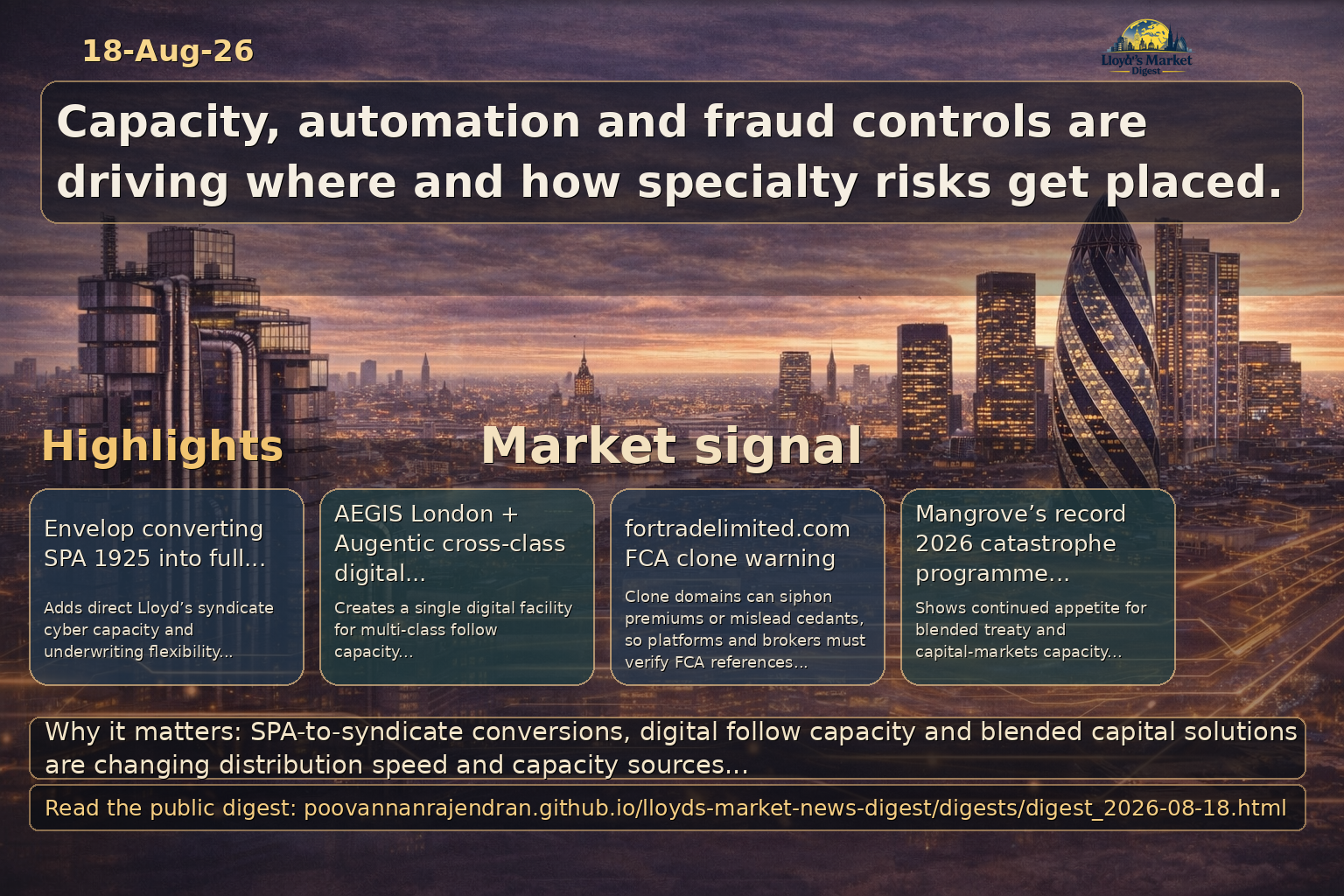
Why it matters: Envelop's move to convert SPA 1925 into full Syndicate 1925 at Lloyd's underscores a continuing shift of cyber-focused capital into Lloyd's platform, enabling expansion into casualty and specialty lines and offering brokers direct syndicate capacity for cyber treaty and related specialty placements.
- Scale and diversification: syndicate status provides growth capacity and underwriting flexibility to expand beyond cyber reinsurance into complementary specialties.
- Data-driven underwriting: Envelop's analytics-led approach exemplifies how Lloyd's entrants leverage data to differentiate cyber and casualty appetite.
- Distribution impact: brokers and placement platforms gain an additional Lloyd's syndicate with treaty cyber capability, improving options for cedants seeking tailored reinsurance solutions.
Source: reinsurancene.ws
Why it matters: Envelop Risk’s transition from SPA 1925 to a full Lloyd’s syndicate (1925) signals continued confidence in data-driven cyber underwriting and demonstrates Lloyd’s receptivity to SPA-to-syndicate conversions that scale specialist capacity.
- Expansion of cyber capacity: full syndicate status increases distribution reach and ability to write broader treaty and facultative cyber products across Lloyd’s platform.
- Competitive differentiation: Envelop’s analytics/AI capabilities will set higher expectations for cyber risk modelling and portfolio management among other syndicates and MGAs.
- Board-level imperative: review strategic alliances with cyber specialists, consider co-investment or follow-line participation, and update reinsurance and aggregation controls for expanding cyber exposures.
Source: reinsurancene.ws
Why it matters: AM Best data placing Lloyd’s atop non-IFRS reinsurers highlights the marketplace’s sustained leadership in global specialty and reinsurance placement, reinforcing its strategic value to brokers and syndicates.
- Affirms Lloyd’s as a primary destination for complex, cross-border specialty risks—supporting continued broker reliance on syndicates for bespoke capacity.
- May shift competitive dynamics and pricing leverage in treaty negotiations as Lloyd’s-originated volumes and brand prominence rise.
- Executives should capitalise on Lloyd’s scale by enhancing distribution alignment, governance and capital-efficiency measures to defend and grow specialty share.
Source: fca.org.uk
Why it matters: An FCA warning that a firm is operating without authorisation signals heightened fraud risk to clients and distribution partners; unauthorised entities can siphon premiums, avoid regulatory protections, and create exposure for brokers and platforms that fail to detect them.
- Immediate client and intermediary advisory: notify affected clients and distribution channels that the firm is unauthorised and reinforce that transactions with it carry no FSCS or Ombudsman protection.
- Platform and placement controls: block the entity across placement platforms, check recent submissions or premium flows for diversion, and review onboarding exception reports for similar names or aliases.
- Strengthen verification and escalation: require direct confirmation of FCA authorisation reference numbers for new counterparties, escalate mismatches to compliance and report suspicious activity to the FCA and market intelligence hubs.
Source: fca.org.uk
Why it matters: A clone of an FCA-authorised firm is a targeted impersonation risk that can erode trust between cedants, brokers and syndicates; clones may be used to gather premium payments, mislead cedants about capacity or terms, or to impersonate brokers on placement platforms.
- Verify counterpart identity in workflows: require brokers and platform users to validate counterpart contact details (email domains, phone numbers) against FCA register entries before progressing placements or premium transfers.
- Communicate with syndicates and MGAs: alert underwriters and delegated authorities to recent cloning patterns so binding authorities and authority limits can be reviewed for potential misuse.
- Market-wide detection measures: implement pattern detection for slight-name variants, monitor domain registrations and use shared blacklists or APIs to prevent impersonation across distribution channels.
Source: fca.org.uk
Why it matters: Another clone instance reinforces that impersonation is systematic; multiple clones magnify the risk of successful frauds and indicate attackers are rotating domains and contact details to bypass controls used by brokers, syndicates and placement platforms.
- Adopt persistent screening and threat intelligence: integrate automated checks for newly registered domains and known-clone indicators into onboarding and platform authentication processes.
- Operational response coordination: set up a cross-market incident response protocol to rapidly withdraw fake profiles, notify payment processors, and coordinate client communications to limit premium misdirection.
- Embed stronger contractual and payment safeguards: require insureds and brokers to use verified escrow/payment channels, apply multi-factor authorisation for changes to bank instructions, and incorporate explicit representations about FCA status in placement confirmations.
Source: artemis.bm
Why it matters: Mangrove’s record reinsurance programme and concurrent $111m cat bond sponsorship indicate continuing insurer appetite for blended reinsurance capacity—combining traditional facultative and treaty markets with capital markets issuance to achieve higher attachment points and aggregate cover.
- Capacity engineering: Syndicates and reinsurance brokers should position capital-market solutions as complements to treaty capacity to manage extreme loss tails and aggregation.
- Sponsorship demand: Placement platforms and capital markets desks should scale origination capabilities for insurer-sponsored cat bonds and aggregate covers.
- Portfolio management: Lloyd’s syndicates need to reassess retrocession and aggregate limits, using cat bonds and structured layers to preserve capital efficiency.
Source: businessinsurance.com
Why it matters: Sompo’s reinsurance-driven revenue uptick highlights how reinsurance pricing and cedant behaviour are altering capital deployment and capacity available to specialty markets and Lloyd’s syndicates.
- Signals stronger reinsurance pricing and demand that can tighten retrocession and syndicate capacity available for specialty lines
- Brokers must recalibrate placement strategy to secure capacity and negotiate more favorable terms for clients
- Insurers and syndicates should reassess treaty economics and collateral needs as cedant activity influences capital allocation
Source: businessinsurance.com
Why it matters: High-profile corporate data thefts (Shell, Philips) reinforce cyber as a systemic business risk that affects underwriting, accumulation control and placement practices across specialty and Lloyd’s markets.
- Elevates scrutiny on cyber aggregation, limits and exclusions across syndicates and placement platforms
- Requires brokers to quantify systemic exposure and secure bespoke capacity and wordings for large corporates
- May prompt repricing, stricter underwriting criteria and greater demand for cyber aggregation tools and modelling
Source: businessinsurance.com
Why it matters: Talanx’s mixed results — profit growth alongside stalled reinsurance revenue — underscore uneven reinsurance market dynamics that affect global specialty carriers and Lloyd’s syndicates differently by line and geography.
- Indicates selective underwriting discipline and potential pullback in certain treaty capacities impacting syndicate backstops
- Brokers will need greater data-driven negotiation to place risk where reinsurance appetite remains
- Syndicate portfolio managers should stress-test earnings sensitivity to shifting reinsurance revenue and treaty renewals
Source: businessinsurance.com
Why it matters: A deadly earthquake with widespread building damage is directly relevant to catastrophe exposure, immediate claims pressure on syndicates and reinsurers, and potential hardening across property and parametric placements.
- Triggers near-term claims and potential retrocession activation that can strain available capacity for subsequent renewals
- Drives upward pressure on property pricing, limits and regional underwriting appetite within Lloyd’s and specialty markets
- Highlights the need for rapid claims coordination and resilient placement platforms to manage large-volume, time-sensitive settlements
Source: businessinsurance.com
Why it matters: A seemingly small coverage dispute (dropped ice creams) illustrates how policy language and precedent can affect casualty exposure interpretation — a material issue for specialty contracts and placement precision.
- Underscores importance of precise policy drafting and clarification of coverage triggers for brokered placements
- Syndicates should monitor small-claim precedents that can cascade into broader liability interpretations
- Placement platforms and brokers must document client instructions and warranties to limit ambiguous exposures
Source: globalreinsurance.com
Why it matters: Middle East energy clients are shifting demand toward business interruption, political violence and contingency covers after conflict-related disruption exposed gaps in traditional physical-damage products. This creates immediate product and placement work for brokers, specialty syndicates and reinsurance markets.
- Underwriting and wordings: need for bespoke BI, contingent BI and political violence extensions aligned to supply-chain and transport interruption scenarios.
- Placement complexity: multi-jurisdictional placements, cargo and marine exposures will increase reliance on brokers with Lloyd's and global specialty relationships.
- Risk aggregation and reinsurance: syndicates and reinsurers must reassess accumulation models for regionally correlated non-physical losses.
Source: globalreinsurance.com
Why it matters: Price Forbes' appointment of an experienced US casualty lead signals intensified competition among brokers for cross-border casualty placements into London and Bermuda, reinforcing the strategic importance of senior broking talent to access Lloyd's syndicates and specialty capacity.
- Enhanced placement capability: strengthens broker access to London and Bermuda markets for complex US casualty risks.
- Relationship leverage: senior hires accelerate introductions and negotiated terms with syndicates, MGAs and reinsurers.
- Market positioning: indicates broker strategic focus on casualty growth, with implications for fee models and share-of-wallet with clients.
Source: globalreinsurance.com
Why it matters: A pipeline of 1,400 GCC projects through 2026 presents a material growth vector for MEASA commercial insurance and reinsurance, particularly in construction, energy and infrastructure lines—areas where Lloyd's syndicates and Dubai-based placement platforms can scale specialty propositions.
- Product demand: sizeable need for construction, energy and infrastructure covers, including performance bonds, latent defect and contractor all-risk solutions.
- Public financing implications: high share of publicly financed projects elevates demand for political risk, credit and trade-related risk solutions.
- Placement hubs: DIFC and Dubai platforms positioned to accelerate deal execution; syndicates should streamline appetite and appetite documentation for rapid underwriting.
Source: globalreinsurance.com
Why it matters: Fidelis Partnership's $2.04bn refinancing and inaugural public ratings demonstrate how specialty carriers are using public debt and rating visibility to reduce cost of capital and broaden investor access, with direct consequences for capacity supply, M&A optionality and counterparty confidence.
- Capacity and pricing: lower cost of debt can stabilise or expand underwriting capacity, influencing pricing dynamics in specialty classes.
- Market transparency: public ratings provide brokers and counterparties clearer counterparty assessment, supporting larger or longer-tenor placements.
- Capital strategy precedent: signals a pathway for other specialty insurers and syndicates to diversify funding sources beyond traditional reinsurance capital.
Source: reinsurancene.ws
Why it matters: AEGIS London’s partnership with Augentic to create a cross-class digital follow consortium is a market-first that materially changes how brokers secure multi-class follow capacity at Lloyd’s — reducing operational friction and shortening placement cycles.
- Accelerates multi-line placements: single digital facility enables brokers to obtain Property, Casualty and Specialty follow lines in one workflow, improving speed-to-bind and reducing manual slips.
- Implication for syndicates and carriers: follow capacity providers must adapt underwriting interfaces and approval workflows to participate effectively and protect margin.
- Action for brokers/insurers: assess API and data-integration readiness, pilot with consortium participants, and revise fee/rate negotiations to reflect enhanced placement efficiency.
Source: reinsurancene.ws
Why it matters: TFP’s $2.04bn refinancing and improved public credit ratings demonstrate strengthening access to institutional capital for specialty groups, lowering funding costs and enabling more predictable underwriting capacity across treaty and facultative lines.
- Capital cost reduction: lower debt margins free up capital for underwriting or M&A, improving return on equity for specialty platforms.
- Market signal: favourable pricing and ratings validate the specialty model to institutional investors, increasing appetite for publicly rated re/insurers and rated securitisations.
- Executive action: reassess capital allocation, debt refinancing opportunities and investor communications to capitalise on improved market receptivity.
Source: reinsurancene.ws
Why it matters: Cayman Islands’ application for NAIC Qualified Jurisdiction Status (QJS) is a strategic regulatory development that, if approved, enhances Cayman’s attractiveness for US-origin reinsurance placements and captive domiciles, with implications for capacity flows to Lloyd’s and Bermuda.
- Distribution impact: QJS recognition reduces friction for US cedants placing business with Cayman-domiciled reinsurers, potentially reshaping placement routing and counterparty selection.
- Capital and domicile strategy: insurers and MGAs should review domicile structures, collateral and treaty arrangements to exploit improved equivalence with US supervisory standards.
- Governance focus: legal, compliance and reserving teams must map changes to capital requirements, reporting and counterparty due diligence if QJS is granted.
Source: artemis.bm
Why it matters: Fermat’s NZ PIE-structured cat bond fund underscores demand-led product innovation to open ILS to new investor pools and highlights tax- and distribution-driven structuring that brokers, syndicates and placement platforms must accommodate.
- Distribution: Brokers and syndicates should integrate PIE- and tax-efficient structures into placement advisory to access APAC institutional demand.
- Productisation: Placement platforms must enable modular cat-bond origination and reporting to support bespoke fund structures.
- Capital strategy: Syndicates and primary insurers face growing competition from ILS funds for catastrophe risk capacity; consider hybrid collateralised programmes or co-sponsorship models.
Source: artemis.bm
Why it matters: The appointment of an actuary to a Bermuda-based ILS manager highlights continued talent migration into collateralised reinsurance and ILS investment management, reinforcing Bermuda’s role as an operational hub for structuring and analytics.
- Skills pipeline: Lloyd’s syndicates and brokers must compete for actuarial and ILS structuring talent to support growing product complexity and capital-market transactions.
- Operational readiness: Placement platforms should prioritise in-house pricing, modelling and collateral management expertise to shorten time-to-market for structured issuances.
- Governance & oversight: C-suite should ensure robust model governance and independent validation as actuarial teams drive increased use of parametric and ILS products.
Source: artemis.bm
Why it matters: The IDB-facilitated parametric catastrophe swap for Belize, backed by Swiss Re, is a milestone for sovereign risk transfer, demonstrating a replicable pathway for multi-year parametric protection that engages global reinsurers and capital markets.
- Sovereign market growth: Brokers and syndicates should develop parametric product expertise and rapid issuance capabilities to capture development-bank-led mandates.
- Placement mechanics: Platforms need parametric index standardisation, transparent trigger design and real-time data feeds to scale sovereign transactions.
- Risk modelling & pricing: Syndicates must invest in parametric analytics and vendor partnerships to price basis risk and optimise trigger layers for sovereign clients.
Source: artemis.bm
Why it matters: Beazley’s partnership with Integral ILS to launch a Bermuda cyber ILS fund signals the first-mover commercialisation of cyber securitisation and the emergence of dedicated platforms for non-peak catastrophe risks—material for specialty brokers and Lloyd’s syndicates writing cyber.
- Product evolution: Brokers should prepare for cyber risk securitisation as an alternative capacity source and adapt placement language and loss frameworks accordingly.
- Platform collaboration: Syndicates and capital providers should evaluate joint-ventures with ILS managers or platform providers to access diversified cyber risk pools and investor capital.
- Underwriting & modelling: Lloyd’s and specialty carriers must accelerate cyber aggregation analytics and standardised event metrics to make risks investable for ILS investors.
Source: newsnow.co.uk
Why it matters: High‑profile entertainment litigation and continuing coverage of celebrity criminal trials can drive claims against talent insurers, event cancellation policies, media liability carriers and create reputational contagion for capacity providers. Syndicates and brokers must reassess wording exposures and legal defence cost allocations.
- Elevated demand for media liability, reputational and contingent event cover; survey of exclusions and legal expenses limits required
- Potential for multi-jurisdictional litigation increases defence costs and friction points in claims handling across facultative placements
- Opportunity for innovative products (e.g., tailored D&O/media hybrid policies, sponsorship protection) placed via specialist brokers and digital platforms
Source: newsnow.co.uk
Why it matters: Crime and high‑profile trials centred in Nevada, particularly Las Vegas, affect insurance exposures for gaming, hospitality and entertainment venues; underwriting must reflect operational security, regulatory scrutiny and potential increases in liability and business interruption claims.
- Increased underwriting scrutiny for casinos/hotels on guest security protocols and BI triggers; potential repricing of property/casualty capacity
- Regulatory and reputational fallout can drive D&O and crime/fidelity claims for operators and management teams
- Brokers should coordinate layered risk placements (primary, excess, specialty) and consider captive or parametric structures for rapid liquidity
Source: newsnow.co.uk
Why it matters: Zambia’s macroeconomic and mining profile is material to underwriting appetite in copper/commodity risk, political risk covers and credit exposures; miners’ fiscal stability and export dynamics affect asset, liability and political violence exposures underwritten by global specialty insurers.
- Concentration risk for mining exposures requires syndicates to revisit country limits, sub‑limits and aggregation modelling
- Heightened demand for political risk and trade credit products tied to sovereign debt restructuring dynamics
- ESG and mine‑closure liabilities increase need for long‑tail cover solutions and closer broker‑client underwriting collaboration
Source: newsnow.co.uk
Why it matters: Zambian political developments, including election outcomes and policy shifts, directly influence sovereign risk pricing, mineral royalty regimes and the security environment—key inputs for Lloyd’s underwriters, reinsurers and international brokers allocating capacity.
- Electoral outcomes can trigger rapid reassessment of country risk ratings, affecting renewals and terms for mining and infrastructure accounts
- Potential regulatory or tax changes increase claims uncertainty for long‑term commodity offtake contracts and project finance exposures
- Brokers should maintain scenario plans and contingency clauses in large placements to preserve capacity and ensure rapid response to regulatory shifts
Source: newsnow.co.uk
Why it matters: Coverage and counterparty risk assessment for projects and investments tied to President Hakainde Hichilema’s policy direction matters to underwriters; leadership continuity or reform can change investment flows and thus the risk profile for specialty lines writing African resource exposure.
- Stable or pro‑investment policy signals may expand appetite for project, construction and political risk lines among syndicates
- Conversely, rapid policy reversals create tail risk for claims and prompt re‑pricing of long‑dated covers
- Engage with local brokers and on‑the‑ground intelligence to refine underwriting data and sovereign risk stress tests
Source: risk.net
Why it matters: The paper’s emphasis on automated reconciliation maps directly to pain points in the Lloyd’s and global specialty ecosystem: fragmented placement chains, high-volume premium and claims transactions, and complex reinsurance flows. Enhancing reconciliation capabilities improves placement speed, reduces accounting exceptions and strengthens regulatory and audit readiness.
- Reduce placement friction: Automated reconciliations cut manual interventions in broker-to-syndicate and placement-platform workflows, accelerating bind-to-accounting cycles and improving broker-syndicate settlement timelines.
- Improve capital and reserving accuracy: Consistent, timely reconciled data reduces exceptions that distort syndicate P&L and reserving calculations, supporting better capital allocation and Lloyd’s reporting.
- Operational risk and compliance mitigation: A robust reconciliation engine provides auditable trails and exception management, simplifying Solvency/ICA/IFRS reporting and third-party audits for brokers and carriers.