Source: artemis.bm
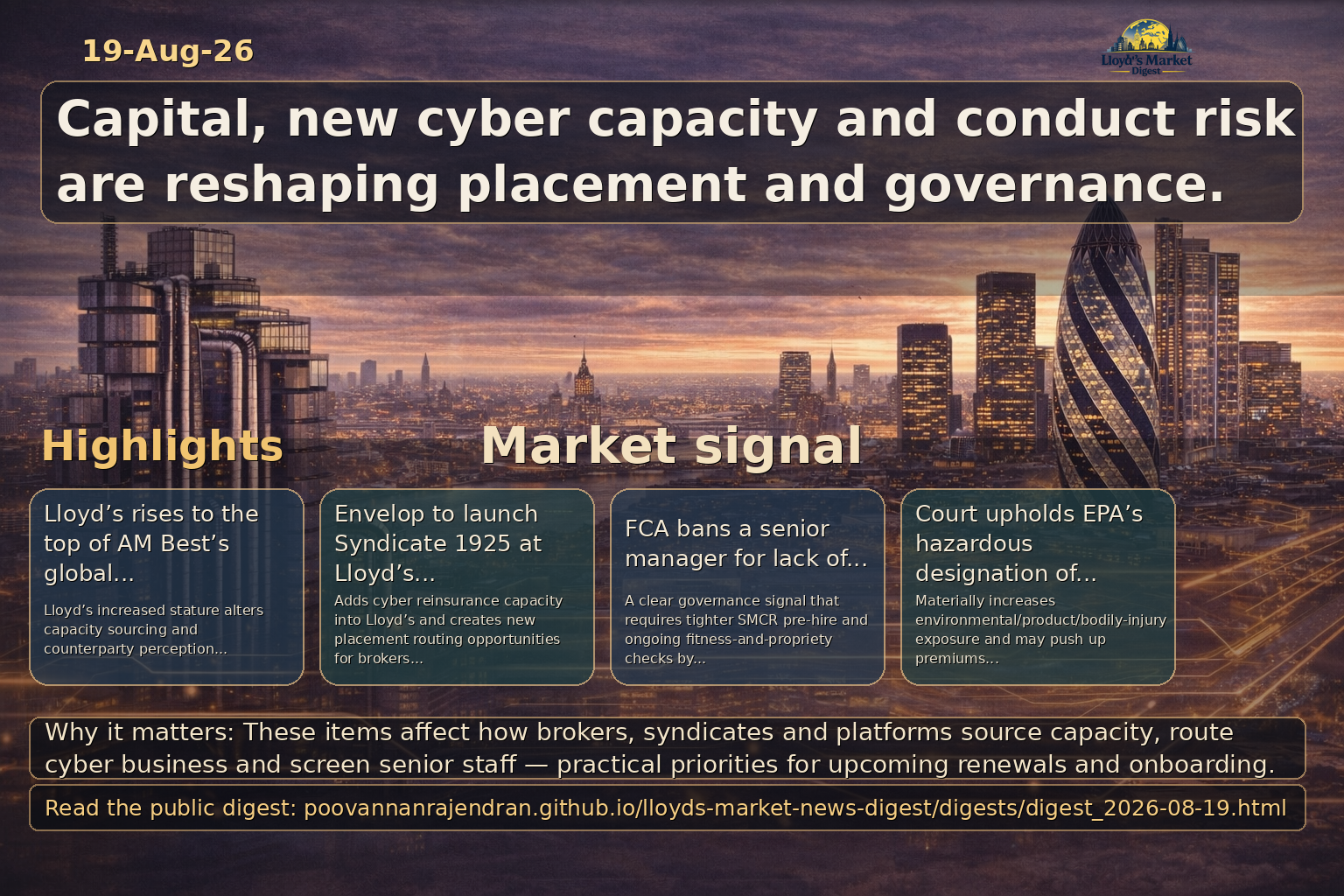
Why it matters: The article signals a material shift in marketplace stature: Lloyd's emerging as the largest non‑IFRS 17 reinsurer on AM Best's table affects capacity sourcing, counterparty perception and strategic positioning for brokers, syndicates and placement platforms. It also highlights capital accumulation and persistent underwriting strength, even as pricing softens—key inputs for renewal planning, treaty structuring and platform investment decisions.
- Market positioning and capacity: Lloyd's rise increases its pull as a primary source of specialty capacity; brokers should reassess syndicate access strategies, lead/joint lead economics and quota share appetite to capture complex risks.
- Pricing, underwriting and profitability: AM Best's note of record capital alongside selective price softening implies tighter margin management; underwriters and program managers must reinforce underwriting discipline, re‑evaluate attachment strategies and stress‑test treaty renewals against softening pockets.
- Reporting and strategic allocation: The split between IFRS 17 and non‑IFRS 17 rankings complicates comparability—executives should factor reporting regime differences into capital allocation, M&A valuations and platform technology investments to ensure continuity of placement efficiency and client transparency.
Source: globalreinsurance.com
Why it matters: Envelop’s in-principle approval to convert SPA 1925 into Syndicate 1925 at Lloyd’s (with cyber reinsurance core and scope to add casualty/specialty) highlights Lloyd’s continuing role as a platform for specialist, data-driven underwriting propositions.
- Prepare for increased cyber capacity and new placement routing into Lloyd’s; brokers and platforms should refine cyber treaty and facultative workflows to exploit expanded supply.
- Assess partnership or capital-provision opportunities with cyber specialists that can scale into casualty and related specialty lines within a Lloyd’s syndicate wrapper.
- Emphasise data analytics and loss prevention services as commercial differentiators when engaging with Envelop and similar cyber-focused syndicates to secure enduring placements.
Source: fca.org.uk
Why it matters: FCA warning on "finnova-limited" indicates an unauthorised entity potentially targeting UK-based insureds and intermediaries. Such actors can be used to defraud brokers, divert premium flows and undermine confidence in placement channels used by Lloyd's and specialty markets.
- Validate all counterparties against the FCA register and maintain an up-to-date denied/flagged-entities list within broker and platform onboarding workflows.
- Require dual-channel verification (known contact lists plus independent telephone confirmation) before transferring premiums or executing placements originating from new or unverified domains.
- Implement transaction monitoring rules to flag unusual premium routing, and coordinate takedown/reporting actions with the FCA and market-sharing groups when impersonation is detected.
Source: fca.org.uk
Why it matters: The VrenKapstead warning represents another unauthorised operator that could impersonate brokers, MGAs or placement services. For global specialty players, impersonation risks extend across borders and can affect binding authorities and delegated underwriting arrangements.
- Apply enhanced due diligence (EDD) for new brokers, coverholders and introducers including corporate registry checks, beneficial owner verification and third‑party reputation screening.
- Mandate contractual clauses for electronic confirmations that specify acceptable channels and require immediate escalation if counterparties are not on approved lists.
- Share observed indicators (domains, email addresses, phone numbers) through Lloyd’s market intelligence and broking networks to accelerate market-wide blocking and reduce recidivism.
Source: fca.org.uk
Why it matters: An FCA ban for a senior manager on honesty and integrity grounds is a critical governance signal for Lloyd’s managing agents, syndicates and large brokers. It highlights the need for rigorous senior manager screening and continuous fitness-and-propriety monitoring under SMCR to protect underwriting and counterparty trust.
- Institute mandatory pre-hire and ongoing integrity checks for SMF roles — criminal, civil, regulatory histories and cross-jurisdictional sanctions screening — with documented approval by the board or delegated committee.
- Conduct a targeted review of delegations, record-keeping and director oversight where senior managers have access to premium flows or binding authority, and remediate control gaps uncovered by the review.
- Update appointment and termination protocols to require immediate notification to compliance, reconciliation of responsibilities, and external reporting where misconduct could affect policyholders or market standing.
Source: fca.org.uk
Why it matters: The PINNACLE CREST INVESTMENT warning signals unauthorised investment or intermediary activity that could be presented to insurers or specialty brokers as legitimate hedging, collateral management or investment counterparties — raising asset-security and conduct risks for syndicates and platforms.
- Treat investment counterparties and providers used by syndicates and platforms as part of procurement due diligence: require audited financials, regulator checks in relevant jurisdictions and validated legal entity identifiers (LEIs).
- Protect client funds by enforcing escrow or regulated custodian requirements for any third-party investment intermediary used to manage collateral or premium investments.
- Train underwriting and treasury teams to recognise red flags (unregistered advisers, offshore-only contact points, unsolicited offers) and to refer suspicious cases to compliance before engagement.
Source: fca.org.uk
Why it matters: A clone site impersonating an authorised firm is a direct threat to placement integrity: it can be used to harvest placement documentation, substitute payment instructions and deceive brokers or cedants working with Lloyd’s syndicates.
- Require explicit verification of counterparty domains and email addresses against the FCA register and known corporate domains before accepting placement documentation or changing premium/claims payment instructions.
- Implement cryptographic signing or secure portal exchange for placement paperwork and premium instructions to reduce the effectiveness of cloned websites and phishing campaigns.
- Set up incident response playbooks for clone-site detection, including immediate communication to affected brokers, platform-wide blocking, and coordinated notification to the FCA and downstream counterparties.
Source: businessinsurance.com
Why it matters: Lockton naming a global solutions practice leader for the U.S. underscores brokers’ ongoing emphasis on integrated global placement capabilities and specialist solutions — a competitive dynamic that influences syndicate access, placement platform integrations and advisory mandates.
- Syndicates and MGAs should prioritise streamlined placement workflows and data connectivity to major brokers to capture cross-border specialty mandates.
- Brokers' strengthened global solution teams will push for bespoke capacity — review product flexibility and delegated authority offers to support tailored solutions.
- Invest in relationship management and platform APIs to reduce friction in quota-share placements and accelerate binding decisions for time-sensitive risks.
Source: businessinsurance.com
Why it matters: A ruling that workers' compensation exclusivity bars a civil suit over an employee's COVID death highlights doctrinal limits on third-party exposure and underscores how jurisdictional precedent affects casualty allocations, indemnity triggers and broker advice on employers' liability placements.
- Review employers' liability and group life wordings — confirm carve-outs, subrogation language and third-party liability interaction to avoid coverage gaps.
- Adopt claim-handling protocols and reserving guidance for pandemic-era exposures; coordinate with reinsurers on aggregation and attachment points.
- Advise corporate clients on risk transfer strategies and contract risk allocation, and update placement platform checklists to capture jurisdictional exclusivity precedents.
Source: businessinsurance.com
Why it matters: Conduit’s hire of a former Aspen CFO signals consolidation of financial expertise in Bermuda reinsurers — a trend affecting capital management, product innovation and syndicate/reinsurer appetite for specialty risk placement.
- Anticipate more sophisticated capital and capital-markets transactions from Bermuda players; syndicates should reassess retrocession and co-participation structures.
- Brokers and placement platforms should engage early with Bermuda reinsurers to shape product terms and secure capacity amid competition for profitable specialty lines.
- Monitor talent flows as indicators of strategic repositioning; evaluate counterparties' balance-sheet strategy and risk-adjusted pricing implications for treaty renewals.
Source: businessinsurance.com
Why it matters: The court upholding EPA's hazardous designation of PFAS materially raises environmental, product and bodily injury exposure across global specialty portfolios — driving potential premium upward pressure, expanded claims frequency and amplified allocation disputes between primary and re/insurers.
- Conduct immediate exposure mapping for PFAS across portfolios, quantify potential IBNR and coordinate with reinsurers on treaty exclusions, limits and cumulative attachment points.
- Update underwriting guidelines and request enhanced disclosure on supply-chain and environmental controls from insureds in construction, chemicals, manufacturing and marine.
- Prepare client-facing materials and placement-platform workflows to advise on remediation coverage options, allocation language and potential need for environmental liability buy-backs.
Source: businessinsurance.com
Why it matters: Sompo’s reinsurance-driven revenue surge illustrates how favourable market pricing and higher ceded volumes are reordering carrier economics — a bellwether for syndicates and brokers as reinsurers recalibrate appetite and cost of capital.
- Anticipate continued upward reinsurance pricing and tighter capacity for peak per-risk exposures; adjust treaty structures and pricing models accordingly.
- Brokers should stress-test client portfolios against higher treaty costs and explore alternative risk financing and parametric solutions where appropriate.
- Syndicates must align underwriting discipline with capital plans; consider selective capacity deployment, retrocession optimisation and margin-focused growth initiatives.
Source: globalreinsurance.com
Why it matters: AM Best highlights sustained profitability despite rate softening and rising capital, signalling intensifying competition for premium-based capacity. For Lloyd’s and global specialty participants this underscores the need to defend margins through disciplined underwriting and differentiated product propositions.
- Reinforce underwriting discipline and stricter risk selection to protect combined ratios as capital-driven pricing pressure continues.
- Leverage Lloyd’s brand and market access to offer differentiated contract wordings and services (claims, risk engineering, analytics) that justify price and retain brokers.
- Prioritise placement-platform efficiency and data-driven segmentation to identify profitable niches and reduce frictional costs in multi-market placements.
Source: globalreinsurance.com
Why it matters: Willis Re’s acquisition of BMS Re US materially shifts broker footprint in US reinsurance, intensifying competition for regional cedants and institutional capital placement. This has direct implications for Lloyd’s-access brokers and syndicates seeking North American premium flow.
- Anticipate increased demand for unified placement capabilities — brokers and platforms should accelerate integration of US and London placement workflows to retain cedant relationships.
- Evaluate partner and distribution strategies with US-focused brokers to secure quota-share and facultative access into Lloyd’s syndicates.
- Prepare for commercialization and retention opportunities arising from combined product suites (capital advisory, facultative, programme business) and ensure seamless data and compliance integration post-deal.
Source: globalreinsurance.com
Why it matters: Middle East energy clients are revisiting political violence, business interruption and contingency cover after conflict-related disruption exposed product and wordings gaps. Syndicates, specialty brokers and placement platforms must adapt offerings to capture this reassessment.
- Develop and market flexible BI/contingent business interruption and political violence solutions, including parametric and contingent logistics covers tailored to energy supply-chain exposures.
- Collaborate with regional brokers and placement platforms to refine wordings and claims triggers that reflect operational realities (e.g., traffic interruption without physical damage).
- Invest in scenario modelling and rapid response claims protocols to provide differentiators that appeal to energy clients and regional public/private project sponsors.
Source: globalreinsurance.com
Why it matters: A senior casualty hire at Price Forbes with deep US casualty placement experience signals continued demand for transatlantic casualty distribution and specialised broking capability feeding London and Lloyd’s markets.
- Monitor talent movements and team composition at key brokers to anticipate shifts in US casualty placement volumes into Lloyd’s and Bermuda markets.
- Strengthen casualty product suites and underwriting appetite where ex-US leadership can drive new business relationships and structured placements.
- Enhance collaboration between underwriting teams and brokers to convert leadership relationships into sustained capacity commitments and tailored placement solutions.
Source: reinsurancene.ws
Why it matters: Moody's view that retail P&C is most vulnerable to near-term AI disruption directly affects broker retail channels, Lloyd's retail-facing intermediaries and placement platforms that serve high-volume, commoditised business.
- Brokers and placement platforms should accelerate AI-enabled client triage and automation while preserving advisory differentiation on complex risks.
- Syndicates must reassess pricing and appetite for commoditised retail lines as automated channels compress margins.
- Invest in governance and explainability for deployed models to satisfy capacity providers and regulators in Lloyd's market.
Source: reinsurancene.ws
Why it matters: Historical archive material signals the durability of supply/demand cycles in P&C reinsurance — a reminder for syndicates and brokers to incorporate cycle-aware strategy in capacity and appetite decisions.
- Executive teams should embed historical cycle analytics into pricing strategy and retro/reinsurance buying decisions.
- Brokers can use cycle narratives to negotiate multi-year capacity and structured solutions for clients.
- Placement platforms should surface historical pricing and capacity trends to underwriters for better line-entry decisions.
Source: reinsurancene.ws
Why it matters: EigenRisk’s inclusion of Weatherwatch hail footprints enhances property-level catastrophe intelligence, materially improving underwriting precision and claims response for Australian exposures — relevant to Lloyd's syndicates and brokers operating in the region.
- Syndicates should integrate higher-resolution hail footprints into underwriting models to refine exposure selection and reinsurance demand.
- Brokers and MGAs can differentiate offerings by embedding fast post-event footprint data into placement and claims workflows.
- Placement platforms must enable ingestion and visualization of third-party event footprints to speed binding and claims triage.
Source: reinsurancene.ws
Why it matters: Beazley Security’s report that AI-assisted vulnerability research is increasing disclosures and noise elevates systemic cyber accumulation risk and underwriting complexity for specialty cyber writers and syndicates.
- Underwriters must tighten exposure management, update silent cyber aggregation assumptions and demand richer cyber controls data from clients and brokers.
- Brokers should reframe cyber placement discussions to include vulnerability management maturity and remediation trajectories.
- Placement platforms need capabilities to surface active exploit intelligence and link it to insured inventories for accumulation control.
Source: reinsurancene.ws
Why it matters: Majesco’s research highlighting a gap between insurer priorities and customer protection needs stresses reputational and market-share risks for carriers and brokers if product design and distribution overlook affordability and trust.
- Syndicates and carriers should reassess product design to balance profitability with demonstrable customer protection outcomes.
- Brokers must articulate client protection gaps and advise on solutions that preserve affordability to reduce churn and regulatory scrutiny.
- Placement platforms should surface customer-impact metrics to underwriters to align offerings with evolving buyer expectations.
Source: newsnow.co.uk
Why it matters: Coverage of Facebook elevates concerns for platform-level cyber, data privacy, content-related liability and systemic aggregation risks that affect capacity deployment, wordings and aggregate loss modelling across Lloyd’s and global specialty markets.
- Underwriting: increased need to model platform aggregation, social-media-driven BI and reputational liability exposures when assessing capacity and appetite.
- Brokers: must expand due diligence and contract wording scrutiny for clients with material platform dependencies and seek aggregation controls or exclusions where necessary.
- Placement platforms & syndicates: opportunity to develop tailored cyber/social-media liability products and refine catastrophe-style scenarios to capture systemic platform failure or large-scale data incidents.
Source: newsnow.co.uk
Why it matters: GCSE results and coverage provide an indicator of the future talent pool for technical roles (underwriting, actuarial, broking, cyber) and highlight the urgency for market-led apprenticeship, reskilling and university partnerships to address skill gaps in specialty lines.
- Recruitment planning: shifts in educational outcomes affect feeder pipelines for junior technical staff — syndicates and brokers should stress-test hiring and succession plans.
- Learning & development: increased imperative to invest in apprenticeships, micro-credentials and targeted training to build digital, data science and specialty underwriting skills.
- Regulatory and diversity objectives: use education outreach and structured entry programmes to meet evolving regulatory expectations and broaden talent sources for long-term market resilience.
Source: newsnow.co.uk
Why it matters: RNLI-related reporting focuses attention on coastal search-and-rescue activity, volunteer fleets and community exposure to maritime incidents — areas directly relevant to marine underwriters, syndicates writing coastal property and brokers arranging charity and fleet covers.
- Underwriting exposure: coastal incident frequency and operational costs drive reassessment of premium adequacy, sub-limits and policy forms for coastal and small-vessel fleets.
- Product innovation: opportunity to design specialist covers (charity fleet insurance, volunteer liability, parametric rescue-response triggers) and community-resilience programmes.
- Placement & data: enhanced use of vessel telemetry, incident data sharing and platform-enabled coordination between brokers, underwriters and NGOs to improve pricing accuracy and claims outcomes.