Source: insurancetimes.co.uk
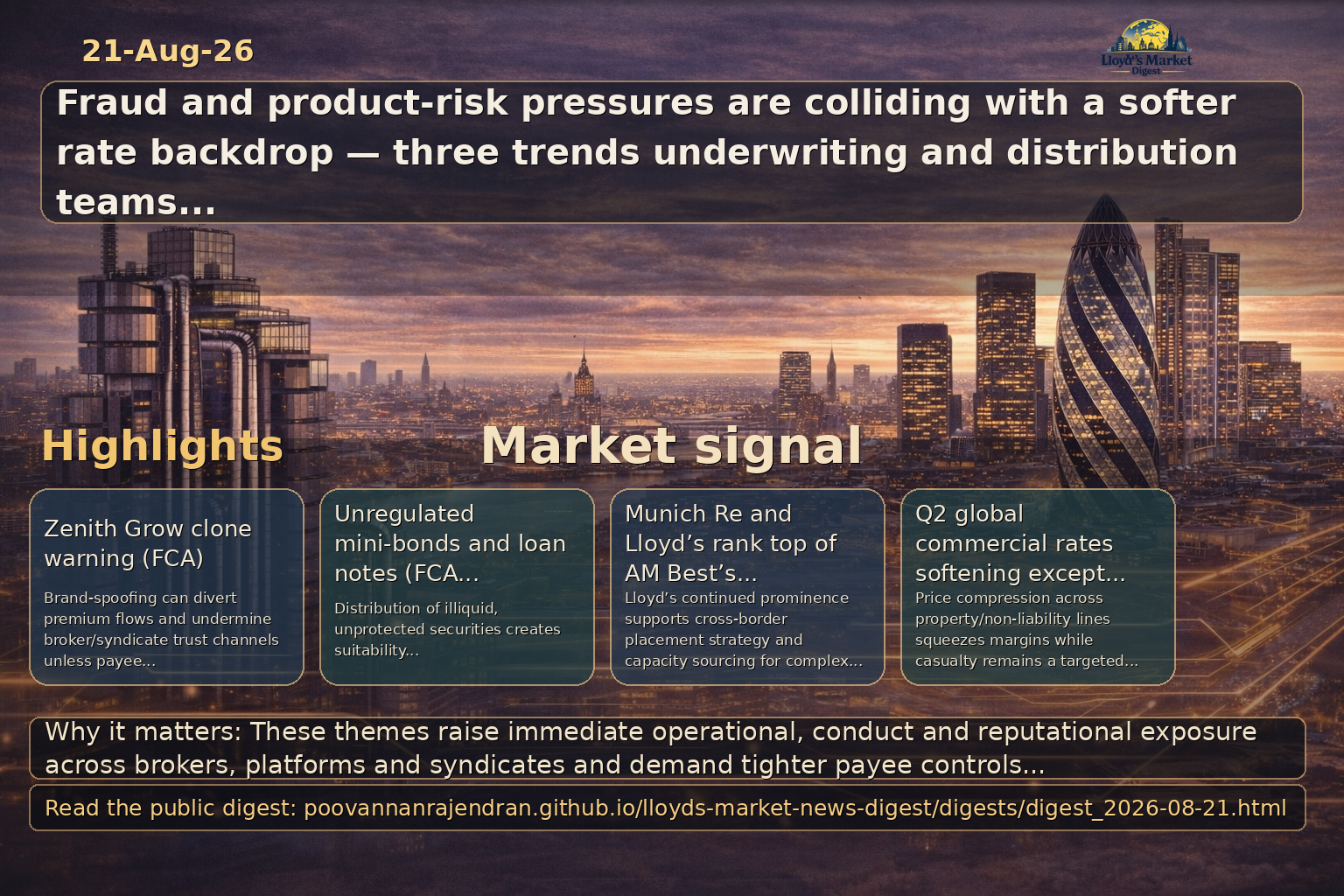
Why it matters: AM Best’s ranking that places Munich Re and Lloyd’s at the top underscores Lloyd’s continued strategic importance in global reinsurance and specialty risk transfer despite currency and accounting variations.
- Leverage Lloyd’s brand and capacity when structuring complex multinational placements seeking market recognition and diverse capacity
- Monitor currency and accounting shifts (IFRS17 adoption effects) that influence comparative market rankings and capital allocation
- Position syndicate propositions to capture cross-border reinsurance flows, emphasizing Lloyd’s distribution and specialist underwriting credentials
Source: fca.org.uk
Why it matters: Clone firm impersonation (Zenith Grow) demonstrates brand‑spoofing risk that can misdirect cedants, place premium flows to fraudsters, and undermine broker/syndicate trust channels.
- Treat domain and brand impersonation as a material third‑party risk — implement continuous monitoring for look‑alike domains and rapid takedown escalation with registrars and law firms.
- Enforce strict payment verification protocols: require authenticated beneficiary confirmation (voice/2FA) for changes to bank account details and use escrow or controlled premium trust accounts where feasible.
- Communications verification: instruct brokers and placement platforms to validate FCA FRN publicly and provide active guidance to clients on how to confirm authorised counterparties before engagement.
Source: fca.org.uk
Why it matters: Unauthorised entity warnings (Raliplen) signal attempts to access UK distribution without regulatory status, posing compliance and compensation exposure if brokers or platforms engage or facilitate.
- Require documented proof of FCA authorisation for any intermediary or counterparty dealing with UK clients; integrate automated checks against the FCA warning list into onboarding workflows.
- For brokers and platforms, suspend introductions from unverified entities and mandate enhanced due diligence on inbound client leads originating from non‑standard channels (social media, unsolicited email).
- Contract terms should include representations and warranties on authorisation status and indemnities for losses arising from dealings with unauthorised firms; escalate persistent suspect approaches to compliance/legal.
Source: fca.org.uk
Why it matters: Clone of an FCA‑authorised firm (bondsmith.uk) using a London address underscores the sophistication of impersonation tactics and the potential for premium diversion or mis‑placement through trusted market routes.
- Augment KYC and payee verification for premium and deposit flows, including confirmation of bank account ownership against certified corporate records and bank‑level validation.
- Placement platforms and electronic placing tools should block registrations from suspicious or newly created domains that mimic existing market firms and implement multi‑factor verification for firm profiles.
- Proactively communicate to broker network and clients about identified clones and provide a checklist for validating counterparties (FCA FRN, official website fingerprinting, registered office verification).
Source: fca.org.uk
Why it matters: FCA statement on mini‑bonds/loan notes reinforces regulatory prohibition on marketing speculative illiquid securities to retail clients, raising distribution and suitability risks for brokers and syndicate funding channels.
- Reassess product acceptance and placement policies: forbid placement of client funds into unregulated mini‑bonds where suitability and protection frameworks do not exist; document decisions and rationale.
- Syndicates and managing agents must scrutinise any counterparty or investment proposals tied to mini‑bond issuers and ensure no contingent exposure within capital structures or collateral arrangements.
- Update client and intermediary guidance on permissible investments and the absence of FSCS protection for unregulated securities; integrate specific red flags into suitability and KYC scripts.
Source: fca.org.uk
Why it matters: Press warnings on mini‑bond failures demonstrate real loss events that can trigger contagion across distribution chains and expose brokers, platforms and syndicates to reputational and remediation costs.
- Implement scenario‑based stress testing for exposures to non‑banking corporate issuers frequently used in mini‑bond structures and require enhanced credit due diligence for counterparties.
- Placement platforms should maintain issuer watchlists and liquidity profiles; require disclosures and mandatory escalations when clients propose allocations to illiquid or unregulated issuers.
- Prepare remediation playbooks addressing client losses from unregulated investments, including communication templates, escalation triggers to compliance and potential voluntary remediation funds where reputational risk warrants.
Source: businessinsurance.com
Why it matters: Lockton's launch of a US aviation practice expands placement capacity and broker-led specialty distribution for aviation risks — a core London placement class.
- Creates incremental demand for Lloyd's syndicates and global specialty underwriters active in aviation hull and liability markets
- Highlights broker-driven concentration of aviation expertise that can streamline complex placements and coverage wordings
- Syndicates should monitor broker-led practice growth to secure lead relationships and appropriate appetite alignment
Source: artemis.bm
Why it matters: Cayman’s pursuit of NAIC Qualified Jurisdiction Status (QJS) could alter domicile economics for ILS and reinsurance vehicles, influencing where syndicates, SPVs and placement platforms choose to domicile and route capital, particularly for US-facing business.
- Monitor regulatory timing and potential NAIC recognition effects; adjust domicile and capital planning scenarios for SPVs, sidecars and reinsurance transformers.
- Evaluate Cayman domiciliation as a competitive option for vehicles seeking access to US-originating reinsurance flows and favourable operational frameworks.
- Placement platforms and brokers should expand cross-jurisdictional compliance, tax and investor onboarding capabilities to capitalise on domicile-driven client demand.
Source: artemis.bm
Why it matters: Nascent Re’s Telford preferred-share ILS issuance via a technology-driven reinsurance transformer demonstrates how platforms can enable smaller, private ILS transactions quickly and efficiently, creating new distribution possibilities for specialty brokers and syndicates.
- Explore partnerships with technology-led transformers to access scalable, cost-efficient collateralised reinsurance solutions for bespoke or smaller programmes.
- Brokers should use these platforms to offer customised ILS and private placements to clients that would not otherwise meet traditional issuance minimums.
- Placement platforms must integrate with transformer APIs, streamline SPV set-up and provide investor reporting to shorten time-to-market and reduce operational friction.
Source: businessinsurance.com
Why it matters: Workers' compensation and employer liability commentary influences claims handling, subrogation and employer-risk placements that syndicates and brokers must consider for international accounts.
- Highlights claims management themes relevant to specialty casualty underwriters and syndicates’ employers’ liability appetite
- Signals opportunities for brokers to differentiate via claims advisory and loss-control services on London placements
- Implication for platform partners: incorporate legal/claims expertise in delegated authority and placement documentation
Source: businessinsurance.com
Why it matters: Evidence that layered contractor safety programs reduce fatalities is directly relevant to underwriting loss frequency/severity assumptions for construction, energy and infrastructure risks.
- Supports underwriting models that recognize active risk engineering and may justify pricing differentiation or capacity expansion
- Gives brokers leverage to negotiate improved terms where clients adopt verified safety programs
- Relevance for syndicates and MGAs: integrate safety-program verification into binding authority and placement criteria
Source: businessinsurance.com
Why it matters: Court ruling on employer recovery from third-party settlements affects subrogation recoveries, reserving and contractual wording for employers’ liability and workers’ compensation placements.
- May increase short-term recoveries but requires review of policy wordings and subrogation clauses by underwriters
- Brokers should reassess placement negotiations and client advice on settlement strategy and indemnity triggers
- Syndicates must consider litigation trends when setting reserves and calculating expected loss ratios
Source: businessinsurance.com
Why it matters: D&O coverage dispute outcome is material for syndicates and brokers dealing with executive liability: coverage interpretation and conflicted-director scenarios can drive litigation and claims volatility.
- Reinforces need for precise D&O policy drafting and underwriting due diligence on governance risk
- Brokers must prepare to advise clients on exclusion negotiation and settlement strategy to protect placement integrity
- Underwriters should monitor precedent-driven exposure and adjust capacity/retentions for higher litigation-prone sectors
Source: globalreinsurance.com
Why it matters: The article demonstrates that subsea cable failures dominate offshore-wind claims and that existing wordings — designed for different perils — fail to capture serial-loss and aggregation characteristics. This is directly relevant to Lloyd's syndicates, global specialty insurers, brokers and placement platforms because it affects appetite, pricing, policy design, portfolio aggregation management and the technical demands placed on placement infrastructure.
- Re-draft product wording and limits: develop dedicated offshore-wind wordings that explicitly address subsea cable exposure, define sub‑limits and aggregate loss triggers, and remove ambiguity that can drive protracted claims disputes.
- Strengthen underwriting with engineering and data: require targeted cable integrity surveys, embed real‑time monitoring and condition‑based maintenance data into underwriting criteria, and invest in loss‑modelling that captures serial-failure scenarios and correlated exposure across sites.
- Adapt market placement and capacity structures: brokers and placement platforms should facilitate layered placements and transparent aggregation reporting to syndicates and reinsurers, standardise clause sets and data templates to speed placement and improve portfolio-level accumulation oversight.
Source: insurancejournal.com
Why it matters: Marsh GIMI confirms broad rate softening while casualty is an outlier — a central input for Lloyd's syndicates, global specialty underwriters and brokers when setting pricing, retention and reinsurance strategy.
- Pressure on property and non-liability lines requires syndicates to tighten underwriting, reduce class-level appetite or pursue alternative product features to protect combined ratios.
- Casualty rate increases (driven by U.S. severity and litigation) create selective opportunities for specialty and Lloyd's casualty-focused syndicates to rebuild margins; brokers should prioritize casualty-capable capacity.
- Placement platforms and brokers must optimize data-driven submission workflows to accelerate placement and demonstrate differentiated underwriting intelligence to capture limited hard casualty capacity.
Source: insurancejournal.com
Why it matters: Court ruling limiting general contractor liability underscores the primacy of contract terms and control evidence — material to underwriting and risk transfer language for construction, GL and related specialty lines.
- Underwriters should demand clear contractual allocation of safety and control responsibilities as part of submission requirements for construction risks to limit latent liability exposure.
- Brokers must advise clients on precise contract drafting (safety obligations, indemnities, evidence of oversight) to preserve insurability and reduce contested claims outcomes.
- Syndicates and placement platforms should incorporate contract and control assessments into automated submission checks and pricing models to reflect the differentiated risk of subcontracted operations.
Source: insurancejournal.com
Why it matters: CIAB's Q2 survey corroborates market-wide premium declines across account sizes — a confirmation of soft conditions that affects commission dynamics, retention strategies and Lloyd's capacity allocation.
- Syndicates must prepare for continued rate compression across commercial lines by emphasizing expense discipline and selective appetite for higher-margin niche classes.
- Brokers will face increased pressure on commissions and should negotiate service-based economics tied to platform efficiencies and value-added risk engineering.
- Placement platforms can capture share by offering faster, lower-cost binding capabilities and demonstrable analytics that justify narrower margins to clients.
Source: insurancejournal.com
Why it matters: Evergrande founder's sentencing is a reminder of sovereign, corporate governance and political tail risks in large real-estate downturns — relevant for syndicates with Asian exposures, credit derivatives, D&O and reinsurance recoverables.
- Underwriters should re-evaluate exposure concentrations to developers and related counterparty risk in Asia; enhanced collateral and credit protections may be warranted for legacy portfolios.
- D&O and financial lines carriers need heightened diligence on governance and asset recovery complexity in jurisdictions with aggressive enforcement actions.
- Reinsurers and syndicates should stress-test retrocession and recoverable scenarios against extended legal actions and asset confiscation that can erode expected recoveries.
Source: insurancejournal.com
Why it matters: Projected climate-related costs to London highlight growing urban concentration risk — directly relevant to property, BI, and infrastructure exposure profiles held by Lloyd's syndicates and global specialty insurers.
- Syndicates must incorporate urban climate stress into underwriting models (heat, flood, business interruption) and consider differentiated urban premiums or underwriting guidelines.
- Brokers should prioritize climate adaptation solutions and resilience-band coverages for corporate clients to reduce expected loss and maintain capacity.
- Placement platforms need to integrate granular climate data and scenario modelling to support accurate pricing, client advisory and portfolio-level aggregation management.
Source: insurancetimes.co.uk
Why it matters: QBE's internal promotion to director of financial lines underscores insurers' preference for home-grown technical talent to lead specialty portfolios in London, reinforcing continuity for brokers and syndicates.
- Signals retention and succession strategy: prioritize internal development to preserve underwriting expertise for Lloyd’s placements
- Expect stability in underwriting stance — brokers should highlight existing placement relationships when negotiating capacity
- Use promotion as a prompt to audit subject-matter expertise across syndicates and ensure technical resources align with evolving financial lines exposures
Source: insurancetimes.co.uk
Why it matters: Commentary on attracting students signals a broader industry need to refresh employer branding and career pathways to secure the next generation of talent across brokers, syndicates and platforms.
- Develop clear early-career propositions—apprenticeships, rotational underwriting and brokerage tracks tailored to specialty lines
- Leverage placement platforms and market access to create visible career progression stories for recruits
- Coordinate industry-wide outreach through Lloyd’s and trade bodies to counter misconceptions about technology-driven job displacement
Source: insurancetimes.co.uk
Why it matters: Alps partnering with Nuvalaw to accelerate dispute resolution demonstrates practical deployment of AI-enabled RaaS, reducing time-to-settlement and lowering claims leakage for insurers and brokers.
- Evaluate RaaS integrations for syndicates and MGAs to streamline small and mid-sized claims, reducing operational cost and complaint risk
- Brokers should include RaaS capabilities in placement conversations as a differentiator for claims outcomes and client retention
- Assess governance and legal risk when adopting AI adjudication—ensure standards, audit trails and appeals processes align with Lloyd’s protocols
Source: insurancetimes.co.uk
Why it matters: Marco Capital’s proposed acquisition of Pro Global to combine with PoloWorks signals large-scale consolidation of insurance services that will reshape servicing, claims administration and legacy workflows across Lloyd’s and the London market.
- Anticipate bargaining power shifts: large integrated service groups can compress service fees and control placement logistics used by brokers and syndicates
- Syndicates and managing agents should revalidate panel arrangements and SLA terms to protect data flows and service levels post-consolidation
- Evaluate strategic responses: partnerships with consolidated platforms, selective outsourcing, or investment in proprietary servicing capabilities
Source: reinsurancene.ws
Why it matters: ICW Specialty's Legacy Solutions platform institutionalises long-tail liability transfer capability, creating a new source of demand for placement expertise, capital structuring and syndicate appetite for LPTs tied to workers' compensation.
- Creates a repeatable LPT origination channel—brokers and placement platforms should prepare standardized submission templates and diligence packs to accelerate execution.
- Syndicates and capital providers can evaluate appetite for structured legacy risk with clearer deal pipelines; opportunity for differentiated pricing and terms.
- Timing (marketed for Sept 2026) enables counterparties to align underwriting, actuarial and claims remediation resources ahead of launch.
Source: reinsurancene.ws
Why it matters: QBE's promotion of a London-based Financial Lines lead signals a strategic emphasis on international financial lines underwriting from the London hub, with implications for broker engagement and product placement into the specialty market.
- Broker partners should align submissions to QBE's strategic direction in London to capture capacity and secure tailored multilocation placements.
- Expect targeted product development and potential capacity expansion for financial lines—syndicates should monitor for partnership or quota-share opportunities.
- Internal continuity reduces execution risk on renewals; placement platforms should update counterparty profiles and appetite matrices accordingly.
Source: reinsurancene.ws
Why it matters: Vantage's appointment of an experienced General Counsel post-acquisition indicates prioritisation of corporate governance, regulatory navigation and transactional capability—critical for specialty insurers engaging in cross-border placements and M&A.
- Strengthened legal oversight supports accelerated M&A and capital transactions; brokers and syndicates should expect more structured diligence requirements.
- Signals preparedness for regulatory complexity across jurisdictions—placement platforms must ensure compliance workflows and documentation standards.
- Improved governance may increase counterparty attractiveness to Lloyd's and international partners seeking robust contractual and claims frameworks.
Source: reinsurancene.ws
Why it matters: Stonybrook's appointment of an international CEO with explicit focus on trading relationships with the Lloyd's marketplace highlights growing advisory and broking activity linking US capital and London capacity.
- Anticipate increased deal flow connecting US clients and investors to Lloyd's syndicates—underwriters should revisit appetite for cross-border, advisory-led placements.
- Brokers and placement platforms can leverage Stonybrook's advisory capability to structure complex capital solutions, including ILS and sidecars.
- Syndicates should proactively engage to shape transactional terms and coordinate submission standards for higher-complexity mandates.
Source: reinsurancene.ws
Why it matters: Clearwater's move into Crisis Management (Active Assailant, Terrorism & Political Violence) expands specialty underwriting capacity in a growing niche and necessitates new data, response partners and placement workflows.
- Underwriting of crisis risks requires incident response capabilities—brokers should develop partner networks (forensics, PR, security) to enhance propositions to buyers and underwriters.
- Syndicates and MGAs should assess analytics and accumulation controls for political violence exposures and consider class-specific appetite statements.
- Placement platforms need to add tailored submission fields and event-modeling outputs to support efficient quoting and risk aggregation analysis.
Source: artemis.bm
Why it matters: Arch Capital’s Voussoir Re preferred-share issuance is evidence of continued reliance on collateralised sidecars and preferred equity structures to channel third-party capital into underwriting. Such vehicles increase balance-sheet flexibility for syndicates and broaden investor access to yield from underwriting performance.
- Managing agents should evaluate quota-share and sidecar structures as tools to scale capacity and preserve rating-agency and regulatory ratios.
- Brokers need to be proficient in structuring collateralised reinsurance and preferred-share economics to optimise outcomes for cedants and capital providers.
- Placement platforms must support SPI and segregated account mechanics, investor disclosures and the operational cycle for preferred-share issuances.
Source: artemis.bm
Why it matters: Expansion of Twelve Securis distribution in Asia highlights a concentrated opportunity set for ILS placement and institutional allocation in markets that remain underpenetrated relative to exposure. Lloyd's syndicates, brokers and placement platforms should prioritise regional go-to-market strategies and investor education to capture capital and risk transfer flows.
- Prioritise market entry and partnerships in South Korea, Japan, Taiwan, Hong Kong, Singapore and Australia to source institutional demand and local distribution channels.
- Design ILS structures and documentation that address local regulatory and investor preferences, including currency, settlement and tax considerations.
- Enhance placement platform capabilities to support local onboarding, investor reporting and bespoke distribution arrangements for Asian institutional investors.
Source: artemis.bm
Why it matters: Munich Re’s appointment of a Head of Weather & Agro underscores reinsurer strategic prioritisation of parametric, weather derivative and commodity-linked hedges. This accelerates demand for distributed expertise and standardised parametric product templates across specialty markets and broker networks.
- Syndicates should assess integrating parametric triggers into specialty lines and consider co-development with reinsurers to expand capacity and product credibility.
- Brokers must develop advisory capabilities around parametric design, index selection and basis risk disclosure to serve corporate and agricultural clients.
- Placement platforms need to support parametric documentation templates, trigger validation workflows and data integration with weather and satellite providers.
Source: newsnow.co.uk
Why it matters: Reporting on Tiananmen-related prosecutions and heightened enforcement in mainland China and Hong Kong signals elevated political and regulatory risk in Greater China. For Lloyd’s and global specialty lines this translates into increased political-violence exposures, reputational and compliance risk for underwriting and distribution, and potential operational disruption for brokers and placement platforms with hubs or clients in the region.
- Underwriting and pricing: Reassess exposure for political violence, kidnap/ransom, D&O and trade-credit portfolios with Greater China/Hong Kong risk; consider tighter sub-limits, higher rates and exclusion language where necessary.
- Compliance and sanctions: Strengthen counterparty screening and KYC for Hong Kong/China-facing covers; monitor regulatory guidance and update sanctions matrices and onboarding checks on affected counterparties.
- Broker/platform operations: Stress-test placement workflows, client communication and contingency plans for local office disruption; update policy wording and advisory materials for clients on political-risk triggers and claim notification processes.
Source: newsnow.co.uk
Why it matters: Continued legal and political volatility around Imran Khan and Pakistan creates a heightened probability of civil unrest, policy uncertainty and disruption to commercial projects and supply chains. This has direct implications for political-risk, political-violence, trade credit, energy and infrastructure exposures underwritten or distributed by Lloyd’s syndicates and global specialty brokers.
- Country risk and capacity limits: Re-evaluate Pakistan country limits, aggregation concentrations and treaty retrocession needs; consider temporary capacity restrictions or adjusted pricing for new and renewal business.
- Claims and contingency planning: Enhance claims-playbooks for political violence, civil commotion and business-interruption scenarios; educate cedants and brokers on trigger thresholds and evidence requirements.
- Client advisory and wordings: Work with legal and broking teams to refine policy wordings, exclusions and express carve-outs for sanctions-related contingencies; proactively advise clients on contractual protections and alternative risk-transfer solutions.