Source: fca.org.uk
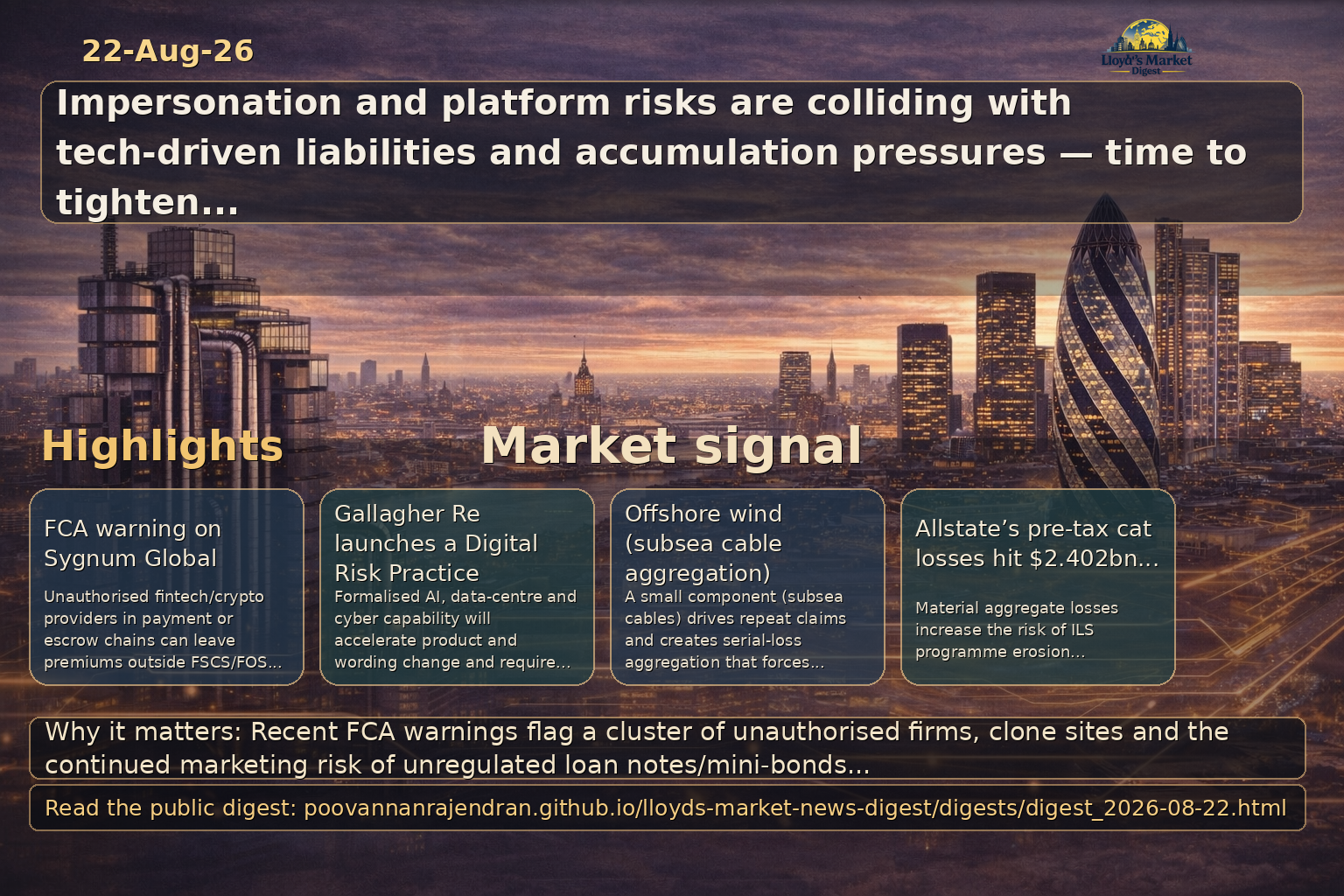
Why it matters: FCA warning on Sygnum Global highlights unauthorised entities offering financial services; for Lloyd's market this signals risk where fintech or crypto-facing counterparties are used for payments, escrow or client onboarding.
- Counterparty risk: transactions routed through unauthorised providers leave premiums and client funds without FSCS/FOS protection and increase recovery friction.
- Operational impact: potential for payment diversion, settlement failure or fraud affecting premium flow to syndicates and delegated authority arrangements.
- Recommended mitigation: blocklisted vendor checks, require FCA registration proof, restrict use of unauthorised payment/crypto partners in placement workflows.
Source: fca.org.uk
Why it matters: Warning on www.keylinefinance.com demonstrates ongoing targeting of UK consumers and businesses by unauthorised operators; brokers and MGAs may be exposed via third-party referrals or co-branded communications.
- Distribution exposure: unauthorised sites may pose as intermediaries, creating accidental referral or lead-sharing affiliations that bypass compliance checks.
- Reputational/regulatory risk: association or perceived endorsement of unauthorised firms can trigger regulatory scrutiny and client complaints.
- Action items: integrate FCA Warning List monitoring into CRM, vet referral partners, and maintain pre-approved partner lists for placement platforms.
Source: fca.org.uk
Why it matters: The wealth-db.co.uk clone warning illustrates classic impersonation risk where fraudsters mimic an authorised firm; in insurance placements this can misdirect policyholder communications, instructions and funds.
- Identity fraud: cloned channels can deceive cedants, brokers or insureds into sending premiums or sensitive data to malicious actors.
- Operational disruption: cloned correspondence can lead to incorrect endorsements, claims instructions or payment allocations impacting syndicate accounting.
- Controls: require multi-channel verification for funding instructions, authenticate domains and email addresses, and issue client advisories about clone scams.
Source: fca.org.uk
Why it matters: Zenith Grow appears as a clone of an FCA-authorised firm; such clones threaten broker networks and platform trust, particularly where digital placement tools rely on external identity or KYC providers.
- Trust erosion: market participants risk reputational damage if clients fall victim to clones appearing to be market-authorised entities.
- KYC/AML exposure: cloned identities can be leveraged to bypass weak onboarding or to launder funds through placement intermediaries.
- Remediations: tighten onboarding verification, demand certified proof of FCA reference numbers, and log suspicious impersonation attempts with regulators promptly.
Source: fca.org.uk
Why it matters: Raliplen-related warning flags another unauthorised operator; repeated instances increase likelihood of social engineering attacks against insurance distribution channels and corporate clients.
- Social engineering risk: fraudsters exploit brand and product familiarity to trick broker staff or clients into authorising payments or sharing credentials.
- Settlement and claims risk: fraudulent instructions from impersonated entities can delay claim handling and create reconciliation issues for syndicates.
- Preventive measures: conduct regular staff phishing simulations, centralise payment instruction verification, and require out-of-band confirmations for material transactions.
Source: insurancejournal.com
Why it matters: The €825m Dutch fine against Uber for automated deactivations reinforces regulatory and privacy liabilities for platform businesses, expanding demand for specialised regulatory defence, cyber/privacy and D&O solutions within global specialty markets including Lloyd’s.
- Demand for regulatory liability solutions: syndicates should expect growth in GDPR/privacy liability and regulatory defence products designed for platform and gig-economy clients.
- Underwriting diligence and pricing: brokers must provide enhanced compliance and operational controls evidence; underwriters may impose tighter warranties and higher premiums for platform clients.
- Placement platform requirements: enhanced policy wordings and modular coverage (privacy, regulatory fines, D&O) will increase complexity of multi-carrier placements and require improved data exchange.
Source: insurancejournal.com
Why it matters: Gallagher Re’s Digital Risk Practice formalises specialist capability in AI liability, data centre and cyber engineering—accelerating product development and advisory services that will influence Lloyd’s syndicates underwriting technology-driven and systemic digital risks.
- Enhanced underwriting expertise: syndicates can leverage specialist advisory to better quantify AI liability and systemic cyber accumulation risk, enabling more granular capacity deployment.
- Product and wordings innovation: expect accelerated development of AI-specific liability products, updated cyber aggregation clauses and engineering-backed risk mitigations required by underwriters.
- Broker and platform implications: brokers must upgrade placement documentation and data submissions to reflect digital risk metrics; placement platforms should support new data feeds and model outputs.
Source: globalreinsurance.com
Why it matters: The piece demonstrates a structural underwriting and contractual mismatch: a small component (subsea cables) drives the majority of claims, creating serial-loss and aggregation risk that directly affects syndicate capital, reinsurance programmes and brokers' ability to place risk. Lloyd's market participants and placement platforms must respond with tailored wordings, improved exposure data and reinsurance design to manage volatility and protect capacity.
- Redraft and standardise offshore-wind/subsea cable wordings: introduce explicit cable-specific definitions, exclusions, warranties and limits to reduce ambiguous cover that produces repeat claims and undefined aggregation exposures.
- Enhance data capture and aggregation analytics on placement platforms: require granular location, cable routing, commissioning history, maintenance regimes and third-party supplier contracts to enable syndicates and reinsurers to model accumulations and price risk accurately.
- Reassess capacity and reinsurance structures: syndicates and brokers should consider per-project sub-limits, layered aggregation clauses, portfolio-level attachment strategies and alternative solutions (parametric triggers, captives) to protect capital and align insurer appetite with true loss drivers.
Source: insurancejournal.com
Why it matters: The KKR-backed acquisition of Steadfast, with Amwins taking the underwriting agency and Dragoneer the broking operations, materially reshapes specialist distribution channels and will redirect placement flows affecting Lloyd’s brokers, syndicates and platform connectivity.
- Distribution concentration: consolidation may compress margins, change commission structures and increase bargaining power of large brokers when placing specialty risks with Lloyd’s syndicates.
- Capacity and access shift: transfer of underwriting agency to a global specialty distributor (Amwins) could reallocate capacity commitments and alter which syndicates see certain classes or geographies.
- Platform and integration risk: placement platforms and systems will need to adapt to new counterparty workflows and data standards to preserve placement speed and reporting accuracy.
Source: insurancejournal.com
Why it matters: Commercial use of Arctic shipping corridors introduces new marine and political risk exposures — increased hull, cargo, salvage and P&I risk, as well as sanctions and partner-dependency issues that will influence Lloyd’s appetite for polar voyages and related placements.
- New peril profile: insurers must price for polar environmental hazards, ice damage, longer salvage/response times and constrained rescue capacity, increasing underwriting scrutiny and potential premium uplift.
- Sanctions and counterparty risk: reliance on Russian cooperation elevates sanctions compliance and KYC requirements for brokers and syndicates; placement platforms must embed screening and clause triggers.
- Accumulative exposure: extended voyages and novel routing concentrate risk in limited transit windows and operators—mandates improved aggregation modelling and bespoke voyage wording from underwriters.
Source: insurancejournal.com
Why it matters: Air traffic controller warnings in Sydney highlight operational and systemic safety issues that increase aviation liability, airport operator exposures and business interruption risks—matters of direct relevance to Lloyd’s aviation and specialty portfolios and to brokers structuring multi-layer aviation programs.
- Underwriting and pricing pressure: heightened incident frequency will prompt syndicates to reassess limits, exclusions and pricing for airline, airport and ATC-related exposures.
- Aggregation and BI risk: airports and adjacent supply chains face amplified contingent business interruption and third-party liability exposures requiring clearer aggregation management and reinsurance protection.
- Placement and claims coordination: brokers and platforms must ensure robust multi-jurisdictional programme placement, crisis clauses and coordinated claims protocols with syndicates and reinsurers.
Source: reinsurancene.ws
Why it matters: Archive index showing historical industry coverage; useful as a reference point for long-term market trends and precedent transactions that inform current strategy.
- Serves as a historical repository for prior reinsurance results and strategic moves that can contextualise current capital and pricing cycles.
- C-suite use: validate precedent pricing, nat-cat impacts and reinsurer performance across cycles for scenario planning.
- Advisory teams can mine archived content to support client communications and retrospective analyses for board briefings.
Source: reinsurancene.ws
Why it matters: Orion180's S-1 filing signals E&S/homeowners consolidation and public-market access for specialty carriers — relevant to capacity providers and brokers placing US personal lines specialty risks.
- IPO intent underscores investor appetite for scaled specialty personal lines platforms and may increase capital available to E&S markets.
- Brokers and Lloyd's syndicates should anticipate competitive capacity and potential distribution partnerships or program opportunities.
- Placement platforms and insurtech vendors can position services to support scaling, compliance and data requirements for public-market reporting.
Source: reinsurancene.ws
Why it matters: AM Best's analysis of rising offshore ceded annuity reserves confirms growth in asset-intensive reinsurance structures — material to reinsurers, retrocession purchasers and capital providers.
- Trend toward offshore, unaffiliated reinsurance increases demand for sophisticated collateral and asset management solutions.
- Lloyd's and global specialty players must evaluate capital efficiency versus counterparty and regulatory complexity when structuring deals.
- Brokers should prepare to advise clients on credit, recovery dynamics and pricing for asset-intensive retrocession arrangements.
Source: reinsurancene.ws
Why it matters: Malaysian Re’s strong contribution to MNRB highlights regional reinsurance profitability and strategic product partnerships (e.g., Cancer Precision Medicine) relevant to syndicates and specialty reinsurers targeting emerging markets.
- Regional portfolio growth and product innovation indicate opportunities for Lloyd's syndicates to co-underwrite or provide facultative capacity.
- Strategic partnerships with life reinsurers (China Re Life) demonstrate a route to enter specialized medical and longevity risk sectors.
- Reinsurers should monitor currency and FX-driven investment gains which materially affect reported profits and capital planning.
Source: reinsurancene.ws
Why it matters: Banyan Risk’s launch of US Inland Marine & Marine Property via an MGA/program partner reflects expansion of programme business and targeted niche capacity that brokers and Lloyd’s syndicates should engage with.
- Programme model focused on construction, logistics and transit aligns with insurers seeking scaled specialty exposures through MGA partnerships.
- Placement platforms and brokers should evaluate appetite to feed these programmes with treaty or paper in Lloyd's and company markets.
- Underwriters can leverage MGA distribution to access specialized data and expedite underwriting in high-volume, homogeneous inland marine segments.
Source: artemis.bm
Why it matters: Hannover Re's build-out of Hannover Re Capital Partners expands reinsurer-backed ILS capabilities, offering new structuring and investor onboarding options that compete with independent ILS managers and placement platforms.
- Adds sponsored capacity and bespoke structuring capability that can accelerate issuance of catastrophe bonds and other ILS solutions, particularly for sponsors seeking co-investment or balance-sheet support.
- May change placement dynamics by offering an alternative to third-party managers, influencing distribution economics and governance expectations for investors.
- Action for brokers and syndicates: evaluate partnership and distribution opportunities with the Hannover Re platform, review governance and transparency provisions for sponsored ILS structures, and brief investor relations teams on potential product pipelines.
Source: artemis.bm
Why it matters: Appointment strengthens Twelve Securis' integrated ILS investment platform, signalling greater sophistication and scale in private ILS and catastrophe bond portfolio management — relevant to placement platforms, investor sourcing and capacity dynamics.
- Enhances portfolio management, analytics and trading capability — likely to improve execution, pricing sensitivity and secondary market responsiveness for ILS instruments.
- Consolidation of catastrophe bond and private ILS capabilities increases product breadth and may pressure competing managers and placement platforms to differentiate on fees and bespoke solutions.
- Action for executives: monitor Twelve Securis’ client offerings for partnership opportunities, reassess distribution strategies, and model potential impacts on available ILS capacity and investor appetite.
Source: artemis.bm
Why it matters: Artemis London is a high-value convening for the global ILS and catastrophe bond community ahead of major reinsurance renewals — critical for market intelligence, investor outreach and syndicate/broker networking.
- A concentrated attendee list (120+ organisations) provides direct access to institutional investors, sponsors, brokers and placement platforms — essential for deal origination and secondary market conversations.
- Timing ahead of renewal rounds means insights gathered will inform pricing, capacity expectations and product structuring for upcoming placements.
- Action for C-suite and heads of distribution: prioritise attendance by senior placement and investor-relations staff, pre-schedule targeted meetings, and use conference intelligence to calibrate renewal strategies.
Source: artemis.bm
Why it matters: Howden Re’s hire of a senior retrocession specialist signals intensifying broker competition in collateralised retro and bespoke retro platforms — a direct influence on how syndicates and sponsors source backward-market capacity.
- Strengthens Howden Re’s capability to place collateralised retrocession and industry-loss arrangements, potentially shifting flow away from established competitors.
- Reinforces the strategic importance of dedicated retro platforms and specialist broker coverage when negotiating terms and collateral requirements with reinsurers and ILS investors.
- Action: syndicates and placement platforms should reassess broker alignments for retro business, consider leveraging Howden’s platform for specific structures, and monitor pricing/terms movements in collateralised retro markets.
Source: artemis.bm
Why it matters: Material pre-tax catastrophe losses reported by Allstate impact aggregate-triggered cat bonds and excess-of-loss arrangements — a direct driver of ILS performance, sponsor capacity management and pricing in renewal cycles.
- Increases likelihood of aggregate erosion in affected programmes and creates heightened scrutiny of trigger definitions, accumulation clauses and qualifying loss criteria in ILS contracts.
- May prompt increased demand for alternative capital (cat bonds, collateralised reinsurance, retrocession) as sponsors and brokers shore up capacity and manage balance-sheet volatility.
- Action: placement platforms, syndicates and investors should revalidate models, reassess collateral and liquidity provisions, and proactively engage sponsors on potential issuance or retrocession needs ahead of upcoming renewals.
Source: newsnow.co.uk
Why it matters: Kryvyi Rih is an industrial and mining hub in Ukraine; ongoing hostilities create concentrated physical, supply-chain and political-risk exposures that directly affect specialty underwriters, war/terror covers, sanctions screening and claims volatility for Lloyd’s syndicates and brokered placements.
- Reassess concentration of exposures: map clients, policy limits and business interruption exposure across mining, metallurgy and logistics assets; quantify potential aggregate loss and contagion to other portfolios.
- Tighten sanctions and claims protocols: update KYC, sanctions filtering and delegated authority controls for local intermediaries; prepare rapid claims escalation and forensics for contested losses.
- Adjust pricing and reinsurance strategy: increase war/political risk pricing, layer reinsurance/retrocession for peak zones and consider alternative market placements or parametric triggers to accelerate recovery.
Source: newsnow.co.uk
Why it matters: UK–Australia relations and trade frameworks influence regulatory equivalence, market access and distribution routes for London-based brokers and Lloyd’s syndicates targeting Australasian specialty business; this affects passporting, capital allocation and platform strategies.
- Review market access frameworks: assess implications of trade agreements and regulatory divergence on Lloyd’s Australasian branches and ability to underwrite local risks; plan for licensing or local partnerships where required.
- Target specialty segments: identify opportunities in marine, agriculture, energy and infrastructure tied to UK–Australia trade flows; structure tailored products via local brokers, MGAs or Lloyd’s delegates.
- Operationalise cross-border placements: update contract wordings, tax/compliance processes and platform integrations to enable efficient electronic placement and claims handling across jurisdictions.
Source: newsnow.co.uk
Why it matters: Netflix represents the type of large-scale global streaming and production exposures that implicate media liability, IP, cyber, production delay and contingent business interruption risks — areas of active interest for global specialty underwriters and placement platforms at Lloyd’s.
- Refine product and aggregation controls: enhance cyber and media liability offerings with explicit aggregation monitoring for global platforms and thresholds for systemic events (platform outages, platform-wide breaches).
- Tighten policy wordings for production and rights disputes: standardise clauses for production delay, copyright/IP infringement, talent liability and reputational damages to reduce ambiguity and litigation risk.
- Leverage data and placement platforms: use real-time exposure analytics and electronic placement channels to underwrite global schedules, manage capacity across syndicates, and speed up facultative/reinsurance procurement for large entertainment programs.
Source: newsnow.co.uk
Why it matters: West Sussex-level reporting highlights regional drivers for property, flood, and personal-lines exposures in the UK; for Lloyd’s syndicates and brokers this translates into the need to calibrate local underwriting, modelling, and supply-chain assumptions for reinstatement and claims handling.
- Update regional catastrophe and flood modelling: incorporate latest local planning, coastal erosion and flood-mapping data into exposure models to refine pricing and capital allocation for coastal and riverine portfolios.
- Reassess claims supply-chain and inflation risk: monitor local contractor availability and rebuild-cost inflation when setting reinstatement reserves and escalation clauses in commercial property policies.
- Pursue targeted distribution and product design: deploy regional pricing tiers, bespoke property endorsements and digital distribution/placement solutions to retain profitable business while limiting adverse selection.