Source: fca.org.uk
Why it matters: An unauthorised entity using the Sygnum Global name (FCA warning) creates counterparty and payment risks for brokers, platforms and syndicates that rely on verified counterparties for premium and claims flows. It undermines trust in digital onboarding and can lead to lost funds and regulatory scrutiny if client protections are assumed but do not exist.
- Validate counterparties: require FCA register checks and documented proof of authorisation before onboarding counterparties or routing premiums via new accounts.
- Protect premium flows: mandate dual-channel confirmation of bank details and implement ACH/CHAPS test transactions for high-value transfers to new recipients.
- Client communications & escalation: notify affected clients and distribution partners, update platform listings, and escalate to compliance/legal where impersonation or fund diversion is suspected.
Source: fca.org.uk
Why it matters: The www.keylinefinance.com warning signals unauthorised firms targeting UK clients; for Lloyd’s brokers and global specialty intermediaries this elevates risks around misdirected premiums, claim payments and exposure to scams that fall outside FSCS/Financial Ombudsman protections.
- Strengthen payment instructions: circulate standard verified beneficiary procedures to brokers and placement platforms; require in-person or voice verification for any banking changes.
- Monitor inbound client queries: ensure client service teams can quickly identify and advise clients who report contact from suspected unauthorised firms.
- Incident logging & reporting: centralise reports of suspicious offers, share intelligence with market associations and consider filing alerts with the FCA and industry bodies to protect syndicates and subscription markets.
Source: fca.org.uk
Why it matters: Clone firms using details of FCA‑authorised entities are a persistent threat to distribution and placement. Clones can mislead cedants, brokers and insureds, enabling social-engineering fraud that diverts premiums or undermines placement accuracy — with severe reputational and legal consequences for intermediaries.
- Implement clone-detection processes: require verification of domain, phone number and FCA reference against the FCA register as a checklist item before any new engagement.
- Train front-line staff: run targeted sessions for brokers and platform onboarding teams on clone indicators and escalation protocols to reduce the chance of misdirected placements.
- Public advisory & remediation plan: prepare templated client notices and an internal remediation playbook (including communication to syndicates, reinsurers and service providers) to rapidly respond if a clone targets your firm or clients.
Source: insurancejournal.com
Why it matters: A near-record GDPR fine against Uber highlights escalating regulatory and automated-decision liabilities for platform businesses, increasing demand for privacy, cyber and regulatory-liability solutions.
- Broaden cyber and regulatory-liability product offerings for digital platforms, explicitly covering administrative fines, remediation costs and reputational loss scenarios.
- Tighten underwriting of gig-economy and platform clients with mandatory data-governance, human-review controls and contractual compliance obligations as conditions precedent.
- Coordinate placement platform workflows to capture governance attestations and to price automated-decision exposures separately, ensuring syndicates can granularly accept or decline regulatory risk.
Source: insurancejournal.com
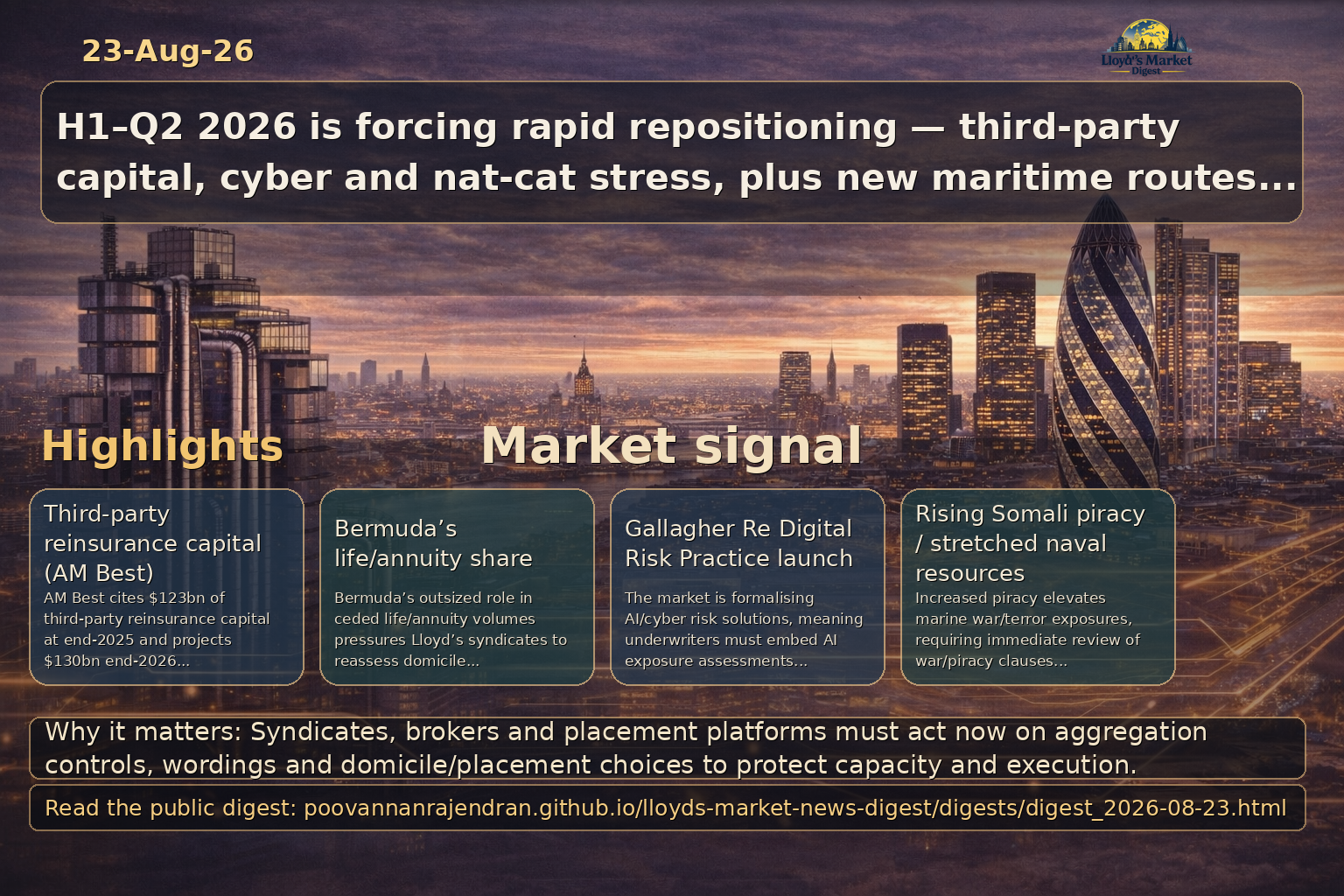
Why it matters: Gallagher Re’s Digital Risk Practice launch signals growing market recognition of AI liability, cyber accumulation and the need for integrated risk engineering and product innovation.
- Accelerate development of AI-liability and cyber suite offerings; syndicates must embed AI exposure assessment into underwriting workflows and accumulation models.
- Leverage broker and platform relationships to pilot modular cyber/AI products and risk-engineering services that include breach prevention, incident response and third-party liability attachments.
- Invest in specialist underwriting talent and data-driven exposure tools; require proposition partners to demonstrate digital risk engineering capabilities as part of placement criteria.
Source: artemis.bm
Why it matters: ALIRT data highlights Bermuda's outsized role in absorbing US life and annuity reinsurance, shifting non-US ceded volumes toward offshore reinsurers and creating competitive pressure for Lloyd's syndicates and global specialty brokers.
- Strategic implication: Bermuda now captures a material portion of ceded liabilities (~$1.1tn; ~40.7% of ceded life/annuity), forcing Lloyd's syndicates to reassess product placement and domicile strategies for life/annuity reinsurance.
- Broker action: Strengthen Bermuda market relationships and transactional capacity to compete for life and annuity ceded flows; build specialist teams conversant with cross-border ceded liability transfers.
- Operational focus: Review capital models, collateral arrangements and treaty design to remain competitive versus Bermuda reinsurers and sidecars in pricing and execution speed.
Source: artemis.bm
Why it matters: AM Best's upward revision of third-party reinsurance capital (to $123bn end‑2025 and projected $130bn end‑2026) confirms persistent investor demand for ILS and catastrophe bonds, affecting capacity and pricing dynamics across reinsurance markets.
- Capacity and pricing: Increased alternative capital supports capacity but may compress spreads for certain perils and layers—syndicates need differentiated value propositions to retain premium.
- Broker strategy: Integrate ILS channels into multi-option placement strategies for clients, using catastrophe bonds and collateralised reinsurance alongside traditional markets.
- Risk management: Monitor rating agency treatment of third-party capital and its impact on counterparty strength assessments used by syndicates and brokers.
Source: businessinsurance.com
Why it matters: Coverage implications from AI-related testimony and evidence are emerging across litigation and professional lines; for Lloyd’s syndicates and brokers this shapes wordings, evidence-handling exposures and D&O/professional liability aggregation.
- Reassess professional and E&O wordings to capture AI governance and failure scenarios
- Engage placement platforms to capture AI use disclosures and preserve audit trails during placement
- Coordinate with claims and legal teams to model potential aggregation from AI-related litigation costs
Source: businessinsurance.com
Why it matters: A lifetime-achievement profile of an industry leader highlights talent pipelines, leadership bench strength and diversity initiatives—critical for brokerages, syndicates and platform operators focused on retention and client continuity.
- Prioritise succession planning for senior producer and placement-lead roles to protect key client relationships
- Benchmark diversity and leadership development programs against market leaders to improve retention
- Leverage award and recognition programs to enhance employer brand for specialist distribution channels
Source: businessinsurance.com
Why it matters: The US insurance awards provide benchmarking intelligence on market positioning, product innovation and distribution effectiveness that inform Lloyd’s syndicates and global brokers when allocating capacity or selecting distribution partners.
- Use award shortlists to validate counterparty expertise when allocating capacity or entering partnerships
- Incorporate award-winning product traits into syndicate product development and go-to-market strategies
- Communicate recognised strengths to clients and brokers to support pricing and retention conversations
Source: businessinsurance.com
Why it matters: The withdrawn lawsuit against major tech platforms underscores volatility in social-media and platform liability litigation; implications extend to cyber and media liability lines, affecting aggregation risk and coverage contours.
- Re-evaluate aggregation scenarios in cyber/media liability models for platform-related litigation volatility
- Refine policy definitions and sub-limits for content-moderation and tech-platform exposures
- Work with placement platforms to ensure clear client disclosures and underwriting data capture for platform risks
Source: businessinsurance.com
Why it matters: A curated Top 10 summary offers a rapid view into market drivers and topical headlines that should inform syndicate risk committees and broker strategy reviews.
- Incorporate Top 10 themes into weekly risk committee briefings for faster tactical responses
- Use the list to prioritise resource allocation across underwriting, claims and distribution
- Share curated intelligence with placement teams to maintain alignment on market sentiment and pricing moves
Source: insurancejournal.com
Why it matters: Resurgent Somali piracy and regional naval strain elevate marine war/terror exposures and increase volatility for hull, cargo and P&I placements.
- Immediate review of war, strikes and piracy clauses and routing warranties across marine portfolios to ensure appropriate coverage triggers and exclusions.
- Reprice and re-evaluate capacity for affected trades; consider targeted war-risk endorsements, excess war limits and parametric cover options distributed through brokers and platforms.
- Direct brokers and placement platforms to verify voyage-risk mitigation (armed guards, hardening, AIS monitoring) and to produce updated accumulation reports for underwriters and syndicates.
Source: insurancejournal.com
Why it matters: KKR-backed buyout of Steadfast and carve-outs to Amwins and Dragoneer underscore accelerated broker consolidation and private-capital reshaping of distribution and underwriting agencies.
- Assess impacts to distribution access: syndicates should model potential shifts in placement volumes and re-negotiate terms with newly owned broker/MGA platforms.
- Anticipate increased competition for specialty mandates and potential valuation-driven M&A by global brokers; refine growth and retention strategies for key distribution partners.
- Conduct enhanced due diligence on new owners’ risk appetites and capital structures; reprice and reallocate capacity where concentration or behavioral change is likely.
Source: insurancejournal.com
Why it matters: Commercial Arctic voyages introduce new exposure corridors, longer transit times and dependence on Russian cooperation, amplifying geopolitical, sanctions and accumulation concerns for marine underwriters.
- Reassess pricing for Arctic transits reflecting extended exposure windows, salvage complexity, and limited local rescue resources; consider specialized clauses for ice navigation and salvage costs.
- Tighten compliance and sanctions due diligence when Russian cooperation is involved; update sanctions wording and refusal-of-trade language in placement documentation.
- Require brokers and platforms to supply enhanced voyage-level modeling and accumulation analytics for Arctic corridors to inform syndicate limit-setting and reinsurance placements.
Source: artemis.bm
Why it matters: RenaissanceRe Capital Partners' AUM decline from a 2025 peak to $8.54bn at H1 2026, with active returns of capital, signals manager-led portfolio optimisation that can alter near-term capacity availability for placements and reinsurance structures.
- Capacity consequence: Managers returning capital or reducing vehicle size can tighten collateralised capacity unexpectedly; syndicates should stress-test placement plans against shorter-duration manager behaviour.
- Broker engagement: Maintain deeper dialogue with third-party managers to anticipate capital recycling and structure timing; diversify investor panels to avoid single-manager concentration risk.
- Commercial response: Re-evaluate fee and return assumptions for ILS-based programmes and incorporate manager liquidity behaviour into deal timing and negotiation.
Source: artemis.bm
Why it matters: Hannover Re's build-out of Hannover Re Capital Partners represents a reinsurer-driven effort to broaden investor access and originate ILS business directly, changing the distribution landscape and potential disintermediation of brokers and placement platforms.
- Direct origination: Carrier-built platforms can offer sponsors an alternative route to capital markets, challenging traditional broker-mediated placements for some structures.
- Partnership considerations: Placement platforms and brokers should explore JV or distribution agreements with carrier platforms to maintain market access and fee capture.
- Strategic priority: Evaluate competitive threat versus collaboration opportunity; consider joint-ventures or white-labeling of placement services to carrier-sponsored platforms.
Source: artemis.bm
Why it matters: IRB (Re)'s renaming and formalisation of its SSPE sponsor structure underscores the maturation of Brazil's ILS ecosystem and the applicability of SSPEs for Latin American issuance, introducing new domicile and structuring options relevant to global specialty placements.
- Market opportunity: Brazil's SSPE regime enables local insurance risk capitalisation and opens a new frontier for ILS issuance and reinsurance collateralisation for LATAM risks.
- Placement implication: Brokers and placement platforms should develop SSPE structuring expertise and local regulatory relationships to offer clients bespoke Latin America issuance options.
- Strategic action: Consider partnership or onshore presence options to lead sponsor, structuring or distribution of Letra de Risco de Seguro (LRS) and similar instruments in the region.
Source: newsnow.co.uk
Why it matters: Rising cyberattack frequency and sophistication increases accumulation risk for Lloyd’s syndicates and specialty cyber capacity, necessitating immediate underwriting and placement adjustments.
- Accelerating loss frequency and severity requires syndicates to reassess aggregate exposure limits, scenario testing and policy wordings to avoid silent cyber and systemic aggregation.
- Brokers must tighten submission data, pursue granular risk-layering strategies and negotiate clearer exclusions/affirmative cyber cover language to protect capacity.
- Placement platforms should prioritise cyber loss aggregation dashboards, real-time threat intelligence integration and automated breach-notification clauses to support faster, more precise placement decisions.
Source: newsnow.co.uk
Why it matters: Japan seismic activity highlights persistent nat-cat risk for global property portfolios and the potential for rapid capital strain across lead and follow market participants.
- Syndicates need refreshed cat-model stress tests and reinsurance program reviews to ensure adequate retro limits and valuation assumptions post-quake activity.
- Brokers should advise clients on parametric solutions and dynamic risk transfer structures to expedite liquidity after an event and reduce claims settlement friction.
- Placement platforms and MGAs must validate exposure data quality (postcode-level housing stock, business interruption correlations) and accelerate catastrophe-response playbooks for rapid client engagement.
Source: newsnow.co.uk
Why it matters: Developments in the German market — political, economic and regulatory — influence European treaty flows, capacity allocation and commercial lines demand relevant to Lloyd’s and global specialty insurers.
- Regulatory or fiscal shifts in Germany can redirect commercial risk appetite and capital deployment across EU markets, prompting syndicates to recalibrate sector exposures (manufacturing, logistics, infrastructure).
- Brokers should track changes in German corporate risk transfer behaviour and adjust placement strategies for D&O, cyber and supply-chain covers accordingly.
- Placement platforms must ensure cross-jurisdictional compliance and seamless binder handling to support increased inbound/outbound business tied to evolving German demand.
Source: newsnow.co.uk
Why it matters: Kazakhstan’s macro and geopolitical trajectory affects energy and commodity exposures, creating demand for political-risk, trade credit and infrastructure insurance from specialty markets and Lloyd’s syndicates.
- Energy and infrastructure projects in Kazakhstan raise demand for tailored political-risk and contractor-controlled insurance — syndicates should assess sovereign risk trends and local partner counterparty strength.
- Brokers need to position integrated packages (political-risk, PI, construction all-risks, business interruption) and advise on local regulatory requirements and security contingencies.
- Placement platforms should support multi-line placements and enhanced diligence workflows for emerging-market mandates to facilitate speed and compliance for syndicate underwriters.
Source: newsnow.co.uk
Why it matters: Central Asia’s evolving economic corridors and state-level reforms create new transactional and infrastructure risk vectors that specialty markets must underwrite with calibrated political-risk frameworks.
- Infrastructure and trade initiatives across Central Asia shift risk concentrations — underwriters must incorporate corridor-specific hazard and sanction-screening into risk selection.
- Brokers should develop structured solutions that combine trade-credit support, political-risk wrapping and parametric triggers for revenue-protection on cross-border projects.
- Placement platforms must enable geolocation-aware analytics and local-market compliance checks to expedite placements while maintaining transparent risk aggregation reporting.