Source: insurancejournal.com
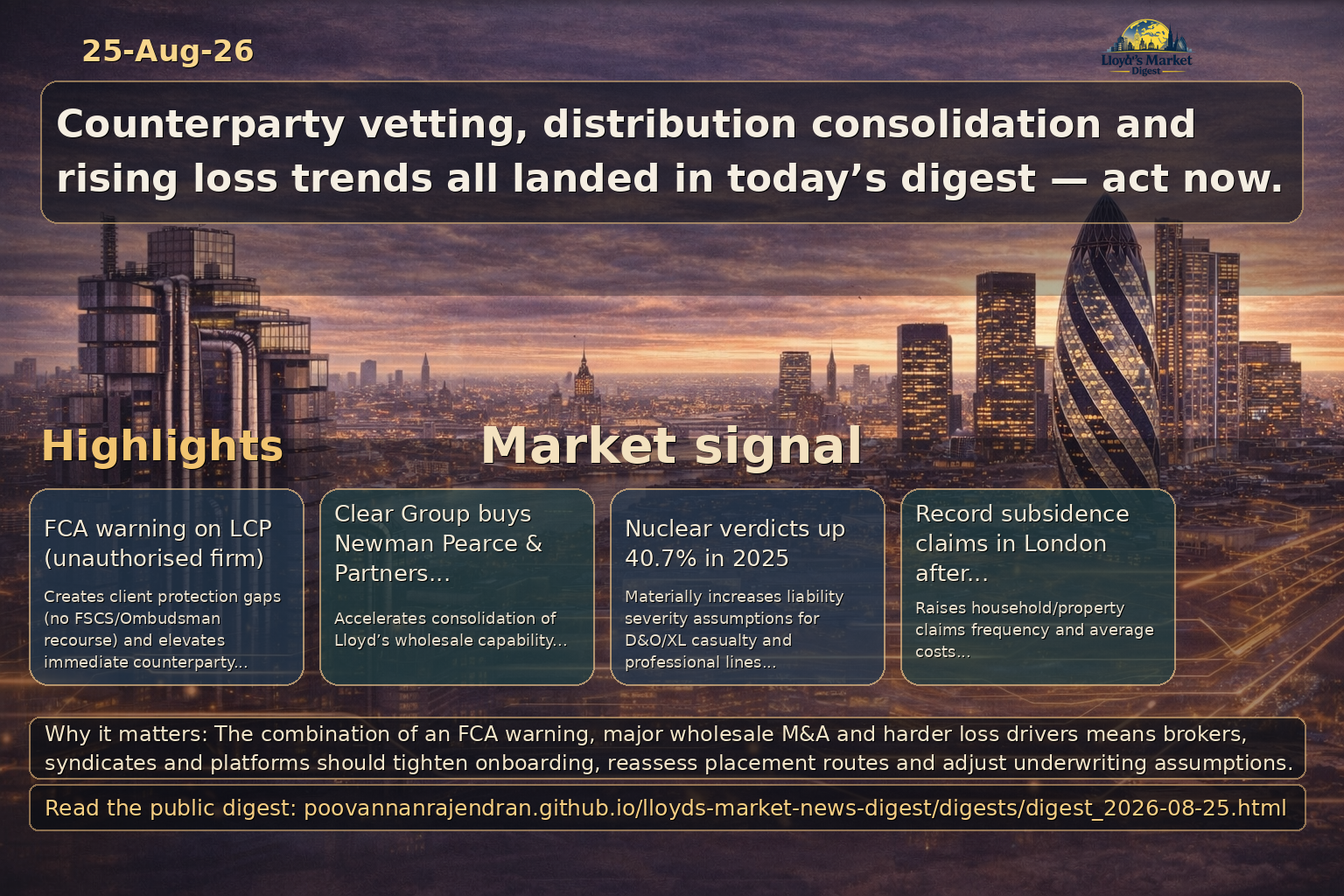
Why it matters: Acquisition of Newman Pearce & Partners by Clear Group signals continued consolidation and strengthening of specialist Lloyd's wholesale capacity; relevant for market access, distribution economics and coverholder sourcing strategies.
- Market structure: Continued roll-up activity accelerates consolidation of Lloyd's wholesale capability, affecting negotiation leverage between syndicates and intermediaries.
- Access & placement: Retail brokers and MGAs should reassess their distribution partnerships and monitor how consolidated wholesalers allocate capacity and sub-broker relationships on placement platforms.
- Strategic response: Syndicates and platforms should evaluate partnership models with scaled wholesalers, ensure competitive marketplace access, and consider targeted investments or alliances to secure preferred distribution routes.
Source: insurancetimes.co.uk
Why it matters: Clear Group’s purchase of Newman Pearce and Partners, a Lloyd’s wholesale specialist, is a direct strategic move to deepen London market access and expand international specialty distribution—relevant to syndicates, MGAs and placement platforms competing for wholesale flow.
- Expect accelerated routing of wholesale and Lloyd’s placements through Clear Group’s platforms—syndicates should strengthen broker relationships and clarify appetite.
- Opportunity to scale international specialty lines: evaluate how the acquisition changes coverage reach, capacity pooling and international binding authority.
- Placement platforms must ensure interoperability with Clear Group systems and maintain competitive slips workflow to preserve market access for diverse carriers.
Source: reinsurancene.ws
Why it matters: AXA XL’s promotion of a Lloyd’s-focused Fine Art & Specie lead signals sustained strategic investment in high-value niche lines at Lloyd’s, impacting broker relationships and syndicate capacity for art/specie business.
- Brokers placing fine art and specie should reaffirm program structures with AXA XL and similar Lloyd’s-capable carriers to optimise terms and limits.
- Syndicates underwriting art/specie must balance selective risk acceptance with pricing to maintain portfolio profitability amid market softening.
- Placement platforms should prioritise specialist data capture for high-value placements to reduce underwriting friction and speed binding.
Source: reinsurancene.ws
Why it matters: Clear Group's purchase of NPP materially strengthens its Lloyd's wholesale footprint and specialist capability across Global Specialty lines, providing scale, deeper distribution into coverholders/retail brokers and an international portfolio that enhances cross-border placement opportunities with syndicates.
- Accelerates market access: Adds Lloyd's wholesale broking capability and specialist classes (International Liability, Construction, Offshore Marine Liability, Specialist Property) to Clear Group’s distribution, improving syndicated placement leverage.
- Internationally oriented book: NPP’s predominantly international portfolio (~95%) supports syndicate appetite for non-UK risk sourcing and enables brokers to originate cross-border business more efficiently.
- Distribution and platform impact: Consolidation increases negotiating power with placement platforms and underwriters, pressures smaller wholesale brokers, and prioritises integration of digital placement and coverholder management.
Source: fca.org.uk
Why it matters: An FCA warning that a firm is unauthorised directly affects Lloyd’s brokers, placement platforms and syndicates through potential use of an unregulated intermediary. It creates client protection gaps, undermines platform trust, and elevates regulatory and reputational risk across distribution chains.
- Client protection and exposure: Transactions involving unauthorised firms leave clients without FSCS compensation or Financial Ombudsman recourse—agents and brokers must promptly identify impacted clients and advise on mitigation and remediation.
- Enhanced counterparty due diligence: Brokers, placement platforms and syndicates should immediately verify authorisations for counterparties, tighten onboarding checks, suspend suspicious flows, and implement retrospective audits of placements involving the named entity.
- Market integrity and escalation: Managing agents and market platforms must log incidents with their compliance teams, consider notifying Lloyd’s Market Services or the FCA where appropriate, and communicate transparently with carriers and key clients to contain reputational and regulatory fallout.
Source: insurancejournal.com
Why it matters: Directly relevant to distribution integrity in Lloyd's and global specialty broking: broker-to-broker talent raids and alleged client transfers affect placement continuity, coverholder relationships, and market reputation—material for brokers, syndicates and placement platforms.
- Immediate: Increased litigation risk between brokers may disrupt live placements and create settlement/coverage continuity issues for clients and syndicates.
- Market impact: Persistent 'raider' activity pressures retail-broker access to wholesale/Lloyd's capacity and drives demand for stronger contractual protections and non-solicitation enforcement.
- Action: Review agency agreements and placement continuity clauses, strengthen data access controls on placement platforms and accelerate contingency arrangements with alternative brokers and coverholders.
Source: insurancejournal.com
Why it matters: A marked rise in 'nuclear' verdicts alters liability tail risk economics for D&O, XL casualty and professional lines frequently underwritten by syndicates and reinsurers, with downstream effects on pricing and capacity.
- Underwriting: Higher jury awards increase severity assumptions and may require immediate repricing and tightening of terms for casualty and professional exposures in specialty portfolios.
- Reinsurance & capital: Expect upward pressure on attachment points and reinsurance premiums as cedants and reinsurers re-evaluate loss pick assumptions and aggregate exposure.
- Mitigation: Elevate litigation and social inflation modelling in underwriting, broaden claims mitigation services through broker partnerships, and consider limit caps, sub-limits and enhanced policy wording where appropriate.
Source: insurancejournal.com
Why it matters: Record subsidence claims in London following successive heat waves are a Lloyd's-market and UK specialty concern—raising property liability and household claims frequency, and challenging traditional exposure models for urban clay-soil geographies.
- Exposure: Growing claims frequency and elevated average claims (ABI averages cited) will stress home insurance portfolios and potential Lloyd's syndicate exposures in urban regions.
- Pricing & underwriting: Syndicates should re-assess vulnerability mapping, revisit premium relativities for subsidence-prone postcodes and update catastrophe models to reflect sustained heat-driven subsidence risk.
- Distribution & remediation: Brokers and coverholders should collaborate on risk-mitigation advisory services, endorse targeted inspection protocols on placement platforms, and demand endorsement updates to limit accumulation.
Source: insurancejournal.com
Why it matters: Significant restructuring at a major professional services firm tightens the consulting and advisory supply chain that specialty insurers, MGAs and Lloyd's brokers rely on for technology, actuarial and transformation projects—impacting delivery capacity and vendor risk.
- Operational impact: Headcount reductions among consulting partners can delay transformation and compliance projects for carriers, MGAs and broker platforms, slowing modernization timelines.
- Market contention: Reduced consulting capacity increases competition for high-quality advisory resources, potentially elevating costs and concentration risks for syndicates engaging external advisors.
- Contingency planning: Insurers and broker groups should re-evaluate vendor diversification, retain critical capabilities in-house where strategic, and build transitional SLAs with remaining vendors.
Source: insurancetimes.co.uk
Why it matters: Large-scale fraudulent claims against multiple insurers highlight persistent retail-channel fraud risks that can distort loss ratios, increase claims costs and erode trust between brokers, carriers and placement platforms. This is material for Lloyd's and specialty markets because the same integrity gaps can transfer into delegated authority and coverholder arrangements.
- Reinforce cross-market data sharing and referral mechanisms with IFED and fraud bureaus to accelerate detection and deterrence.
- Require stricter onboarding and ongoing due diligence by retail brokers and delegated authorities to spot serial policy behaviour and suspicious claims patterns.
- Prioritise fraud-detection tooling and workflow integration on placement platforms to reduce false payments and protect syndicate loss performance.
Source: insurancetimes.co.uk
Why it matters: Aviva’s deployment of video-based AI for musculoskeletal risk signals a maturing focus on preventative services that reduce frequency and severity of workplace injury losses—an approach specialty underwriters and syndicates can replicate for complex casualty and operational risks.
- Assess integration of third‑party risk prevention data into underwriting models and appetite frameworks to reward clients who adopt loss-reduction technology.
- Establish clear data governance, privacy and contractual terms before brokers or platforms pass video-derived risk scores into underwriting decisions.
- Explore partnerships between placement platforms, MGAs and specialist risk-control firms to create bundled value propositions that protect underwriting profitability.
Source: insurancetimes.co.uk
Why it matters: Aviva’s consolidation of high-value protection teams and expanded limits reflects a strategic move to centralise expertise and offer larger capacity to HNW segments—an example of how carrier-level capability alignment can shift referral flows and competitive dynamics for brokers and syndicates.
- Brokers should recalibrate referral pathways to leverage unified carrier expertise on complex HNW and IHT-driven placements.
- Syndicates and specialist carriers must evaluate competitive positioning where global insurers increase single-client limits and bundled wealth-protection services.
- Prepare operational alignment (pricing, underwriting authority, service levels) to capture or defend high-value flows that require coordination across sales, underwriting and servicing teams.
Source: insurancetimes.co.uk
Why it matters: Aon’s report of record insurer profitability amid slowing premium growth raises strategic questions on sustainability of current cycle dynamics—critical for Lloyd’s syndicates, reinsurers and brokers when setting expected returns, capacity deployment and rate adequacy.
- Reassess cycle assumptions: strong recent returns may attract capital, but underwriting discipline must persist to avoid softening that impairs long-term ROE.
- Brokers and syndicates should stress-test portfolios for margin compression and consider service-led differentiation (loss control, analytics) to defend pricing.
- Use profitability signals to negotiate capacity and reinsurance structures proactively, aligning risk-adjusted returns with long-term capital supply.
Source: reinsurancene.ws
Why it matters: Historical Reinsurance News archive provides market cycle context and precedent around catastrophe losses, broker commentary and capital efficiency arguments; useful for benchmarking current Lloyd's and syndicate strategies.
- Use archived cat-loss and combined ratio data to benchmark current catastrophe modelling and capital adequacy assumptions for syndicates.
- Reference broker commentary on reinsurance as contingent capital to refine cedent engagement and product positioning.
- Inform actuarial and underwriting scenario-setting with prior episodes of market softening and pricing evolution.
Source: reinsurancene.ws
Why it matters: Arch Insurance International elevates transactional risk leadership, signalling growth in R&W, tax and M&A-related specialty lines that brokers and placement platforms should prioritise for global placement.
- Brokers should align M&A transactional desks with Arch’s expanded underwriting capacity to accelerate deal closings.
- Syndicates and Lloyd’s managing agents should monitor pricing and appetite shifts in transactional risk for potential co-participation or facultative opportunities.
- Placement platforms must ensure data and workflow support for rapid placement of representations & warranties and tax insurance products.
Source: reinsurancene.ws
Why it matters: AM Best’s positive outlook on AmericanAg highlights strengthened balance sheet capacity for agricultural and niche farm reinsurance programmes, relevant to brokers placing rural and treaty business in London and international markets.
- Brokers serving farm bureau clients can leverage AmericanAg’s improved outlook to secure expanded treaty capacity or more favourable terms.
- Lloyd’s and syndicates should reassess appetite for agricultural aggregate exposures given potential capacity competition.
- Treaty structuring teams should use AM Best commentary to support client conversations on counterparty strength in renewal negotiations.
Source: artemis.bm
Why it matters: Fermat’s expansion in Singapore and Japan signals deeper APAC institutional engagement with ILS, which affects capital sourcing for syndicates and the regional distribution strategies of brokers and platforms.
- Mobilises APAC institutional capital: Strengthened investor relations in Singapore and a Japan office increase the probability of persistent APAC allocations into catastrophe bonds and ILS, offering alternative capacity for Lloyd’s syndicates.
- Alters broker and placement dynamics: Greater local investor connectivity raises expectations for brokers and placement platforms to offer APAC‑friendly access routes, time zones and documentation standards.
- Regulatory and product implications: Local presence in Japan and Singapore necessitates attention to jurisdictional regulation, currency and tax considerations, and may drive tailored product structures and operational workflows for syndicates and platforms.
Source: artemis.bm
Why it matters: The weekly industry roundup highlights consolidation among brokers and changes in reinsurer rankings, underscoring evolving market concentration and counterparty hierarchies that influence placement strategies and syndicate counterparty selection.
- Consolidation shifts placement leverage: Deals such as major broking mergers concentrate placement power, potentially compressing negotiations for syndicates and elevating the importance of strategic broker relationships.
- Capital ranking movements matter to counterparties: Changes in reinsurer rankings (eg AM Best) alter perceived counterparty strength and appetite, affecting where Lloyd’s syndicates place treaty and facultative business.
- Sustained ILS and cat bond prominence: Continued top reads on ILS and catastrophe bonds signal ongoing investor and market attention, reinforcing the need for broking and placement platforms to integrate ILS workflows and reporting.
Source: artemis.bm
Why it matters: Blackstone’s direct catastrophe bond purchases demonstrate growing institutional willingness to invest directly in ILS, which has structural implications for ILS managers, syndicates seeking capital and the distribution architecture used by brokers and placement platforms.
- Direct allocations compress intermediary value: Large managers investing directly can reduce flow through specialist ILS managers, pressuring fee models and forcing a rethink of intermediary services offered to syndicates and brokers.
- Enhances liquidity and pricing dynamics: Incremental direct capital from large allocators supports market depth and may tighten spreads, changing pricing and capacity availability for Lloyd’s syndicates and reinsurers.
- Demand for bespoke access and documentation: Institutional direct investments frequently require tailored legal, operational and reporting arrangements, prompting brokers and platforms to enhance connectivity, settlement and compliance capabilities.
Source: newsnow.co.uk
Why it matters: The search result demonstrates a null return for a specific keyword. For Lloyd’s ecosystem stakeholders this is a data-point indicating either true absence of public reporting or a failure in aggregation/indexing that could hide operational or reputational signals relevant to underwriters, brokers and platform operators.
- Validate relevance: Confirm whether "Plaistow" corresponds to a counterparty, location, claim matter, broker office or other Lloyd’s-related exposure; if relevant, escalate monitoring and watchlist inclusion.
- Audit aggregation and platform indexing: Instruct placement platforms and intelligence suppliers to verify crawl/index configurations, API feeds and access permissions to prevent blind spots in market surveillance and news ingestion.
- Strengthen governance and alerts: Implement a low-latency alerting protocol for null-search events on watchlisted terms and require monthly reporting from brokers and syndicates on digital footprint gaps and remediation progress.