Source: globalreinsurance.com
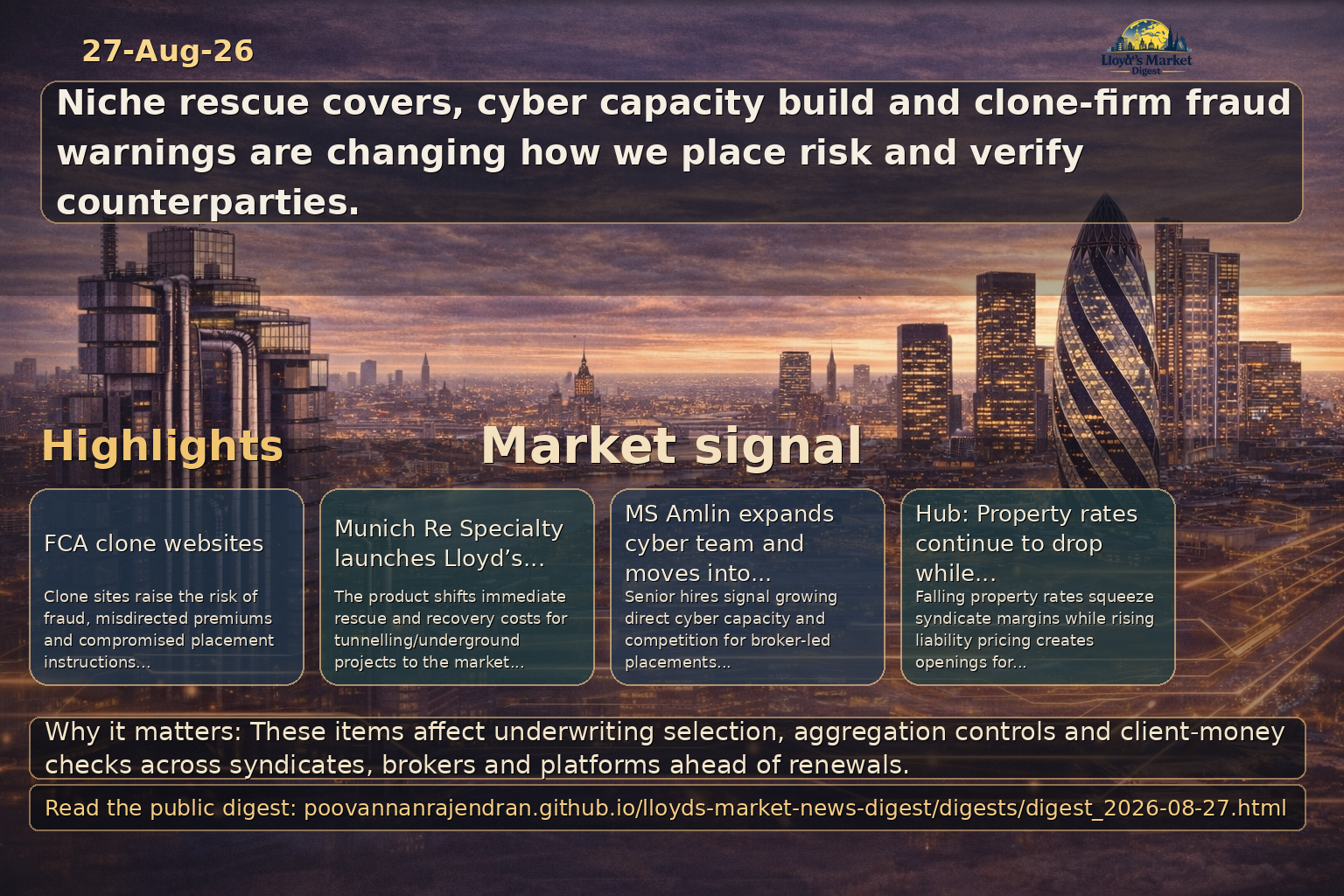
Why it matters: Munich Re Specialty's Construction Rescue Insurance is a niche Lloyd's offering addressing immediate rescue and recovery costs for tunnelling and underground projects, representing product innovation that transfers acute crisis-response expense to the insurance market and creates new placement opportunities for brokers and syndicates.
- Product differentiation: Covers immediate rescue, specialist equipment and coordination costs — filling a protection gap for owners, contractors and lenders on complex underground projects.
- Broker and placement implications: High-touch, bespoke placements expected; brokers will need to coordinate technical risk advisers, on-the-ground response providers and placement platforms for efficient binding.
- Risk management and pricing: Underwriting requires specialist engineering input, scenario modelling of catastrophic incidents and contingency of response costs, with implications for capacity allocation and potential insured retentions.
Source: fca.org.uk
Why it matters: Clone websites and impersonation tactics increase the risk of fraud, misdirected premiums and compromised placement instructions for brokers and syndicates. These schemes can exploit electronic placement workflows and erode trust in digital distribution channels.
- Validate counterparty identities using FCA register checks and out-of-band confirmation before funding or placing business, particularly for new or changed payment instructions.
- Require platform and broker partners to implement anti-impersonation controls: domain monitoring, SPF/DMARC email protection and mandatory voice verification for high-value transactions.
- Incorporate clone-firm risk into onboarding and continuous monitoring frameworks; escalate alerts to compliance and notify impacted clients and carriers promptly if impersonation is detected.
Source: fca.org.uk
Why it matters: Unauthorised firms operating in the market create exposure for brokers and placement platforms that may inadvertently channel business or premium flows to entities not covered by FSCS or Financial Ombudsman protections, raising settlement, recovery and reputational risks for syndicates.
- Embed verification steps in broker workflows to confirm FCA authorisation status and legal entity identifiers before accepting mandates or premium settlements.
- Require contractual representations and indemnities from intermediary partners and platforms confirming regulatory status and insurance of client monies where applicable.
- Increase monitoring of inbound business sources; deploy transaction thresholds that trigger enhanced due diligence when dealing with unverified or offshore intermediaries.
Source: fca.org.uk
Why it matters: The administration of an FCA-authorised wealth management firm highlights operational and client-asset vulnerabilities that can arise even among authorised firms; for Lloyd's market participants this signals counterparty continuity and client money controls risks when intermediaries fail.
- Review custody and client-money arrangements across broker and platform counterparties; require segregation and independent custody where possible to limit contagion in insolvency scenarios.
- Establish business continuity and claims handling protocols with syndicates and fronting carriers to manage risks from intermediary failures, including notification templates and escrow arrangements.
- Perform periodic stress-testing of concentration risk tied to key intermediaries and update acceptance criteria for intermediaries that hold or transfer premiums and policyholder funds.
Source: fca.org.uk
Why it matters: Enforcement against individuals who structured schemes to bypass regulations demonstrates how conduct failures can materially affect client eligibility, underwriting integrity and distribution compliance; such conduct can propagate across brokers, MGAs and platforms.
- Strengthen senior manager and individual-level probity checks for key intermediary personnel and principals involved in cross-border placements and immigration-adjacent advisory services.
- Mandate documented escalation and transaction justification for unusual placement structures or client eligibility workarounds, with audit trails accessible to underwriters and compliance teams.
- Coordinate with legal and compliance to update contractual warranties and representations addressing prohibited structuring and to include clear termination and remediation rights for syndicates and platforms.
Source: globalreinsurance.com
Why it matters: MS Amlin's appointments signal a strategic move from treaty into direct cyber at Lloyd's, prioritising experienced underwriting leadership and coverholder relationships to capture growth while managing selection and portfolio risk.
- Market positioning: Senior hires indicate intent to expand direct cyber share within Lloyd's and compete for broker-led placements and delegated authority flows.
- Distribution and platforms: Continued reliance on strategic coverholders and broker relationships implies the need for robust placement-platform integration and MDR/coverholder oversight.
- Underwriting and capital: Scaling direct cyber requires investment in analytics, strict appetite definition and active portfolio management to protect syndicate capital and maintain pricing discipline.
Source: insurancetimes.co.uk
Why it matters: MS Amlin’s senior cyber hires and expansion into treaty and direct cyber underline the sustained demand and capacity build for cyber lines, requiring disciplined underwriting and aggregation control across Lloyd’s and global specialty markets.
- Scale specialist cyber underwriting teams and data analytics to assess accumulation and systemic exposure.
- Design placement strategies that use treaty, facultative and delegated channels in concert to manage portfolio concentration.
- Engage brokers and platforms early on aggregation modelling to set prudent limits and reinsurance structures.
Source: businessinsurance.com
Why it matters: Marsh's operational data center facility signals broker investment in infrastructure that will shift underwriting, placement efficiency and data-driven decision making across property-heavy specialty portfolios.
- Improved data and on‑site assessment capabilities enable more granular underwriting, affecting syndicate appetite and pricing for data center and complex property risks.
- Placement platforms should accelerate API and data‑model integrations to capture Marsh's outputs and streamline multi‑insurer submissions.
- Syndicates and reinsurers can use richer operational data to refine aggregation models and limit unintended accumulations in urban/tech clusters.
Source: businessinsurance.com
Why it matters: Munich Re Specialty's construction rescue product highlights insurer-led niche product development that presents new placement opportunities for brokers and potential participation for Lloyd's syndicates.
- Niche rescue and delay‑related covers create openings for specialty capacity providers to offer tailored limits and endorsements.
- Brokers will need standardised submission data and bespoke wordings to place these non‑standard construction exposures efficiently.
- Underwriters must evaluate claims frequency/severity and accumulation risk on construction sites to price appropriately and determine reinsurance needs.
Source: businessinsurance.com
Why it matters: Senior commentary from Munich Re Specialty (Sabrina Hart) provides signals on underwriting appetite and product focus that brokers and syndicates can use to anticipate capacity shifts.
- Public leadership insights inform brokers on likely underwriting priorities and fast‑track product conversations for placement negotiations.
- Syndicates can align boutiques and lead capacity with stated market strategies, reducing friction in negotiated transactions.
- Placement platforms should surface such strategic signals to brokers and clients to optimize submission timing and structure.
Source: businessinsurance.com
Why it matters: Hub's data showing falling property rates and rising liability prices is a core market signal that affects capital allocation, product design and renewal strategies across the Lloyd's and global specialty community.
- Syndicates writing property face margin pressure and must prioritize risk selection, underwriting discipline and catastrophe modelling refinement.
- Rising liability prices create strategic openings for specialty capacity to expand limits and recalibrate excess‑of‑loss towers.
- Brokers should reweight portfolios, lock in liability renewals earlier and leverage pricing differentials to negotiate multi‑line placements.
Source: businessinsurance.com
Why it matters: Allianz Trade appointing a China CEO is material for global credit and trade risk distribution, with implications for brokers facilitating multinational placements and for reinsurers providing trade credit capacity.
- A leadership shift in China may signal intensified underwriting activity and tailored products for Asia, affecting regional capacity needs.
- Brokers should engage early on integrated trade credit solutions for clients operating in China and adjacent supply chains.
- Reinsurers and Lloyd's participants must monitor capacity appetite changes and potential shifts in treaty structures supporting trade credit lines.
Source: insurancejournal.com
Why it matters: Heightened probability of extreme climate shocks increases model uncertainty, aggregate loss potential and demand for alternative risk transfer across catastrophe lines — directly affecting Lloyd's syndicates and global specialty capacity.
- Reassess catastrophe models and peak‑peril scenarios; stress test capital and reinsurance programmes for extreme tail events.
- Develop and scale parametric and indexed products to provide rapid pay‑out options and protect balance sheets against model misspecification.
- Brokers should articulate client exposure aggregation across portfolios and drive pooled solutions with reinsurers and ILS managers to shore up capacity.
Source: insurancejournal.com
Why it matters: Russia's expanding hybrid attacks blur lines between cyber incidents, physical sabotage and state action, creating acute ambiguity for war/non‑war coverage and increasing aggregation risk for cyber and political violence exposures.
- Urgently review and standardise war/non‑war and hostile act wordings across placements to reduce coverage disputes and hidden aggregation.
- Enhance cyber aggregation controls and limitations; require clearer client disclosures on cyber risk posture and incident response readiness.
- Brokers and placement platforms must flag potential cross‑line accumulations (marine, hull, cyber, political violence) to underwriters and reinsurers ahead of placement.
Source: insurancejournal.com
Why it matters: Talks between Iran and Oman on interim reopening of the Strait of Hormuz would reduce shipping disruption risk if successful, but the transition period will create uneven risk profiles for marine hull, cargo, and war risk underwriting.
- Monitor negotiations closely and update voyage‑specific exposures; implement dynamic pricing for transitional security risk during corridor reopening.
- Prepare bespoke covers for mine‑clearance operations and temporary maritime corridor management, including contractor liability and POL/PRI interfaces.
- Brokers should advise clients on phased routing options and contingency logistics, using placement platforms to flag short‑term protective solutions.
Source: insurancejournal.com
Why it matters: Investor pressure on hyperscalers over AI’s energy demands highlights an underwriting intersection of ESG, operational risk and cyber exposure — relevant to syndicate asset strategies and technology sector underwriters.
- Incorporate ESG and energy‑intensity metrics into technology underwriting and counterparty credit assessments for insureds and brokers' PI exposures.
- Consider product innovations that address AI‑related operational interruption and emissions‑linked performance triggers.
- Ensure investment and asset allocation policies at syndicate level account for potential regulatory and reputational shocks tied to AI energy use.
Source: insurancejournal.com
Why it matters: The Hong Kong ruling limiting PwC International’s exit from Evergrande litigation deepens professional liability contagion risk, signaling greater potential for cross‑jurisdictional claims against global firms and higher PI exposures.
- Anticipate upward pressure on PI and D&O premiums and tighter retentions for accounting/audit exposures in Asia‑focused portfolios.
- Revisit policy wordings for multinational affiliates, choice of law and liability carve‑ins to manage cross‑border claim risk.
- Brokers should prepare enhanced due‑diligence packages and stress‑tested defence cost funding solutions for clients in audit, real‑estate and corporate services.
Source: insurancetimes.co.uk
Why it matters: IUA CEO commentary reinforces that underwriting expertise, disciplined risk selection and contract wording remain central strategic levers for market resilience — a direct signal for Lloyd’s syndicates and placement platforms to prioritise technical capability and documentation quality.
- Re-evaluate syndicate underwriting governance and contract drafting standards to reduce leakage and basis risk.
- Coordinate with market bodies and brokers to standardise wording where appropriate to limit ambiguity in complex placements.
- Invest in targeted underwriting training and retention programmes to preserve scarce technical capability in specialty classes.
Source: insurancetimes.co.uk
Why it matters: The profile of a senior claims/policy wording specialist highlights the strategic value of claims advocacy and precise policy language for dispute avoidance — relevant to insurers, brokers and placement platforms focused on client outcomes and regulatory scrutiny.
- Embed claims advocacy expertise into placement and renewal discussions to pre-empt disputes and protect client relationships.
- Leverage specialists in policy wording to reduce ambiguity in delegated authority contracts and coverholder agreements.
- Use senior claims advisors as part of client advisory propositions to differentiate broker and platform service models.
Source: insurancetimes.co.uk
Why it matters: The briefing on FOS complaints signals that proactive claims handling and clearer customer communications materially reduce escalation risk — an operational priority for carriers, syndicates and brokers to limit reputational and regulatory exposure.
- Implement tighter first-notice-of-loss triage and decision governance to reduce referral to ombudsman services.
- Review complaint reporting and root-cause analytics across underwriting portfolios to identify systemic issues in wording or settlement practice.
- Ensure placement documentation and client communications are explicit on cover scope and claims expectations to lower dispute incidence.
Source: insurancetimes.co.uk
Why it matters: Brokerslink’s board expansion following investment indicates active capital-backed growth among broker networks, enhancing cross-border distribution channels and creating new placement routes for syndicates and specialty insurers.
- Assess partnership opportunities with expanding broker networks to access regional flows in Central and North Africa and Europe.
- Monitor investor-led network consolidation as a potential source of larger, aggregated programmes requiring syndicated capacity.
- Consider bespoke distribution and service models for capital-backed broker networks, including delegated authority and strategic relationships.
Source: reinsurancene.ws
Why it matters: Historical archive content provides precedent for cyclical market behaviour and loss-event impact on reinsurance results; useful for benchmarking underwriting and pricing decisions at syndicates and brokers.
- Source material for long-term cycle analysis and rate benchmarking following loss events
- Helps underwriters and syndicates compare current margin exposure to prior catastrophes
- Useful reference for brokers constructing historical loss narratives in negotiations with capital providers
Source: reinsurancene.ws
Why it matters: Steadfast’s FY'26 scale increase highlights the continued rise of large broker networks that shift distribution leverage and influence capacity placement strategies for Lloyd’s and global specialty markets.
- Scale strengthens broker negotiating power on terms, fees and placement pathways
- Larger broker networks accelerate cross-border flow of business to London and specialist syndicates
- Consolidation and network growth raise the bar for platform integration and data-driven submission handling
Source: reinsurancene.ws
Why it matters: Fitch’s projection of further property catastrophe rate softening in 2027 signals continued margin compression for property-focused syndicates and reinsurers unless a major loss resets pricing.
- Softening particularly evident in loss-free higher layers where alternative capital is most active
- Syndicates must emphasise portfolio diversification and stricter underwriting discipline to protect returns
- Brokers and placement platforms will need to re-evaluate attachment strategies and structure risk solutions beyond price
Source: reinsurancene.ws
Why it matters: Continental Re’s expansion into Rwanda underscores the strategic importance of local presence in Africa for underwriting access and strengthening broker-reinsurer relationships in emerging specialty markets.
- Onshore offices accelerate market intelligence and faster placement decisions for regional risks
- Local licensing supports regulatory engagement and treaty structuring tailored to African exposures
- Placement platforms should accommodate localized underwriting workflows and documentation
Source: reinsurancene.ws
Why it matters: Gartner’s identification of AI-driven cyber vulnerability discovery as a leading emerging risk elevates the underwriting and aggregation challenges for specialty cyber lines across Lloyd’s and global reinsurers.
- AI lowers barriers for vulnerability discovery, increasing frequency and scale of cyber events
- Underwriters must incorporate AI-driven threat intelligence into exposure modelling and policy wording
- Brokers and platforms can differentiate by offering advanced cyber risk analytics and mitigation advisory
Source: artemis.bm
Why it matters: Rising insured nat-cat losses and constrained traditional reinsurance capacity make ILS and broader securitisation essential tools for transferring peak peril risk and scaling capacity; this reshapes capital sourcing, pricing dynamics and distribution needs across the Lloyd’s ecosystem.
- Reinsurers and syndicates must incorporate ILS and securitisation into capital planning and pricing frameworks to preserve underwriting capacity and manage tail volatility.
- Brokers need to expand advisory and structuring capabilities to securitise aggregate and event risk, acting as conduits between capital markets and Lloyd’s syndicates.
- Placement platforms should prioritise technical integration to support structured transactions, transparency for investors, and secondary market capability to attract institutional ILS participation.
Source: artemis.bm
Why it matters: The Wilton Re — Sun Life partnership launching a life/annuity sidecar-like reinsurer demonstrates how asset managers and insurers are creating dedicated capital vehicles for longevity and annuity risk, indicating a new wave of non-traditional capacity that will influence pricing, product design and capital partnerships in global specialty markets.
- Syndicates and brokers should develop expertise in life and longevity risk transfer structures to capitalise on growing insured and institutional demand for reinsurance capacity beyond P&C.
- Placement platforms and capital management teams must be equipped to execute bespoke sidecar and quota-share transactions, including operational integration, reporting and asset-liability alignment.
- Executives must build regulatory and commercial timelines into strategic plans (eg. 2027 launch assumptions), conducting due diligence on partner capabilities, governance, and solvency impacts before committing capital or distribution resources.