Source: globalreinsurance.com
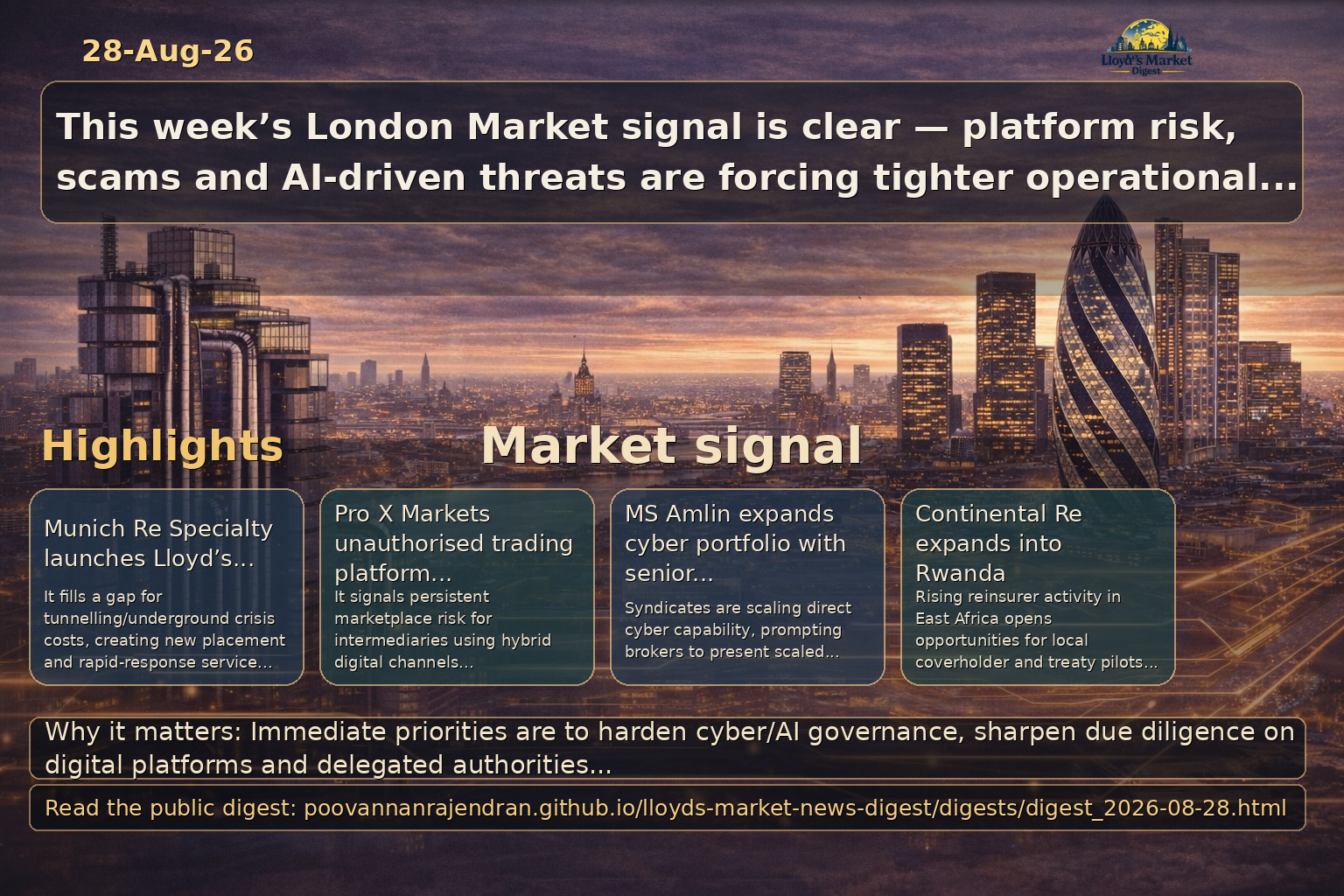
Why it matters: Munich Re Specialty's Lloyd's Construction Rescue cover is a differentiated product addressing immediate rescue and crisis-response costs for tunnelling and underground projects, showcasing Lloyd's capacity to underwrite complex, high-severity engineering contingencies and creating new placement and service opportunities for brokers and syndicates.
- Product innovation: A bespoke rescue-response policy fills a clear coverage gap on major underground projects and can become a model for other specialist construction lines within Lloyd's syndicates.
- Broker and platform opportunity: Brokers and placement platforms can add value by packaging multidisciplinary risk information, coordinating emergency-response partners and structuring layered placements to manage limit and retention needs.
- Operational and claims complexity: The product shifts focus to rapid-response logistics, specialist suppliers and real-time coordination — requiring pre-agreed protocols, clear claims triggers and potential captive/reinsurance attachments for accumulation control.
Source: fca.org.uk
Why it matters: Unauthorised operator warning: poses direct consumer and intermediary risk when fraudsters impersonate or solicit business, eroding trust in referral channels used by brokers and platforms.
- Immediate action for distribution partners: verify FCA authorisation numbers and publish trusted counterparty lists to clients and placement platforms
- Operational control: enhance onboarding checks and domain/email authentication to block impersonation attempts targeting brokers and syndicates
- Client protection: reinforce communications on lack of FSCS/FOS protection and require written confirmation of counterparty authorisation before fund transfers
Source: fca.org.uk
Why it matters: Unauthorised trading platform warning: indicates persistent marketplace risk from unregulated platforms targeting UK clients and downstream exposure for intermediaries using hybrid digital channels.
- Due diligence: treat engagements with new digital platforms as high‑risk and mandate enhanced onboarding and contractual protections
- Placement platform risk: assess API integrations and third‑party access controls to prevent misdirection of premiums or data leakage
- Client advisories: update client-facing disclosures to clarify regulatory protections and recourse limitations when third‑party platforms are used
Source: fca.org.uk
Why it matters: FCA research shows rising trust in AI among less experienced investors, raising distribution‑integrity and advice‑governance issues for brokers, MGAs and digital placement platforms.
- AI governance: require documented model‑risk controls, provenance of advice and clear consumer disclosures across broker tools and platform recommendation engines
- Training and oversight: mandate training for brokers and syndicate underwriters on AI limitations and client protection obligations
- Product governance: review algorithmically generated product matches and communications to ensure regulatory compliance and avoid misleading representations of protection or regulation
Source: fca.org.uk
Why it matters: Clone of authorised firms targeting clients: repeated clone incidents signal systemic threat to market credibility and increased operational burden for brokers and placement platforms.
- Information sharing: establish rapid exchange of clone‑firm indicators among Lloyd’s brokers, platforms and market associations
- Technical controls: deploy email domain verification and inbound traffic monitoring to detect impersonation campaigns
- Client protocols: standardise verification steps for any unsolicited approaches purporting to be from known authorised firms
Source: fca.org.uk
Why it matters: Unauthorised entity alert: highlights ongoing targeting of UK clients by unregulated entities, with potential knock‑on effects for syndicate underwriting and broker reputations.
- Broker accountability: require brokers to confirm counterparty authorisation before binding business and retain audit trails of verification
- Reputational risk: monitor secondary channels (social media, influencer referrals) for unauthorised promotion of specialty products
- Escalation processes: implement a centralised reporting mechanism to market conduct teams when unauthorised operators are detected
Source: reinsurancene.ws
Why it matters: MGAA's reported growth and regulatory engagement confirm the MGA sector's rising significance and the need for enhanced oversight and systems integration across the London market.
- Expansion of MGA membership increases demand for capacity and creates competition for syndicate underwriting allocations.
- Regulatory engagement signals heightened expectations for governance, compliance and data transparency from brokers and syndicates dealing with MGAs.
- Brokers and placement platforms should strengthen due-diligence, automated oversight tools and API connectivity to manage delegated portfolios at scale.
Source: reinsurancene.ws
Why it matters: FCA authorisation for Pinpoint UK Solutions increases regulatory credibility for an AM Specialty coverholder and supports its expansion as a directly authorised participant in the UK/London market.
- Authorisation simplifies access to UK business and enhances confidence among Lloyd's syndicates and brokers when placing delegated authority business.
- Strengthens AM Specialty's platform credibility and supports broader capacity partnerships and Lloyd's placements.
- Brokers should re-evaluate routing and documentation requirements to leverage authorised entities for efficient placements.
Source: globalreinsurance.com
Why it matters: MS Amlin's senior cyber hires signal a deliberate shift from treaty-only positions into expanded direct cyber capacity via strategic coverholder relationships, reflecting Lloyd's syndicates' pursuit of scale, specialized underwriting capability and closer broker/coverholder partnerships.
- Market positioning: Appointment of a head of cyber and lead underwriter indicates a push to build a meaningful direct cyber book alongside treaty business — a cue for brokers to present scaled, well-structured programmes.
- Distribution and placement implications: Reliance on select coverholders creates demand for robust oversight, placement platform integration and streamlined documentation to enable efficient flow from broker to syndicate.
- Underwriting and accumulation risk: As MS Amlin expands direct cyber, syndicate-level aggregation, cross-class correlation and claims-model sophistication become priorities; reinsurance structures and risk selection criteria will be tested.
Source: artemis.bm
Why it matters: A one‑third share of third‑party capital in global life annuity reinsurance underscores a structural shift: sidecars and investor capital are materially augmenting capacity in life and annuity lines, with governance, longevity modelling and capital efficiency implications for reinsurers and brokers.
- Assess capital mobilisation options (sidecars, quota share with third‑party investors) to optimise balance sheet efficiency for life/annuity portfolios.
- Strengthen governance, reporting and cash‑flow transparency to meet investor due diligence and rating agency expectations.
- Brokers should develop product solutions that reflect blended capital sources and communicate longevity catastrophe protection to institutional counterparties.
Source: artemis.bm
Why it matters: EIB and WFP‑led parametric microinsurance pilots in Ethiopia demonstrate scalable public‑private models for climate resilience that create distribution and capacity opportunities for specialty insurers and Lloyd’s syndicates, particularly through index standardisation and donor‑backed credit enhancement.
- Evaluate partnership opportunities with development institutions to provide capacity and expertise for parametric programmes in emerging markets.
- Prioritise investment in index validation, basis‑risk analysis and payout governance to make products bankable for institutional investors.
- Leverage parametric programmes for ESG and market access narratives while managing reputational and operational oversight.
Source: businessinsurance.com
Why it matters: Continental Re's expansion into Rwanda signals increased reinsurer and primary-market activity in East Africa — a region of growing opportunity for Lloyd's syndicates, specialty brokers and placement platforms seeking local distribution and treaty relationships.
- Syndicates: evaluate facultative and treaty appetite for East African political, agriculture and infrastructure risks; consider capacity pilots via local coverholders.
- Brokers: strengthen in-country partnerships and due diligence on local intermediaries to capture premium growth and manage placement execution.
- Placement platforms: ensure geolocation compliance, local tax/ regulation support and rapid onboarding for Rwandan counterparts.
Source: businessinsurance.com
Why it matters: A sharp profit uptick among UAE insurers indicates capital availability and increased local underwriting momentum, with direct implications for reinsurance purchasing, retrocession pricing and Lloyd's appetite in the Gulf region.
- Syndicates: reassess capacity allocation to MENA commercial lines and energy/engineering portfolios where margin opportunity is expanding.
- Brokers: position global specialty products to support UAE clients expanding regionally; leverage profit momentum to negotiate improved terms.
- Placement platforms: integrate regional regulatory controls and support multi-jurisdictional placement workflows for UAE-origin business.
Source: businessinsurance.com
Why it matters: Vienna Insurance's rising profits reflect healthier European primary-market results that can influence reinsurance demand, pricing and syndicate treaty negotiations across Central and Eastern Europe.
- Syndicates: monitor margin recovery for cedants in Austria/Central Europe to anticipate treaty demand and pricing pressure.
- Brokers: leverage competitive cedant positions to expand specialty placements and cross-border program solutions.
- Placement platforms: support cross-border quoting and documentation for EEA/EU-adjacent jurisdictions with up-to-date compliance checks.
Source: businessinsurance.com
Why it matters: An earthquake-triggered avalanche and subsequent flood underscores correlated catastrophe exposure and secondary perils risk — critical for property catastrophe modelling, syndicate accumulation controls and claims readiness.
- Syndicates: revisit accumulation models and retrocession strategies to capture combined seismic, avalanche and flood scenarios.
- Brokers: advise clients on risk mitigation, business continuity plans and appropriate parametric or indemnity cover structures.
- Placement platforms: enable accelerated claims intake, geospatial loss aggregation and data feed integration for rapid exposure assessment.
Source: businessinsurance.com
Why it matters: A profile of an industry professional can signal influence on distribution or underwriting strategy; personnel visibility matters for broker-syndicate relationships and market intelligence.
- Brokers & Syndicates: confirm relationship continuity and client handoffs where profiles indicate senior role changes or influence.
- Talent strategy: incorporate profile insights into succession planning for key broker or syndicate contacts.
- Placement platforms: maintain updated relationship data to optimise lead routing and executive engagement.
Source: insurancejournal.com
Why it matters: Growth in bank Significant Risk Transfers (SRTs) creates an addressable market for Lloyd’s and global specialty capacity — syndicates and MGAs can provide structured protection, while brokers and placement platforms will coordinate complex capital and documentation requirements.
- Opportunity: Syndicates and reinsurers can deploy tailored SRT capacity and structured-finance desks to capture increased deal flow, particularly against corporate loan and asset-backed pools.
- Placement implications: Brokers should ready documentation, collateral and capital structuring expertise; placement platforms must support funded-transaction mechanics and bilateral collateral flows.
- Risk management: Underwriters must enhance portfolio analytics and stress-testing for credit concentrations and counterparty collateralization to avoid hidden correlation with market/credit cycles.
Source: insurancejournal.com
Why it matters: A glacier collapse-triggered flood in the Himalayas highlights acute physical climate risk in geographies with limited insurance penetration — this underscores the need for specialty parametric products, improved exposure mapping by syndicates, and broker-led risk-transfer solutions for frontier territories.
- Product innovation: Accelerate parametric and index-based catastrophe products tailored for mountainous river basins to provide rapid liquidity where indemnity cover is constrained.
- Exposure assessment: Syndicates and platforms must invest in high-resolution hazard and exposure modelling for transboundary alpine risks to quantify accumulation and treaty retrocession needs.
- Distribution: Brokers should develop advisory offerings for financial resilience (contingent liquidity, sovereign/NGO programmes) and coordinate multi-lateral placements where local capacity is thin.
Source: insurancejournal.com
Why it matters: AI-assisted intrusion campaigns against corporates demonstrate escalating cyber threat sophistication and signal heightened claims frequency/severity for cyber lines; this requires Lloyd’s syndicates and brokers to revisit underwriting controls, policy language, and platform security.
- Underwriting evolution: Insurers must refine cyber underwriting to account for AI-assisted attack vectors, expanding scenario analysis and conditional exclusions/affirmative controls tied to AI misuse.
- Policy design: Update contractual language and affirmative cybersecurity requirements (patching, endpoint controls, vendor governance) and consider differentiated pricing for AI-enabled risk profiles.
- Broker and platform roles: Brokers should advise clients on cyber resilience and incident response readiness; placement platforms must vet cyber supply chains and ensure secure transmission of sensitive submission data.
Source: insurancejournal.com
Why it matters: Credit markets’ limited pricing reaction to severe climate-driven droughts implies a potential mispricing of climate-related credit risk that affects insurers active in credit and loan-protection products, including SRTs and balance-sheet guarantees.
- Pricing risk: Syndicates and reinsurers providing credit protection should intensify climate scenario stress-testing to detect underpriced tail exposures linked to prolonged physical risk.
- Capital allocation: Re-evaluate capital models for credit-linked lines and SRT exposures to reflect climate-driven correlation between corporate earnings and environmental stressors.
- Broker advisory: Brokers need to challenge counterparties on forward-looking climate risk disclosures and structure coverage with clauses that reflect changing physical risk profiles.
Source: insurancejournal.com
Why it matters: Senior appointment activity at Marsh/Guy Carpenter and QBE signals strategic repositioning in regional broking leadership and specialised risk verticals (data centres) with direct consequences for placement flows into Lloyd’s syndicates and tailored capacity requirements.
- Relationship dynamics: Leadership changes can shift regional placement preferences; syndicates should proactively engage new broking leads to reconfirm appetites and service models.
- Product focus: The creation of a global data-centre role at QBE underscores demand for specialist coverage — syndicates should ensure availability of technical underwriting and aggregation limits for large-scale tech exposures.
- Talent and distribution: Brokers’ talent mobility will affect client retention and origination; syndicates and platforms must reinforce direct-market access and co-development of bespoke terms.
Source: insurancetimes.co.uk
Why it matters: The hire strengthens PKF Littlejohn’s ability to provide specialist audit and regulatory advisory services targeted at insurers, brokers and placement platforms operating in complex and cross‑border markets, which matters to syndicates and capital providers seeking robust financial controls and reporting.
- Direct auditing experience across intermediaries and carriers enhances credibility with Lloyd’s syndicates and global specialty operators seeking independent assurance and regulatory readiness.
- Improved capability to advise on operational and reporting challenges supports brokers and placement platforms during complex placements, due diligence and capital raisings.
- Signals increased competition among professional services firms for senior insurance audit talent, potentially expanding market choice and raising the bar for audit quality and sector‑specific advisory services.
Source: reinsurancene.ws
Why it matters: Historical archive reference useful for trend analysis and benchmarking of market cycles, pricing and product evolution relevant to strategic planning in specialty lines and Lloyd's.
- Provides a baseline for long-term pricing cycles and catastrophe loss comparisons that inform syndicate and reinsurer strategy.
- Useful for broking teams to validate shift in product demand and delegated authority growth over a decade-plus horizon.
- Caveat: historical context must be combined with current capital flows (ILS and traditional) when shaping placement decisions.
Source: reinsurancene.ws
Why it matters: Ageas' strong net inflows and commercial performance indicate robust primary market activity that will influence reinsurance demand and capacity dynamics for specialty lines.
- Higher primary inflows increase cedant demand for reinsurance capacity, creating opportunity but also pressure on pricing for brokers and syndicates.
- Regional growth (Belgium, Europe, Asia) signals where syndicates and MGAs should prioritise distribution and capacity allocation.
- Sustained profitability supports reinsurer/reinsurance buyer counterparty strength, affecting collateral and terms in treaty negotiations.
Source: reinsurancene.ws
Why it matters: Bridgehaven's long-term capacity commitment to Amiga Specialty exemplifies the hybrid-capacity partnership model that underpins MGA scale-up and continuity of specialty underwriting platforms.
- Long-term capacity stabilises underwriting plan and makes Amiga a more reliable counterparty for Lloyd's syndicates and global brokers.
- Highlights the market trend of capacity providers embedding governance and delegated underwriting oversight—key for syndicates assessing delegated business.
- Placement platforms and brokers must adapt workflows to accommodate multi-year capacity deals and delegated authority structures.
Source: artemis.bm
Why it matters: Marsh’s Stratus $10bn exchange for data‑centre property risks is a landmark broker‑led aggregation and placement mechanism that mobilises alternative capital for a fast‑growing, complex line of specialty business and shifts single‑placement dynamics in favour of organised exchange channels.
- Syndicates and alternative capital providers should engage early with exchange mechanisms to secure preferred access to attractive digital infrastructure programmes.
- Review underwriting standards, accumulation controls and aggregation models specific to digital infrastructure before deploying material capacity through exchanges.
- Brokers and platform operators need robust due diligence, standardised data submission and transparent risk‑sharing terms to scale exchange placements.
Source: artemis.bm
Why it matters: Incremental increases by institutional managers into catastrophe bonds signal sustained demand for ILS paper, supporting alternative capacity available to syndicates and changing relative pricing versus traditional reinsurance. This matters for placement strategy, collateral requirements and syndicate capital optimisation.
- Review syndicate pricing and retro structures in light of stronger ILS demand to avoid margin erosion at renewal windows.
- Coordinate with broker ILS desks and placement platforms to offer sponsor‑friendly structures that compete with direct ILS issuance.
- Enhance investor‑grade reporting and transparency to secure long‑term allocations from growing institutional mandates.
Source: artemis.bm
Why it matters: Positive performance reports from institutional allocators into ILS reinforce the asset class’ attractiveness and support continued flows of alternative capital into reinsurance markets, affecting capacity planning, pricing and collateralisation expectations across Lloyd’s and specialty markets.
- Prepare for sustained inflows into ILS by ensuring syndicate product offerings and collateral frameworks remain competitive.
- Use strong ILS performance narratives in capital raising and investor outreach to diversify capacity sources.
- Monitor correlation and tail‑risk modelling as increased ILS penetration can change market loss absorption dynamics.
Source: newsnow.co.uk
Why it matters: Developments in Venezuelan oil production, PDVSA behaviour and sanctions regimes create concentrated exposure for energy portfolios, trade credit, marine and political‑risk lines—directly relevant to Lloyd's syndicates writing energy and commodity risk.
- Reassess sanctions and AML onboarding processes: ensure real‑time screening and legal sign‑offs for exposures tied to PDVSA and Venezuelan counterparties.
- Reprice and re‑word capacity for political risk, trade credit and hull/cargo: consider restrictive clauses, sanctions carve‑outs and enhanced war/contingency premiums.
- Engage brokers and placement platforms to centralise diligence packages and evidence of origin: optimise documentation standards to speed placements while demonstrating compliance to capital providers.
Source: newsnow.co.uk
Why it matters: Broad planetary and exoplanet mission activity signals a sustained uptick in satellite development, scientific payloads and deep‑space initiatives — an expanding addressable market for space, launch and R&D insurance within the Lloyd's ecosystem.
- Expand specialised capacity: syndicates should evaluate allocating more capital or tapping co‑insurers for launch, on‑orbit and payload risks driven by increased mission frequency.
- Develop modular policy frameworks: brokers and platforms should offer parametric and tailored liability/third‑party coverage to accommodate diverse mission profiles and international regulatory regimes.
- Invest in data and modelling: underwriting precision requires enhanced telemetry, debris‑collision modelling and structured data ingestion from mission operators to price per‑mission risk accurately.
Source: newsnow.co.uk
Why it matters: High‑visibility astronomical events (e.g., lunar eclipses) correlate with concentrated observational campaigns and small‑sat launch windows, creating episodic demand for short‑term launch, satellite and media liability coverage that specialty markets can monetise.
- Create short‑term product offerings: design short‑duration launch and event policies to capture concentrated demand around observation campaigns and media activities.
- Coordinate with clients on surge capacity: brokers should pre‑negotiate terms with syndicates for predictable event windows to avoid last‑minute capacity shortfalls.
- Leverage publicity for distribution: placement platforms can market boutique space products to research institutes, media houses and universities participating in these events.
Source: newsnow.co.uk
Why it matters: UK socio‑economic analysis from think‑tanks influences fiscal policy, labour markets and consumer spending — factors that affect claims frequency, cost inflation and the availability of skilled underwriting and technical talent across the London market.
- Stress test pricing and reserves for wage‑driven claims inflation: syndicates should model higher loss development and adjust rate‑on‑line where exposures are labour‑intensive.
- Prioritise talent retention and remote recruiting: brokers and Lloyd's managing agents must accelerate digital hiring, training and flexible work models to retain scarce specialists.
- Drive operational efficiency via platforms: invest in placement, data and automation tools to offset rising operating costs and improve time‑to‑bind for complex specialty placements.