Source: fca.org.uk
Why it matters: FCA warning on TradeWell is evidence of unauthorised entities promoting financial services into the UK — a direct threat to distribution channels used by specialty brokers and clients who purchase Lloyd’s cover. Such actors create claims and settlement friction, expose intermediaries to third‑party fraud, and can undermine trust in electronic placement flows.
- Risk: Unauthorised firms can take premiums outside regulated channels, leaving insureds and brokers without FSCS or FOS protection and creating recovery and settlement gaps for syndicates.
- Immediate action: Require verification of FCA authorisation for any counterparty; enforce checklist that includes FCA Warning List checks before onboarding or placing business.
- Controls: Add contractual representations on regulatory status, adopt a ‘no money to unknown entities’ payments policy and circulate FCA Warning List updates via broker compliance teams.
Source: fca.org.uk
Why it matters: Hale Wealthwick warning reiterates the pattern of unauthorised operators using professional-looking sites and outreach to penetrate UK buyers. For global specialty distribution this raises the prospect of bogus intermediaries submitting business, misdirecting premiums or misrepresenting cover to clients and syndicates.
- Risk: Misplaced trust in unauthorised intermediaries increases exposure to non-payment of premiums, fraudulent claims notifications and later repudiation that impacts loss ratios and reinstatement rights.
- Immediate action: Insist on FCA authorisation proof and use electronic verification tokens (screenshots of FCA register entries with dates) before executing placements.
- Controls: Build a triage process for inbound intermediaries: verification, restricted test placements only via known banks, and mandatory escalation to syndicate/commercial legal teams for red flags.
Source: fca.org.uk
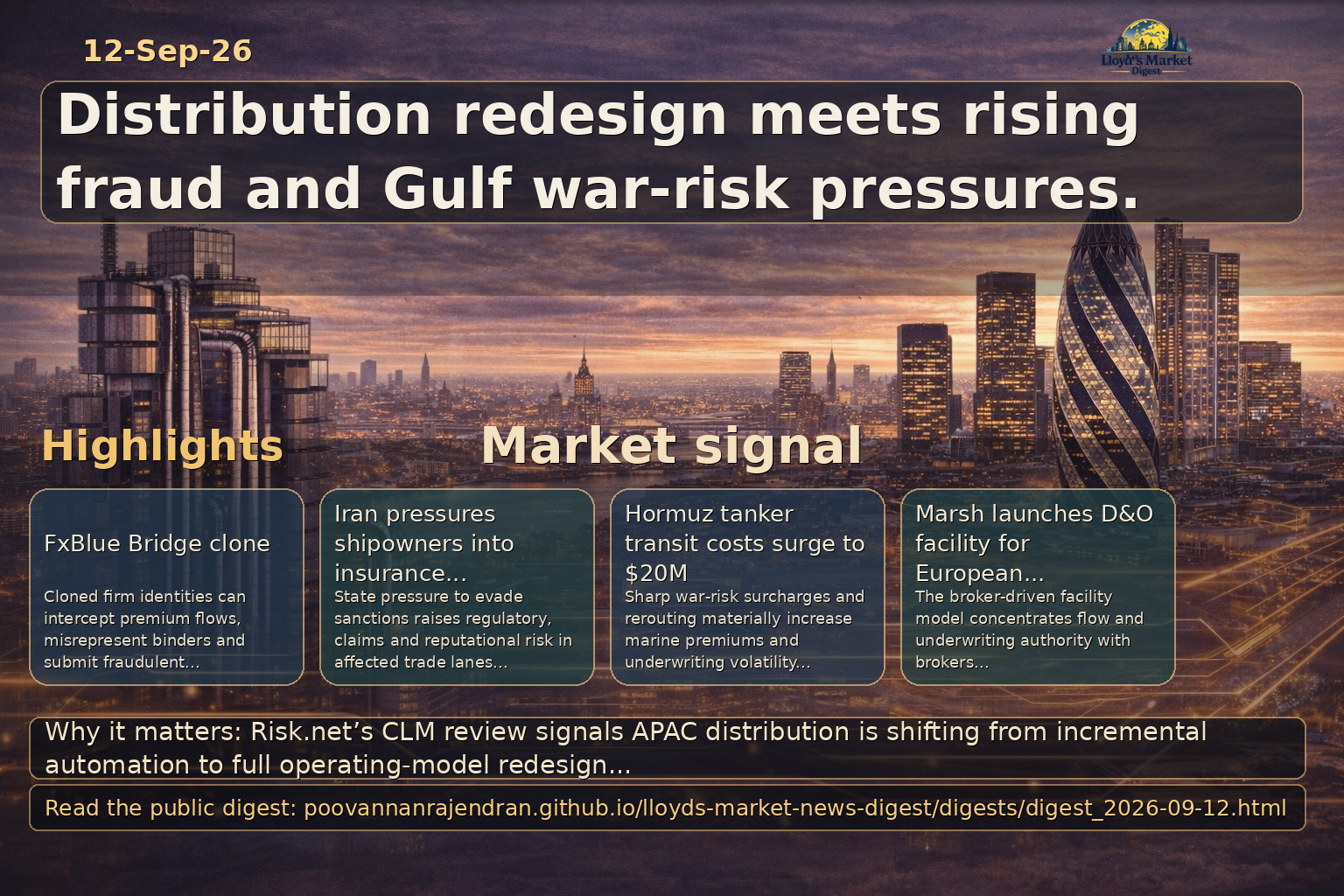
Why it matters: The FxBlue Bridge clone notice underscores a growing tactic: fraudsters cloning legitimate firms’ identities to deceive counterparties. In the Lloyd’s and specialty context clones can impersonate brokers, MGAs, or platform operators to intercept premium flows, misrepresent binders or submit fraudulent documentation.
- Risk: Cloned domains and email addresses enable social engineering and BEC-style attacks that can reroute premiums or secure unauthorised cover, causing operational and balance-sheet disruption for syndicates.
- Immediate action: Enforce domain and email provenance checks (DMARC/DKIM/ SPF) for high-value instructions; confirm any change of bank account or contact through pre-established phone verification with known numbers.
- Controls: Require digital identity attestations from counterparties, maintain a watchlist of look‑alike domains, and integrate FCA clone-firm alerts into platform onboarding and AML screening.
Source: fca.org.uk
Why it matters: The enforcement case involving forged takeover documents highlights the use of fabricated identities and forged documentation to influence market behaviour. For underwriters and brokers this translates into risk of manipulated information affecting pricing, valuations and placement decisions for complex specialty risks.
- Risk: Forged bids, fabricated documents or false confirmations can distort exposure assessments, lead to misplaced capital allocation and create downstream dispute and litigation exposure for syndicates and brokers.
- Immediate action: Elevate document authentication for material underwriting inputs — require source confirmations for market-moving documents and use secure document-exchange protocols with audit trails.
- Controls: Deploy enhanced surveillance of unusual market communications, mandate sign-off protocols for material transactions, and coordinate suspicious activity reporting with Lloyd’s market security and the FCA.
Source: businessinsurance.com
Why it matters: State pressure on shipowners to circumvent sanctions increases sanctions-related exposure within marine insurance placements, raising regulatory, claims and reputational risk for carriers, brokers and Lloyd's syndicates operating in affected trade lanes.
- Greater sanctions exposure can produce regulatory investigations, claims repudiations and cross-border enforcement actions against insurers and brokers.
- Brokers must strengthen sanctions due diligence, KYC, and include robust warranties/representations in placements; placement platforms should embed screening controls.
- Syndicates should review and tighten sanctions and war exclusions, coordinate with compliance/legal teams, and consider restricting appetite for high-risk operators or trade lanes.
Source: insurancetimes.co.uk
Why it matters: Appointment of MS Amlin’s chief executive to the LMA board consolidates managing agent influence in market advocacy and governance—impacting Lloyd’s-wide strategic priorities and the interaction between syndicates, brokers and policyholder-facing initiatives.
- Expect stronger alignment between managing agents and LMA lobbying priorities; syndicates should engage early on policy and market reform discussions
- Brokers and placement platforms can leverage the appointment to elevate market operational issues (e.g., placement efficiency, data standards) through formal LMA channels
- Monitoring board-led initiatives will be critical for C-suite planning around capital deployment, product strategy and international distribution
Source: businessinsurance.com
Why it matters: A US$1bn claim tied to cancelled LNG tanker contracts is a systemic signal for complex marine contract disputes that can produce material losses for specialty marine underwriters, increase reliance on Lloyd's syndicates for volatile exposures, and impose heavy claims-handling burdens on brokers and placement platforms.
- Potential for large attritional and liability-driven payments that strain marine capacity and reinsurer recoveries.
- Brokers and syndicates should review charterparty and build-contract wording, cancellation triggers and allocation of delay/loss exposures.
- Placement platforms and claims teams must prepare for multi-jurisdictional coverage disputes and longer tail settlements, updating documentation and escalation protocols.
Source: businessinsurance.com
Why it matters: Marsh’s launch of a D&O facility for European organisations reinforces the broker-driven facility model — shifting flow business, data requirements and underwriting authority toward brokers and managed platforms, with implications for Lloyd's syndicates and delegated underwriting governance.
- Signals brokers are consolidating flows via facilities; syndicates should evaluate participation to secure consistent premium streams and data access.
- Placement platforms must support delegated authority controls, standardized data feeds and real-time performance monitoring to qualify as partners.
- C-suite should reassess distribution strategy — consider selective facility partnerships, governance terms, and implications for long-tail D&O reserving.
Source: businessinsurance.com
Why it matters: Sharp increases in Hormuz tanker transit costs reflect concentrated war-risk and security surcharges that materially affect marine premium calculations, route risk, and the appetite of global specialty underwriters, including Lloyd's syndicates.
- Sustained surcharges and rerouting raise underwriting volatility and may trigger mid-term endorsements or increased retentions.
- Brokers need to re-evaluate routing clauses, war-risk premium mechanics and client advisory on alternative routings and supply-chain impacts.
- Syndicates should stress-test portfolios for concentrated Gulf exposures and adjust reinsurance and retrocession strategies accordingly.
Source: businessinsurance.com
Why it matters: MNK’s acquisition of a Danish insurer is indicative of ongoing consolidation in regional insurance markets; such M&A shifts distribution channels, can alter local capacity and changes how Lloyd's syndicates and global brokers access niche markets.
- Consolidation may reconfigure access to local distribution and capacity, requiring syndicates to remap partner networks.
- Brokers should evaluate whether acquisitions create strategic partnership opportunities or competitive constraints for placements in the Nordic/EMEA corridor.
- Executive teams must assess regulatory, capital and cross-sell implications and update go-to-market and underwriting partnership plans.
Source: insurancejournal.com
Why it matters: The 9/11 retrospective underlines long‑run lessons for catastrophic terrorism underwriting, legacy claims management and market reputational duties — all core to syndicate exposure controls and broker advisory services.
- Reinforce catastrophic-accumulation controls and scenario modelling for terrorism events across portfolios.
- Audit legacy claim reserves and communications protocols to preserve market reputation and regulatory readiness.
- Equip brokers with client-facing retrospectives and continuity advice to demonstrate underwriting discipline and risk-transfer value.
Source: insurancejournal.com
Why it matters: Uncertainty over reauthorisation of the federal terrorism backstop materially affects capacity, pricing and structure for U.S. terrorism exposures — a direct concern for Lloyd’s syndicates, global specialty insurers and broker placement strategies.
- Model scenarios with and without TRIA-equivalent backstop to quantify capital and pricing impacts across lines and geographies.
- Prepare alternative placement structures (parametric, layered reinsurance, captive solutions) and pre-negotiated wordings to offer clients rapid continuity.
- Engage with brokers and industry associations to coordinate advocacy and inform clients about potential coverage, pricing and retentions shifts.
Source: insurancejournal.com
Why it matters: BIS warnings on AI-driven financial stability risk translate into insurer-level concerns: investment volatility, model risk in underwriting/pricing, and operational exposures from widespread AI adoption on placement platforms and in claims handling.
- Institute rigorous model governance, validation and stress-testing for AI-based underwriting and pricing tools used by syndicates and platforms.
- Stress-test investment portfolios against an AI-led correction and reassess capital allocation to technology and insurtech exposures.
- Tighten third‑party vendor controls and incident plans for AI services embedded in placement platforms, distribution and claims workflows.
Source: insurancejournal.com
Why it matters: Reports that major insurers have limited exposure to a commodity-trading fraud highlight the effectiveness of fraud exclusions and due diligence — a salient issue for trade‑credit and working capital lines underwritten by global specialty players and Lloyd’s syndicates.
- Review and harmonise fraud and insolvency exclusions across trade credit and political-risk product suites to prevent coverage leakage.
- Enhance KYC and counterparty-monitoring requirements in broker submissions and placement-platform data feeds.
- Adjust recoverability and credit-loss assumptions in models to reflect heightened fraud detection and slower post-event recoveries.
Source: insurancejournal.com
Why it matters: Ongoing hybrid-warfare activity increases demand for nuanced political‑risk and war exclusion drafting, complicates claims assessment and raises sanction/compliance risks for underwriters and brokers operating across Europe and beyond.
- Update policy definitions and exclusions to explicitly address deniable hybrid tactics (sabotage, logistic disruption, industrial interference).
- Arm brokers with standardised placement templates and scenario-based advisory material for clients with supply‑chain and logistic vulnerabilities.
- Implement coordinated sanctions screening and legal claims playbooks to reduce settlement friction and regulatory exposure.
Source: insurancetimes.co.uk
Why it matters: Escalating UK wildfires will drive complex coverage disputes and litigation risk that directly affects Lloyd’s syndicates, global specialty underwriters and broker placement practice—particularly around non-damage extensions and business interruption-like exposures.
- Immediate review of non-damage and business interruption extensions across syndicate wordings; clarify triggers and exclusions to reduce litigation exposure
- Brokers should strengthen client advisory and placement documentation to ensure expectations on cover scope are explicit during submission and binding
- Placement platforms and claims teams must integrate wildfire scenario modelling and legal contingency planning to support expedited dispute resolution and reserves management
Source: insurancetimes.co.uk
Why it matters: Senior hires in broking and reinsurance leadership (eg. Willis Re’s new CEO) signal potential strategic shifts in global reinsurance distribution, client coverage strategies and competition for specialty placements relevant to Lloyd’s and global specialty markets.
- Anticipate strategic reorientation and potential consolidation efforts within reinsurance broking that could change market share for large facultative and treaty placements
- Clients and syndicates should map relationship risk and continuity plans where key broker contacts change, to protect renewal outcomes and terms
- Placement platforms must be ready to support increased demand for differentiated advisory services and bespoke placement workflows as brokers chase growth mandates
Source: insurancetimes.co.uk
Why it matters: Aviva’s hybrid MGA fronting proposition and Swiss Re’s tightened liability appetite highlight shifting capacity models and the growing prominence of fronting and MGA structures—material for Lloyd’s syndicates, managing agents and platforms facilitating delegated authority.
- Syndicates and capital providers should reassess appetite for fronted/MGA-originated business and implement enhanced due diligence on delegated underwriting governance
- Brokers need to evaluate fronting propositions as alternatives to traditional placements, factoring in counterparty, capital and claims-handling implications
- Placement platforms must support documentation and oversight for fronting arrangements (delegated authority workflows, data capture, and reporting) to maintain market confidence
Source: insurancetimes.co.uk
Why it matters: LMG commentary that London is "getting its mojo back" reflects improved government engagement, the planned captive regime and a momentum opportunity for Lloyd’s and London-based specialty capacity providers.
- Use the UK captive regime and renewed government access as a marketing lever to attract global specialty and captive business to London
- Syndicates and brokers should coordinate on targeted product and distribution strategies to capitalise on market reorientation and international client interest
- Sustain engagement with regulators and government to convert political momentum into durable policy and infrastructure improvements affecting placements and trading
Source: reinsurancene.ws
Why it matters: Archival collection of market commentary; limited direct actionable insight for current Lloyd’s/syndicate strategy but useful for historical pricing context and trend analysis.
- Provides historical pricing and loss-context useful for modelling long-term volatility and renewal cycle analysis
- Low immediate relevance to placement or capacity decisions but supports retrospective benchmarking for syndicates and brokers
- Useful reference for C-suite scenario planning and reviewing past market responses to catastrophe activity
Source: reinsurancene.ws
Why it matters: WTW survey showing moderated US commercial pricing underscores softening commercial market dynamics that influence Lloyd’s appetite and reinsurer attachment strategies.
- Moderation in US commercial pricing signals potential downward pressure on primary rates, affecting syndicate underwriting profitability and reinsurance programme structures
- Brokers should recalibrate client renewal expectations and placement timing to optimise terms in a softer primary market
- Syndicates and reinsurers must monitor line-by-line loss picks to preserve rate adequacy amid falling top-line pricing
Source: reinsurancene.ws
Why it matters: Launch of specialist cyber brokerage demonstrates growing broker-driven distribution for cyber lines and speed-to-quote models relevant to Lloyd’s cover holders and delegated authority partners.
- Carrier-agnostic cyber broker with rapid turnarounds increases market access and creates alternative conduits for syndicates to reach regulated sectors
- Highlights demand for compliance-mapped programmes — opportunity for Lloyd’s syndicates and MGAs to provide tailored cyber products with delegated authority
- Placement platforms and Lloyd’s brokers should evaluate integrations to capture fast-moving cyber placements and reduce time-to-bind
Source: reinsurancene.ws
Why it matters: Gallagher Re and KYND study validates the value of digital footprint and external attack-surface data — a material enhancement to specialty cyber underwriting and portfolio selection for syndicates and MGAs.
- Digital-footprint indicators can materially improve risk segmentation, pricing accuracy and loss prediction for cyber portfolios placed through Lloyd’s markets
- Syndicates and delegated authorities can leverage external data to refine appetites and limit selection adverse selection in programmes
- Placement platforms and brokers should incorporate such data into submission flows to accelerate decisioning and reduce manual enquiry cycles
Source: reinsurancene.ws
Why it matters: Rokstone Agriculture’s growth and secured Lloyd’s capacity highlights the continued expansion of sector-specific MGUs/MGAs leveraging Lloyd’s and A-rated capacity for scale.
- Demonstrates how MGUs can scale nationwide distribution while sourcing Lloyd’s capacity to support delegated underwriting and claims authority
- Syndicates and managing agents can target niche agriculture/livestock MGUs as routes to diversified premium pools and fee-based income
- Brokers should recognise specialist MGUs as strategic partners for underwriting flexibility and faster placement for agricultural risks
Source: newsnow.co.uk
Why it matters: A search feed returning no matching content for "Passenger train" flags a monitoring and data-source gap for rail-transport risks that matter to specialty underwriters and claims teams.
- Operational risk: Incomplete feeds increase the probability of late detection for rail incidents that can generate large casualty and liability claims for specialty lines.
- Data strategy: Recommend immediate validation of the feed, backfill with alternative real‑time sources (local transport authorities, rail operators, specialist aggregators) and integrate alerts into broker/syndicate dashboards.
- Placement implication: For broker/client advisory, confirm exposures in rail-heavy portfolios and pre-position catastrophe/loss-of-income capacity and claims teams to reduce settlement latency.
Source: newsnow.co.uk
Why it matters: Ongoing shifts in Irish political composition and coalition negotiations create potential regulatory, fiscal and procurement changes that could affect Lloyd’s-access, distribution models and commercial insurance demand in Ireland and the broader EU context.
- Regulatory risk: Changes in government could alter insurance taxation, solvency interpretation, or market access arrangements—run scenario analysis on policy shifts and their impact on Lloyd’s passporting and third‑party advisory services.
- Distribution impact: Political uncertainty may influence public-sector procurement and corporate risk-transfer appetite; brokers should review pipeline deals and syndicates assess appetite for public-sector lines and political risk products.
- Engagement: Coordinate targeted stakeholder engagement (local brokers, counsel, trade bodies) and update placement-platform configurations to reflect potential changes in regulatory filings, compliance workflows and documentation requirements.
Source: newsnow.co.uk
Why it matters: Major sporting events such as the Irish Open concentrate contingent exposure across event cancellation, liability, travel and cyber — creating targeted placement and product opportunities for specialty underwriters and brokers.
- Exposure aggregation: Single-event concentration can generate simultaneous claims (contingency, event organisers’ liability, travel suppliers); syndicates should map accumulation across portfolios and counterparties.
- Product and placement opportunity: Brokers can leverage placement platforms to assemble multi-line capacity (contingency, non-appearance, prize indemnity, cyber liability) and offer streamlined, programmatic solutions for repeat events.
- Operational readiness: Update policy wordings on attritional vs catastrophic triggers, confirm reinsurance/retro structures, and ensure claims workflow and on-site crisis provisions are pre-positioned for high-profile events.
Source: risk.net
Why it matters: The article’s emphasis on converting automation into hard ROI is directly applicable to brokers and placement platforms operating in APAC — where onboarding complexity, compliance and multi-jurisdictional placements drive placement cost and time to bind.
- Quantify cost-per-placement: redesign CLM to move beyond time-savings metrics and measure impact on gross margin per policy and binder throughput.
- Protect client trust in the final mile: ensure digital onboarding and post-bind confirmation workflows reduce client churn and preserve broker relationships, particularly for large or complex specialty risks.
- Integrate data and placement stacks: align CLM data models with MGAs, placing platforms and syndicate systems to eliminate manual handoffs and accelerate cross-border placements while maintaining auditability