Source: artemis.bm
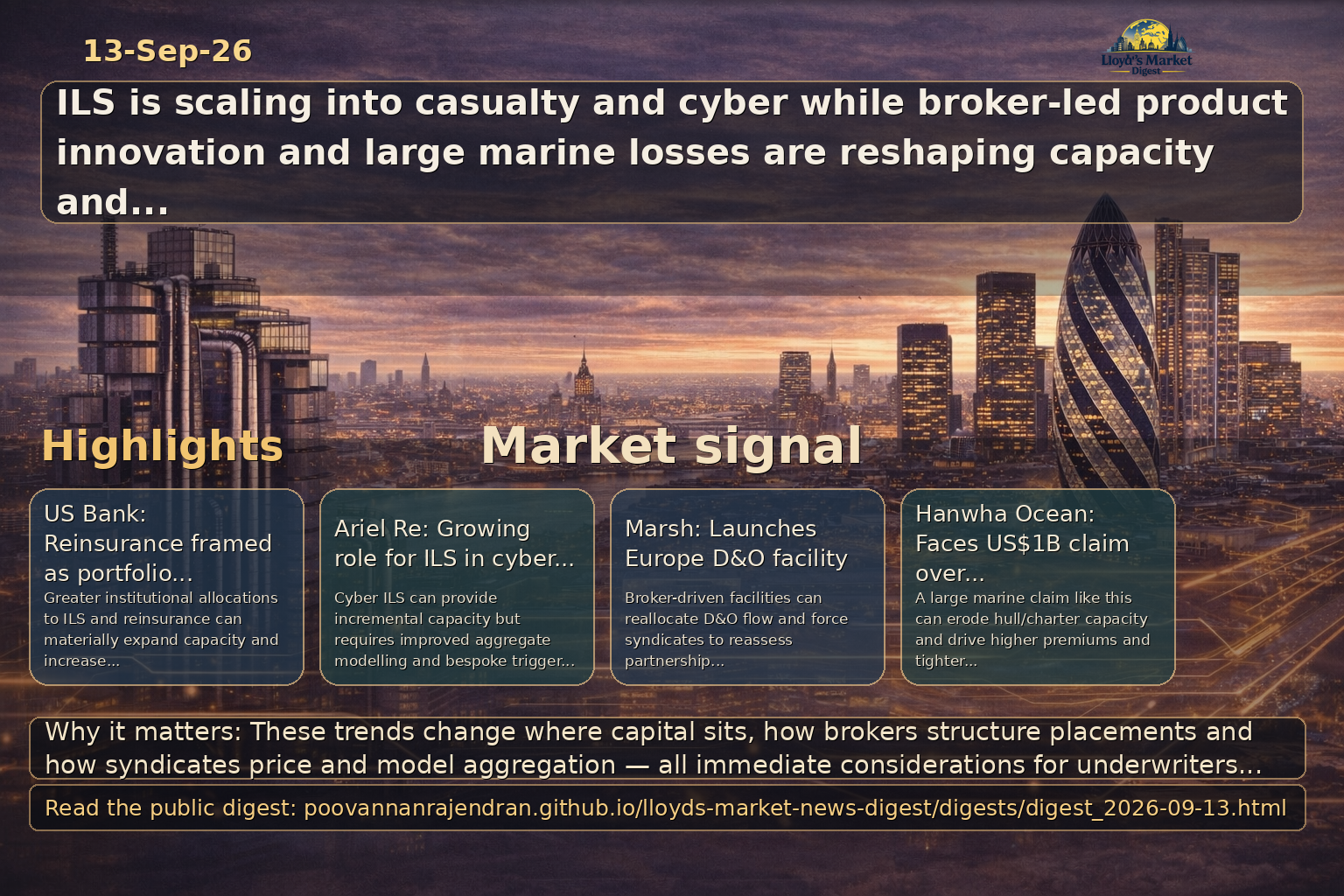
Why it matters: US Bank positions reinsurance as an effective portfolio diversifier with total‑return potential, reinforcing the investment case for qualified institutional allocations to ILS and related reinsurance strategies — a structural tailwind for capacity growth in the Lloyd's and global specialty markets.
- Greater institutional allocations can materially expand capacity, increase competition and compress risk premia across treaty lines, particularly where correlation to public markets is low.
- Opportunity for Lloyd's syndicates and managing agents to access long‑dated capital via quota‑share and ILS mandates, but success depends on scalable investor governance and transparent performance metrics.
- Brokers and placement platforms must enhance investor reporting, due‑diligence support and product standardisation to win and retain institutional capital.
Source: businessinsurance.com
Why it matters: A US$1B claim tied to cancelled LNG tanker contracts is material to marine and energy underwriting, with direct implications for syndicate exposure, broker negotiation of charterparty-linked coverages, and reinsurance allocation across the market.
- Potential for large attritional and peak exposures to erode marine hull/charter capacity and drive higher premium requirements for LNG-related risk.
- Brokers will need to negotiate contractually precise coverages and conditional wording for cancellation and charterparty disputes to limit insurer ambiguity.
- Syndicates and reinsurers must reassess aggregation and modelled losses for energy logistics exposures, with implications for retrocession programs.
Source: businessinsurance.com
Why it matters: Marsh's launch of a Europe-focused D&O facility signals broker-driven product innovation that will influence capacity placement, underwriting segmentation and the role of delegated authorities across specialty markets.
- New broker facilities can reallocate D&O risk away from traditional syndicates or complement capacity through co-placement and tailored appetite bands.
- Syndicates should evaluate partnership, appetite and coinvestment options to maintain share in broker-originated flow.
- Placement platforms and binding authority arrangements may be leveraged to operationalize the facility quickly and standardize wordings and pricing.
Source: businessinsurance.com
Why it matters: A surge in Hormuz tanker transit costs to US$20M materially affects war/terrorism and kidnap & ransom exposures for marine portfolios, influencing underwriting appetite, pricing and routing decisions for global specialty insurers and brokers.
- Higher transit premiums and war-risk surcharges are likely, materially altering underwriting economics for certain trade lanes and commodity exposures.
- Brokers must enhance contingency placement capabilities and negotiate cover extensions or alternative routings to protect clients' supply chains.
- Syndicates and placement platforms will need faster multi-carrier placement workflows to assemble layered war, P&I and cargo covers under time-sensitive conditions.
Source: businessinsurance.com
Why it matters: MNK's acquisition of a Danish insurer highlights regional consolidation that impacts distribution, local capacity and potential integration of specialty portfolios relevant to Lloyd's syndicates and broker networks.
- Consolidation can centralize Nordic specialty capacity, altering where Lloyd's syndicates compete and partner for regional business.
- Combined portfolios may change reinsurance buying patterns and aggregate exposure profiles, necessitating re-evaluation of retrocession limits.
- Acquirers frequently adopt platform and MGA capabilities that shift intermediary economics and require syndicates to adapt distribution strategies.
Source: businessinsurance.com
Why it matters: Operational and casualty anecdotes (such as a cleaning crew incident) signal the importance of granular operational risk assessment for employers' liability and casualty lines in specialty portfolios and for underwriting discipline across syndicates.
- Even low-severity operational incidents can aggregate into material loss trends if exposure concentration exists within specialty segments.
- Brokers should prioritize client risk controls, training and contract terms to limit frequency-driven exposure and improve insurability.
- Syndicates need to monitor attritional loss trends and refine policy wordings and endorsements to manage latent or operational liabilities.
Source: insurancejournal.com
Why it matters: 25-year reflection on 9/11 renews market attention on terrorism accumulation, legacy liabilities and reputational obligations — factors that influence Lloyd’s syndicate underwriting strategy, broking advice and public policy engagement.
- Re-examine terrorism accumulation models and aggregation assumptions across treaty and facultative layers to ensure capital adequacy and avoid surprise contingent exposures.
- Revisit policy wordings and exclusions for terrorism and related perils; brokers must proactively advise clients on gaps that anniversary-driven public attention can expose.
- Coordinate market communications and claims-readiness for legacy liabilities and anniversary-related inquiries to preserve reputation and client trust.
Source: insurancejournal.com
Why it matters: Ongoing uncertainty around federal terrorism reinsurance/backstop reauthorization directly impacts market capacity for large-scale terrorism exposures and the pricing/availability decisions of global specialty insurers, Lloyd’s syndicates and brokers.
- Engage with trade associations and policymakers to advocate for clear, timely reauthorization and to communicate market capacity needs to legislators.
- Stress-test syndicate portfolios under scenarios where the backstop is reduced or lapses, adjusting retention, limits and facultative reinsurance strategies accordingly.
- Update placement-platform workflows and client advisories to capture changes in backstop status, claims triggers and brokered treaty reporting requirements.
Source: insurancejournal.com
Why it matters: BIS warnings on AI-driven financial-stability risk have direct implications for underwriting models, pricing, investment portfolios and operational risk across specialty insurers and placement technologies.
- Implement rigorous model governance and validation protocols for AI-driven pricing and exposure-management tools used by syndicates and brokers; require explainability for critical decisions.
- Incorporate AI-stress scenarios into capital planning and investment-risk assessments to guard against concentrated downside if AI-fueled valuations unwind.
- Evaluate third-party AI vendors used by platforms and brokers for resilience, data bias and governance; require contractual SLAs and audit rights.
Source: insurancejournal.com
Why it matters: Public disclosures by major insurers of no material exposure to a troubled commodity trader reinforce the importance of counterparty diligence in trade-credit and political-risk placements relevant to Lloyd’s and specialty markets.
- Reinforce KYC, credit-monitoring and concentration checks for trade-credit and political-risk underwriting; brokers should demand granular exposure reporting from clients.
- Ensure policy wordings and exclusions (eg, fraud) are clearly applied and that claims handling protocols reflect complex insolvency scenarios.
- Consider supplemental due-diligence products or parametric triggers for clients with high counterparty concentrations to reduce balance-sheet volatility for syndicates.
Source: insurancejournal.com
Why it matters: European difficulty countering hybrid attacks underscores an escalation in ambiguous geopolitical risk — a core consideration for political violence, war and trade-disruption covers written by syndicates and placed by brokers.
- Reassess political-violence and war exclusions, war-lists and attractivity clauses in light of hybrid tactics that fall below traditional war thresholds.
- Enhance scenario planning for supply-chain and logistic hubs exposed to deniable state actions; coordinate with clients on contingency planning and crisis response.
- Prioritise rapid placement and short-term capacity solutions for clients operating in Europe’s high-risk corridors; placement platforms should enable expedited bind and notification workflows.
Source: artemis.bm
Why it matters: Hiscox Capital Partners' hiring of an experienced ILS portfolio manager signals continued consolidation and professionalisation of third‑party capital management within Lloyd's groups — a capability shift that affects capital access, product innovation and competitive dynamics in placement.
- The appointment reflects Lloyd's‑market players scaling in‑house ILS and quota‑share management, improving direct access to institutional capital for syndicates and cedants.
- Enhanced internal asset management capabilities facilitate more flexible capital solutions (sidecars, bespoke funds, quota‑shares), altering broker placement strategies and fee models.
- Competition for senior ILS talent will intensify; brokers and placement platforms should anticipate more vertically integrated counterparties and adapt partnership and distribution arrangements.
Source: artemis.bm
Why it matters: KBW flags that growing casualty ILS inflows are an incremental negative for reinsurers and that property catastrophe pricing may soften more than headline RVS metrics indicate — a direct signal to Lloyd's syndicates, global specialty carriers and brokers that capital substitution is accelerating and margin pressure is rising.
- Increased ILS capacity into casualty likely to prolong rate deceleration and compress underwriting margins for traditional reinsurers and syndicates.
- More pronounced nat‑cat rate softening than RVS headlines imply requires syndicates to reassess retro placement, capital modelling and capital allocation plans.
- Brokers and placement platforms should prioritise bespoke ILS structures and differentiated distribution propositions to preserve cedant outcomes and capture alternative capital flows.
Source: artemis.bm
Why it matters: Ariel Re's view that ILS will play a growing role in cyber exposures highlights a strategic inflection point: as cyber portfolios scale, alternative capital can become material to capacity but will require refined triggers, modelling and structuring to coexist with traditional reinsurance.
- Cyber ILS offers incremental capacity but issuance remains constrained by competition from traditional reinsurers and modelling immaturity; successful scaling requires credible aggregate loss modelling and trigger design.
- Syndicates and brokers can differentiate by developing hybrid solutions (parametric, industry‑loss, layered indemnity) that align investor risk appetite with cedant loss profiles.
- Placement platforms need to support bespoke structuring, investor education and secondary market liquidity to attract diversified capital into cyber ILS.
Source: newsnow.co.uk
Why it matters: County Dublin coverage highlights high population and development concentration — relevant to property, construction and casualty lines underwritten by Lloyd’s syndicates and global specialty brokers.
- Underwriting: elevated aggregation risk from dense residential and commercial pipelines; construction delay and latent defect exposures require tightened wordings and limits.
- Broker action: advise clients on project viability, phased placement strategies and contingency/prolongation covers for delayed build programmes.
- Platform implication: ensure placement systems and data models capture municipal planning status and local build-permit-to-completion timelines for accurate accumulation modelling.
Source: newsnow.co.uk
Why it matters: Coverage of Ulf Kristersson and Swedish politics flags potential shifts in Scandinavia’s political landscape — material for political risk, trade credit and cyber exposures that affect EMEA portfolios.
- Risk assessment: policy shifts or far-right ascendency can change regulatory regimes, trade patterns and sanctions exposure affecting cross-border placements.
- Syndicate strategy: revisit political violence and government interference wordings for Nordic clients and counterparties; reassess appetite for public sector and infrastructure accounts.
- Broker engagement: proactively brief clients on scenario planning and offer targeted political risk and trade-risk solutions to protect supply-chain and credit exposures.
Source: newsnow.co.uk
Why it matters: Empty search result for “West Lothian” signals an intelligence gap on a regional Scottish constituency that could hide local exposures relevant to transport, energy projects or regional insurance programmes.
- Data/information: close the gap by integrating alternative regional feeds (local authority portals, industry bulletins) into underwriting and exposure dashboards.
- Due diligence: require brokers to supplement submissions with local risk briefs when placing regional portfolios or bound accounts.
- Platform readiness: placement platforms should support attachable regional dossiers and allow underwriters to flag low-information territories for targeted inquiries.
Source: newsnow.co.uk
Why it matters: Coverage around Micheal Martin and Irish political leadership underscores continuing policy negotiations and potential regulatory change affecting Irish domiciled risks and inbound capacity from London and international markets.
- Regulatory monitoring: maintain active liaison with EMEA regulatory teams on likely shifts in insurance tax, planning and housing policy that could affect claims frequency and long-term liabilities.
- Client advisory: brokers should brief corporate clients and public sector account-holders on near-term policy outcomes that could affect infrastructure procurement and project finance structures.
- Capacity planning: syndicates must model scenarios for changing loss environments driven by public policy (housing delivery, developer viability) and adapt facultative/umbrella capacity accordingly.
Source: newsnow.co.uk
Why it matters: Empty search results for “Passenger train” point to a potential deficiency in near‑real‑time incident intelligence for public transport — a gap for underwriters of rail liability, business interruption and third-party casualty programs.
- Exposure management: reinforce alternative monitoring (rail operator feeds, regulator notices) to capture incidents, service changes and maintenance backlogs affecting premium adequacy.
- Product refinement: consider bespoke endorsements or parametric triggers for rail-related business interruption and mass transit liability placements.
- Placement workflow: require brokers to attach transport operator incident history and maintenance records to submissions for syndicates to underwrite aggregate exposure.
Source: risk.net
Why it matters: The report’s emphasis on transforming CLM into a measurable growth engine is directly relevant to Lloyd’s market participants seeking to scale APAC distribution while preserving margins. For syndicates, carriers and brokers, the ‘final mile’ of account activation and measurable cost-per-case reductions are critical to faster placements, improved client retention and more efficient use of underwriting capacity.
- Commercial impact — Prioritise CLM initiatives that track hard KPIs (cost-per-case, time-to-bind) to demonstrate ROI and justify investment to underwriting committees and capital providers.
- Platform integration — Ensure CLM redesign includes APIs and workflow integration with broker systems and placement platforms to enable higher straight-through processing (STP) rates and reduce manual touchpoints during binding.
- Risk & compliance — Standardise data capture and KYC workflows across APAC jurisdictions to reduce rework, speed onboarding and lower operational capital tied up by compliance friction.