Source: artemis.bm
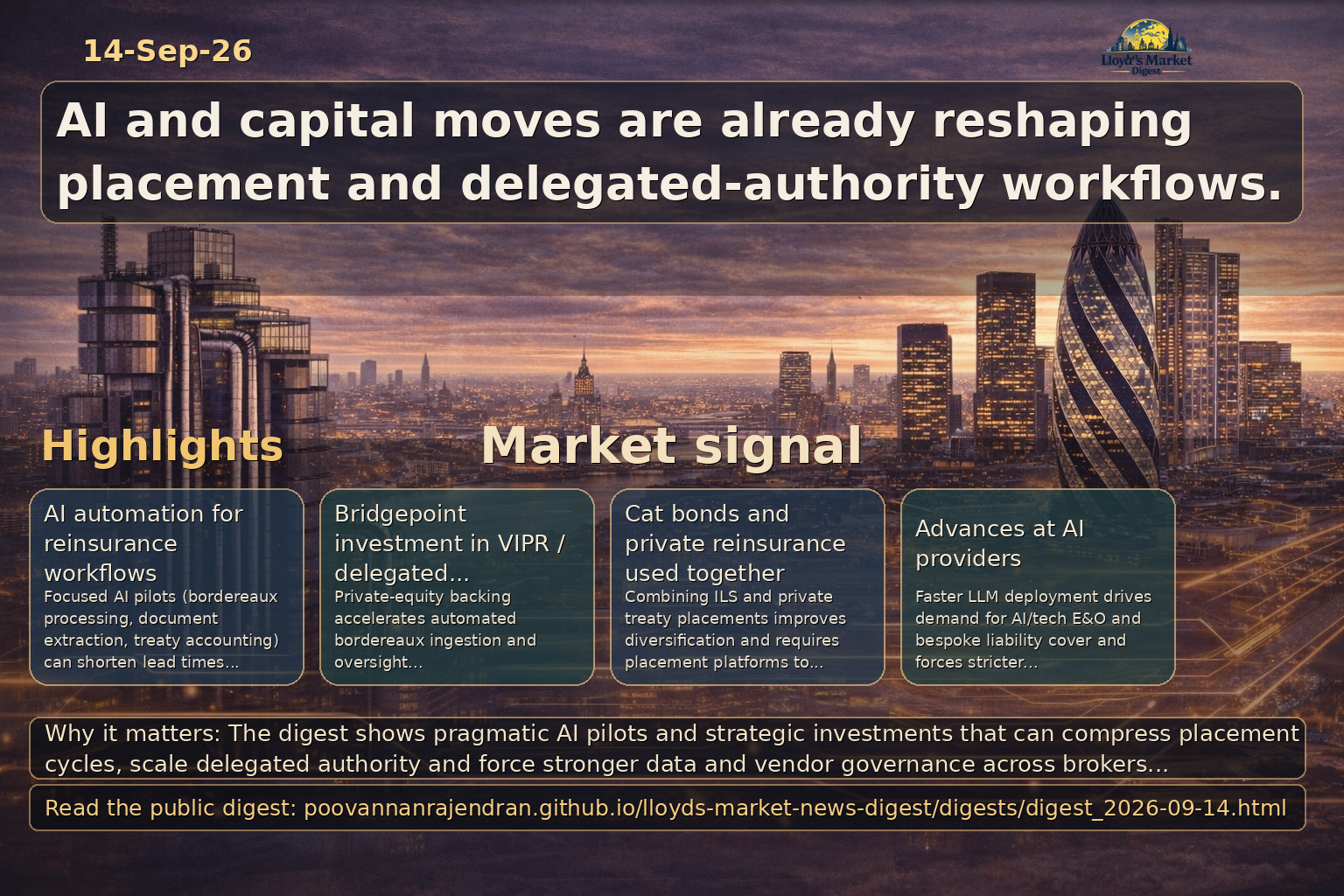
Why it matters: The Artemis interview highlights a strategic shift for capital providers and intermediaries: catastrophe bonds and private reinsurance should be used together to improve portfolio diversification and risk‑adjusted returns. For Lloyd’s syndicates and global specialty brokers this means rethinking how capacity is sourced, priced and packaged for clients, and how placement platforms support combined placements and investor due diligence.
- Brokers: Proactively design combined placement strategies that package cat bonds and private reinsurance as complementary layers, enabling clients to achieve more efficient risk‑return profiles while preserving syndicate market share.
- Syndicates & Capital Managers: Coordinate capital planning with ILS managers and reinsurers to optimise capacity deployment across instruments, reducing basis risk and improving year‑on‑year volatility management for underwriting results.
- Placement Platforms & Market Infrastructure: Upgrade workflows and data exchange standards to support hybrid transactions (simultaneous bond and treaty placement), enhanced modelling transparency and faster investor on‑ramping to capture ILS flows without disrupting traditional reinsurance broking.
Source: insurancetimes.co.uk
Why it matters: This piece signals an actionable opportunity for Lloyd's market participants and global specialty brokers to convert soft-market pressure into a capability advantage by applying AI to manual reinsurance workflows. It matters to syndicates and placement platforms because automation can shorten lead times, lower placement costs, and improve data fidelity for pricing and claims. Executives should view AI not as a theoretical tool for modelling but as an operational priority requiring data engineering, platform partners and change management.
- Execute focused AI pilots on high-volume mid/back-office tasks (e.g., bordereaux processing, treaty accounting, document extraction) with measurable KPIs: reduction in cycle time, error rate and FTE reallocation.
- Build a canonical data model and API-first integration strategy across brokers, syndicates and placement platforms to ensure AI models operate on clean, interoperable data and accelerate straight-through processing for placements.
- Establish governance: vendor due diligence, explainability standards, regulatory compliance checkpoints and a phased change plan to upskill staff and redeploy underwriting capacity toward complex specialty exposures
Source: reinsurancene.ws
Why it matters: Bridgepoint’s majority investment in VIPR accelerates scale and AI-driven capability in delegated authority intelligence—directly affecting bordereaux processing, oversight and data quality across MGAs, carriers, syndicates and placement platforms.
- Delegated-authority capacity: Faster onboarding and automated oversight will enable MGAs and coverholders to scale business with improved governance, increasing the potential volume of capacity placed through Lloyd’s syndicates and fronting carriers.
- Operational efficiency & analytics: Improved bordereaux ingestion and analytics reduces reconciliation friction and claims/commission disputes, enabling more accurate risk selection and pricing for syndicates and reinsurers.
- Consolidation and integration risk: Private equity backing raises likelihood of roll-ups and tighter integration with broker/placement tech stacks—placeholders for M&A due diligence and strategic partnerships for carriers and managing agents.
Source: reinsurancene.ws
Why it matters: The appointment of Nina Arquint to lead Commercial EMEA and join the AGCS board signals Allianz’s push to deepen LargeCorp and MidCorp penetration across EMEA, with implications for broker relationships, placement strategies and syndicate appetite for multinational commercial risk.
- Broker engagement & strategic relationships: Expect intensified collaboration and bespoke placement solutions for multinational accounts; brokers should prioritize tailored offerings and streamlined placement workflows to retain share.
- Capacity allocation and appetite shifts: A stronger LargeCorp/MidCorp focus may reallocate carrier and syndicate capacity toward packaged global solutions, affecting opportunities for specialty syndicates and niche underwriters.
- Cross-border product standardisation: Greater coordination across EMEA will accelerate product standardisation and process alignment—requiring brokers and placement platforms to enhance cross-border placement capabilities and data exchange.
Source: reinsurancene.ws
Why it matters: Aon’s hire of Johan Forsgård to lead the Nordics reflects active broker competition for regional market share and suggests accelerated execution of growth strategies in a market that feeds specialty placements into Lloyd’s and global carriers.
- Regional competition for placements: Aon’s strengthened Nordic leadership will intensify competition for specialty and corporate placements, prompting brokers and syndicates to bolster local expertise and distribution channels.
- Technology and platform focus: To capture Nordic flows, expect increased investment in integrating regional placement channels into global platforms—affecting how syndicates and managing agents access and underwrite Nordic risks.
- Client retention and talent effects: Senior lateral hires increase the risk of client migration; carriers and syndicates should prioritise direct client engagement, transparent data-sharing and stable placement processes to protect pipelines.
Source: newsnow.co.uk
Why it matters: Political developments in Sweden can change regulatory regimes, public spending priorities and sanctions posture, with downstream effects on capacity allocation, local distribution and demand for specialty covers.
- Regulatory and licensing risk: shifts in consumer protection, solvency or EU-aligned regulation could require syndicates and platforms to adjust local authorisation, compliance processes and product terms.
- Political-risk and sanctions implications: changes in government policy can increase demand for political violence, trade credit and sanction-screening services, complicating placements for exposures in geopolitically sensitive regions.
- Market and placement effects: altered public spending, energy policy or infrastructure decisions can affect marine, energy and construction exposures and influence the role and bargaining power of local brokers in Lloyd’s placements.
Source: newsnow.co.uk
Why it matters: Advances at AI providers such as Anthropic accelerate deployment of large language models across broking and placement platforms, creating opportunities for efficiency and new product demand while introducing concentrated model, cyber and liability exposures.
- Underwriting and product development: growth in AI adoption drives demand for bespoke technology E&O, AI‑specific liability and systemic failure cover; syndicates must refresh wordings, exclusions and aggregation modelling.
- Vendor and model governance: brokers and platforms using or reselling LLM services need rigorous third‑party due diligence, contractual SLAs, and model validation frameworks to satisfy underwriters and regulators.
- Claims, pricing and operational risk: LLMs change claims intake, fraud detection and pricing workflows but increase systemic model risk and operational resilience requirements — adjust reserving practices, incident response playbooks and oversight.