Source: fca.org.uk
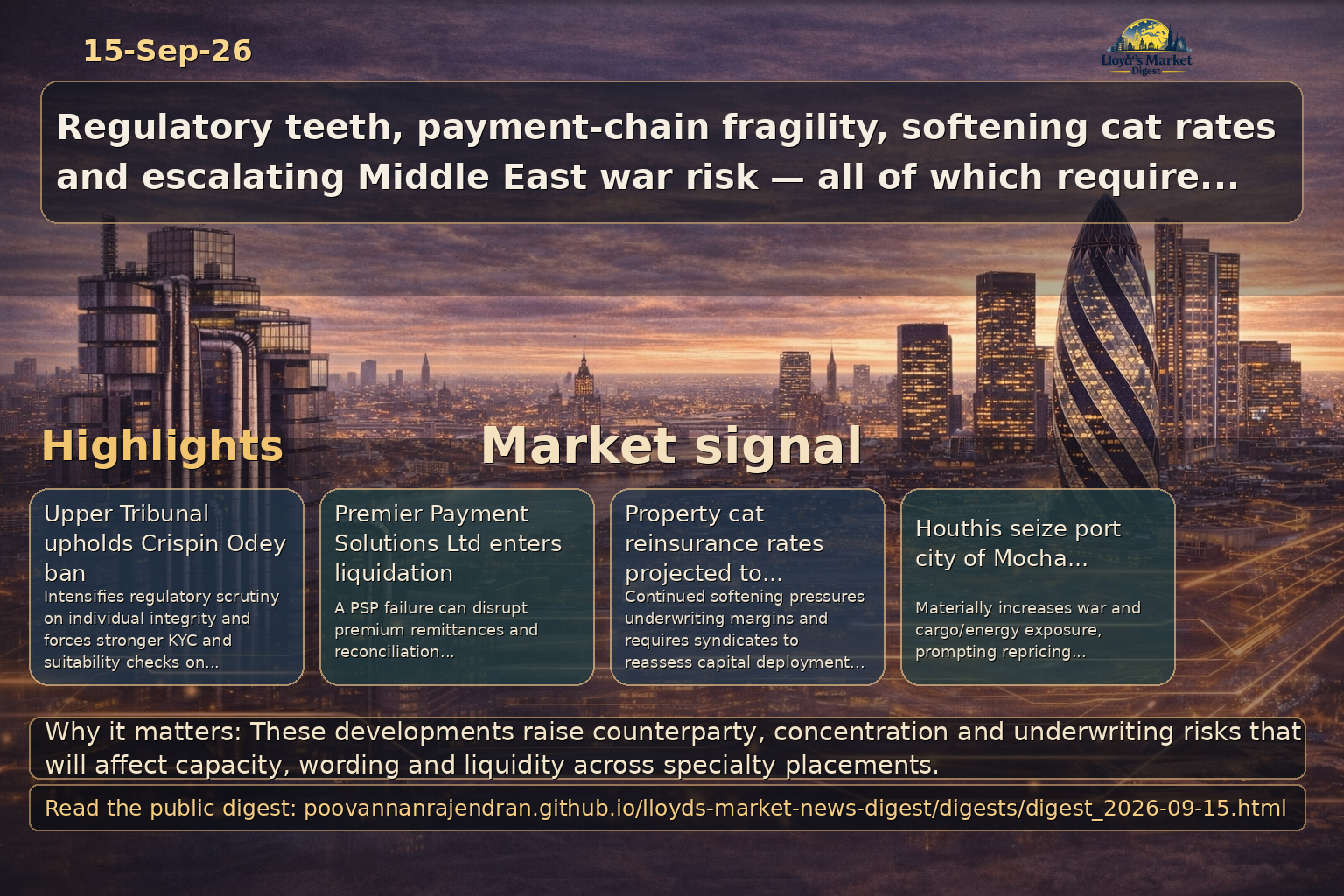
Why it matters: The Upper Tribunal's upholding of an industry ban underscores intensified regulatory scrutiny on individual integrity and governance. For syndicates, managing agents and capital providers, this elevates the need for robust suitability assessments of investors, senior executives and influential stakeholders whose conduct can transmit reputational and regulatory risk across the specialty market.
- Governance and capital due diligence: strengthen KYC/fitness checks on names, investors and capital providers, including behavioural and conduct assessments, escalation triggers and periodic revalidation of suitability for exposure to Lloyd's vehicles.
- Contractual and operational safeguards: review investor and sponsor agreements to ensure enforceable clauses for removal, suspension of voting rights and mandatory disclosures where integrity concerns arise.
- Board and risk committee actions: instruct boards to refresh codes of conduct, whistleblowing protocols and executive oversight mechanisms; require rapid reporting to the board and regulators on any material governance or conduct incidents.
Source: fca.org.uk
Why it matters: The liquidation of a payment services firm that supports agent networks and cross‑border remittances highlights concentration and operational risk in premium payment chains. Disruption to a PSP or its agent network can interrupt premium remittance, reconciliation and commission flows, exposing brokers, MGAs and syndicates to liquidity, client money and coverage risks.
- Transactional remediation: conduct an immediate reconciliation of premium inflows tied to the PSP and its agents, suspend automated transfers where exposure is uncertain, and validate beneficiary accounts before any further remittance.
- Commercial and platform resilience: require placement platforms and brokers to use regulated PSPs with contingency banking arrangements and escrow capabilities; mandate backup collection channels and periodic proof of client money segregation.
- Legal and contingency planning: activate incident response playbooks, notify affected cedants and carriers, engage liquidators and legal counsel to assess recoveries and claims, and quantify short‑term liquidity implications for syndicate cashflow and solvency planning.
Source: businessinsurance.com
Why it matters: Brown & Riding launching an agribusiness practice highlights expanding demand for specialized agricultural risk solutions and opportunities for tailored specialty placements.
- Agribusiness growth requires integrated covers (crop, commodity, supply chain, weather) and presents opportunities for parameteric and hybrid solutions
- Syndicates and MGAs should evaluate capacity and modelling capabilities to support seasonality and accumulation risks unique to agriculture
- Brokers must develop distribution channels and advisory services that combine insurance with loss-prevention and risk management to differentiate offerings
Source: businessinsurance.com
Why it matters: Projected 10%+ fall in property catastrophe reinsurance rates signals continuing soft market dynamics that will affect Lloyd's syndicates, capital allocation and renewal strategies.
- Underwriting margin pressure for reinsurers and syndicates; risk of rate-driven underwriting easing and need to reinforce discipline and aggregate controls
- Opportunity for large buyers and cedants to secure improved terms and multi-year programs via brokers and placement platforms, reducing cedant reinsurance spend
- Syndicates should reassess portfolio concentration, capital deployment and diversify product mix (non-cat specialty lines) to defend returns
Source: businessinsurance.com
Why it matters: Rising shipping insurance costs are shifting trade flows and increasing demand for war/strikes and marine cargo coverage, pressuring global specialty capacity and placement processes.
- Elevated premiums and war risk surcharges on Red Sea/Gulf of Aden transits prompt shippers to reroute, increasing logistical complexity and exposure for insurers
- Brokers must proactively advise clients on routing, clauses, and transshipment costs and leverage placement platforms to obtain voyage-specific capacity
- Specialty syndicates and MGAs can capture margin by developing tailored marine, supply‑chain and contingency covers (including parametric options)
Source: businessinsurance.com
Why it matters: The Houthi seizure of Mocha and threats to Saudi oil exports materially increase geopolitical and war risks for hull, cargo and energy lines, prompting rapid repricing and potential policy exclusions.
- Immediate upward pressure on hull, cargo and energy insurance rates; possible use of voyage or named-peril exclusions and higher war risk premiums
- Concentration risk for energy underwriters increases, requiring enhanced scenario modelling, limits management and reinsurance support from Lloyd's syndicates
- Brokers and placement platforms must coordinate contingency wording, war-risk schedules and capacity rotation with carriers to ensure continuity of cover for critical exposures
Source: businessinsurance.com
Why it matters: Marsh appointing a new global placement head at a pivotal time signals potential strategic shifts in placement platform relationships and syndicate engagement across worldwide specialty placements.
- Change in placement leadership may alter platform adoption, panel strategies and fee structures—syndicates should engage early to understand new priorities
- Competitors and alternative platforms may seek to exploit any transitional gaps in placement flow; syndicates must safeguard distribution channels
- For C-suite leaders, this is a prompt to review placement efficiency, tech integrations and relationship economics with lead brokers to protect marketplace share
Source: globalreinsurance.com
Why it matters: The appointments materially strengthen a major broker’s facultative bench in North America, with immediate implications for how large and complex property and casualty facultative risks are sourced, priced and placed — affecting Lloyd’s syndicates, specialty carriers and platform operators.
- Market dynamics: Augmented facultative leadership at a top broker will increase competition for large facultative placements, pressuring syndicates to sharpen underwriting terms, capacity allocation and pricing discipline to retain share.
- Placement implications: Expect greater use of broker-led placement workflows and tighter integration with digital placement platforms; syndicates should prioritize real‑time platform connectivity and streamlined acceptance processes to capture flow.
- Strategic actions for executives: Review and adjust facultative capacity frameworks, accelerate investment in placement and data connectivity, and engage proactively with broker teams to co-design product and capacity solutions aligned to North American cedent needs.
Source: insurancejournal.com
Why it matters: Captive formation for mega AI data-centres shifts portfolio risk away from traditional insurers and creates new underwriting and placement opportunities for specialty capacity and fronting arrangements.
- Risk transfer impact: growing captives will reduce third‑party premiums for property/construction/liability but increase demand for fronting, facultative reinsurance and stop‑loss cover from Lloyd’s syndicates.
- Product and modelling need: syndicates must develop tailored coverage for build‑outs, operational AI-specific perils (heat, fire, power failure) and aggregated exposure modelling for concentration risk.
- Broker and platform strategy: brokers and placement platforms should offer captive set‑up advisory, fronting solutions, and integrated loss-control/engineering services to retain client relationships as clients self‑insure.
Source: insurancejournal.com
Why it matters: The Baldwin Group going private via a $7.7bn deal underscores private capital appetite to build vertically integrated insurance platforms, altering distribution dynamics and competitive pressure in wholesale and specialty broking.
- Market concentration risk: private ownership with deep capital can accelerate M&A and platform investments, pressuring smaller brokers and increasing bilateral negotiating leverage with carriers and syndicates.
- Platform and product investment: expect accelerated investment in digital placement, analytics and carrier‑owned MGAs that may bypass traditional third‑party brokers or demand new partnership models.
- Counterparty and conflict management: Lloyd’s managing agents and syndicates should reassess broker panels and commission structures, and ensure robust conflict‑of‑interest controls as broker ownership shifts.
Source: insurancejournal.com
Why it matters: Large historical sexual‑abuse compensation claims at an iconic retailer highlight latent liability exposures, potential reserve shortfalls and reputational impacts for insurers providing E&O, D&O, employment practices and corporate liability cover to major corporates.
- Reserve adequacy and social inflation: syndicates should reassess reserving practices for legacy employment and abuse claims and run sensitivity tests for social‑inflation adjustments to loss development patterns.
- Coverage and wording exposure: brokers must perform historical policy reconciliation and advise clients on gaps or exhaustion of limits; underwriters should tighten interrogatories on historical conduct and prior settlements.
- Reputational and reinsurer contagion: reinsurers and retrocessionaires may face indirect exposure—underwriters should coordinate communications and consider limits/reinstatement terms for long‑tail corporate liability programs.
Source: insurancejournal.com
Why it matters: New strikes in the Strait of Hormuz and attacks on Saudi infrastructure materially increase marine, energy and political‑risk exposures, prompting war‑risk premium spikes and altered routing/coverage requirements across shipping, energy and trade sectors.
- War and Hull & Machinery exposure: expect immediate hardening of war and kidnap & ransom (K&R) terms for transits through affected waters and increased use of exclusions—underwriters must reprice and re‑underwrite voyage risk.
- Supply‑chain and energy claims volatility: syndicates with energy and cargo portfolios should run stress tests for supply interruptions, contingent BI claims and increased frequency of attritional losses.
- Operational response for brokers/platforms: placement platforms and brokers need to integrate real‑time voyage and exclusion alerts, war‑risk clauses, and coordinate with P&I clubs on cover and premium allocation.
Source: insurancejournal.com
Why it matters: China’s preparedness for AI risks in response to warnings about uncontrollable models elevates global regulatory attention on AI safety and creates demand for new insurability frameworks for advanced AI and model governance liabilities.
- Product development imperative: insurers and Lloyd’s syndicates should accelerate design of AI governance, model‑risk and failure‑to‑control products that combine cyber, professional indemnity and systemic loss triggers.
- Regulatory liaison and standards: market participants must engage proactively with regulators in multiple jurisdictions to shape standards for AI model validation, audit rights and insurer remediation obligations.
- Underwriting data and controls: brokers should require enhanced client disclosures on model testing, change control and third‑party model use; underwriters need to build capabilities to assess model governance and concentration risk.
Source: artemis.bm
Why it matters: Swiss Re research surfaces a sizable data‑centre and renewable infrastructure premium pool (~US$200bn by 2030) that is fodder for alternative reinsurance capital — but only where ILS economics and product design deliver investor returns. This is strategic for Lloyd's syndicates, reinsurers and placement platforms seeking new capacity sources.
- Assess product economics: syndicates and ILS managers must model tail loss, concentration and recovery timings to determine viable cat‑bond/sidecar structures for data‑centre exposures.
- Invest in risk data and standardisation: brokers and platforms should prioritise consistent exposure datasets and parametric triggers to reduce friction and attract institutional ILS demand.
- Structure alignment with investors: adopt transparent governance, fee economics and co‑investment options to secure long‑term capital while protecting underwriting margins.
Source: artemis.bm
Why it matters: Mt. Logan (Everest) expansion of third‑party capital capabilities underscores the drive to scale managed balance‑sheets while prioritising investor alignment and capital efficiency — a model increasingly relevant to Lloyd's syndicates and global specialty managers.
- Prioritise alignment and governance: syndicates and platform operators should emulate clear alignment mechanisms (co‑investment, fee structures, reporting) to attract long‑term third‑party capital.
- Measure capital efficiency: boardrooms must adopt consistent KPIs for capital utilisation, return on deployed capital and frictional costs across managed vehicles.
- Integrate managed solutions into placement strategy: brokers and placement platforms should facilitate access to managed balance‑sheets as an alternative distribution channel for portfolio optimization.
Source: artemis.bm
Why it matters: RenaissanceRe's emphasis on discipline and right‑sizing ILS capital reinforces that, despite compressed spreads, the asset class remains attractive relative to history — requiring calibrated allocation and disciplined underwriting from sponsors and syndicates.
- Right‑size ILS exposure: C‑suite and investment committees should set clear limits and stress tests for ILS to secure target risk‑adjusted returns amid spread compression.
- Maintain underwriting discipline: syndicates and brokers must protect structural pricing integrity by avoiding growth-for-growth's-sake placements that erode spreads.
- Enhance placement transparency: platforms should improve price discovery and secondary liquidity mechanisms to support disciplined market participation.
Source: artemis.bm
Why it matters: S&P signals a retrocession rebound as reinsurers respond to softening reinsurance pricing and seek measured catastrophe limit management. Collateralised tail protection remains stable and is an important lever for capital and rating preservation across syndicates and reinsurers.
- Revisit retro programs: managing agents and carriers should re‑size retro purchases to optimise capital relief, regulatory ratio outcomes and rating agency metrics.
- Leverage collateralised tail protection selectively: use collateralised structures to protect peak exposures without diluting balance‑sheet economics where appropriate.
- Enable brokerised retro placement: brokers and placement platforms must expand capabilities to package tailored retro solutions, matching supply from alternative capital and traditional reinsurers.
Source: artemis.bm
Why it matters: The Artemis weekly roundup highlights market innovation, notably Howden Re's Novark initiative to modernise ILS infrastructure — a clear signal that digital, admin and securities‑grade platforms will be critical enablers for scaling ILS and improving placement efficiency.
- Modernise back‑office and securities admin: syndicates and managing agents should prioritise integration with digital administration platforms to reduce settlement friction and operational cost.
- Broker‑platform partnerships: brokers must build API and workflow integrations with modern platforms to accelerate deal execution and widen investor reach.
- Monitor strategic entrants: executive teams should evaluate partnership, investment or acquisition options for platform capabilities that materially improve distribution, transparency and speed-to-capacity.
Source: newsnow.co.uk
Why it matters: High‑profile criminal convictions of healthcare staff are directly material to underwriters and brokers because they can generate large institutional claims, test policy coverage for deliberate acts, drive regulatory investigations and create concentrated aggregation losses across hospital portfolios and NHS trusts.
- Review and tighten policywording: confirm how criminal, deliberate or malicious acts by employees interact with indemnity triggers and exclusions; consider endorsed wording to clarify insurer and insured obligations.
- Reassess accumulation and reinsurance models: run stress tests on exposure concentrations across hospitals/trusts, adjust aggregate limits, catastrophes and facultative/reinsurance placements to reflect tail risk from systemic or serial misconduct.
- Strengthen underwriting and placement controls: require enhanced due diligence on provider governance, staff background‑checking protocols and loss‑control measures; ensure placement platforms surface these risk indicators to brokers and syndicates for pricing and conditions.
Source: risk.net
Why it matters: Although framed around UAE banks, the briefing contains directly transferable insights for Lloyd’s syndicates, global specialty carriers and brokers operating in the region — notably on counterparty, liquidity and operational resilience risks that affect placement decisions, capacity deployment and contractual terms.
- Reassess counterparty exposure and concentration limits for bank and corporate clients in MENA; incorporate funding-cost and liquidity-stress scenarios into underwriting appetite and reinsurance placement decisions.
- Tighten operational and cyber underwriting preconditions and post-placement monitoring; require validated third‑party resilience controls through placement platforms to reduce aggregation risk across syndicates.
- Integrate dynamic stress-testing and scenario outputs into pricing and capital allocation for regional portfolios; ensure placement platforms capture the data fields necessary for model governance and regulatory reporting.