Source: lloyds.com
Why it matters: The Associations directory is a centralised entry point for Lloyd's market governance, market participant support and the Crystal+ compliance toolset—resources that directly affect syndicate underwriting, broker distribution and platform interoperability.
- Market credibility and capacity: The Half Year 2026 metrics (GWP £34.7bn; combined ratio 90.8%) signal healthy underwriting returns and available capacity—key for brokers advising clients and syndicates planning deployment of capital.
- Regulatory and governance clarity: The page aggregates byelaws, market rules and compliance resources (including Crystal+), reducing friction for cross-jurisdictional placements and helping chief compliance officers maintain consistent controls.
- Network and operational enablement: Associations provide access to subject-matter expertise, best-practice guidance and contact points that accelerate partner sourcing, placement workflow integration and strategic initiatives across the Lloyd's ecosystem.
Source: fca.org.uk
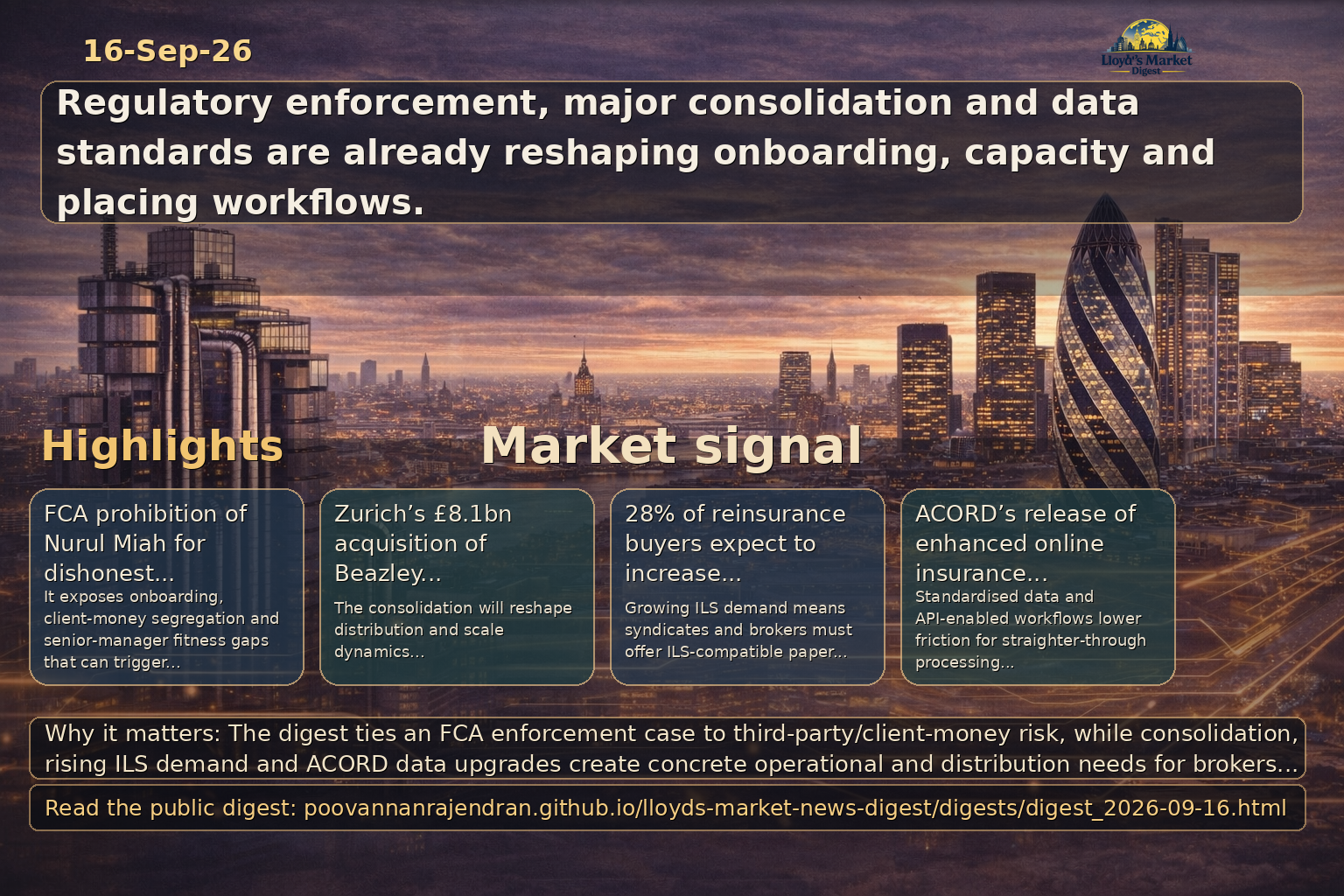
Why it matters: The FCA’s ban for dishonest misappropriation of substantial client funds demonstrates the regulator’s willingness to remove individuals who lack integrity regardless of prior approvals, and signals downstream risk for intermediaries, platforms and syndicates that rely on third‑party managers or adjacent professional firms. The judgment is directly relevant to Lloyd’s market participants because it exposes vulnerabilities in onboarding, delegated administration, client‑money handling and ongoing fitness‑and‑propriety monitoring.
- Reassess onboarding and approval processes for non‑traditional service providers and senior managers: enforce enhanced identity, criminal and civil history checks, conflicting role analysis and continual monitoring for any individual approved to operate within placement platforms or broker firms.
- Strengthen client money segregation, reconciliation and audit trails across broker, MGA and platform flows: require daily/weekly reconciliations, independent custodial arrangements where appropriate, comprehensive transaction logs and external assurance on client money arrangements.
- Tighten governance of delegated authority and third‑party arrangements: include contractual right to audit, accelerated incident reporting, defined remediation timelines, and escalation to syndicate boards and compliance functions to limit contagion from third‑party misconduct
Source: reinsurancene.ws
Why it matters: IRB(Re)'s regulatory approvals to operate new P&C and life subsidiaries in Brazil mark meaningful local capacity growth, with implications for cross-border placements, retrocession needs and broker market strategies in Latin America.
- Expanded local capacity reduces dependence on international facultative/reinsurance for Brazilian insurers, shifting some placement volume away from Lloyd's and global platforms
- Lloyd's syndicates should monitor partnership and retrocession opportunities as domestically domiciled players alter demand and risk retention patterns
- Placement platforms and brokers will need to manage local regulatory compliance, contracting standards and coordination for cross-border program placements
Source: reinsurancene.ws
Why it matters: Zurich's acquisition of Beazley is a transformational consolidation in global specialty insurance that will reshape competitive dynamics for Lloyd's syndicates, brokers and placement platforms through scale, product breadth and distribution reach.
- The combined group will intensify competition in specialty lines, pressuring Lloyd's syndicates to emphasize underwriting expertise, speed and niche specialization
- Brokers may centralize program placements with larger counterparties while negotiating differentiated terms across a rebalanced carrier landscape
- Placement platforms must ready for increased specialty volumes and potential system-level integration changes as Zurich/Beazley align distribution and policy administration processes
Source: artemis.bm
Why it matters: Moody’s survey signal that a sizeable minority of reinsurance buyers plan to increase alternative capital use in 2027, a direct indicator that ILS will continue to compete with traditional capacity and drive changes in placement structures, duration profiles and broker advisory services.
- Syndicates and managing agents should accelerate development of ILS‑compatible paper and longer‑dated structures to remain competitive for cedant demand.
- Brokers need to expand ILS structuring advisory and deepen relationships with capital providers to capture the flow of ceded risk migrating to alternative channels.
- Placement platforms must enhance investor onboarding, standardised documentation and reporting to lower friction for repeated ILS issuance.
Source: businessinsurance.com
Why it matters: Nepal’s large flood recovery bill signals elevated nat‑cat losses that will influence reinsurer supply, Lloyd’s syndicate claims volatility and brokered placement complexity for specialty buyers.
- Immediate upward pressure on catastrophe claims and potential spike in facultative/reinsurance layer utilizations for Asian exposures
- Opportunity for Lloyd’s syndicates and specialty capacity to offer differentiated terms for complex nat‑cat programs, with careful accumulation management
- Brokers and placement platforms must enhance modeling, accumulation controls and client communication to secure capacity and manage expectations
Source: businessinsurance.com
Why it matters: Resignations tied to falsified nuclear safety data elevate counterparty, operational and liability risk for insurers writing nuclear-related coverages and for brokers placing such risks.
- Raises potential for latent claims and third‑party liability exposures under nuclear/industrial policies, increasing scrutiny by underwriters
- Syndicates and specialty carriers should intensify due diligence and contractual warranties for insureds operating high‑hazard facilities
- Brokers and placement platforms will face greater demand for enhanced risk information, audits and conditional terms prior to binding
Source: businessinsurance.com
Why it matters: Groupama’s robust first‑half profit strengthens a major European specialty insurer’s capital position, potentially influencing underwriting capacity, pricing competition and reinsurance behaviour.
- Improved capital allows increased deployment into specialty lines and selective capacity expansion supporting syndicate and broker needs
- Could exert downward pricing pressure in competitive segments as profitable carriers seek market share
- Might alter reinsurance strategy (less reliance on external protection) with knock‑on effects for reinsurance placement dynamics
Source: businessinsurance.com
Why it matters: Iran’s warning on insurers covering so‑called ‘banned’ vessels signals elevated geopolitical and sanctions risk for marine and war risk insurers, complicating placements and capacity availability.
- Insurers and Lloyd’s syndicates will require stricter sanctions screening, creating friction in marine hull and P&I placements
- Expectation of higher war/terror premiums and restricted capacity for exposures to contested waters, increasing broker structuring complexity
- Placement platforms must integrate sanctions controls and provenance tracing to support compliant, auditable placements
Source: businessinsurance.com
Why it matters: Profile coverage of John Diaz highlights the importance of named senior market figures whose connections and decisions affect distribution, capacity access and syndicate relationships.
- Senior individuals remain pivotal in unlocking Lloyd’s capacity and sustaining broker–syndicate relationships during volatile renewals
- Leadership profiles serve as signals to clients and capital partners about strategic priorities and market positioning
- Talent continuity and succession planning are material to maintaining placement efficiency and account retention
Source: globalreinsurance.com
Why it matters: Miller Malaysia creates a new conduit for treaty and facultative placements in Southeast Asia, reinforcing broker-led access to cedants and increasing the pool of intermediary routes to Lloyd’s syndicates and global specialty capacity. The Labuan structure, senior hires and prior Asian investments indicate a scalable, compliance-focused play that will affect brokers, syndicates and placement platforms seeking local distribution and tailored reinsurance flows.
- Strategic distribution: Establishes direct regional relationships and origination capability — accelerates access to Southeast Asian cedents, which can increase the volume and diversity of premium flows available to Lloyd’s syndicates and specialty carriers.
- Placement and competitive dynamics: Adds broker competition for treaty and facultative business and may shift placement behaviour toward brokers able to offer offshore Labuan structures; increases demand for integrated placement platforms and curated syndicate solutions.
- Operational and regulatory considerations: Labuan licensing offers tax and structural efficiencies but requires robust compliance, governance and capital planning; syndicates and placement platforms should reassess subscription strategies, coverage terms and onboarding processes for Labuan-originated business.
Source: insurancejournal.com
Why it matters: Miller’s launch of Miller Malaysia (Labuan license) signifies accelerating broker-led distribution into Asian specialty and reinsurance markets and creates direct placement opportunities for Lloyd’s syndicates and global reinsurers.
- Immediate commercial opportunity: secure treaty and facultative placements with a broker expanding local relationships and talent in Malaysia and the broader ASEAN region.
- Placement platforms should enable Labuan-compliant workflow and multi-jurisdictional slips to streamline capacity deployment to the new office.
- Syndicates should evaluate appetite for Asian treaty exposure, consider strategic partnerships or quota-share arrangements, and pre-emptively align policy wordings to local regulatory and tax regimes.
Source: insurancejournal.com
Why it matters: A record-quiet Atlantic hurricane season (driven by El Niño) materially reduces near-term catastrophe losses but elevates the risk of rate correction and model complacency at upcoming renewals.
- Near-term pricing impact: potential softening pressure at upcoming property/reinsurance renewals — syndicates should avoid reflexive rate reductions and protect margin via underwriting discipline.
- Stress-test models for non-linear outcomes: calibrate scenarios that reverse rapidly if El Niño conditions shift or other drivers produce a concentrated loss year.
- Use the calm period to optimise retrocession strategy and capital allocation: consider opportunistic retro purchases, reinsurance structure refinements, and improved aggregation reporting across platforms.
Source: insurancejournal.com
Why it matters: BloombergNEF’s forecast that U.S. data centres will markedly increase natural gas consumption highlights accelerating property and business-interruption exposure concentrations tied to AI infrastructure — a systemic risk for specialty markets and capacity providers.
- Underwriting criteria must evolve: require granular engineering data on onsite generation, fuel storage, fire suppression, and redundancy for large data-centre clients.
- Aggregation control: syndicates and placement platforms should enforce exposure limits, enhanced monitoring, and diversification requirements to avoid single-event or systemic loss accumulation.
- Product development: create specialized composite covers (property, contingent BI, dependent business interruption, and new-tech endorsements) and offer risk engineering services to mitigate concentration.
Source: insurancejournal.com
Why it matters: Public calls for a global ‘technology stability’ body to oversee AI development signal an evolving regulatory and governance landscape that will shape AI/tech liability exposures and the market’s role in setting operational standards.
- Regulatory engagement: Lloyd’s marketplace and major brokers should proactively engage with policymakers to inform standards and ensure insurability of AI risks.
- Product and capacity strategy: accelerate development of AI-specific policy language, underwriting frameworks for model risk, and combined cyber/AI liability offerings.
- Risk assessment capability: invest in third-party model validation, scenario testing and placement-platform tools that capture supply-chain and vendor-model dependencies.
Source: insurancejournal.com
Why it matters: A coordinated insurer push for third‑party litigation funding (TPLF) disclosure in federal courts reflects insurer concern about hidden funding that can amplify claims — an issue directly relevant to liability underwriting, reserving and claims strategy.
- Monitor rulemaking: claims and legal teams must track the Advisory Committee process and prepare to adapt disclosure clauses and discovery strategies.
- Underwriting impact: price or impose conditions on liability classes where TPLF prevalence is high; consider requiring policyholder cooperation clauses tied to funding disclosure.
- Broker advisory role: brokers should counsel insureds on the implications of funding disclosure, coordinate legal support and adjust placement documentation to mitigate surprise exposures.
Source: reinsurancene.ws
Why it matters: Historic archive material provides context on past catastrophe impacts and market responses (e.g., Chinese flood commentary), useful for cycle-aware capacity and penetration strategy.
- Use historical loss and penetration trends to inform underwriting and growth strategy in emerging and concentrated markets.
- Syndicates should reassess exposure to regional flood and climate risks, refining accumulations and retro placements.
- Brokers can leverage historical narratives to justify risk mitigation spend and shape programme renewals.
Source: reinsurancene.ws
Why it matters: ACORD's enhanced online data and information models are material for interoperability across brokers, MGAs, syndicates and placement platforms—enabling straighter-through processing and faster placements.
- Integration: adopt ACORD Reference Architecture to standardise data exchange and reduce manual placement friction.
- Technology: invest in API-enabled workflows and data governance to exploit updated models across underwriting and policy admin.
- Competitive edge: early adopters will shorten time-to-bind and improve data quality for reinsurance and retrocession analytics.
Source: reinsurancene.ws
Why it matters: AXA's 2027-29 strategy — emphasising scaling AI, efficiency and targeted ROE — signals how major carriers are reshaping capacity allocation, pricing discipline and operational transformation.
- Capacity signal: expect increased competition in short-tail P&C and specialty where carriers target technical excellence.
- Margin pressure: syndicates should prioritise efficiency and analytics to protect underwriting margins in competitive lines.
- Broker alignment: position client programmes to match carriers' technology-driven underwriting and loss-prevention priorities.
Source: artemis.bm
Why it matters: A minority growth investment into Appleby by New Mountain Capital highlights private capital supporting legal and corporate services that underpin ILS issuance and SPV formation — improving speed and scale of cross‑border transactions for brokers, placement agents and domiciled syndicates.
- Managing agents and brokers should reassess legal and MSO partners to leverage enhanced capabilities for faster SPV setups and cross‑jurisdictional transactions.
- Lloyd’s syndicates and MGAs must anticipate more competitive service offerings and price accordingly for bespoke corporate and administration support.
- Placement platforms and originators can capitalise on upgraded vendor capacity to streamline issuance timelines and reduce operational friction for institutional investors.
Source: artemis.bm
Why it matters: Arch Re’s promotion and hire signify ongoing investment in ILS human capital at reinsurers — a market signal that experienced ILS leadership is becoming a differentiator in winning third‑party capital and executing complex structures.
- Brokers and syndicates should proactively engage newly appointed ILS heads to co‑develop products and secure priority capacity for key clients.
- Placement platforms must ensure their operating models support bespoke ILS portfolios and maintain transparent performance metrics to satisfy sophisticated ILS portfolio managers.
- Underwriters and managing agents should formalise governance and escalation processes around ILS products as teams scale to avoid operational or regulatory gaps.
Source: artemis.bm
Why it matters: CalPERS’ rapid increase in cat bond and ILS allocations to near $2.5bn validates the asset class’s institutional appeal and signals durable, scalable demand from large pensions — a material source of long‑term capacity for the Lloyd’s market and global specialty insurers.
- Syndicates should create targeted institutional‑facing products with enhanced transparency, governance and reporting to attract large allocators seeking predictable exposures.
- Brokers and placement platforms must improve standardisation and investor due diligence tools to meet pension fund governance and risk committees’ requirements.
- Lloyd’s and managing agents should promote syndicate governance and capital allocation frameworks that demonstrate alignment with institutional investors’ return and liquidity objectives.
Source: artemis.bm
Why it matters: Gallagher Securities working on a cat bond introducing a previously untransacted peril confirms the market’s expansion into novel exposures, increasing opportunities for risk transfer but also raising modelling, structuring and investor education needs across brokers, syndicates and placement platforms.
- Underwriters and model vendors must invest in analytics, parametric triggers or index design to accurately underwrite and price novel perils before committing significant capacity.
- Brokers and placement platforms should prioritise investor education and bespoke offering documentation to secure buy‑in for non‑traditional peril transactions.
- Syndicates should consider staged capacity deployment and conservative attachment levels to build a performance track record while the market calibrates new peril behaviour.
Source: newsnow.co.uk
Why it matters: The search result returns no content for "Brantham," signalling a data/coverage gap that can materially affect underwriting, claims validation and aggregation modelling for local property, industrial or marine exposures tied to that location.
- Treat as an intelligence gap: instruct brokers and delegated authority partners to perform immediate on‑the‑ground verification or commissioned surveys to confirm exposure and recent loss activity.
- Adjust modelling and exposure monitoring: require syndicates and analytics teams to run accumulation checks and stress scenarios where granular location data is absent, and apply conservative assumptions until validated.
- Leverage placement platforms and delegated authority workflows: use electronic placing and data-sharing tools to capture and distribute verified locality information, and include contingency clauses in placements to protect capacity where information is uncertain.
Source: newsnow.co.uk
Why it matters: Sustained reporting on London airports highlights elevated operational-risk exposures (ATC failures, cancellations, infrastructure outages) with immediate implications for travel insurance, airline/operator liability, airport property and business interruption lines — and potential accumulation across portfolios concentrated in UK aviation hubs.
- Reassess pricing and limits: underwriting teams should review travel-disruption, airline liability and airport operator policies for current exposure, increase monitoring of claims frequency, and consider capacity reallocation or pricing adjustments where risk is concentrated.
- Tighten contract terms and cover design: brokers must prioritise precise triggers (including parametric options), sublimits for proximate causes, and explicit contagion/aggregation language to manage multi-line loss scenarios involving airports.
- Mobilise placement and reinsurance actions: use Lloyd’s electronic placing and global specialty platforms to source capacity quickly, coordinate syndicate appetite for aviation-related risks, and engage reinsurance partners to protect against peak accumulation events.