Source: fca.org.uk
Why it matters: FCA warning that www.thinkingmega.com is operating without authorisation signals active fraud operations targeting UK customers; for Lloyd's market intermediaries this raises direct risks of clients being diverted to unauthorised providers and exposes brokers and syndicates to reputational and financial leakage.
- Immediate action: verify client-facing links and marketing to ensure no inadvertent referrals; publish a short advisory to clients on verifying firms via the FCA register.
- Payments control: enforce out-of-band verification for any new premium/invoice payment instructions and apply mandatory bank-account verification for large or unusual flows.
- Brand protection: monitor domain registrations and marketplace listings; escalate takedown requests and notify compliance/legal teams to flag to FCA where impersonation of market participants is suspected.
Source: fca.org.uk
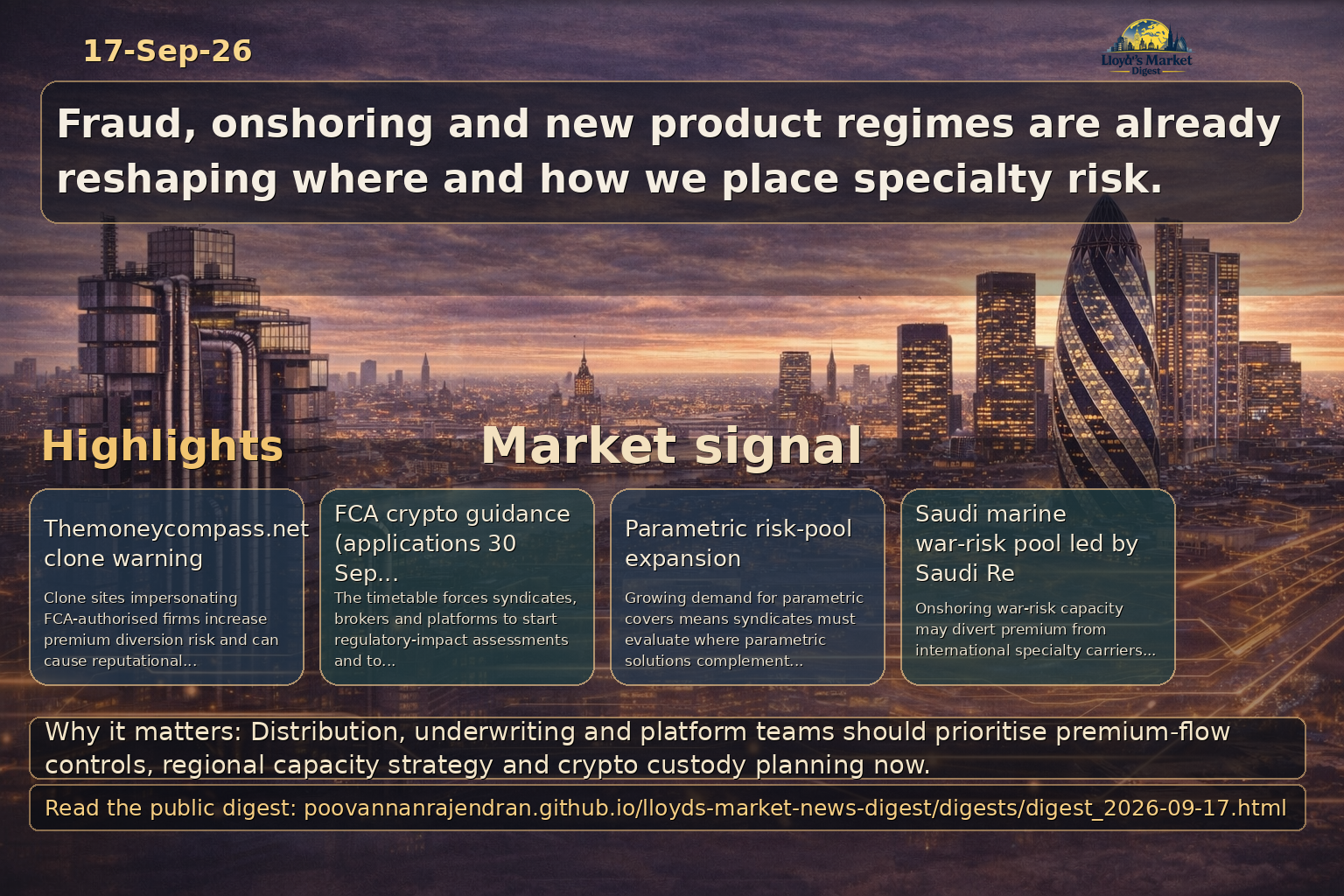
Why it matters: Themoneycompass.net is a clone of an FCA-authorised firm; clone operations specifically target trust in regulated intermediaries — a high-risk vector for premium diversion and fraud within specialty lines and international placements.
- Client education: require brokers and wholesale distribution partners to circulate a standard checklist to clients on how to confirm firm authenticity before making payments.
- Distribution hygiene: mandate that brokers confirm client contact details through known CRM records and flagged channels before accepting electronic transfers.
- Legal & escalation: add a protocol to report suspected clone activity immediately to the FCA Warning List and to internal incident response for communication and remediation with affected counterparties.
Source: fca.org.uk
Why it matters: Smartpaynet.com is another clone-firm alert—multiple simultaneous clone warnings indicate coordinated fraud campaigns that can impersonate payment platforms or premium collection portals used by brokers and placement platforms.
- Payment platform verification: require tokenised or dedicated escrow accounts on placement platforms; prohibit ad-hoc beneficiary changes without multi-factor approvals.
- Platform governance: review onboarding and KYC/KYB of third-party payment providers and ensure contractual indemnities and liability clauses for misdirected premiums.
- Operational detection: deploy real-time monitoring for anomalous beneficiary changes and train front-office teams to validate any payment-redirection requests through verified executive sign-off.
Source: fca.org.uk
Why it matters: FCA guidance on how the new cryptoasset regime will apply establishes a clear regulatory timetable and scope for activities (stablecoins, trading platforms, dealing/arranging, safeguarding, staking) — material for syndicates, brokers and placement platforms exploring tokenised insurance, parametric products or crypto custody partnerships.
- Roadmap: start regulatory-impact assessments for any crypto-related initiatives now; prepare for formal applications from 30 Sep 2026 and full regime from 25 Oct 2027 where activities fall within scope.
- Governance & custody: define safeguarding and custody models for tokenised premiums/assets that meet FCA expectations; re-evaluate custody partners, insurance wrappers and operational-resilience plans.
- Commercial positioning: reassess product go-to-market timelines, partner SLAs and underwriting appetite for crypto-linked exposures; ensure clear client disclosures on regulatory protections (or lack thereof) for crypto assets.
Source: fca.org.uk
Why it matters: FCA banning of an individual who caused significant client-money loss highlights enforcement intensity and the criticality of senior-manager fitness-and-propriety, as well as the systemic implications of poor third‑party oversight for client funds — a direct lesson for brokers, MGAs and syndicates holding or controlling client money.
- Senior manager controls: tighten SMCR attestations and periodic due diligence for senior staff and outsourced service leads, with enhanced scrutiny around those handling client money.
- Third-party oversight: conduct targeted audits of solicitors, escrow agents and payment processors used in distributions and claims handling; verify segregation and traceability of client funds.
- Incident readiness: update client-money incident playbooks, ensure rapid reconciliation capabilities and communicate remediation and restitution processes to boards and stakeholders.
Source: businessinsurance.com
Why it matters: Marsh’s promotion in healthcare practice leadership highlights talent and capability shifts within a top global broker — changes that influence specialty distribution, client relationships and sector-specific capacity placement at Lloyd’s and broker-led platforms.
- Client and capacity effects: Leadership changes in major brokers can re-prioritize sector focus, impacting where Lloyd’s syndicates and specialty carriers source renewals and risk pools.
- Talent strategy: Syndicates and carriers should proactively engage with broker leadership to reaffirm placement pipelines, and consider strategic partnerships or incentives to secure access to growing practice areas.
- Succession planning: Placement platforms must ensure platform-agnostic processes and data access so distribution continuity is preserved regardless of broker personnel moves.
Source: businessinsurance.com
Why it matters: Cross‑border M&A and antitrust scrutiny (Intesa/Generali) can reshape ownership of distribution channels, capital providers and reinsurers, creating knock‑on effects for Lloyd’s syndicates, broker relationships and placement outcomes.
- Assess counterparty and ownership change risk when negotiating lead terms and delegated authority agreements
- Prepare antitrust and regulatory due‑diligence playbooks for syndicates and managing agents to anticipate transaction delays or remedies
- Communicate contingency plans to brokers and clients to mitigate capacity or distribution disruption during protracted reviews
Source: businessinsurance.com
Why it matters: Drone attack and prolonged pipeline outage underscore intensifying geopolitical supply‑chain and terrorism exposures that affect energy underwriting, contingent business interruption and marine/commodity risk appetite across specialty markets.
- Recalibrate energy and supply‑chain underwriting assumptions and war/terror endorsements for affected geographies
- Brokers should model contingent BI scenarios with clients and secure tailored placement structures (e.g., layered war/terror, parametric triggers)
- Placement platforms must enable rapid quote/bind workflows and integrate third‑party loss estimates to support time‑sensitive placements
Source: businessinsurance.com
Why it matters: Expansion of parametric risk pools signals rising client demand for rapid, objective payouts and for transfer vehicles that sit alongside traditional Lloyd’s capacity and reinsurance programmes.
- Syndicates should evaluate where parametric structures complement indemnity portfolios and how basis risk will be managed
- Brokers to integrate parametric options into placement strategies for clients prioritising liquidity and speed of settlement
- Placement platforms and insurtech partners need API and data integrations to price, bind and trigger parametric covers seamlessly
Source: businessinsurance.com
Why it matters: Miller’s launch of a Malaysia reinsurance business reflects strategic capacity growth in APAC — relevant for Lloyd’s syndicates and brokers seeking regional placements and local cedant relationships.
- Identify partnership and distribution opportunities with regional reinsurers to support APAC specialty programmes
- Review local regulatory and capital implications for syndicates placing business into Malaysia and neighbouring markets
- Brokers and placement platforms should ensure regional market knowledge and on‑shore servicing capabilities to capture growth flows
Source: globalreinsurance.com
Why it matters: A senior appointment to lead Mapfre Re's Brussels centre signals intensified EMEA focus on client/broker engagement and localized underwriting — a dynamic that affects syndicate competition and placement strategies.
- Reinforces pressure on Lloyd's syndicates to demonstrate regional underwriting relevance and deepen broker relationships in Benelux/EMEA to retain placement flow.
- Highlights talent mobility: senior underwriters with broker‑relationship expertise become differentiators for reinsurers and create recruitment/retention challenges for syndicates and managing agents.
- Drives demand for tailored treaty structures and bespoke EMEA products; placement platforms should ensure connectivity and workflow integration to capture business routed through local reinsurer hubs.
Source: globalreinsurance.com
Why it matters: The Saudi national marine war risk pool represents a policy‑led effort to onshore war‑risk capacity and strengthen trade resilience, directly reducing some demand for international specialty war‑risk capacity including Lloyd's syndicates.
- May divert premium and risk away from Lloyd's and global specialty carriers for marine war‑risk classes, pressuring syndicates to seek alternate niches or co‑participation opportunities.
- Creates opportunities for reinsurance support, fronting arrangements and facultative placements — brokers and syndicates can structure quota‑share or facultative reinsurance to the pool.
- Placement platforms and brokers will be pivotal in administering terms and claims protocols for the pool; technology and program management capabilities will be competitive differentiators for market participants.
Source: globalreinsurance.com
Why it matters: Miller's establishment of a Labuan‑based Malaysia operation demonstrates brokers' strategic push into Asia to originate treaty and facultative reinsurance flows, influencing placement patterns and capacity sourcing for syndicates.
- Accelerates localisation of reinsurance placements in Asia, challenging Lloyd's brokers to partner or compete for origination and placement of regional treaty and facultative business.
- Increases competition for specialist capacity as regional brokers package treaty and facultative programs; syndicates must weigh direct market entry, capacity partnerships or distribution via established brokers.
- Reinforces need for placement platforms with cross‑jurisdictional capability, digital workflow and compliance support to handle Labuan and wider Asia placements efficiently and at scale.
Source: insurancejournal.com
Why it matters: High‑value corporate enforcement over diversity practices raises broader vendor and professional-liability compliance expectations for brokers, Lloyd’s syndicates and placement platforms that rely on large consultants and service providers.
- Impact: Heightened regulatory scrutiny can cascade to contract and procurement risk for brokers and MGAs that use major consultancies, increasing reputational and operational exposure.
- Action: Review vendor due‑diligence frameworks, contractual indemnities and representations for material suppliers; embed ESG/compliance covenants into placement agreements.
- Implication: Syndicates should ensure professional liability and PI wordings account for supplier conduct risk and coordinate with brokers on disclosure requirements to avoid coverage disputes.
Source: insurancejournal.com
Why it matters: The guilty plea by an unlicensed prize insurer underscores persistent fraud and licensing lapses in niche contingency products, relevant to specialty underwriters and brokers placing prize, event and contingency covers.
- Impact: Exposure to unpaid claims and regulatory sanctions where intermediaries or fronting arrangements are used without robust licensing checks.
- Action: Reinforce onboarding and licensing verification for contingency product providers; require audited trust arrangements and solvency evidence for prize insurers.
- Implication: Placement platforms should introduce automated compliance gates for low‑frequency specialty products and syndicates must tighten policy conditions and audit rights.
Source: insurancejournal.com
Why it matters: Public commentary from a global insurer CEO on sovereign reform and debt highlights macroeconomic and political risks that can affect investment returns, sovereign exposure and pricing assumptions across Lloyd’s and global specialty markets.
- Impact: Rising sovereign debt concerns can depress asset returns, affect capital adequacy and influence reserving assumptions for long‑tail lines held by syndicates.
- Action: Reassess asset‑liability strategies, stress test portfolios for sovereign shocks and communicate investment governance expectations to capital providers.
- Implication: Brokers should flag potential credit and political‑risk exposures to clients; underwriters may need to reprice products sensitive to macro volatility.
Source: insurancejournal.com
Why it matters: An EU 'climate insurance alliance' represents a potential large‑scale public‑private programme that will drive demand for catastrophe capacity, parametric products and distribution via specialist brokers and platforms.
- Impact: Opportunity to deploy Lloyd’s and global specialty capacity into EU‑backed schemes, increasing premium volumes but requiring scalable capacity and standardised wordings.
- Action: Engage early with EU policymakers and brokers to shape product architecture; develop parametric and hybrid solutions and prepare capacity allocation frameworks.
- Implication: Syndicates should update aggregation models for new exposure pools and placement platforms must support efficient, compliant onboarding for public‑private transactions.
Source: insurancejournal.com
Why it matters: Ukraine’s exploration of ship insurance to restore exports points to a surge in demand for war, kidnap & ransom, and cargo/marine liability covers—critical for Lloyd’s marine underwriters and brokers handling Black Sea trade.
- Impact: Elevated demand for war and marine cover with complex risk triggers, heavy reinsurance reliance and potential government involvement or backstops.
- Action: Structure layered solutions with clear war/strikes wording, coordinate with reinsurers and consider pooled or facility-based approaches to scale capacity.
- Implication: Brokers should prepare contingency placement strategies; syndicates must evaluate appetite limits, pricing for attritional loss frequency and clauses for reroute and transshipment exposures.
Source: insurancetimes.co.uk
Why it matters: Swiss Re’s near-zero appetite for new US liability highlights litigation-driven reserve strain affecting reinsurer capacity — a direct signal to syndicates, placement platforms and brokers handling US-exposed global specialty risks.
- Implication: Expect reduced reinsurance capacity and higher attachment points for US casualty business, pressuring Lloyd’s syndicates to reassess US liability exposures.
- Action: Brokers should pre-emptively seek alternative placements, restructure programmes and emphasise loss mitigation and governance to attract capacity.
- Strategy: Syndicates and capital providers must tighten underwriting disciplines, increase scrutiny on social inflation exposure and price accordingly to protect combined ratios.
Source: insurancetimes.co.uk
Why it matters: Leadership profile of a fast-rising broker MD underscores talent-driven growth, succession planning and broker diversification into international schemes — core to sustaining distribution for Lloyd’s and specialty markets.
- Observation: Broker firms are investing in leadership development to support expansion into international and scheme-based business, enhancing deal flow to specialty syndicates.
- Recommendation: Syndicates and platforms should partner with growth-minded brokers early, offering differentiated product and scheme support to secure long-term volume.
- People: Talent-first strategies by brokers will be a competitive advantage; underwriters and capital providers should align incentives to retain broker-led distribution relationships.
Source: insurancetimes.co.uk
Why it matters: A digital classic car product illustrates demand for niche retail specialty lines delivered via online distribution and insurer-MGA collaborations — relevant for syndicates seeking diversified motor exposure and platform-enabled retail flows.
- Market: Digital retail propositions expand addressable specialty motor niches and attract younger customer segments, creating new premium pools for delegated capacity.
- Distribution: Placement platforms and brokers should evaluate streamlined onboarding for such digital products to access scaled, consistent retail risk flows.
- Underwriting: Syndicates must assess data-driven risk selection and pricing for collectible/modern-classic vehicles, considering repair cost inflation and specialty supply-chain exposures.
Source: insurancetimes.co.uk
Why it matters: Bridgehaven’s partnership with a new MGA to underwrite specialist commercial portfolios exemplifies how hybrid insurers and MGAs are expanding capacity and direct access to brokers — a model increasingly important to Lloyd’s distribution ecosystem.
- Capacity: Hybrid insurer-MGA arrangements provide scalable capacity and streamlined decision-making attractive to brokers placing specialist commercial risks.
- Engagement: Placement platforms should integrate MGA-led desks to improve speed-to-bind and enable syndicates to source targeted risks efficiently.
- Governance: Syndicates need clear delegated authority frameworks and oversight to manage concentration and pricing discipline across MGA channels.
Source: insurancetimes.co.uk
Why it matters: Aviva’s regional partnership for community travel is peripheral to core specialty markets but signals insurer brand engagement and partnership models that brokers and syndicates can mirror for client retention and corporate reputation strategies.
- Relevance: While not core to Lloyd’s specialty lines, such partnerships reinforce insurer distribution strength and local market relationships that can influence broker sourcing decisions.
- Client strategy: Brokers should note insurer community initiatives when aligning client propositions and selecting carrier partners for reputational fit.
- Branding: Syndicates and managing agents may leverage similar CSR-aligned programmes to strengthen broker and corporate client relationships in competitive placement contexts.
Source: reinsurancene.ws
Why it matters: Historical Reinsurance News archives provide context on past market cycles and catastrophe impacts; useful for benchmarking underwriting and pricing evolution but limited direct operational relevance today.
- Use archival reports to benchmark current combined-ratio and catastrophe-loss trends against prior cycles to validate pricing models
- Inform regulatory and governance retrospectives — cite historical precedent when discussing capital and rate interventions with boards
- Leverage for claims and loss-development studies to support reserving assumptions and stress-test scenarios
Source: reinsurancene.ws
Why it matters: Aon’s CyQu Marketplace targets the gap between cyber risk assessment and actionable remediation — directly relevant to underwriters, brokers and placement platforms seeking evidentiary underwriting standards and loss-control outcomes.
- Evaluate pilot partnerships or integrations with CyQu to provide underwriters verified remediation pathways as part of submission packages
- Require structured risk-improvement artefacts from brokers when negotiating cyber terms to accelerate underwriting decisions and reduce moral hazard
- Ensure placement platforms can ingest and present remediation evidence to syndicates to shorten decision timelines and support differentiated pricing
Source: reinsurancene.ws
Why it matters: Markel’s senior hires in Marine Transportation strengthen specialist underwriting capacity in London, affecting broker placement strategy for marine, hull and logistics risks within the Lloyd’s/global specialty ecosystem.
- Brokers should engage Markel’s consolidated marine capability to explore bundled placements across hull, liability and cargo risks
- Syndicates and capacity providers must monitor portfolio expansion for appetite alignment and potential co-insurance opportunities
- Placement platforms ought to spotlight Markel’s delegation and product set to simplify quote aggregation for marine-focused broking desks
Source: reinsurancene.ws
Why it matters: Ascot establishing a foundation signals continued prioritisation of ESG, reputation and stakeholder engagement among global specialty carriers — relevant to broker-client dialogues and market positioning.
- Integrate insurer ESG credentials into commercial discussions to differentiate submission narratives and client placement decisions
- Corporate teams should align philanthropic messaging with distribution strategies to support broker relationship development and talent attraction
- Placement platforms can showcase carrier ESG commitments as part of carrier selection criteria for risk-sensitive clients
Source: reinsurancene.ws
Why it matters: AM Best’s report showing continued surplus lines expansion (including Lloyd’s syndicate activity) underscores shifting demand dynamics in the US, with implications for capacity allocation, pricing and broker placement strategy.
- Syndicates and Lloyd’s capital managers should reassess US binding authority and quota-share strategies to capture surplus-lines growth while controlling aggregation risk
- Brokers must rebalance appetite between admitted and surplus capacity, emphasising evidence of underwriting discipline to secure capacity
- Placement platforms should streamline access to surplus and Lloyd’s capacity and improve filtration for compliance and tax-domicile requirements
Source: newsnow.co.uk
Why it matters: Federal Reserve monetary policy drives interest rates and liquidity conditions that materially influence Lloyd’s syndicates’ investment returns, cost of capital for brokers/platforms and overall market pricing dynamics.
- Monitor duration and asset-allocation strategies at the syndicate level; lower returns on risk-free assets may push greater reliance on underwriting profits and influence rate adequacy.
- Anticipate higher cost-of-capital scenarios to impact broker financing, acquisition valuations and placement platform fundraising; reflect this in pricing and capital planning.
- Track cross-border FX and capital flows as Fed moves affect global reinsurer balance sheets and retrocession market depth—prepare for knock-on pricing and capacity adjustments.
Source: newsnow.co.uk
Why it matters: Political developments involving Palestinian leadership increase geopolitical and operational risk for specialty underwriters and brokers—affecting war/terror coverage, sanctions exposure and appetite among Lloyd’s syndicates.
- Review and stress-test war, civil commotion and terrorism wordings; anticipate claims frequency/severity shifts and potential reinsurer retentions tightening.
- Reassess reinsurance programme structure and retrocession appetite in the near term; prepare for potential capacity withdrawal or repricing from global reinsurers.
- Communicate proactively with clients and brokers on sanctions screening, policy exclusions and contingency plans; document placement decisions where geopolitical exposure is material.
Source: newsnow.co.uk
Why it matters: Absence of searchable content for an individual demonstrates limitations in open-source monitoring and presents a red flag for KYC, identity validation and reputational risk processes used by brokers, platforms and underwriters.
- Treat gaps in open-source intelligence as a trigger for enhanced due diligence: deploy paid databases, watchlists and human-led checks before placement or claims handling.
- Embed provenance and evidence requirements in intake workflows—document steps taken where public information is sparse to mitigate AML and sanctions risk.
- Ensure placement platforms and brokers integrate identity-resolution tools and escalation routes to protect syndicates from exposure to sanctioned persons or unidentified beneficial owners.
Source: newsnow.co.uk
Why it matters: County-level reporting (e.g., Oxfordshire) is a proxy for regional risk concentrations — climate-related losses, local commercial exposures (SMEs, universities, tech firms) and operational claims that demand tailored underwriting and distribution approaches.
- Reassess flood and storm modelling for regional portfolios; ensure retail brokers and syndicates price for evolving climate volatility and update exposure maps.
- Target product development for regional concentrations such as cyber and professional indemnity for universities, research institutions and tech SMEs.
- Leverage placement platforms to offer rapid regional solutions and claims handling partnerships; use localised data to optimise capacity allocation across syndicates.