Source: artemis.bm
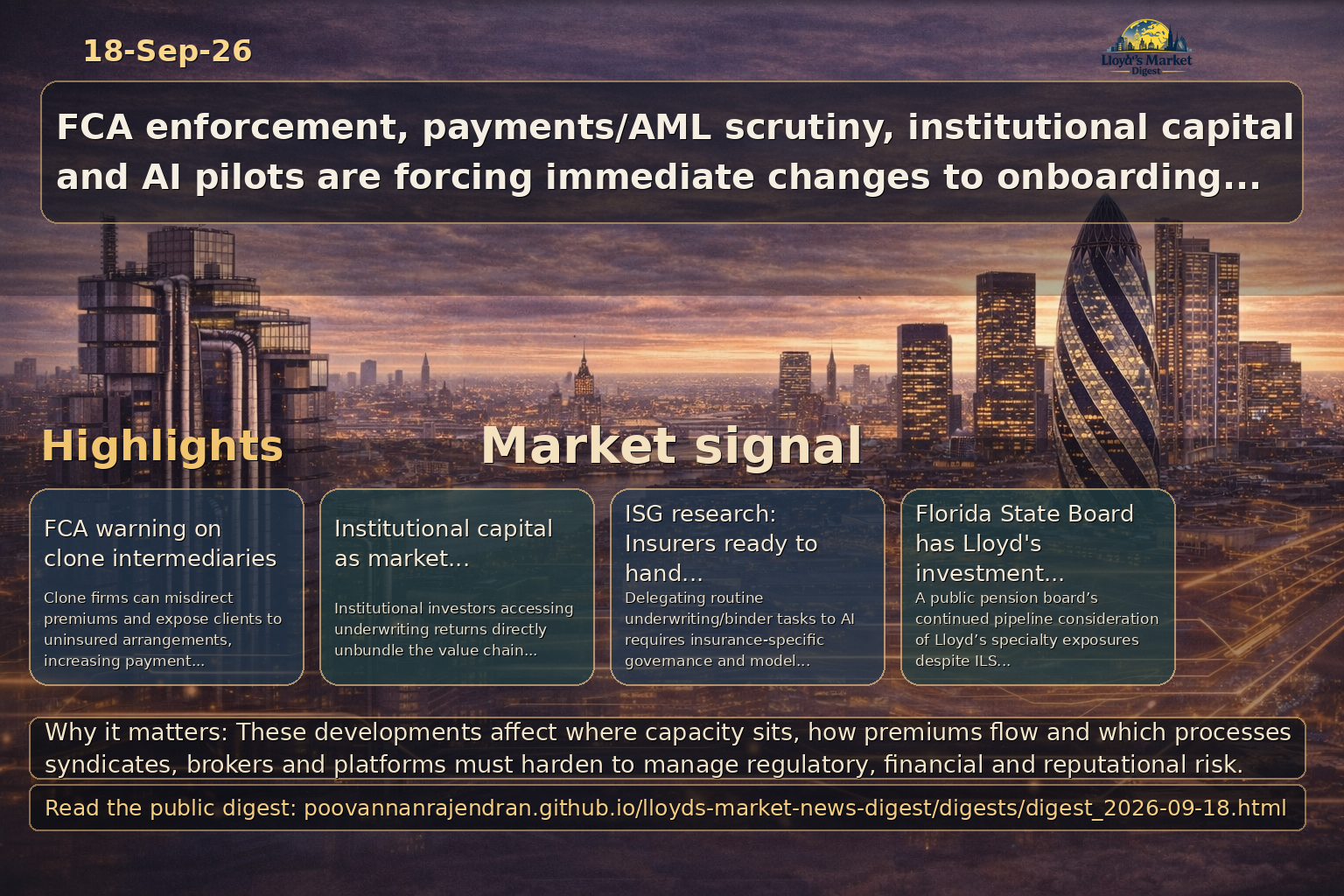
Why it matters: A public pension board’s continued pipeline consideration of Lloyd’s specialty exposures despite ILS softness signals that large institutional allocators still see value in Lloyd’s-originated risk, but expect tailored diversification and transparent governance.
- Demand opportunity: Syndicates and brokers should articulate differentiated risk-adjusted return propositions that complement ILS strategies to capture pension-scale allocations.
- Product design: Expect preferences for diversified structures (layering, multi-peril, geographic diversification) and clearer attachment mechanics to mitigate ILS repricing.
- Investor transparency: Provide enhanced reporting and governance disclosures to satisfy institutional due diligence and justify allocation alongside other alternative risk assets.
Source: fca.org.uk
Why it matters: Clone firms impersonating regulated entities create direct distribution, payment and reputational risk for brokers and syndicates; they can misdirect premiums and expose clients to uninsured arrangements.
- Enforce strict counterparty verification for all new retail and wholesale distribution channels; cross-check names, websites and contact details against FCA Warning List before engagement.
- Communicate proactively with clients and brokers on how to identify authentic market counterparties and the firm’s official contact points to prevent diversion of premiums.
- Implement transaction monitoring rules to detect unexpected premium routing or new payees and suspend flows pending confirmed legitimacy.
Source: fca.org.uk
Why it matters: Unauthorised intermediaries offering financial services can erode client protections (FSCS, FOS), creating potential liability and confusion for brokers and placement platforms that rely on third‑party distributors.
- Require evidence of FCA authorisation for partners handling client money or providing advisory services; decline engagement where authorisation cannot be validated.
- Update contracts to include representations and indemnities against dealing with unauthorised firms and a right to audit onboarding practices.
- Educate account teams and wholesale brokers on the customer protection consequences (no FSCS/FOS) to ensure appropriate client warnings and disclosures.
Source: fca.org.uk
Why it matters: FCA insight on payments and customer vulnerability highlights operational frictions that affect SME clients and commercial lines placements; simpler payment/onboarding promotes retention and reduces execution risk.
- Review payment onboarding and reconciliation processes to reduce technical barriers for SME clients and brokers, including callback support and simplified instructions.
- Train distribution and operations teams to identify vulnerability markers and apply flexible servicing protocols where needed to preserve placement continuity.
- Audit payment providers and platform UX to remove unnecessary steps or repeated checks that increase abandon‑rates for small commercial accounts.
Source: fca.org.uk
Why it matters: An FCA AML investigation into a payments/FX firm underscores regulatory appetite to pursue systemic weak AML controls that can be exploited to launder insurance premium flows or launder claim proceeds.
- Conduct enhanced AML risk assessments on payment and FX partners, focusing on country risk, customer profiles and delivery channels used for premium and claims settlements.
- Introduce or tighten EDD on counterparties with cross‑border activity and ensure AML documentation is current and auditable for supervisory scrutiny.
- Coordinate with correspondent banks and payment vendors to require AML attestations and real‑time transaction flagging for suspicious flows.
Source: fca.org.uk
Why it matters: FCA measures to improve SME access to finance signal opportunities and risks for insurers serving microbusinesses; underwriting, pricing and distribution should adapt to capability and disclosure constraints of smaller customers.
- Develop simplified product documentation and streamlined application processes tailored to microbusinesses to increase conversion and reduce misrepresentation risk.
- Collaborate with brokers and fintech lenders to design integrated finance-insurance propositions, addressing collateral and intangible asset coverage gaps.
- Enhance data collection to assess SME credit and operational risk more efficiently, reducing duplication of checks across providers.
Source: reinsurancene.ws
Why it matters: Echo Re’s elevation of a combined compliance, risk and information security executive underscores insurers’ need to embed governance and cyber controls as they scale operations from Bermuda and Swiss domiciles.
- For brokers: enhance diligence on counterparties’ compliance and InfoSec posture when placing business across jurisdictions.
- For syndicates: formalise information security SLAs and audit evidence for intermediaries and colocated platforms.
- For placement platforms: incorporate compliance checks and secure data handling workflows to meet reinsurer requirements.
Source: reinsurancene.ws
Why it matters: Howden's creation of a dedicated US Sports & Entertainment practice demonstrates demand for verticalised specialty coverage and bespoke placement solutions — a market for Lloyd's syndicates to provide tailored capacity and holistic risk services.
- Develop industry‑specific underwriting guidelines and bundled coverage options for sports and entertainment risks, including event cancellation and talent liability.
- Equip brokers and platform underwriters with rapid quoting tools and specialist claims partners to win time‑sensitive placements.
- Explore affinity partnerships and local market distribution to capture niche, high‑touch client relationships in the vertical.
Source: businessinsurance.com
Why it matters: CFC's cyber upgrades for financial institutions signal product segmentation and higher-touch underwriting for sensitive FI accounts — a direct indicator for Lloyd's syndicates and specialty brokers to reassess appetite, pricing and distribution strategies for FI cyber risk.
- Underwriting: Expect more bespoke FI cyber forms and conditional coverages requiring specialised underwriters and forensic claims capabilities.
- Distribution: Brokers and placement platforms should prepare for consultative sales cycles and coordinate evidence-based risk assessments to access capacity.
- Pricing & terms: Syndicates need to evaluate margin and aggregation exposure; upgraded products may tighten attachment/limits and alter reinsurance demand.
Source: businessinsurance.com
Why it matters: Lori Seidenberg's launch of a risk management consulting firm reflects growing demand for advisory services that augment traditional broking — an opportunity for Lloyd's market participants to partner on risk engineering and client advisory propositions.
- Partnerships: Syndicates and brokers should explore strategic alliances to integrate advisory services within placement solutions and enhance client retention.
- Value add: Specialist consulting can de-risk accounts pre-placement, improving loss ratios and enabling expanded capacity on complex risks.
- Talent pipeline: Recruiting or collaborating with boutique consultancies will be important to deliver sector-specific risk mitigation for large or complex clients.
Source: businessinsurance.com
Why it matters: Rising California workers' compensation medical payments underline sustained claims inflation for casualty lines that affect pricing, reserving and reinsurance strategies for syndicates writing U.S. accounts.
- Pricing action: Brokers and underwriters must factor elevated medical severity into renewal strategies and bespoke loss-sensitive programmes.
- Reinsurance/reserving: Syndicates should reassess retrocession and IBNR assumptions to reflect sustained medical cost inflation.
- Client advisory: Placement platforms can differentiate by offering claims-management and cost-containment solutions alongside capacity.
Source: businessinsurance.com
Why it matters: The revived Florida yacht coverage dispute highlights ongoing marine wording and jurisdictional litigation risk — material for Lloyd's marine syndicates, high-net-worth brokers and platform managers involved in leisure and yacht placements.
- Wording clarity: Syndicates should re-evaluate hull and yacht exclusions, breach definitions and choice-of-law clauses to limit litigation exposure.
- Broker diligence: Brokers need enhanced documentation and pre-placement disclosure protocols for cross-border marine exposures.
- Claims governance: Platforms should coordinate legal risk assessments and consider captive or excess structures for high-value yacht portfolios.
Source: businessinsurance.com
Why it matters: Senior leadership changes at Marsh in hospitality and real estate will influence distribution dynamics for specialty property and casualty risks, affecting how syndicates and alternative capital engage those sectors.
- Relationship shifts: Syndicates should monitor broker leadership changes that could alter preferred panel composition and appetite for large hospitality accounts.
- Strategic focus: Expect renewed emphasis on sector-specific productisation (e.g., operational interruption and contingent BI) where specialist capacity can differentiate.
- Competition for mandates: Placement platforms must proactively secure engagements as broker realignment may prompt re-tendering of major portfolios.
Source: globalreinsurance.com
Why it matters: AIG’s scheduled transition of its general insurance CEO to a senior advisor role signals planned leadership succession with direct implications for underwriting strategy, Lloyd’s-facing platforms (Talbot) and broker relationships. The move will influence continuity of underwriting discipline, talent development and strategic distribution across global specialty lines.
- Underwriting continuity: Expect emphasis on maintaining underwriting standards and disciplined appetite during the transition—critical for syndicates and placement platforms that rely on AIG/Talbot capacity.
- Distribution and broker relationships: Brokers should proactively engage AIG leadership to reaffirm placement routing, terms and collaborative product development, particularly where Talbot interacts with Lloyd’s brokers and syndicates.
- Talent and succession risks: Opportunity for competitors and specialty MGAs to target displaced talent or disrupt distribution; syndicates should monitor changes in decision-making and appetite that could affect capacity availability.
Source: globalreinsurance.com
Why it matters: Mapfre Re’s appointment of Benoit Goureau to lead its Brussels Management Center strengthens its EMEA commercial and treaty presence and signals a renewed focus on client and broker engagement in continental Europe—relevant to Lloyd’s brokers and syndicates competing for regional placements.
- Enhanced broker engagement in EMEA: A leadership presence in Brussels reinforces direct engagement with local and international brokers, affecting placement dynamics for treaty and facultative business.
- Treaty and claims expertise: Goureau’s background in non-life treaty and claims underwriting suggests tightened focus on portfolio management and loss appetite—important data points for syndicates and platforms evaluating retrocession and co-reinsurance relationships.
- Competitive positioning versus Lloyd’s: Strengthened continental reinsurer capabilities may shift some ceded flows away from London placements, prompting Lloyd’s syndicates and platforms to highlight value-add services and service speed to retain business.
Source: globalreinsurance.com
Why it matters: Saudi Re’s appointment to lead a government-backed marine war risk pool reflects a strategic move to domesticise capacity for geopolitical exposures. This will materially affect demand for international war-risk cover and create partnership and placement implications for Lloyd’s syndicates, global specialty insurers and brokers.
- Domestic war-risk capacity: The pool reduces reliance on volatile international capacity, potentially shrinking immediate demand for Lloyd’s and global specialty war-risk lines and altering pricing dynamics for marine and energy clients.
- Placement and platform adaptations: Brokers and placement platforms must adapt workflows to accommodate domestic program terms, coordinate with local insurers and assess retrocession pathways for excess risk.
- Opportunities for partnerships and retrocession: Syndicates and reinsurers can pursue reinsurance/retrocession arrangements with the pool or offer complementary specialist capacity and services (claims handling, sanctions compliance) to support continuity of trade.
Source: insurancejournal.com
Why it matters: A New York ruling expanding bad‑faith liability into third‑party claims elevates litigation and consequential‑damages exposure for liability underwriters, brokers and syndicates with US placements. It requires immediate review of claims governance, policy language and reinsurance/excess structures to manage retroactive and extra‑contractual loss potential.
- Claims governance: strengthen documented claims handling protocols, escalation triggers and training across delegated authorities and managing agents to mitigate extra‑contractual exposure.
- Policy drafting and pricing: reassess wordings (duty to defend, consent to settlement, allocation clauses) and adjust pricing/reserving for US casualty and US‑domiciled exposures.
- Reinsurance and placement implications: review excess layer attachment points and facultative arrangements; brokers should flag increased litigation tail to reinsurers and clients.
Source: insurancejournal.com
Why it matters: The Nepal mountain collapse driven by interacting climate and seismic factors highlights the growing frequency of compound physical perils that standard cat models may understate, creating accumulation risk for specialty lines covering infrastructure, travel, and parametric products in high‑altitude regions.
- Model validation: update catastrophe and site‑specific models to capture compound permafrost melt, glacial dynamics and seismic legacy effects on slope stability.
- Underwriting and accumulation controls: institute tighter geographic accumulation limits, stricter risk selection and increased use of geotechnical surveys for mountain and alpine exposures.
- Product innovation: accelerate parametric and indexed solutions for rapid pay‑outs where traditional loss adjustment is delayed or impossible; placement platforms should standardise data inputs for efficient quoting.
Source: insurancejournal.com
Why it matters: El Niño combined with disruptions from the Iran conflict raises acute food‑security and commodity supply risks across Asia, increasing exposure for crop, commodity, trade‑credit and supply‑chain insurance — critical considerations for global specialty insurers and brokers handling agricultural and trade portfolios.
- Concentration and pricing: reprice crop, commodity and supply‑chain covers in affected geographies; apply tighter limits and dynamic underwriting for high‑volatility crops and palm oil exposure.
- Political/credit risk layering: consider layering political‑violence and trade‑credit cover or revising exclusions where social unrest could trigger insured loss or non‑payment events.
- Client advisory and risk mitigation: brokers should promote hedging, diversified sourcing and captive or parametric solutions to clients while syndicates reassess reinsurance protection for correlated agricultural losses.
Source: insurancejournal.com
Why it matters: Escalating, more brazen Russian attacks into European and maritime zones materially increase war, terrorism and sabotage exposures for energy, marine, offshore and critical‑infrastructure portfolios — directly affecting Lloyd’s syndicates and wholesale brokers active in those classes.
- Underwriting discipline: tighten coverage on near‑shore, offshore energy and critical‑infrastructure risks; reassess applicability of war/hostile acts exclusions and war‑risk premium loadings.
- Operational continuity and scenario stress testing: run enhanced scenario analyses for CBIP, crew and asset evacuation costs, and contractor failure chains; placement platforms should capture these scenarios in binders and quote matrices.
- Sanctions and compliance: maintain up‑to‑date sanctions screening and counsel on policy enforceability where state attribution or jurisdictional complications arise.
Source: insurancejournal.com
Why it matters: EU signals to address Chinese trade imbalances create near‑term policy and regulatory uncertainty affecting trade finance, credit insurance and supply‑chain exposures. Lloyd’s markets with China‑linked business must monitor tariff/controls flow‑downs and adapt risk appetite and document capture accordingly.
- Trade‑credit exposure management: re‑evaluate credit limits for China‑dependent counterparties and introduce covenant or documentary evidence enhancements for political/regulatory risk shifts.
- Contract and jurisdiction strategy: brokers should advise clients on re‑negotiating terms, currency clauses and choice‑of‑law provisions to mitigate transit/collection risk under changing controls.
- Market and regulatory monitoring: syndicates must track EU measures and China responses for impacts on premium flows, collateral requirements and potential need for regulatory capital adjustments.
Source: reinsurancene.ws
Why it matters: ISG research for mea Platform signals insurer willingness to delegate repeatable tasks to AI but with insurance‑specific controls — a direct call to action for Lloyd's syndicates, brokers and placement platforms to define governed AI models and integration roadmaps.
- Assess underwriting and binder workflows that are repeatable and high‑volume as priority candidates for insurance‑specific AI pilots.
- Define governance and model‑risk frameworks consistent with Lloyd's and EEA/UK regulatory expectations prior to deploying AI into placement channels.
- Engage brokers and placement platforms in co‑development to ensure model outputs map to syndicate appetite and delegated authority rules.
Source: reinsurancene.ws
Why it matters: Archive entries illustrate historical market cycles and underwriting outcomes that remain relevant for benchmarking syndicate performance, underwriting appetite shifts and capital behaviour — useful for strategic planning and stress testing.
- Leverage historical archive analysis to validate current pricing adequacy and reserve assumptions for long‑tail lines and run‑off portfolios.
- Use precedent transaction and performance data to inform RITC pricing and syndicate capital planning for volatile lines.
- Incorporate archived market events into scenario testing for placement platform stress and broker contingency planning.
Source: reinsurancene.ws
Why it matters: Persisting NFIP subsidies and phased pricing reforms materially affect US flood exposures, influencing reinsurer appetite, parametric product demand and broker placement strategies for flood risk across global specialty portfolios.
- Reassess US flood accumulation modelling across Lloyd's and London portfolios to reflect continuing subsidised pricing and projected premium adjustments through the late 2030s.
- Accelerate development of private flood and parametric offerings via placement platforms to plug affordability and capacity gaps left by NFIP reforms.
- Advise clients on renewal timing and limits structure given the shifting distribution of policyholders moving to full‑risk pricing.
Source: artemis.bm
Why it matters: Aon’s framing of institutional capital as structural market infrastructure confirms a shift: capital providers access underwriting returns directly and the underwriting value chain is unbundling, amplifying the role of brokers and platforms in capital design and matching.
- Strategic positioning: Brokers must evolve from placement-only roles to capital architects—designing governance, triggers and investor-facing documentation.
- Platform integration: Placement platforms and Lloyd’s should prioritise connectivity and modular product interfaces to enable direct investor access while preserving distribution economics.
- Governance & productisation: Competitive advantage will accrue to market participants who can standardise high-integrity data, reporting and governance to make bespoke capacity investible at scale.
Source: artemis.bm
Why it matters: Adoption of AI-based contract intelligence by a Bermuda ILS/reinsurance manager demonstrates that automation of contract review is maturing—reducing friction in underwriting, strengthening auditability and accelerating placement cycles.
- Workflow efficiency: Syndicates and brokers can materially reduce cycle times and legal costs by integrating contract intelligence into placement and renewal workflows.
- Integration imperative: Placement platforms should prioritise APIs and document-linkage features to carry contract metadata through execution and post-bind servicing.
- Control environment: Maintain human-in-the-loop validation and clear audit trails to satisfy compliance and preserve underwriting judgment while scaling automation.
Source: artemis.bm
Why it matters: A guilty plea tied to fraudulent standby letters of credit connected to an ILS intermediary underscores persistent operational and reputational risks in collateralised reinsurance and ILS structures, prompting heightened regulatory and investor scrutiny.
- Elevated compliance focus: Firms should tighten KYC/AML, document authentication and third‑party due diligence for collateral arrangements and fintech partners.
- Reputational and counterparty risk: Syndicates and brokers must reassess counterparties and incorporate contractual protections and representations for collateral authenticity.
- Regulatory readiness: Placement platforms and managers should prepare for stricter regulatory enquiries and investor demands for immutable audit trails and independent verification of collateral instruments.
Source: artemis.bm
Why it matters: Significant pre-tax catastrophe losses reported by a major US insurer, and their impact on aggregate cat bond programmes, highlight how active loss experience can erode investor returns and rapidly alter capacity and pricing for property catastrophe risk.
- Capacity & pricing implications: Syndicates and alternative capital providers should anticipate near-term repricing and selective capacity withdrawal in corridors with elevated losses.
- Trigger and collateral review: Brokers must re-evaluate trigger language, attachment methodologies and collateralisation mechanics to ensure investor and cedant expectations remain aligned.
- Risk management: Syndicates and platforms should proactively model aggregate erosion scenarios and communicate potential impacts to investors and distribution partners ahead of renewals.
Source: newsnow.co.uk
Why it matters: Developments linked to Poland/Ukraine and statements from EU leaders signal elevated hybrid/threat-of-accidental strikes risk; this materially affects political violence, war exclusion triggers and cross-border liability for global specialty portfolios.
- Brokers and syndicates should re-run P&V stress tests for Eastern Europe exposures and update appetite and wordings accordingly.
- Placement platforms must enable rapid quoting and binding for contingency programmes and short-term capacity as clients seek immediate cover adjustments.
- Reinsurers and capital providers should be briefed on scenario outcomes to recalibrate capacity and retrocession arrangements for correlated regional losses.
Source: newsnow.co.uk
Why it matters: The ongoing legacy and ceremonial role of the British monarchy influence UK institutional stability and reputational exposures; that stability underpins London’s attractiveness as a global specialty hub and affects sovereign/regulatory sentiment.
- Syndicates should maintain readiness for event-driven demand (commemorative/national events) that can create short-term concentration in event liability and contingency lines.
- Brokers must incorporate reputational and political risk considerations into client advice for major UK-linked programmes.
- Placement platforms and market communications teams should have protocols for rapid PR and client guidance during high-profile national events to protect market integrity.
Source: newsnow.co.uk
Why it matters: OpenAI and fast-moving AI developments materially expand cyber exposures, model risk, and potential for new third-party AI liability; they also create opportunities for bespoke specialty products.
- Underwriters should develop AI-specific cyber and tech-professional indemnity products, with clear coverage triggers and exclusions for model misuse.
- Brokers need to enhance client due-diligence on AI governance, vendor management and model validation to support placement terms.
- Placement platforms should integrate AI-risk scoring, cyber telemetry and policy automation to accelerate quoting and loss mitigation services.
Source: newsnow.co.uk
Why it matters: Nvidia represents concentration in the semiconductor and AI hardware supply chain; losses or disruption to key suppliers create aggregation, business-interruption and contingent BI exposures across global specialty portfolios.
- Syndicates must reassess aggregation limits and concentration thresholds for clients dependent on a narrow set of hardware suppliers.
- Brokers should map supply-chain dependencies for insureds and structure parametric or contingent BI solutions where appropriate.
- Placement platforms ought to incorporate supplier-status indicators and global supply-chain intelligence into risk assessments for faster, more accurate risk selection.
Source: newsnow.co.uk
Why it matters: Malawi exemplifies emerging-market exposures where climate shocks, health crises and development finance needs affect political risk, crop/agribusiness and humanitarian-insurance demand in the specialty market.
- Consider scaling parametric and index-based products for weather and agricultural loss in vulnerable markets to provide faster pay-outs and lower basis risk.
- Syndicates and brokers should evaluate sovereign and political-risk appetite, partnering with development agencies and local brokers to access on-the-ground intelligence.
- Placement platforms can support smaller-scale transactions by streamlining documentation and enabling modular capacity slices to spread risk among multiple participants.