Source: fca.org.uk
Why it matters: FCA warning on an unauthorised entity underscores persistent marketplace fraud risks that can infiltrate broker networks and placement channels, exposing syndicates and platforms to reputational and financial contagion.
- Risk: Unauthorized intermediaries can introduce non-compliant risk, leaving syndicates exposed to uninsured losses and client complaints when FSCS/ombudsman protections do not apply.
- Action: Strengthen intermediary onboarding and periodic re‑verification (credentials, regulatory status, payment flows) before accepting placements.
- Mitigation: Require documented proof of authorisation or formal refusal checks and include contract clauses to shift liability for fraud introduced by third‑party intermediaries.
Source: fca.org.uk
Why it matters: Another FCA warning for an unauthorised firm highlights recurring patterns of market abuse and the need for brokers and platforms to treat warning‑list checks as routine pre-placement controls.
- Risk: Persistent use of unauthorised entities as intermediaries increases operational and compliance burdens on syndicates when attempting recovery or dispute resolution.
- Action: Integrate FCA Warning List checks into placement platform workflows and broker CRM systems to block or flag transactions involving listed names.
- Mitigation: Train front‑office and underwriting teams to recognise red flags from marketing materials and to escalate suspected clone/unauthorised approaches to compliance immediately.
Source: fca.org.uk
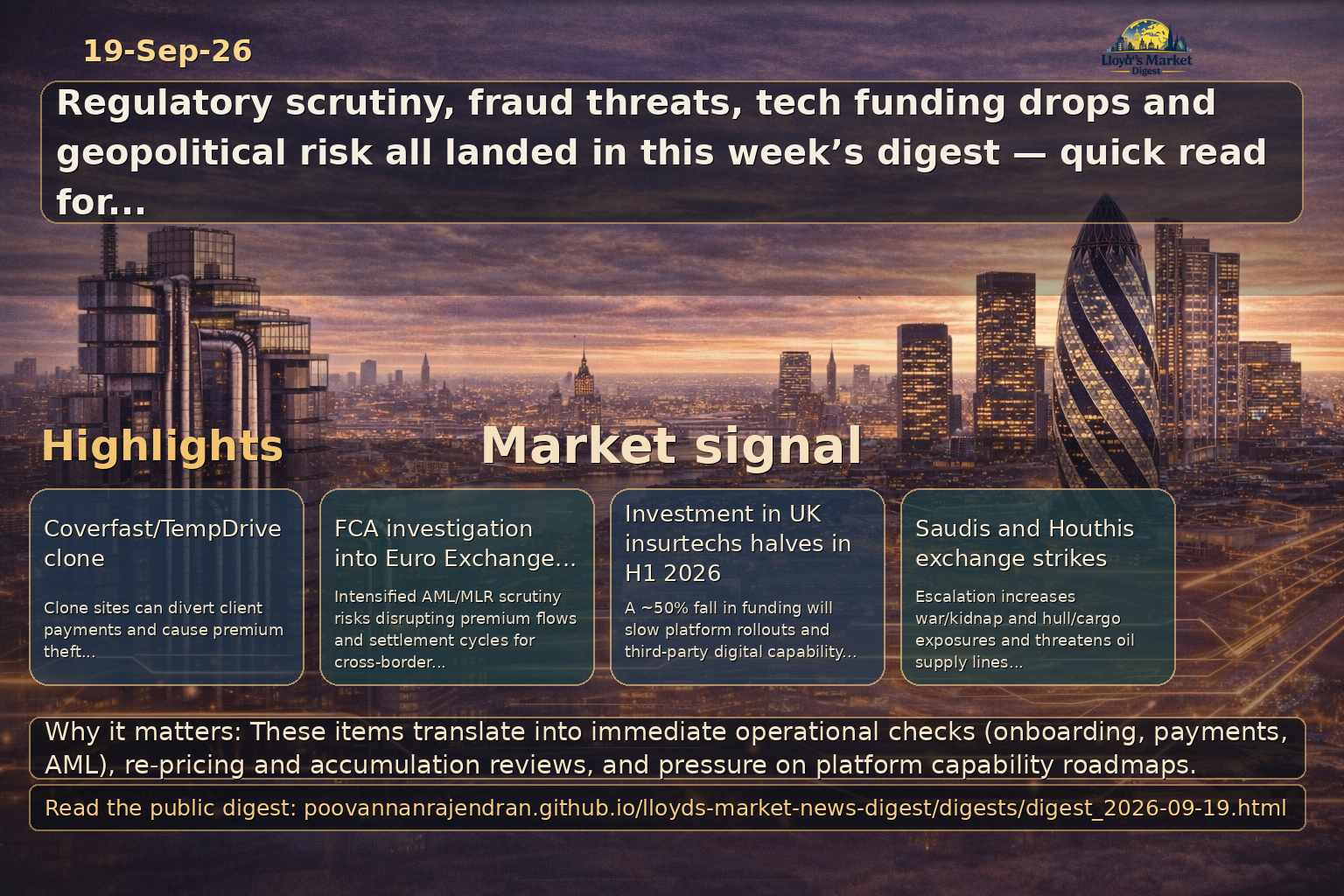
Why it matters: FCA investigation into Euro Exchange Securities (MLR breaches) signals intensified scrutiny on money‑laundering controls that can affect cross‑border specialty placements and premium flows through brokers and platforms.
- Risk: Weak AML frameworks in intermediaries can trigger investigations that disrupt premium movement, client servicing and syndicate settlement cycles.
- Action: Brokers and platforms should conduct targeted AML gap assessments on correspondent firms and payment intermediaries used for premium collection and claims payments.
- Mitigation: Implement tiered AML due diligence proportional to exposure, review transaction monitoring thresholds for specialty placements, and document enhanced checks for high‑risk geographies.
Source: fca.org.uk
Why it matters: FCA commentary on building a stronger investment culture, with emphasis on scams and illegal promotions, reinforces expectations for transparency and scam prevention in distribution — relevant where insurance products are offered alongside investments or as part of risk‑transfer solutions.
- Risk: Cross‑selling or packaged products that resemble investment propositions can attract regulatory scrutiny if promotions lack clear risk and regulatory-status disclosures.
- Action: Ensure marketing and placement materials for products with investment characteristics are explicit about regulatory protections and prohibitions on unauthorised promotions.
- Mitigation: Coordinate with placement platforms to vet third‑party marketing and enforce content standards, retaining audit trails for promotional approvals.
Source: fca.org.uk
Why it matters: Clone‑firm warning replicating an authorised insurer exemplifies a direct threat to broker/client trust and increases the need for verification steps before routing business or accepting electronic payments.
- Risk: Clients may be diverted to clone sites leading to premium theft, policy avoidance and reputational damage to genuine Lloyd's participants impersonated by fraudsters.
- Action: Require brokers and platforms to confirm counterparty details via independent regulatory databases and to use verified corporate digital identities for electronic exchanges.
- Mitigation: Communicate proactively with clients on how to verify authorised contacts, and create a rapid response protocol to notify market participants when clones are reported.
Source: insurancejournal.com
Why it matters: PRA dynamic stress test actions directly affect capital planning, data demands and scenario design for London Market syndicates and brokers, with implications for placement cadence and reinsurance purchasing.
- Data and reporting: brokers and placement platforms must streamline exposure aggregation and verification processes to meet intensive live exercise timelines and avoid placement delays.
- Capital and pricing: syndicates should re-evaluate model assumptions, catastrophe aggregation and retrocession strategies in anticipation of more onerous stress outcomes.
- Regulatory engagement: C-suite and market associations need proactive dialogue with the PRA to seek more realistic scenario calibration and to limit impractical short‑term reporting burdens.
Source: insurancejournal.com
Why it matters: Escalation between Saudi Arabia and Houthi forces increases war, kidnap and ransom, hull and cargo exposures and threatens global oil supply lines that concentrate Lloyd's and global specialty risk appetites.
- Underwriting action: re-price and restrict war and political violence cover for affected trades and routes, and consider tightened warranties for vessels and cargo owners.
- Accumulation management: syndicates must stress-test exposures to energy infrastructure and Red Sea transit concentrations and adjust single‑risk and sector limits.
- Broker advisory: brokers should offer contingency routing, alternative logistics advice and pre-binder war risk solutions to clients while securing appropriate reinsurer capacity.
Source: insurancejournal.com
Why it matters: Regulatory action against a major food brand in India highlights elevated product liability and recall risk in a high‑growth market, relevant to specialty carriers and reinsurers underwriting product recall, contamination and supply chain liability portfolios.
- Policy wording and exclusions: underwriters should review product recall triggers, contamination definitions and multi-jurisdictional defence and indemnity provisions, particularly for emerging markets.
- Accumulation and treaty review: reinsurers need to identify and limit aggregation by industry sector and geography to avoid surprise accumulations tied to regulatory actions.
- Client risk mitigation: brokers should mandate enhanced supply chain controls, third‑party testing regimes and recall response plans as prerequisites for placement.
Source: insurancejournal.com
Why it matters: A publicized fintech data breach with ransom demands demonstrates systemic cyber exposure concentration for financial platforms and raises underwriting and aggregation concerns for cyber portfolios placed by brokers and syndicates.
- Exposure concentration: underwriters must reassess limits and aggregation modelling for platforms serving large client pools to avoid correlated losses across accounts and policyholders.
- Placement and data requirements: brokers and placement platforms should demand stronger pre-bind cyber hygiene evidence and standardized incident response retainer terms.
- Risk transfer strategy: C-suite should expand cyber incident response partnerships, review retrocession terms for cyber, and consider stress scenarios that reflect ransom and secondary extortion dynamics.
Source: insurancejournal.com
Why it matters: A suspected cyber attack on an LNG tanker underscores the growing intersection of cyber and maritime perils, including potential physical damage, business interruption and supply chain disruption that affect marine, energy and commodity underwriters.
- Clause and exclusion clarity: marine and energy underwriters must revisit cyber, war and perils wording to define coverage boundaries for vessel control system failures and cyber‑enabled losses.
- Vessel and counterparty diligence: brokers should require proof of cyber resilience measures from shipowners and operators, including ICS/OT security and supplier assurance for time‑charter counterparties.
- Aggregation and scenario modelling: syndicates need to incorporate cyber‑enabled marine failure scenarios into accumulation models, particularly for LNG and other hazardous cargoes with concentrated exposures.
Source: insurancetimes.co.uk
Why it matters: Clear Group's move to a consolidated London headquarters is a deliberate operational and strategic signal to the Lloyd's market and global specialty community: it enhances collaboration, client engagement and placement speed while reinforcing London as a centre for broking expertise — relevant to syndicates, coverholders and placement platforms that rely on concentrated broker presence for efficient distribution.
- Concentration of talent and facilities will shorten placement cycles and improve bid/quote coordination with Lloyd’s syndicates and wholesale carriers, increasing responsiveness on complex specialty placements.
- The relocation is a market signal of continued confidence in London’s role for international broking, supporting face‑to‑face meetings, broker‑underwriter relationships and use of meeting infrastructure by placement platforms and capital providers.
- Execution focus: convert new workspace into measurable commercial advantage (client events, syndicate roadshows, integrated tech for straight‑through processing) while managing Central London cost base and hybrid working expectations.
Source: insurancetimes.co.uk
Why it matters: A ~50% decline in UK insurtech investment in H1 2026 materially affects the supply of third‑party digital capability for brokers, MGAs, syndicates and placement platforms. Reduced funding increases the risk of delayed platform deployments, vendor consolidation and a shift toward incumbent‑led digital investment or strategic acquisitions by capitalised market participants.
- Fewer fundraises and smaller rounds will slow development of API connectivity, smart quoting engines and automation modules relied on by placement platforms and syndicates for efficiency gains.
- Expect greater vendor due diligence and a pick‑up in M&A: well‑funded brokers, reinsurers and syndicates should prioritise selective acquisitions or minority investments to secure strategic capabilities and protect distribution workflows.
- Strategic response: accelerate internal digitisation of core distribution functions, form exclusive partnerships with viable insurtechs, and engage policymakers/regulators on incentives to restore growth funding and maintain London’s competitiveness for specialty tech.