Source: artemis.bm
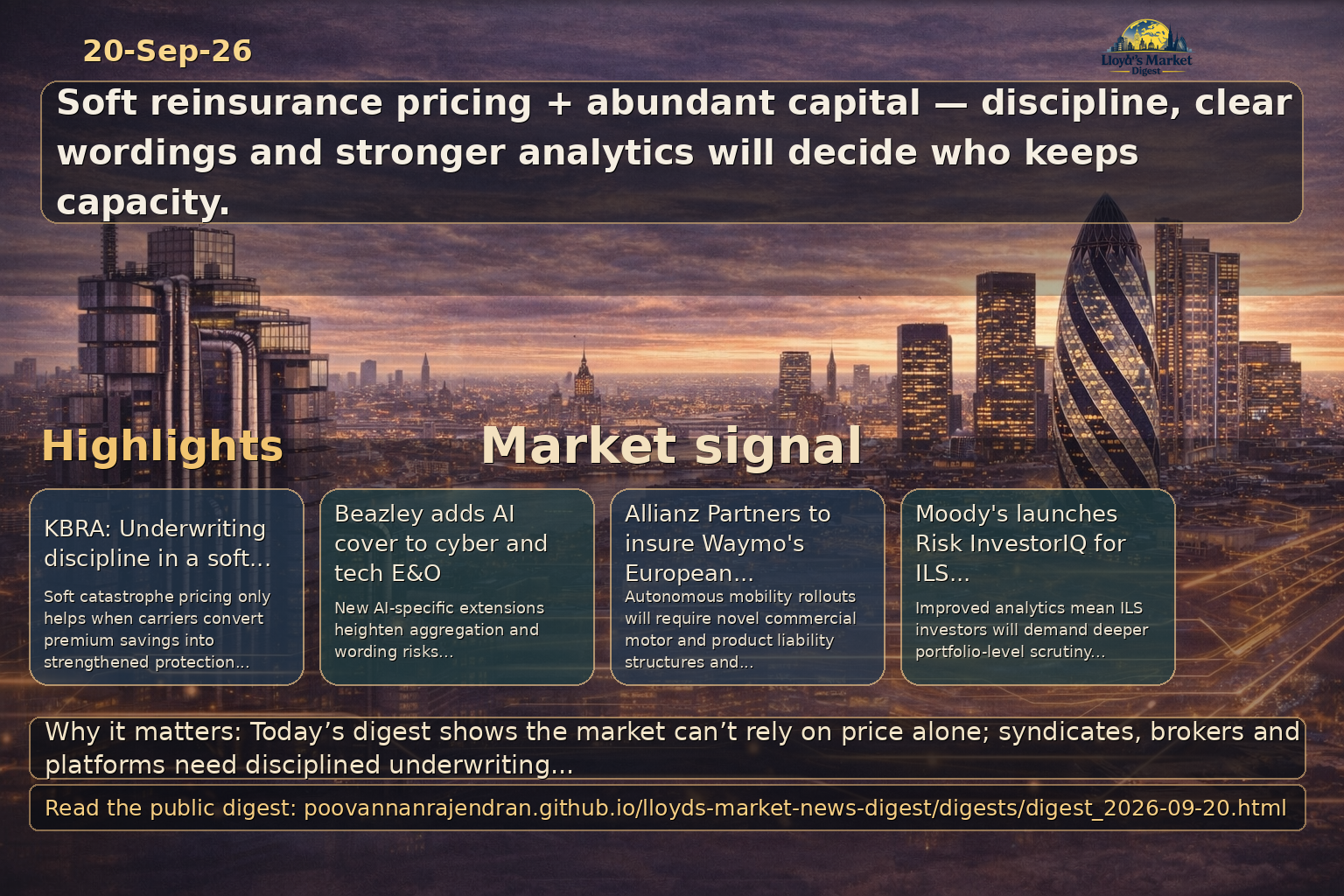
Why it matters: KBRA’s analysis underscores that soft catastrophe pricing only benefits carriers and capital providers when management converts pricing savings into strengthened protection rather than growth at the expense of resilience.
- Reinforce underwriting discipline: Lloyd’s syndicates and global specialty carriers must embed stress-tested exposure limits and catastrophe modelling in pricing governance to protect ratings and capital efficiency.
- Broker advisory role expands: Brokers should counsel cedents to invest premium savings in coverage breadth, limits and programme placement rather than accelerated growth that increases tail risk.
- Placement platforms must preserve transparency: Platforms and capital arrangers should document collateralisation, retentions and accumulation metrics so investors can assess true protection versus short‑term pricing gains.
Source: businessinsurance.com
Why it matters: Rising rebuilding costs and underinsurance materially increase tail exposures for property portfolios—impacting syndicate capital adequacy, pricing and placement strategies.
- Reprice and reunderwrite: Syndicates should reassess rebuild-cost assumptions and calibrate MCT/retro needs to avoid surprise loss amplification.
- Broker advisory role: Brokers must prioritise client property valuations, promote agreed-value/indexed solutions and package layered placements to protect client balance sheets.
- Platform enablement: Placement platforms should introduce valuation data capture, rebuild-cost indices and parametric triggers to streamline rapid placements and claims validation.
Source: businessinsurance.com
Why it matters: Beazley adding AI cover underscores accelerating product innovation in cyber/tech E&O—raising aggregation, wording and accumulation challenges for the specialty market.
- Wordings and exclusions: Syndicates must standardise clear AI-specific definitions, aggregation language and exclusions to limit silent cyber and systemic accumulation.
- Broker diligence: Brokers should run scenario analyses for AI-related losses and secure multi-carrier placements to diversify accumulation risk.
- Platform capability: Placement platforms need fields for AI use-case data, model exposure indicators and automated aggregation reporting to support capacity decisions.
Source: businessinsurance.com
Why it matters: Allianz Partners insuring Waymo's European rollout signals large-scale demand for novel commercial motor and product liability structures for autonomous mobility—an addressable opportunity for specialty capital.
- New liability profiles: Syndicates should develop products addressing AV software failures, telematics data liability and OEM/insurer co‑liability structures.
- Global capacity coordination: Brokers must coordinate multinational placements and reinsurance programs to provide consistent coverage across jurisdictions.
- Data-driven placement: Platforms that integrate telematics and incident-data feeds will accelerate underwriting, claims validation and tailored pricing for AV deployments.
Source: businessinsurance.com
Why it matters: An EU-led climate insurance alliance creates a framework for public–private risk-sharing that will alter demand, capital roles and underwriting approaches for extreme climate perils.
- Risk-sharing opportunities: Lloyd's syndicates can offer specialist capacity and parametric structures to support government-backed programs and sovereign risk transfer.
- Product design and modelling: Brokers and carriers must align on common modeling standards and standardised triggers to scale coverage affordably.
- Compliance and distribution: Placement platforms should incorporate regulatory reporting, subsidy management and multi-stakeholder workflows to execute pooled solutions.
Source: businessinsurance.com
Why it matters: Media contributors and profile pieces remain a leading source of market sentiment and regulatory signal—monitoring reporters like Emily Drew supports proactive stakeholder engagement and intelligence.
- Market intelligence: Track Emily Drew's coverage for early indicators on EMEA regulatory shifts, major placements and distributor commentary that affect appetite.
- Engagement strategy: Compliance‑aligned PR and executive commentary should be coordinated to influence narrative and protect syndicate reputation.
- Competitive insight: Use her reporting to benchmark competitor moves and client concerns, informing product positioning and broker conversations.
Source: globalreinsurance.com
Why it matters: Willis survey shows cedants are increasingly buying facultative cover to expand internationally and manage capital in a softening market — a shift that affects capacity allocation, broker workflow and platform requirements across Lloyd’s and global specialty markets.
- Facultative as a strategic tool: Syndicates and Lloyd’s underwriters should expect more facultative placement demand to support new market entries and capital optimisation; prepare flexible capacity and pricing frameworks.
- Broker operational imperative: Brokers must scale facultative origination and placement processes (workflows, data capture, rapid appetite matching) to capture growth and preserve margins.
- Platform and distribution impact: Placement platforms need to prioritise facultative‑specific features (rapid quoting, document automation, capacity tracking) to reduce friction and speed execution.
Source: globalreinsurance.com
Why it matters: The AerCap ruling highlights that a single line of contingent cover can determine multi‑hundred‑million recoveries. This elevates legal and commercial risk from policy and reinsurance wordings for syndicates, brokers and placement systems.
- Immediate wordings review: Underwriters and ceding managers must audit war, contingency and exclusion clauses across programs; small drafting ambiguities now carry outsized financial consequences.
- Brokers as risk‑mitigation advisers: Brokers should document client instructions and negotiation history, push for unambiguous drafting, and incorporate legal review into placement precedents.
- Embed clause governance in platforms: Placement and contract‑management platforms must enable clause libraries, redline tracking and provenance records to demonstrate intent and reduce post‑loss disputes.
Source: globalreinsurance.com
Why it matters: MAPFRE Re’s view of an orderly softening coupled with increasing client differentiation signals a market moving from broad repricing to selective underwriting and product diversification — critical for syndicates, brokers and capital providers to navigate renewals.
- Selectivity and segmentation: Syndicates should tighten underwriting criteria and tailor terms to individual cedant risk profiles rather than relying on blanket market moves.
- Capital and product diversification: Reinsurers’ continued allocation to ILS, life and growth markets requires brokers to align capital solutions with cedant objectives and present multi‑channel placement strategies.
- Data and analytics demand: Brokers and platforms must offer granular portfolio analytics and client‑level profitability metrics to support differentiated pricing, negotiate terms, and win allocations.
Source: reinsurancene.ws
Why it matters: Swiss Re’s appointment strengthens its India operational hub, with direct implications for servicing Lloyd’s and global specialty business through improved regional coordination, talent retention and scalable support for underwriting, claims and placement workflows.
- Operational leverage: A stronger India GCC improves turnaround and cost-efficiency for policy administration and placement support, helping brokers and syndicates manage global bind-and-bind workflows more effectively.
- Client and broker servicing: Local leadership continuity enhances relationships with regional brokers and multinational clients, reducing friction on multinational placements that touch Lloyd’s and other global capacity providers.
- Scalability for specialty lines: An experienced India head accelerates capability building (data, analytics, back-office) that supports scaled specialty underwriting and platform integrations across APAC and London placements.
Source: reinsurancene.ws
Why it matters: A near-doubling of ceded premiums among Europe’s top buyers signals materially higher demand for reinsurance capacity and broker services; while Lloyd’s remains a dominant buyer, easing concentration below the top five opens strategic opportunities for syndicates, brokers and placement platforms.
- Demand and pricing pressure: Rapid growth in ceded spend increases competition for capacity and reinsurer attention, pressuring syndicates to refine pricing, limit structures and treaty terms across specialty lines.
- Relationship concentration: Continued top-level dominance by Lloyd’s and a few groups reinforces the need for brokers and placement platforms to prioritise deep, strategic relationships with these buyers and their primary intermediaries.
- Mid‑market opportunity: Fluidity below the top five creates openings for alternative capacity providers and digital placement platforms to capture shifting mandates and niche specialty volumes.
Source: artemis.bm
Why it matters: Marsh Securities’ view that ILS investors must broaden mandates highlights a strategic inflection: distribution and product teams that offer flexibility will secure alternative capital as traditional capacity proliferates.
- Design flexible structures: Brokers and Lloyd’s managing agents should create bespoke structures (layered terms, multi-peril, parametric elements) to attract ILS capital with broader mandates.
- Platform capability matters: Placement platforms that support custom documentation, bespoke modelling and rapid execution will outcompete in a capacity-rich market.
- Syndicate–ILS collaboration: Syndicates can capture market share by partnering with ILS capital on hybrid solutions, sharing underwriting data and aligning governance to investor return profiles.
Source: artemis.bm
Why it matters: Swiss Re’s emphasis on risk awareness, prevention and transfer signals a shift where reinsurers and brokers provide advisory and engineering services to reduce loss frequency and severity before transferring residual risk.
- Monetise risk prevention: Brokers and syndicates should package risk engineering, loss-control recommendations and premium crediting as part of placement strategies to differentiate offerings.
- Price secondary perils realistically: Underwriters at Lloyd’s and global specialty markets must update modelling and terms to reflect supply‑chain, climate and geopolitical drivers that increase correlated losses.
- Integrate prevention into platforms: Placement platforms should capture engineering data and actionable risk metrics to demonstrate value to cedents and justify pricing and capacity decisions.
Source: artemis.bm
Why it matters: Moody’s launch of Risk InvestorIQ raises the analytical bar for ILS evaluation, enabling investors and intermediaries to assess transaction and portfolio impacts with greater granularity.
- Elevated investor due diligence: Syndicates and brokers should anticipate deeper portfolio-level interrogation of exposures, correlations and tail metrics by ILS investors using advanced analytics.
- Differentiation through data: Placement platforms that integrate analytics and transparent loss-model inputs will facilitate faster, higher‑confidence allocations from institutional capital.
- Use analytics to win mandates: Brokers can leverage tools like Risk InvestorIQ to quantify marginal portfolio benefit of placements, improving pitch effectiveness to sophisticated alternative capital.
Source: artemis.bm
Why it matters: Ledger’s findings on casualty sidecars highlight that growth in asset‑driven collateralised structures increases the importance of applying equal discipline to the supporting asset portfolios as to underwriting risk.
- Align asset–liability governance: Lloyd’s syndicates and cedents using sidecars must implement investment criteria and stress tests that mirror underwriting risk tolerances to avoid hidden volatility.
- Demand transparency on collateral: Brokers and placement platforms should require full disclosure of collateral composition, liquidity and reinvestment risk when structuring casualty sidecars.
- Strengthen reporting and controls: Establish standardised reporting, independent asset oversight and triggers within placement documentation to reassure investors and rating agencies.
Source: newsnow.co.uk
Why it matters: Riyadh’s Vision 2030-driven pipeline and PIF-led investments create immediate capacity demand and elevated aggregation exposures for Lloyd’s syndicates and global specialty brokers.
- Market opportunity: Large-scale infrastructure, construction and energy-transition programmes require tailored insurance products and appetite from syndicates and delegated-authority partners; target modular, multi-year placements.
- Regulatory & access implication: Engaging with Saudi regulators and establishing onshore distribution or local coverholder arrangements accelerates placements and compliance; assess Takaful interaction where relevant.
- Risk management: Concentration of high-value projects increases aggregation and climate-related exposures (heat, supply-chain, construction casualty); integrate enhanced loss modelling, parametrics and active engineering services.
Source: newsnow.co.uk
Why it matters: Islington represents a microcosm of London’s urban exposures, broker talent pool and proximity to Lloyd’s distribution channels—factors that matter for underwriting, product development and broker recruitment.
- Distribution & talent: Borough-level broker networks are an important feeder to London specialty desks; invest in retention, apprenticeship and tech tools to secure origination pipelines.
- Product implications: Mixed-use properties, SMEs and digital economy businesses require combined property, cyber and contingent BI offerings tailored to urban risk profiles; streamline placement workflows for speed to bind.
- Data & regulatory impact: Local planning, flood and building-regulation changes create underwriting volatility; deploy granular geospatial analytics and proactive client advisory services to mitigate loss potential.
Source: newsnow.co.uk
Why it matters: Search results for “Millionaires' Row” returned no direct content, but the underlying concept—clusters of UHNW assets—remains a strategic focus for private-client underwriting and placement operations.
- Bespoke product demand: Concentrated high-value real estate, art and lifestyle assets require bespoke limits, specialty wordings and risk-engineering services from syndicates and specialist brokers.
- Placement complexity: UHNW placements need multilayered capital solutions, strict KYC/AML, residency and tax considerations, and white-glove service—placement platforms must support confidential workflows and high-touch broker engagement.
- Aggregation & reinsurance: Geographic clustering of valuable assets elevates accumulation risk; syndicates and reinsurers should model concentration, consider coinsurance structures and explore parametric or captive solutions.