Source: artemis.bm
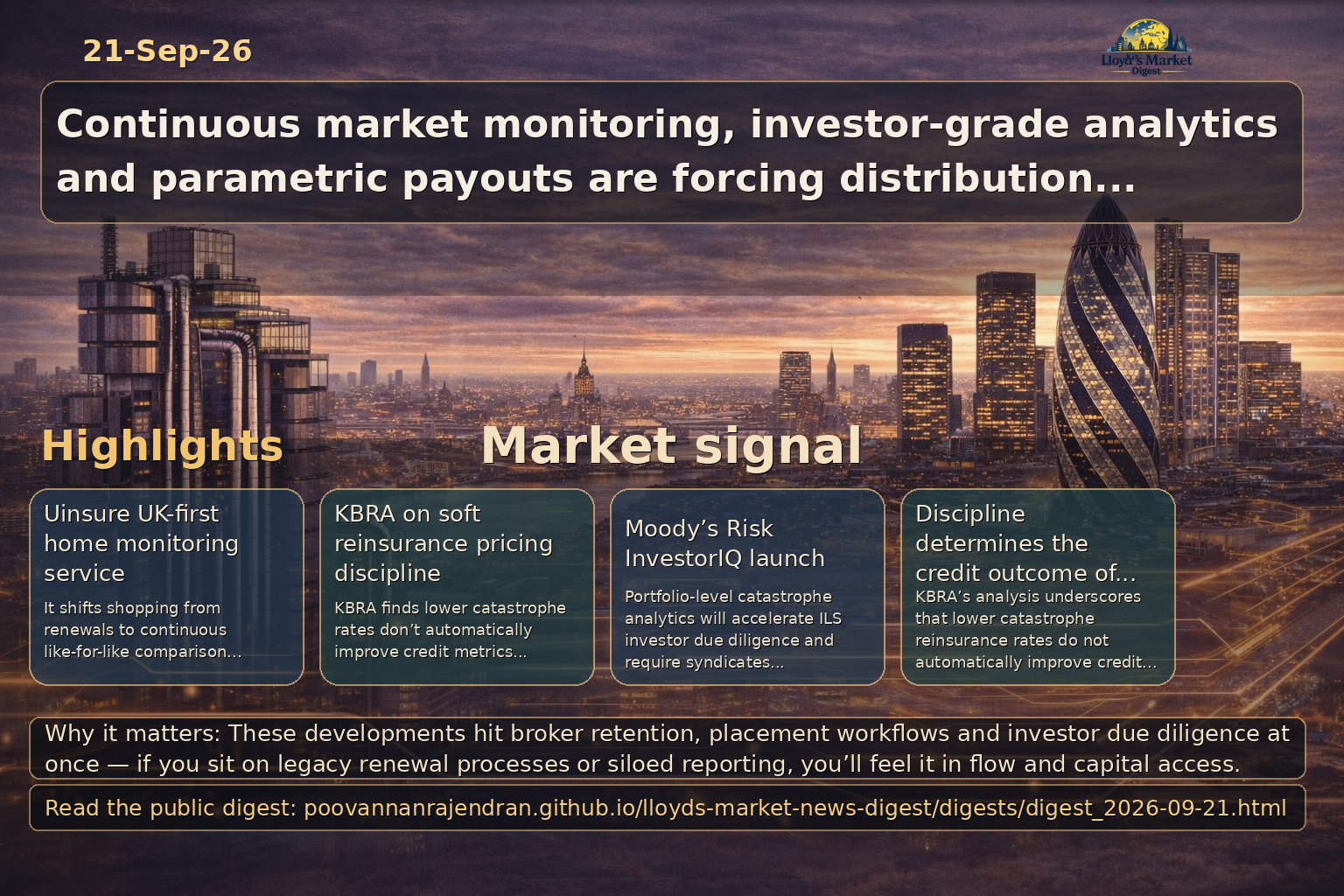
Why it matters: KBRA’s analysis underscores that lower catastrophe reinsurance rates do not automatically improve credit metrics — management choices and disciplined use of savings drive credit outcomes. For Lloyd’s syndicates, global specialty carriers and brokers, this reinforces the need to avoid growth-at-all-costs placements and to structure protections that sustain solvency through market cycles.
- Syndicates: preserve underwriting standards and loss-absorbing capacity rather than accelerating growth purely to exploit cheaper reinsurance.
- Brokers: advise cedents to reinvest pricing savings into stronger terms, higher attachment points or additional per-risk protections to maintain credit quality.
- Placement platforms: highlight contract wording, aggregate limits and collateralisation features that protect clients when market conditions deterior.
Source: insurancejournal.com
Why it matters: The Top 20 Agency Partnerships report signals where retail distribution is concentrating and which networks will control access to mid-market and specialty risks — a direct input to syndicate distribution strategies, global broker alignment, and placement platform prioritization.
- Targeted distribution: Identify top agency networks that aggregate industry segments aligned with your syndicate appetites and create bespoke binding authority or delegated underwriting pilots to secure flow.
- Platform integration: Prioritize API and EDI integration with networks that are investing in AI and technology to ensure faster evidence capture, streamlined submissions, and reduced time to bind for specialty lines.
- Strategic capital response: Monitor PE-backed acquisitions for potential MGA formation; establish pre-emptive reinsurance and capacity frameworks or JV offers to convert new MGAs into stable, institutionalised capacity partners.
Source: insurancejournal.com
Why it matters: Regional market intelligence in Insurance Journal West highlights localized cost inflation, regulatory complaints and service expectations that influence underwriting loss assumptions, rate adequacy and broker-servicing models — critical for Lloyd's market players placing U.S.-exposed specialty risks.
- Loss-cost and rate calibration: Incorporate regional medical and claims cost trends into syndicate loss picks and territorial rate cards, particularly for U.S. casualty and professional lines placements.
- Broker servicing and complaint mitigation: Equip Lloyd's brokers and placement platforms with standardized client-service SLAs and dispute-handling protocols to reduce regulatory and consumer friction in jurisdictions reporting elevated complaints.
- Localized data feeds: Establish partnerships with regional agency clusters and data providers to ingest granular cost and utilization metrics, improving appetite mapping and enabling real-time triage of submissions on global placement platforms.
Source: insurancetimes.co.uk
Why it matters: The Uinsure monitoring service demonstrates a shift from renewal-centric shopping to continuous market comparison and instant execution. For the Lloyd’s and global specialty ecosystem—where products are often bespoke and broker-led—the development highlights the commercial imperative to deliver comparable digital experiences: accurate cover equivalence, rapid binding via placement platforms, and data transparency that preserves broker value while reducing customer frictions.
- Brokers must formalise continuous-market monitoring and retention workflows: integrate comparable quote engines and client-alert capabilities into broker management systems to protect margins and client relationships.
- Syndicates and underwriters should prioritise product standardisation where feasible and accelerate API-based quoting/binding capabilities to enable instant placement through distributor platforms while maintaining underwriting controls.
- Placement platforms should develop like-for-like cover-matching logic, secure API connectivity to insurer panels, and instant-bind plumbing to capture flows; craft partnership models with brokers and syndicates to avoid direct-to-consumer disintermediation
Source: reinsurancene.ws
Why it matters: Archive material provides historical context on market discipline, capacity cycles and recurring issues that shape syndicate and broker strategy at Lloyd's and across global specialty markets.
- Source of longitudinal insight on cost-of-capital debates and underwriting discipline that inform current capital allocation and pricing decisions.
- Useful for brokers and placement platforms to track how previous loss events and market responses influenced terms, capacity and appetite over time.
- Helps executives calibrate strategic positioning by comparing past market corrections and distribution responses against current exposures and product innovation.
Source: reinsurancene.ws
Why it matters: PCRIC’s USD 2m parametric payout highlights the operational value of parametric sovereign cover and platform-enabled premium financing—directly relevant to syndicates, brokers and placement platforms expanding into sovereign and climate-adaptive solutions.
- Demonstrates the speed and transparency of parametric triggers, reinforcing sovereign and donor-funded use cases for rapid liquidity after events.
- Shows how premium financing via platforms such as the GSSP and actors like WFP reduces upfront capital barriers, widening distribution opportunities for specialty underwriters and Lloyd's syndicates.
- Signals demand for integrated placement workflows and data-driven trigger design; brokers and platforms should prioritise technical integration and standards for parametric products.
Source: reinsurancene.ws
Why it matters: Marsh Re’s analysis of Iberian windstorm losses underscores regional concentration risk and multi-peril exposures that affect pricing, capacity allocation and reinsurance programme design across Lloyd's syndicates and global specialty carriers.
- Concentration of losses in Spain and Portugal may prompt syndicates and reinsurers to reassess exposure aggregation, retrocession buying and limits to single-country concentrations.
- Brokers and placement platforms must enhance spatial analytics and multi-peril modelling to support clients and underwriters in stressed geographies.
- Expect renewed focus on underwriting differentiation, narrower terms or price adjustments for coastal and Iberian portfolios; syndicates should review capital efficiency and diversification strategies.
Source: reinsurancene.ws
Why it matters: SiriusPoint’s appointment of a CHRO with significant HR transformation and integration experience signals that global specialty underwriters are prioritising people, culture and post-merger integration—factors that materially affect underwriting performance and broker relationships.
- A CHRO with M&A and integration experience indicates focus on operationalising acquisitions and embedding consistent underwriting and distribution behaviours across the group.
- Impacts broker engagement and distribution if organisational changes alter service models, authority levels or underwriting speed; brokers should monitor for shifts in delegated authority and appetite.
- For syndicates and placement platforms, strengthened HR capability supports talent retention critical to maintaining technical underwriting capacity and executing complex placements.
Source: artemis.bm
Why it matters: Marsh Securities’ call for ILS investor flexibility is a direct response to abundant capacity and greater competition from traditional reinsurers. Brokers, placement platforms and syndicates must adapt structures and distribution strategies to align with changing investor appetites or risk losing ILS as a long‑term source of capital.
- Brokers: prioritise structuring creative, non‑standard covers and multi-peril solutions attractive to flexible ILS mandates.
- Placement platforms: develop product workflows and documentation for hybrid transactions (ILS + traditional capacity) to speed execution and broaden investor interest.
- Syndicates/insurers: differentiate on underwriting insight and tailored risk transfer to attract capital that can no longer rely on narrow, name-peril mandates.
Source: artemis.bm
Why it matters: Swiss Re’s emphasis on risk awareness, prevention and transfer signals that reinsurers expect cedents and brokers to embed mitigation and engineering into placement discussions. For Lloyd’s and global specialty markets, advisory-led placement and prevention services will become a competitive advantage in pricing and client retention.
- Brokers: expand advisory services to include loss prevention, supply‑chain resilience and parametric solutions tied to mitigation outcomes.
- Syndicates: incorporate engineering and prevention metrics into underwriting criteria to improve loss ratios and support differentiated pricing.
- Placement platforms: offer data capture and KPIs for prevention measures to demonstrate client risk reduction and justify premium/structure benefits.
Source: artemis.bm
Why it matters: Moody’s Risk InvestorIQ delivers portfolio‑level catastrophe analytics tailored to ILS investors and risk professionals, enabling more rigorous transaction evaluation. Lloyd’s syndicates, brokers and placement platforms should expect faster investor due diligence demands and greater granularity in modelling and reporting requirements.
- Syndicates and ILS originators: use advanced analytics outputs to substantiate attachment points, expected loss and diversification benefits when marketing deals.
- Brokers: leverage analytics to compare structures objectively for cedents and to accelerate investor engagement with standardized metrics.
- Placement platforms: integrate analytics APIs and reporting templates to streamline investor vetting, reduce time-to-market and enhance transparency.
Source: artemis.bm
Why it matters: Ledger’s work highlights that casualty sidecars and asset-driven structures shift focus onto the asset portfolio as a second source of risk. For Lloyd’s syndicates, brokers and placement platforms, this elevates collateral governance, asset-liability alignment and counterparty transparency as core underwriting and placement issues.
- Syndicates: enforce rigorous asset selection, stress-testing and governance standards for collateral held against casualty exposures.
- Brokers: include asset-risk due diligence and liquidity covenants in sidecar term-sheets to protect cedents and investors during market stress.
- Placement platforms: build standardized disclosure and monitoring tools for asset portfolios to support faster syndication and investor confidence.
Source: newsnow.co.uk
Why it matters: Austin-focused news flags operational, political and social developments in a major US tech and service hub — relevant to cyber, D&O, liability, and event-driven business interruption exposures underwritten by global specialty syndicates.
- Monitor incident escalation (e.g., law enforcement shootings) for contagion into protest risk, civil unrest endorsements and contingency planning for onshore insureds.
- Reassess capacity and pricing for technology sector risks and D&O exposures given Austin’s concentration of scale-ups and headquarters relocations.
- Ensure brokers and clients have clear business interruption and event cancellation wording; consider targeted surveillance feeds to capture rapid developments in US state-level hotspots.
Source: newsnow.co.uk
Why it matters: A CDU political feed provides early insight into German policy shifts that can affect EU regulatory frameworks, sanctions policy, trade, and systemic risk considerations relevant to financial lines and political risk underwriting.
- Track CDU policy signals for changes to trade, sanctions or insurance regulation that could impact cross-border placements and compliance obligations for Lloyd’s brokers.
- Evaluate potential ripple effects on German corporates’ supply chains and export credit exposures to adjust political risk and credit insurance appetite.
- Coordinate with compliance and government affairs teams to pre-position evidence-based responses for clients and underwriters as legislative changes emerge.
Source: newsnow.co.uk
Why it matters: East Sussex coverage highlights coastal, tourism and infrastructure developments that inform property, flood, and liability exposures for regional portfolios and for syndicates writing UK SME and leisure business.
- Update flood and coastal erosion exposure models and underwriting lobbies for syndicates with UK coastal books, prioritising areas with recent infrastructure or defence works.
- Engage retail brokers operating in the county to validate policy limits and resilience measures for hospitality and small commercial clients.
- Assess aggregation risk for portfolios with concentration in tourist-driven economies; recommend reinsurance or facultative protection where appropriate.
Source: newsnow.co.uk
Why it matters: Brighton news contains local commercial and consumer developments — insolvencies, public safety incidents and events — that impact travel, liability, professional lines and SME underwriting at the Lloyd’s and broker level.
- Flag insolvency trends (e.g., language school failures) as drivers of potential claims for travel, tuition and associated business interruption placements.
- Advise syndicates to review local event insurance wordings and exposures around seasonal tourism peaks and coastal leisure liabilities.
- Use Brighton operational indicators to validate city-level exposure assessments and inform broker conversations on terms for SME and hospitality clients.
Source: newsnow.co.uk
Why it matters: Riyadh coverage is a proxy for large-scale infrastructure and sovereign-driven project activity under Vision 2030 — central to political risk, construction, energy and marine underwriting strategies for syndicates and brokers targeting MENA expansion.
- Monitor major development project timelines and regulatory shifts to align construction and political risk capacity with anticipated placement volumes.
- Consider strategic partnerships with regional brokers and onshore capacity providers to accelerate placements while managing local risk-transfer constraints.
- Stress-test contract wordings and security packages for large infrastructure accounts against evolving project finance models and government contractual guarantees.