Source: fca.org.uk
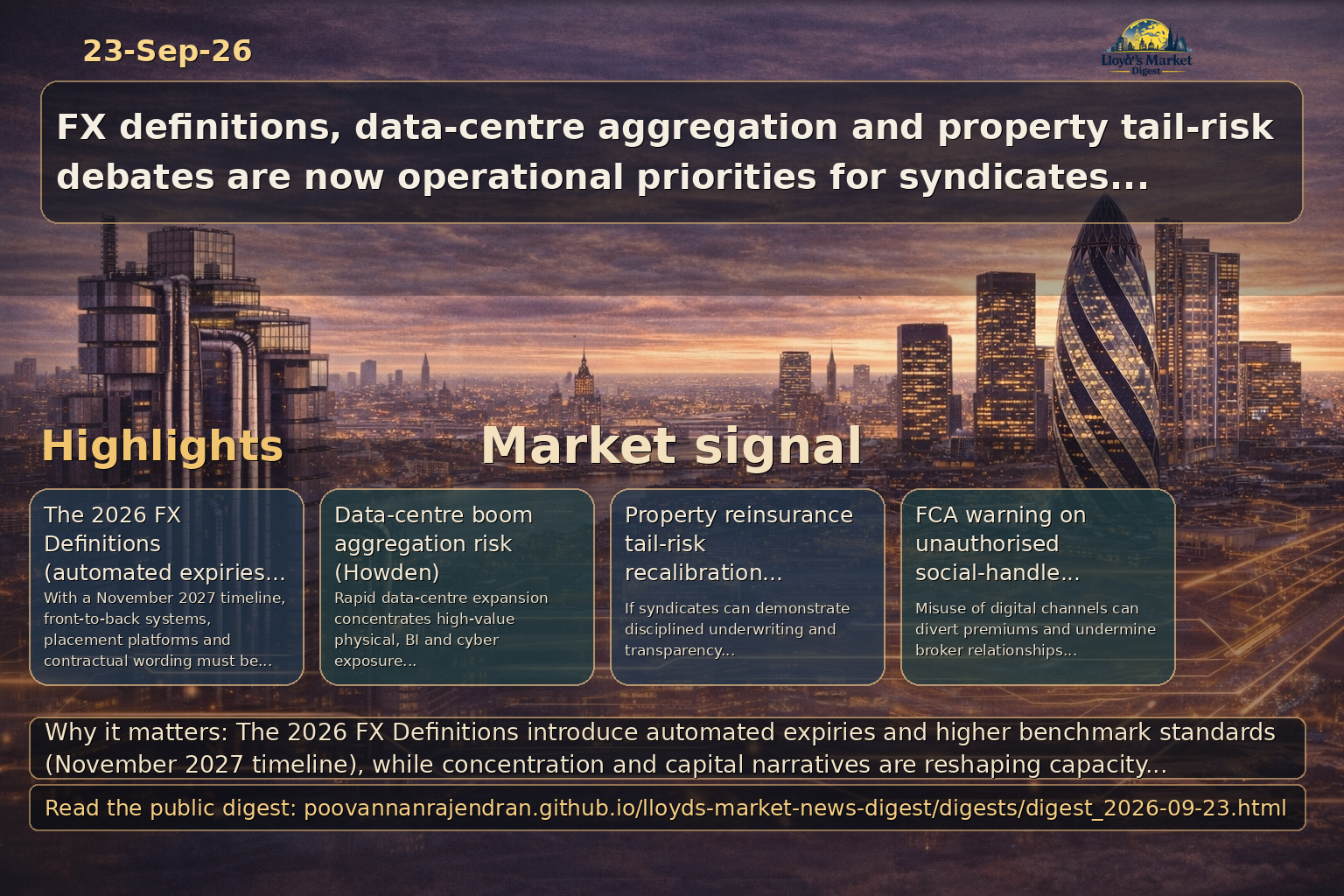
Why it matters: The FCA warning about an unauthorised operator using a social-handle style identity signals active misuse of digital channels to promote financial services. Such actors can target cedants or retail clients, undermine broker relationships and create exposure for syndicates if premiums or information are diverted through illegitimate routes.
- Immediate review of incoming premium routing and beneficiary verification processes to prevent diversion or interception of funds.
- Enhance digital-brand and social-handle monitoring by brokers, syndicates and placement platforms to detect impersonation and fraudulent profiles early.
- Update client-facing guidance and broker onboarding scripts to remind clients about authorised channels, FSCS/FOS protections and how to verify counterparties.
Source: fca.org.uk
Why it matters: A second FCA notice involving a social-media style account reinforces a pattern of unauthorised promotion through non-traditional channels. Specialty markets that rely on niche distribution and digital placement can be targeted by bad actors posing as brokers or capital partners, increasing settlement, claims and compliance risk.
- Mandate multi-factor verification for new broker contacts sourced via social or informal channels before accepting instructions or sharing privileged placement data.
- Require placement platforms to implement identity attestation and provenance checks for new users, and to flag accounts originating from unverified social profiles.
- Coordinate with market brokers and Lloyd’s market-wide intelligence hubs to circulate indicators of compromise and suspected impersonator profiles.
Source: fca.org.uk
Why it matters: The FCA warning naming a corporate-sounding entity underscores risks from unauthorised firms that may present as legitimate corporates or SPACs. For Lloyd’s and global specialty participants, perceived corporate legitimacy can facilitate fraudulent approaches to capital providers, reinsurance counterparties and distribution partners if standard verification is bypassed.
- Integrate corporate registry, beneficial ownership and sanction-screening checks into counterparty onboarding workflows for investors, MGAs and new syndicate partners.
- Require legal and compliance sign-off on any counterparties purporting to provide capital or strategic services before negotiations progress; consider escrowed payment mechanisms for initial transactions.
- Document and escalate suspected corporate impersonation to the FCA and market associations, and communicate verified lists of acceptable counterparties to front-office teams.
Source: fca.org.uk
Why it matters: The FCA’s red-flag guidance on debt advice and high-pressure sales is relevant to insurers and brokers because client financial distress and aggressive distribution tactics increase conduct risk, mis-selling exposure and potential downstream claims disputes. Syndicates and brokers must be alert to signs that clients under financial pressure are being steered into unsuitable solutions or paying intermediaries outside authorised channels.
- Train brokers and claims teams to recognise pressure-sales indicators and to escalate cases where clients in distress may have been directed to fee-based or unauthorised intermediaries.
- Review credit-control and premium-finance interactions to ensure customers are not coerced into rapid decisions; enforce cooling-off periods and clear disclosures on fees and protections.
- Collaborate with consumer-protection and compliance functions to publish clear guidance for cedants and insureds on accessing authorised advice, and to report suspected misconduct to the FCA.
Source: artemis.bm
Why it matters: The Agecroft view recalibrates the perception of tail risk in property reinsurance and signals an actionable opportunity for Lloyd's syndicates, specialty brokers and placement platforms to attract institutional capital by demonstrating disciplined underwriting, portfolio construction and transparency.
- Syndicate strategy: Lloyd’s syndicates can leverage the narrative to design collateralised or partially collateralised structures (quota shares, sidecars, multi-year programs) that translate managed tail exposure into investable propositions for ILS and pension funds, but must evidence robust accumulation management and contract clarity.
- Broker and distribution action: Brokers should refocus investor messaging from headline catastrophe risk to portfolio-level loss distributions, diversification benefits and underwriting controls; this requires enhanced due diligence, bespoke structuring and use of placement platforms to reach institutional channels efficiently.
- Placement platform and analytics requirement: Platforms and ILS managers must invest in transparent analytics, scenario and stress testing, and standardized reporting to validate tail-risk management claims — enabling faster capital deployment, supporting pricing discipline and reducing basis and model-risk concerns.
Source: businessinsurance.com
Why it matters: The rapid expansion of data centres concentrates high-value physical, business‑interruption and cyber exposures that challenge aggregation limits, model accuracy and capacity allocation for specialty syndicates and broker placements.
- Immediate aggregation review: run granular scenario and probabilistic aggregation models across regions and providers to identify accumulation and reinsurance attachment vulnerabilities.
- Endorsements and wording clarity: update policies to address hybrid perils (physical fire, BI from supply chain disruption, silent cyber) and specify sublimits/aggregation clauses to limit unintended exposure.
- Platform and broker controls: require real‑time telemetry and exposure feeds from placement platforms to enable dynamic capacity management, delegated underwriting oversight and more precise facultative/reinsurance buys.
Source: businessinsurance.com
Why it matters: Rising disaster costs are driving a sustained upward repricing in property lines, compressing capacity for peak perils and forcing syndicates and brokers to prioritise portfolio profitability over growth.
- Reprice and segment: implement differentiated pricing by peril, construction and mitigation features; enforce stricter terms in high‑frequency/high‑severity zones.
- Underwriting appetite and capital allocation: redeploy capital away from poorly modelled aggregations; increase attachment points and carve‑outs where catastrophe exposure is latent.
- Broker-client playbook: equip brokers and placement platforms with scenario outputs and comparative quotes to manage client expectations at renewal and to secure diversified capacity across markets.
Source: businessinsurance.com
Why it matters: Large regulatory fines for misuse of location data highlight growing regulatory and third‑party liability risks for technology firms, amplifying demand for robust cyber/privacy products and precise coverage language from specialty carriers and syndicates.
- Clarify cover for regulatory fines and penalties: review wordings to address jurisdictions where fines are insurable and ensure transparent exclusions for deliberate criminal acts.
- Systemic aggregation monitoring: evaluate how regulatory enforcement across multiple insureds could create correlated loss events and adjust capacity/reinsurance accordingly.
- Underwriting data governance: require enhanced due diligence on data handling, retention policies and vendor controls as standard underwriting criteria; use platform data to standardise risk scoring.
Source: businessinsurance.com
Why it matters: Potential consolidation in trade‑credit (CNP talks with Coface) signals shifting capacity dynamics and counterparty concentration that will affect pricing, reinsurance structures and broker distribution strategies in global specialty markets.
- Counterparty and concentration stress tests: conduct portfolio-level analyses to quantify exposure shifts and recovery risk following potential M&A among major capacity providers.
- Reassess reinsurance and retro structures: anticipate changes in cedant profiles and adjust reinsurance programs for liquidity and collateral impacts post‑consolidation.
- Distribution and placement impact: brokers and platforms should map potential changes in appetite and ensure alternative panel arrangements and streamlined onboarding to maintain client continuity.
Source: businessinsurance.com
Why it matters: A people-profile item that signals visibility of senior market figures and the importance of public leadership presence for broker-syndicate relationships and market intelligence.
- Maintains industry visibility that supports broker and syndicate relationship management — useful for client introductions and strategic partnerships.
- Helps placement platforms and wholesale brokers map senior-level influence when prioritising distribution strategies into Lloyd’s syndicates.
- Flag for talent trackers: public profiles assist C-suite planning around succession, retention and external recruitment in competitive specialty markets.
Source: globalreinsurance.com
Why it matters: Appointing Louise Radford as active underwriter gives HDI senior underwriting control as it advances the launch of Lloyd's Syndicate 2029; her financial‑lines background provides continuity and shapes initial appetite, broker engagement and portfolio construction.
- Immediate market signal: expect early communications on Syndicate 2029 appetite and delegated authority/placement processes — brokers and capacity providers should seek face‑time to secure line and clarify submission standards.
- Underwriting governance: Radford’s dual role with financial lines suggests integrated portfolio management — review risk aggregation, reinsurance strategy and pricing for financial‑lines exposures ahead of syndicate underwriting cycles.
- Placement implications: syndicate launch will change capacity dynamics; brokers should model expected impact on available capacity, negotiate early terms, and incorporate syndicate participation into multi‑market strategies.
Source: globalreinsurance.com
Why it matters: Ollie Waterman’s appointment as regional director secures claims leadership for McLarens in the Middle East at a pivotal time for regional growth and complex loss handling; continuity of leadership mitigates client and broker disruption as the incumbent retires.
- Operational continuity: insurers and brokers should confirm SLAs, escalation paths and local adjuster panels to ensure stable claims handling during the leadership transition.
- Market positioning: leverage Waterman’s London and Dubai experience to refine major-loss response plans and to align global claims resources with regional market needs, supporting placement confidence.
- Broker collaboration: brokers should coordinate with McLarens on pre‑loss protocols, catastrophe planning and loss‑reserve communication to preserve client service levels and underwriting relationships.
Source: globalreinsurance.com
Why it matters: Phillip Esser’s elevation to CEO of Aon Reinsurance Solutions Germany signals a governance reset to accelerate client growth across treaty, facultative and analytics — with Volker Wahl as executive chairman delivering continuity during the transition.
- Strategic engagement: reinsurers and cedants should meet Aon’s new leadership to confirm strategic priorities, analytics capabilities and how treaty/facultative workflow changes will affect placement timing and data requirements.
- Product and distribution review: expect emphasis on analytics‑driven solutions; syndicates and brokers should evaluate product design, attachment structures and reporting standards aligned to Aon’s coordinated approach.
- Relationship governance: monitor potential shifts in account team structures, mandate holders and market routing practices as the new leadership implements its coordination and growth agenda.
Source: insurancejournal.com
Why it matters: Agency networks are reshaping distribution channels and exploring MGAs and PE-enabled consolidation, which affects how brokers and syndicates access and price retail-originated specialty risks in the Lloyd's ecosystem.
- Networks expanding into MGAs and facilitated agency sales create new feeder channels for specialty business — syndicates should reassess appetite and delegated authority frameworks.
- Private equity involvement raises valuation and exit dynamics for distribution partners; brokers must strengthen counterparty due diligence on capital and governance.
- Network-driven tech platforms will change submission quality and speed — syndicates and platforms should align API/standards to capture upstream data and preserve lead-market integrity.
Source: insurancejournal.com
Why it matters: Agricultural innovation (deeper-rooted crops) alters crop vulnerability and carbon sequestration potential, influencing parametric products, pricing models and long-term exposure profiles for specialty agricultural lines and syndicate portfolios.
- Crop physiology changes reduce or shift per-acre peril exposures; underwriters should monitor R&D adoption rates and recalibrate yield volatility assumptions.
- Opportunity to design new parametric or resilience-linked products that reward climate-adaptive farming practices and carbon-storage outcomes.
- Reinsurers and syndicates need scenario analysis on portfolio correlation changes as agritech adoption could compress or concentrate losses across regions.
Source: insurancejournal.com
Why it matters: Litigation by Atlantic Coast Life and downgrades spotlight how regulatory action and solvency disputes can rapidly curtail capacity and trigger rating-driven collateral demands relevant to syndicates, run-off portfolios and reinsurers.
- Regulatory rehabilitation moves and public litigation can precipitate ratings downgrades, accelerating reinsurance commutation requests and collateral calls — brokers must stress-test counterparty concentration.
- Syndicates and lead markets should incorporate enhanced covenant and transparency clauses when accepting capacity from entities with regulatory scrutiny.
- Claims about bad-faith regulatory action increase litigation risk in contested insolvencies — legal and reserving teams should prepare for protracted disputes and disclosure demands.
Source: insurancejournal.com
Why it matters: Rapid intensification of Hurricane Polo off Mexico’s Pacific coast underscores acute property and business-interruption exposure in resort and coastal portfolios — a near-term test for catastrophe modeling, treaty response and capacity deployment.
- Surge in regional claims will pressure facultative and treaty placements; syndicates should validate aggregation models for Pacific coastal exposures and adjust ILS/tranche strategies.
- Placement platforms and brokers must mobilize streamlined workflows to bind emergency covers and manage surge capacity across lead and follow markets.
- Underwriters should review policy wordings around offshore cores, flood and storm surge triggers, and prepare PRA-style catastrophe response playbooks for Latin American exposures.
Source: insurancejournal.com
Why it matters: Victoria's data center siting and renewable-energy mandates create new underwriting parameters for tech-property portfolios, altering occupier risk, business-interruption profiles and environmental risk assessments for specialty insurers.
- Mandated on-site renewables and recycled-water cooling change operational risk profiles and CAPEX disclosures — underwriters must refine engineering surveys and warranty schedules.
- Prohibition in residential zones affects concentration risk and location exposure analyses; global syndicates should update aggregation models for APAC data-center portfolios.
- Insurers can develop tailored products linking renewable performance guarantees to premium or capacity adjustments, creating cross-selling opportunities with cyber and contingent BI covers.
Source: newsnow.co.uk
Why it matters: Great British Energy signals large, government-led renewable project pipelines that will drive focused demand for specialty insurance across construction, operational performance and political/credit lines — presenting both underwriting opportunities and concentration-risk challenges for Lloyd’s syndicates, global brokers and placement platforms.
- Accelerated demand for project-specific coverages: Contractors’ All Risks, Delay in Start-Up (DSU), mechanical breakdown and performance guarantees will scale; syndicates should prepare modular policy forms and rate frameworks for repeatable placement.
- Counterparty and political risk profile changes: Sovereign backing reduces counterparty default risk but elevates regulatory and political event exposures — specialty underwriters and reinsurers must recalibrate appetite and consider capacity limits to avoid accumulation.
- Placement and distribution implications: Brokers and electronic placement platforms will need to enable multi-syndicate programme structures, long-duration capacity commitments and streamlined data workflows to support efficient placement and servicing of large, state-led renewable portfolios.
Source: risk.net
Why it matters: Automated expiry and raised benchmark standards change how FX-related exposures are processed across the Lloyd’s chain — from broker placement through syndicate settlement and reinsurer recoveries. The article underscores the need to modernise system interfaces, contractual language and data sourcing to avoid settlement mismatches, margin surprises and pricing distortions.
- Systems & workflow: Upgrade front-to-back systems and placement platforms to ingest machine-readable expiry events and automated exercise outcomes; redesign reconciliation and exception workflows to eliminate manual cutovers across brokers, managing agents and service providers.
- Benchmark & data governance: Adopt independently governed, transparent benchmark feeds with published fallbacks and SLAs; embed vendor governance into procurement and model-validation processes to protect pricing and reserve accuracy.
- Risk transfer & commercial remediation: Review premium, claims and reinsurance wording to reference the new definitions; reassess hedging strategies, collateral triggers and liquidity buffers to address potential mismatches during the transition period.