Source: fca.org.uk
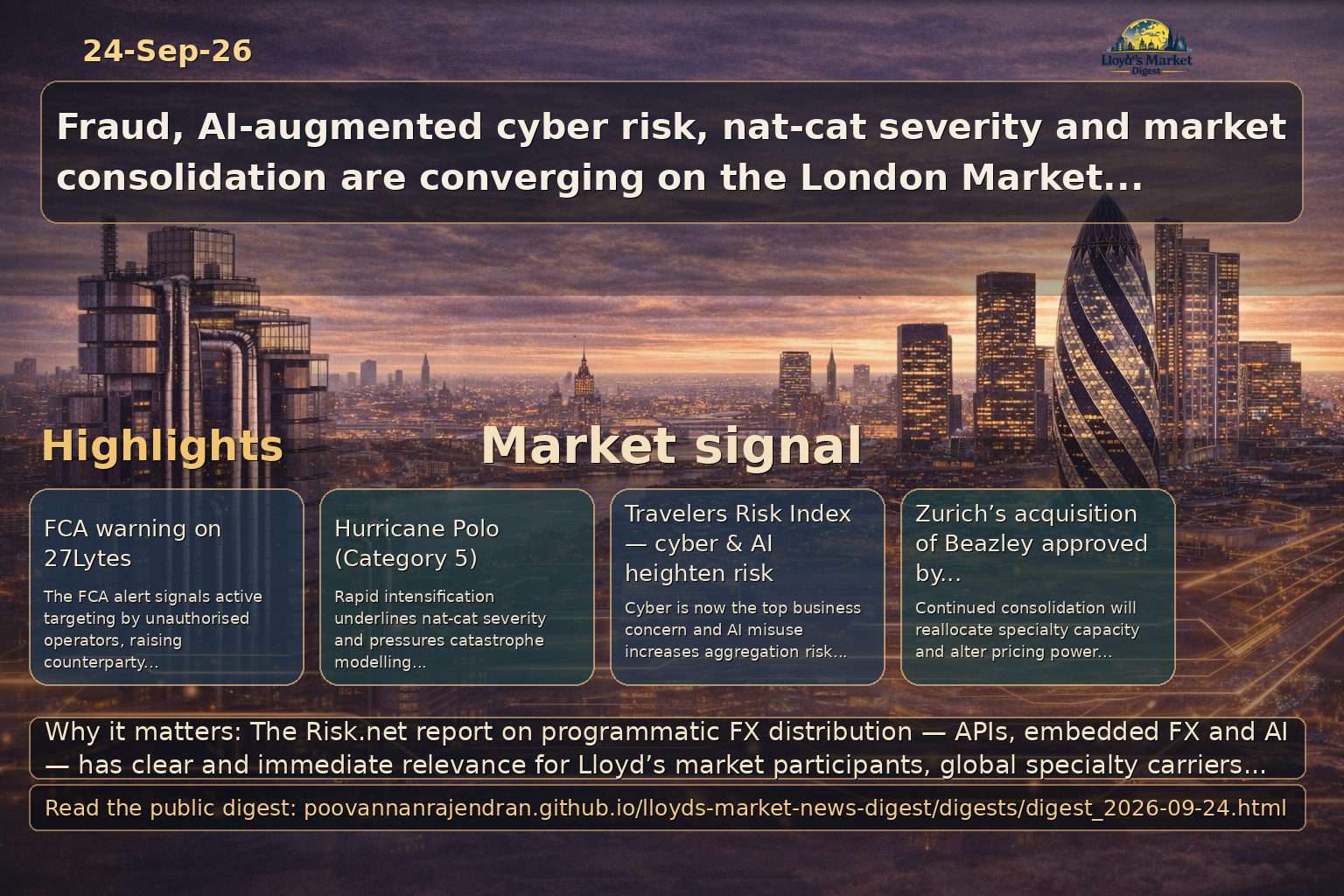
Why it matters: FCA warning on 27Lytes signals active targeting by unauthorised operators; such firms create counterparty, reputational and customer-protection risk for brokers, syndicates and placement platforms that may be referenced in distribution chains or used to launder premiums.
- Revalidate onboarding and counterparties against the FCA Warning List and Lloyd's registers; implement automated checks for unauthorised entity flags in broker workflows.
- Tighten payment beneficiary verification to prevent premium diversion to unauthorised firms; require dual verification for new payees and high-value transactions.
- Issue targeted guidance to broker networks and MGAs on identifying impostor firms and documenting due diligence to protect syndicate exposures and client funds.
Source: fca.org.uk
Why it matters: The SBank Business Online Banking warning highlights risks from spoofed banking platforms and unauthorised payment channels — a material threat to premium finance flows, trust accounts and platform settlement processes used across specialty placements.
- Mandate independent verification of banking details for premium and claims settlements; adopt call-back or confirmation-of-beneficiary processes for new or amended accounts.
- Integrate bank-account screening and domain/URL reputation checks into broker and platform onboarding to detect spoofed online banking sites.
- Collaborate with clearing banks and payment service providers to establish rapid-alert mechanisms and remediation steps for suspected fraudulent banking channels.
Source: fca.org.uk
Why it matters: MyCarSecurity.com warning illustrates the prevalence of unauthorised product providers that can attach to motor and ancillary insurance products; such schemes can create claims fraud, operational disputes and consumer-protection breaches for carriers and intermediaries.
- Require evidence of authorisation or contractual indemnities from third-party product vendors before allowing integration into policy offerings and endorsements.
- Embed vendor validation checkpoints in broker portals and placement platforms to prevent listing of unauthorised add-ons and services.
- Communicate to distribution partners the consequences for customers of dealing with unauthorised firms and reinforce complaint and claims verification protocols.
Source: fca.org.uk
Why it matters: FCA analysis showing large numbers of closed suspected money-mule accounts underscores the scale of money-laundering risk impacting UK financial flows; for the specialty insurance market this translates into heightened AML obligations around premium collection, commission payments and intermediary networks.
- Increase transaction-monitoring sensitivity for premium and commission flows, with scenario rules to detect rapid account chaining, atypical routing and multiple small-value transfers.
- Strengthen ongoing KYC and beneficial-owner checks for brokers, MGAs and platform users; require periodic revalidation and risk-scored access controls for placement systems.
- Coordinate intelligence-sharing across syndicates, brokers and banks and escalate suspicious activity reports promptly to meet regulatory expectations and reduce laundering channels.
Source: fca.org.uk
Why it matters: The FCA chief executive's speech advocating movement from experimentation to adoption for tokenisation and on-chain infrastructure is a strategic signal: Lloyd's market participants and platform providers must plan for interoperability, regulatory engagement and operational resilience as digital market structures evolve.
- Assess selective pilots for tokenised assets, smart-contract driven placements and straight-through processing to quantify efficiency gains and legal/regulatory gaps.
- Develop market-level interoperability and governance standards for placement platforms, ensuring auditability, custody arrangements and fall-back procedures are defined.
- Engage proactively with the FCA, TheCityUK and industry bodies to shape agile regulation, sandbox activity and resilience requirements that enable adoption without compromising market integrity.
Source: businessinsurance.com
Why it matters: The $1.3B insured loss from Prairie storms underscores ongoing nat-cat volatility and aggregate exposure risk for regional and global specialty markets, driving reinsurance cost and stricter accumulation controls for Lloyd’s syndicates.
- Syndicates must review catastrophe models, accumulation limits and retro programs against recent loss experience to protect capital and maintain adequate pricing.
- Brokers need to advise clients on gap exposure, aggregate deductibles and resilience investments to limit future claims frequency/severity.
- Placement platforms should enable rapid post-loss analytics and support reinsurance renewals with updated exposure feeds and loss-cost assumptions.
Source: businessinsurance.com
Why it matters: Iran signaling to reopen the Strait of Hormuz materially affects marine, cargo and energy exposures that Lloyd’s syndicates and specialty brokers underwrite — increasing war/geo-risk considerations and marine premium opportunity but raising accumulation concerns.
- Underwriters should reassess exclusions, war risk loadings and reinsurance attachments for crude/oil-tanker and offshore energy portfolios.
- Brokers must proactively clarify client voyage routes, cargo values and contractual indemnities to secure capacity with clear geo-political risk disclosures.
- Placement platforms and syndicates need scenario modelling for route concentration and supply-chain knock-on effects to manage accumulation and price accordingly.
Source: businessinsurance.com
Why it matters: Rising food insecurity across Asia elevates political instability and supply-chain disruption risk, driving demand for trade credit, political-risk and parametric agribusiness solutions sold by global specialty brokers and Lloyd’s syndicates.
- Syndicates should re-evaluate agricultural exposures, commodity-linked policies and parametric triggers tied to weather and yield indices.
- Brokers need to expand political-risk and trade-credit placement capabilities for clients exposed to regional food-security shocks.
- Placement platforms should incorporate granular supply-chain and commodity-price data to support rapid structuring and pricing of contingent solutions.
Source: businessinsurance.com
Why it matters: Court approval of Zurich’s acquisition of Beazley signals continued consolidation in global specialty insurance, with implications for capacity distribution, pricing power and competitive dynamics between traditional carriers and Lloyd’s syndicates.
- Potential reallocation of market capacity could pressure syndicates to differentiate on niche underwriting expertise and service speed.
- Brokers must re-map counterparty risk and capacity sources, anticipating single-carrier concentration in certain lines.
- Placement platforms and integration teams should prepare for portfolio transfers, harmonisation of policy wordings and systems migration to minimise placement friction.
Source: businessinsurance.com
Why it matters: Leadership profiles such as Emily Schaffer highlight the importance of individual underwriter and broker relationships that drive specialty placements and client retention across Lloyd’s and global markets.
- Executive moves can shift account stewardship—brokers should maintain institutional relationship maps to avoid placement disruption.
- Syndicates should prioritise continuity planning for key underwriters to protect large or complex accounts.
- Placement platforms must capture relationship metadata and contact hierarchies to preserve institutional knowledge during personnel changes.
Source: globalreinsurance.com
Why it matters: Munich Re Specialty entering the Italian primary specialty market reshapes continental distribution of specialty capacity, creating direct competition for Lloyd’s syndicates and independent European carriers while signalling reinsurer-led vertical integration of underwriting and distribution.
- Syndicate impact: Expect pressure on Lloyd’s and local carriers to defend market share in construction, engineering, property and surety—review appetite and differentiated product offerings.
- Broker strategy: Brokers should reassess panels and placement routing in Italy, emphasizing local underwriting agility, service levels and speed to market to retain mid-market SME flow.
- Placement platforms: Platforms and digital placement providers must prepare for increased connectivity and API-based integrations as Munich Re Specialty seeks streamlined distribution with brokers and MGAs.
Source: globalreinsurance.com
Why it matters: Senior appointments at Pine Walk reflect consolidation at scale across MGA ecosystems and a move to institutionalise underwriting governance and cross-sell synergies—material for capacity providers, Lloyd’s syndicates and brokers managing increasing platform-based distribution.
- Platform governance: Syndicates and capital partners should scrutinise Pine Walk’s operational controls and underwriting oversight as the platform scales toward larger premium volumes and MGA aggregation.
- Broker and wholesaler implications: Brokers must map Pine Walk-affiliated MGAs within their distribution strategies to optimise access to capacity and streamline delegated authority placements.
- Strategic partnerships: Placement platforms and Lloyd’s managing agents should evaluate collaboration or competitive responses, including co-syndication or technology-led connectivity, to capture redistributed flow.
Source: globalreinsurance.com
Why it matters: Sean Dalton’s election as IUMI president signals consolidated marine leadership from a major reinsurer, likely accelerating harmonisation of marine underwriting standards and influencing syndicate risk appetite, broking practices and global specialty rate adequacy.
- Underwriting trajectory: Lloyd’s marine syndicates should anticipate emphasis on disciplined underwriting metrics and shared best practices that could tighten appetite or repricing in selected marine lines.
- Broker engagement: Marine brokers need proactive dialogue with underwriters to align on acceptable risk profiles, documentation standards and data requirements driven by renewed industry guidance.
- Global specialty coordination: Placement platforms and global brokers should prepare for coordinated initiatives on loss prevention, cargo/war wording consistency and data-sharing frameworks championed by IUMI leadership.
Source: insurancejournal.com
Why it matters: PE-backed insurer IPO postponements signal stressed public markets and potential liquidity timing risk for portfolio companies that may affect reinsurance buying patterns, broker commissions and counterparty stability in placement chains.
- Possible reduced access to public capital increases reliance on reinsurance and facultative capacity — syndicates should stress-test retro and quota-share arrangements.
- Brokers should reassess exposure to PE-owned insureds for credit and concentration risk; consider requiring stronger collateral or revised payment terms.
- Placement platforms must monitor client solvency signals and adapt workflows for contingent capital scenarios to preserve slip flow and limit settlement friction.
Source: insurancejournal.com
Why it matters: Travelers’ Risk Index that ranks cyber as top concern — amplified by AI misuse — highlights accelerating demand for cyber capacity and advisory services; the gap between AI adoption and governance creates insurer moral hazard and aggregation risk.
- Underwriters should tighten aggregation models for AI-augmented cyber attacks and expand scenario testing for rapid, automated breach campaigns.
- Brokers and placement platforms need to elevate pre-bind cyber hygiene and AI governance disclosures to reduce information asymmetry and pricing volatility.
- Syndicates should diversify cyber risk appetite across industry verticals and consider layered capacity solutions (parametric triggers, cyber pooled covers) to manage accumulation.
Source: insurancejournal.com
Why it matters: Category 5 Hurricane Polo underlines ongoing nat-cat severity and the potential for surprise intensification events — relevant to global catastrophe modelling, retrocession purchasing and capital allocation for exposed syndicates and carriers.
- Urgently review model inland intensity assumptions and windstorm vulnerability factors for exposures in the eastern Pacific corridor and related supply-chain concentrations.
- Reassess catastrophe attachment points and retrocession programmes; expect increased demand for short-tail reinsurance and surge capacity in peak peril seasons.
- Brokers should pre-position clients and placement platforms should ensure nat-cat aggregation analytics and real-time exposure feeds are integrated into slips.
Source: insurancejournal.com
Why it matters: Opaque UAE entities linked to Radiant World highlight counterparty credit, conduit risk and the need for stringent KYC/AML checks for commodity and trade-credit exposures that can propagate to global specialty placements.
- Syndicates and Lloyd’s managing agents must tighten collateral/counterparty limits and enhance verification of obligors in freezone jurisdictions.
- Brokers should increase due diligence for trade-credit and commodity clients, applying enhanced documentation and escrow arrangements where necessary.
- Placement platforms need integration with enhanced sanctions and beneficial-ownership screening to prevent slips referencing high-risk counterparties.
Source: insurancejournal.com
Why it matters: Aon’s reinsurance leadership and governance changes in Germany reflect continued broker consolidation and localization of reinsurance advisory — a structural shift affecting treaty negotiation dynamics and client access to capacity in Europe.
- Syndicates should engage directly with restructured broker teams to secure placement pipelines and adjust approach to program renewals in Germany.
- Lloyd’s and managing agents must monitor broker governance changes for potential shifts in market leverage and fee models affecting placement economics.
- Placement platforms should adapt connectivity and reporting to reflect new broker regional structures and align with centralized reinsurance solutions.
Source: reinsurancene.ws
Why it matters: LIIBA research underscores that, within the London market, trust and human judgement remain core to successful placements even as digital trading matures — a strategic directional signal for syndicates and placement platforms.
- Implication: Digital platforms must preserve broker-underwriter relationship workflows rather than attempt wholesale disintermediation.
- Action: Brokers and syndicates should design hybrid processes that combine algorithmic risk scoring with expert override and relationship governance.
- Market impact: Platforms that enable transparent, auditable human decision points will attract London market volume and sustain broker-syndicate trust.
Source: reinsurancene.ws
Why it matters: Marsh Re signals a maturing cyber reinsurance market with more tailored structures, directly affecting global specialty capacity, accumulation management and broker program design.
- Implication: One-size-fits-all cyber treaties are giving way to bespoke coverage and blended property/cyber solutions to address accumulation risk.
- Action: Brokers must enhance cyber aggregation analytics and propose multi-layered capacity structures aligned to clients’ changing exposure profiles.
- Market impact: Syndicates and reinsurers offering flexible, specialty cyber solutions will capture displacement of commoditised capacity.
Source: reinsurancene.ws
Why it matters: Travelers’ survey demonstrates that AI-related cyber risk is rising on corporate agendas, creating underwriting, claims and risk engineering implications for specialty lines and Lloyd’s syndicates.
- Implication: AI integration into operations materially changes loss profiles and underwriting metrics across insureds of all sizes.
- Action: Underwriters and brokers should require standardized disclosures of AI use, controls and incident response as part of submission practices.
- Market impact: Carriers that rapidly develop clear AI-related underwriting frameworks and risk mitigation services will differentiate in capacity allocation.
Source: reinsurancene.ws
Why it matters: Mosaic’s HALO platform exemplifies how AI-enabled underwriting platforms can extend specialty capacity to SMEs and streamline broker-syndicate workflows in the London and global specialty market.
- Implication: Faster, data-driven SME placements will expand addressable specialty premium pools but require integration with broker systems.
- Action: Brokers should pilot APIs and data standards to route submissions into platform workflows and preserve advisory value.
- Market impact: Syndicates offering delegated authority via compliant digital platforms can scale profitable SME specialty books efficiently.
Source: reinsurancene.ws
Why it matters: The Reinsurance News archive provides precedent and historical context that remain valuable for underwriting cycles, pricing discipline and regulatory responses relevant to Lloyd’s and global specialty participants.
- Implication: Historical insight helps underwriters and executives calibrate market discipline during capacity swings and product innovation periods.
- Action: Executive teams should maintain structured access to archival analysis to inform stress-testing and strategic planning.
- Market impact: Firms that institutionalise historical intelligence into underwriting playbooks will better navigate episodic market volatility.
Source: artemis.bm
Why it matters: Verisk’s indication that US property claim severity and reconstruction costs are rising — even absent an increase in designated catastrophe events — is a direct stress on loss ratios, reserve adequacy and reinsurance programme effectiveness for Lloyd’s syndicates and global specialty carriers. Brokers and placement platforms must factor escalating per‑claim costs into pricing, aggregate modelling and capital allocation.
- Reprice and refine underwriting appetites by geography and vulnerability class to reflect concentrated high‑cost claims and reconstruction inflation.
- Revisit reinsurance attachment points, aggregate layers and reinstatement provisions — increasing likelihood of narrower attachments or higher limits purchase to control volatility.
- Enhance claims analytics and post‑event reconstruction monitoring; mandate portfolio segmentation and model runs on per‑claim severity to inform placement and reserve strategy.
Source: artemis.bm
Why it matters: The rapid intensification of Hurricane Polo and focus on the IBRD CAR Mexico 2024 (Pacific) parametric bond highlights operational and basis‑risk considerations for placement of Mexican Pacific exposure. Syndicates, brokers and placement platforms must manage parametric trigger design, real‑time monitoring and investor communications during active storm periods.
- Assess parametric trigger sensitivity and basis risk on relevant programs; ensure policy/contract alignment with parametric payouts and client expectations.
- Activate real‑time modelling and accumulation checks for Mexican Pacific exposures; adjust short‑term retro and facultative placements where track uncertainty increases peak exposure.
- Engage ILS investors and placement platforms pre‑event to clarify payout mechanics and investor reporting, preserving market confidence and liquidity for subsequent placements.
Source: artemis.bm
Why it matters: HCMA’s assessment that casualty sidecars are evolving into a third pillar reflects structural change in capacity sourcing for casualty exposures. With traditional reinsurance constrained, Lloyd’s syndicates, global carriers and brokers should consider sidecars as scalable, contractible capital that complements treaty and balance‑sheet options.
- Develop standardized sidecar documentation, governance and reporting templates to accelerate sponsor onboarding and investor due diligence.
- Prioritise casualty-sidecar structuring where long‑tail volatility is well‑understood; use sidecars to segregate targeted lines and preserve balance‑sheet capacity.
- Leverage placement platforms and ILS desks to market sidecars to institutional investors, creating diversified capital sources and improving pricing competition.
Source: artemis.bm
Why it matters: CatIQ’s upward revision of Montreal West Island flood insured losses to CAD 442m signals that regional flood events are producing larger-than-anticipated industry losses. This affects treaty pricing, accumulation management and flood coverage design for UK and international markets writing Canadian exposure.
- Reassess Canadian flood exposures and accumulation limits, updating retro and treaty placements to reflect higher event severity and frequency trends.
- Incorporate updated loss estimates into pricing models and renewal negotiations; consider differentiated terms for zones with repeated flooding loss patterns.
- Advise clients on mitigation, underwriting requirements and policy wording (e.g., sublimits, deductibles, flood mapping) to reduce future loss amplification.
Source: artemis.bm
Why it matters: Twelve Securis’s observation of demand for blended liquid catastrophe‑bond and private ILS portfolios signals investor appetite for products that balance liquidity and bespoke exposures. This trend impacts syndicates and brokers as a source of flexible capital and requires placement platforms to offer integrated execution and reporting capabilities.
- Consider blended ILS strategies as part of multi‑year capital planning to diversify reinsurance alternatives and manage liquidity needs across the underwriting cycle.
- Require placement platforms to support combined issuance, secondary trading transparency and unified investor reporting to attract broader institutional demand.
- Align syndicate and client risk transfer design with blended offerings — use liquid cat bonds for indexed hedges and private ILS for tailored, basis‑reduction exposures.
Source: newsnow.co.uk
Why it matters: Gosport’s proximity to Portsmouth Dockyard and maritime infrastructure concentrates exposures relevant to Lloyd’s specialty lines: hull & machinery, ports & terminals, shipyard liability, defence supply chains and coastal property. Even local human-interest reporting can signal clusters that affect portfolio aggregation, war/terror risk appetite, and placement strategy.
- Concentration & aggregation review: instruct brokers and syndicates to map policies and exposures within the Portsmouth–Gosport corridor to quantify aggregation risk across hull, cargo, ports, and property classes; incorporate stress-testing for major marine incidents and port disruption.
- War/terrorism and specialist wording review: given naval assets and defence supply chains, update wordings and underwriting criteria for war, terrorism, sanctions and subcontractor risks; coordinate with placement platforms to secure specialist capacity where standard cover is constrained.
- Commercial and placement actions: task brokers to develop bespoke multi-line packages (shipyard liability, builders’ risk, specialised marine liability, business interruption) and use digital placement platforms to syndicate capacity efficiently while informing syndicate lead decisions on underwriting appetite.
Source: risk.net
Why it matters: Programmatic FX via APIs and embedded FX directly affects cross-border premium flows, broker commission remittances and multi-currency claim payments — all core to Lloyd’s syndicates, global specialty insurers and placement platforms. For C-suite and consultants, understanding these mechanics is essential to protect underwriting margin and ensure seamless placement workflows.
- Embed FX pricing and settlement options into placement platforms to reduce currency slippage and improve quote-to-bind speed across multi-jurisdictional placements.
- Integrate FX execution APIs with treasury and actuarial systems so syndicates can model FX impact on premium adequacy and reinsurance recoverables in real time.
- Establish strategic partnerships or RFPs for FX-as-a-service providers, prioritizing audit trails, regulatory compliance and SLA commitments for settlement latency.