Source: globalreinsurance.com
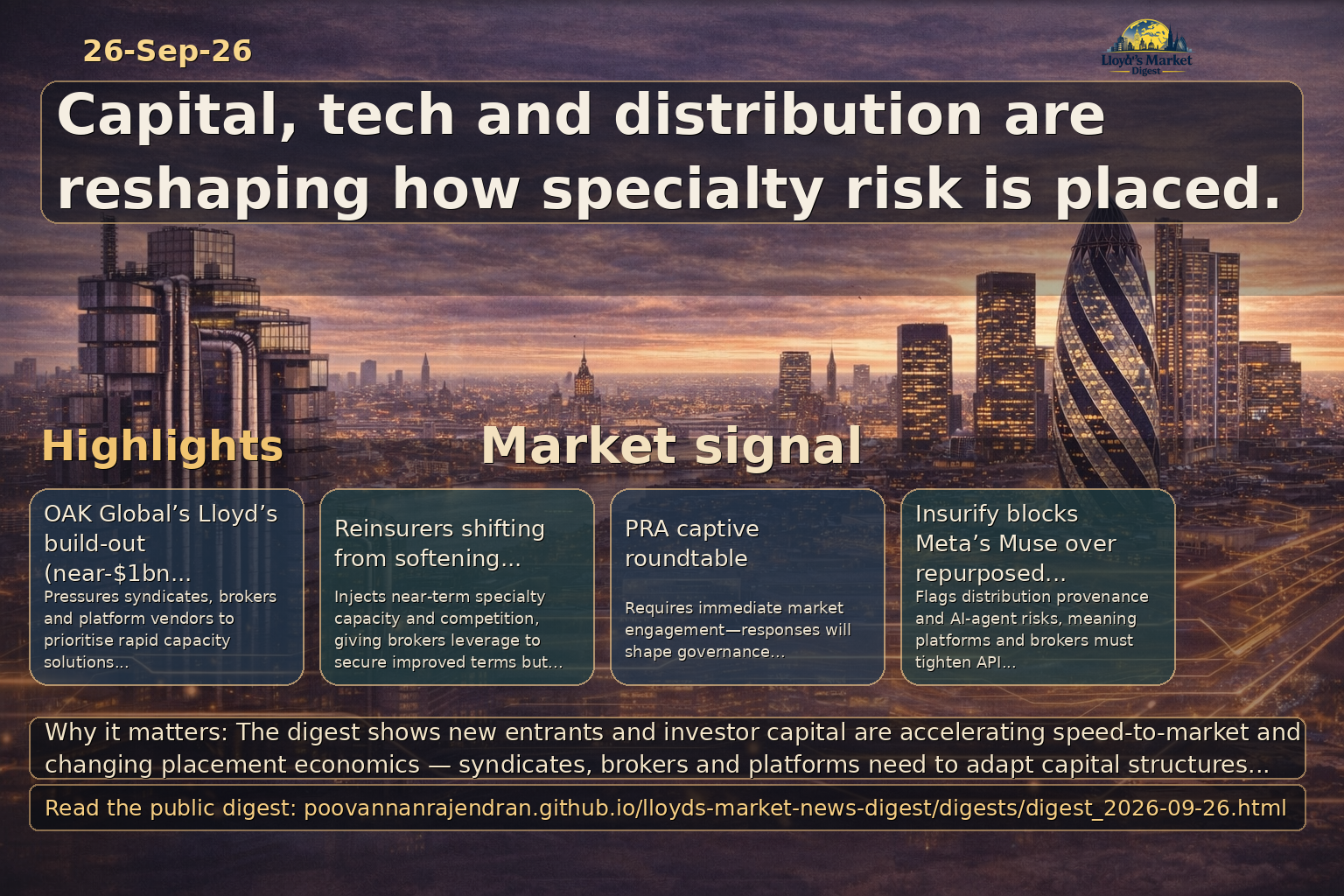
Why it matters: The OAK Global example demonstrates how a new entrant can rapidly scale in the Lloyd's ecosystem by combining hybrid capital, focused product strategy (including retro), and modern placement technology—creating lessons for syndicates, brokers and platform providers on competition, collaboration and capability investment.
- Market entry strategy: Confirms Lloyd's attractiveness for rapid re/insurance scale-up; syndicates and managing agents should assess competitive implications and consider tailored capacity or strategic partnerships to retain broker-led flow.
- Capital and product innovation: Hybrid capital and a move into retro highlight demand for flexible capital solutions; capital providers and sponsors must design products that support speed-to-market and secondary market optimisation.
- Placement and relationships: Greenfield technology plus active relationship-building with brokers is central to OAK's model; brokers and platform vendors should prioritise integration, straight-through workflows and data-sharing to win mandates and support client retention.
Source: businessinsurance.com
Why it matters: An M&A move that proceeded despite regulatory pushback highlights persistent strategic consolidation among brokers/insurers and regulatory risk that can affect cross-border distribution and syndicate access.
- Signals continued consolidation appetite—syndicates and Lloyd’s managing counterparty concentration and distribution risk
- Regulatory rejection and persistence increase due diligence burdens for placement platforms and brokers on cross‑border deals
- Implication for syndicate capacity: potential shifts in distribution arrangements if the acquisition succeeds or fails
Source: insurancejournal.com
Why it matters: The NAIC’s defense signals continued modernization of state-led oversight, particularly around private investments and rating challenges, which will affect capital treatment, reporting burdens, and solvency assessments relevant to Lloyd’s syndicates and global specialty carriers.
- Capital and asset strategy: Syndicates and carrier boards should stress-test portfolios for potential reclassification or regulatory challenge to private-credit valuations and assess capital impact scenarios.
- Data and reporting: Expect increased demand for granular disclosures to meet evolving NAIC reporting; brokers and placement platforms must be prepared to furnish investment-linked risk narratives on capacity providers.
- Pricing and capacity consequences: Heightened transparency and potential capital charges on private assets may pressure rate adequacy in specialty lines and shift reinsurance and retrocession dynamics.
Source: bankofengland.co.uk
Why it matters: This PRA roundtable on CP11/26 matters because a tailored captive regime will directly affect how clients, brokers, syndicates and placement platforms structure, place and administer captive-backed solutions for specialty risks. The discussion clarifies immediate regulatory expectations and the areas where market response during the consultation can materially influence final rules, with consequences for capital, governance, reporting and distribution models across the Lloyd's ecosystem.
- Immediate engagement imperative: Consultation closes 14 October 2026 — Lloyd's participants, brokers and placement platforms must prioritise coordinated consultation responses to shape scope, thresholds and transitional arrangements that will affect product design and client advisory obligations.
- Operational and compliance impact: Proposed governance, reporting and capital standards will raise due-diligence, onboarding and ongoing monitoring requirements for brokers, MGAs and placement platforms handling captive placements, necessitating amendments to placement protocols and third‑party service agreements.
- Strategic market consequences: Final rules could alter demand for captive solutions (either expanding or constraining their use), shifting risk flows between captives, syndicates and reinsurers; Lloyd's syndicates and specialty carriers should assess pricing, capacity allocation and product delivery models in anticipation of changed captive economics and cross‑border placement limitations.
Source: businessinsurance.com
Why it matters: Reinsurers reallocating appetite from softening property-cat markets into specialty lines creates capacity opportunities and competitive pressure for Lloyd’s syndicates and wholesale brokers.
- Creates near-term upward pressure on specialty capacity and competition among Lloyd’s syndicates for differentiated risk
- Brokers should reassess placement strategy—specialty submissions may secure more favourable terms as reinsurers re-enter these niches
- Placement platforms must support more complex specialty data and risk modelling to capture inflows from reinsurer appetite shifts
Source: businessinsurance.com
Why it matters: A Labuan re targeting Asian growth underscores the rise of regional reinsurers offering alternatives to Lloyd’s and Bermuda capacity, affecting placement decisions and pricing leverage in Asia-Pacific.
- Heightens regional capacity competition—Lloyd’s syndicates must demonstrate value (claims service, treaty terms) to retain placements
- Brokers gain more options for treaty and facultative placements but must navigate regulatory and capital differences
- Placement platforms servicing APAC need to integrate regional counterparties and compliance checks to facilitate efficient placement
Source: businessinsurance.com
Why it matters: Broker Miller’s Malaysia launch exemplifies brokers’ on‑the‑ground expansion in Asia, shifting origination toward local markets and prompting syndicates and platforms to deepen regional connectivity.
- Local broker footholds accelerate flow of Asia-originated specialty risks to global markets, requiring Lloyd’s syndicates to adapt underwriting footprints
- Strengthens argument for real‑time placement platform integration between local broker desks and international capacity providers
- Talent and market access advantages for onshore brokers increase competition for market share in specialty classes
Source: businessinsurance.com
Why it matters: Industry editorial leadership and profiles influence market narratives and stakeholder perceptions—important for market positioning, thought leadership and syndicate reputational management.
- Editorial voices shape broker/syndicate reputation and market sentiment—important for communications strategy around new products and capital moves
- Consistent engagement with trade media supports market intelligence and competitive benchmarking for C-suite decision making
- Placement platforms and distribution partners benefit from visibility in industry discourse when marketing capability or new facilities
Source: insurancejournal.com
Why it matters: Insurify's decision to block Meta's Muse highlights distribution risk from autonomous AI agents that can repurpose quote data without context—an issue that affects brokers, placement platforms, and syndicates as they seek to preserve accurate risk representation and compliance.
- Distribution controls: Mandate API contractual terms and metadata standards with comparison sites and platforms to preserve contextual underwriting attributes and prevent fragmented quotes.
- Placement platform implications: Require provenance and versioning on quoted terms so brokers and syndicates can trace and validate the source and context of any automated recommendation.
- Regulatory and reputational risk: Anticipate consumer-protection scrutiny and provide audit trails demonstrating how AI-mediated interactions maintain disclosure and suitability for insureds.
Source: insurancejournal.com
Why it matters: State Farm’s substantial claims hiring program reflects industry-wide emphasis on claims capability and speed-to-service — a material consideration for specialty underwriters and brokers when assessing carrier selection, retention, and delegated authority relationships.
- Claims as a competitive differentiator: Underwriters and syndicates should quantify claims response and digital capability when offering facilities or binding authorities to maintain market share.
- Delegated authority and MGA oversight: Brokers must evaluate MGAs’ claims infrastructure and SLAs as part of placement due diligence to avoid service and reputational gaps.
- Operational investment signals: Increased carrier investment in claims tech and staffing could alter loss-adjustment expectations and influence pricing negotiations across specialty lines.
Source: insurancejournal.com
Why it matters: IAG’s near-A$2.8bn settlement tied to Greensill underscores enduring tail exposures from trade-credit and structured finance products — a reminder for syndicates and brokers to reassess reserving, contract wording and retrocession protections.
- Reserve and exposure review: Syndicates writing trade-credit and supply-chain products should conduct targeted reserve adequacy reviews and scenario testing for latent counterparty failures.
- Policy design and wording: Brokers must revisit policy triggers, exclusions and aggregation language for structured-credit exposures to prevent ambiguous cover interpretations.
- Reinsurance and capacity allocation: Expect reinsurers to demand stricter underwriting evidence and potentially re-price or limit appetite for long-tail credit products, affecting placements and capacity availability.
Source: insurancetimes.co.uk
Why it matters: Evidence that specialist commercial lines are bucking soft-market premium declines and that eTrading/platform capability is becoming a competitive differentiator for brokers and underwriters.
- Specialist commercial lines recorded growth while broader premiums fell, indicating niching is a viable margin-protection strategy for brokers and syndicates.
- eTrading and platform distribution were cited as competitive advantages — accelerating placement speed and data-driven pricing for specialty risks.
- Recommendation: syndicates and brokers should prioritise niche underwriting expertise, data capability and platform integrations to sustain income in a soft market.
Source: insurancetimes.co.uk
Why it matters: A High Court-sanctioned Part VII transfer demonstrates active legacy portfolio consolidation into UK carriers, with immediate implications for capital, claims continuity and reinsurance arrangements.
- Part VII transfer of Soteria and DLUK business into Darag Insurance UK centralises legacy exposures and alters balance-sheet and reinsurance dynamics for capacity providers.
- Legacy consolidation creates deal flow and advisory opportunities for brokers and specialist acquirers focused on tail-risk management.
- Operationally, underwriters and brokers must coordinate communications, claims transition plans and reinsurance pass-throughs to preserve policyholder continuity.
Source: insurancetimes.co.uk
Why it matters: Lloyd's market research flags a leadership trust gap on AI transformation, signalling a governance and culture risk that could hinder productive adoption across syndicates and brokers.
- Survey data points to immature AI governance and employee concerns over experimentation scope, data use and ethical guardrails.
- Without clear policies and transparent oversight, AI initiatives risk eroding staff and client trust — impeding efficiency gains in underwriting and operations.
- Action: establish cross-market AI governance frameworks, clear experimentation protocols and communication plans to align leadership, compliance and talent.
Source: insurancetimes.co.uk
Why it matters: Targeted senior appointments at Lloyd's and UK operations indicate an active effort to bolster specialist underwriting and distribution capabilities.
- Promotions and hires — including leadership focused on private equity, business development and specific syndicate underwriting roles — strengthen sector-specific capacity.
- These moves reflect market recognition that talent aligned to specialist lines and institutional clients is critical to win business in price-pressured markets.
- Recommendation: boards should map critical specialty skills, accelerate retention schemes and align hiring to strategic product growth areas.
Source: insurancetimes.co.uk
Why it matters: Broker consolidation and strategic sales activity are recalibrating distribution channels, with direct consequences for syndicate placement strategies and platform partnerships.
- Acquisitions of specialist brokers (eg. tech/life sciences) expand distribution reach into higher-margin segments valued by Lloyd's syndicates.
- Strategic review or sale processes at owner-level (eg. private equity portfolio companies) can change long-term distribution relationships and commercial terms.
- Syndicates and placement platforms should proactively reassess broker relationships and commercial models to secure preferred access to consolidating specialist intermediaries.
Source: artemis.bm
Why it matters: AM Best's report and Artemis data point to materially tighter loss multiples (H1 2026 average 2.5x versus 3.28x a year earlier), illustrating that abundant investor capital is compressing pricing while rising expected losses threaten returns—creating a higher bar for investors and placing pressure on syndicate and broker strategies for the January 1 renewals.
- Refine underwriting and portfolio limits: Syndicate and carrier leaders should tighten selection criteria, increase attachment or reduce limits on marginal business, and run accelerated stress tests to quantify the impact of lower cat-bond premia on overall return-on-capital.
- Rework placement and structuring strategies: Brokers and placement platforms must prepare layered, hybrid solutions (parametric elements, collateralized retrocession, bespoke triggers) and sharpen model/data transparency to attract selective investors while preserving client protection at renewals.
- Engage investors proactively and optimize capital mix: Capital managers and platform heads should present clear risk-adjusted return cases, demonstrate enhanced loss-model governance, and consider diversifying between traditional reinsurance and alternative capital to maintain capacity without eroding underwriting economics.
Source: newsnow.co.uk
Why it matters: High-level political statements and UN interventions increase the probability of rapid escalation in regional disputes. For Lloyd’s syndicates and specialty markets, this affects political violence, trade disruption, energy and marine exposures, as well as sanctions/compliance considerations during placement.
- Immediate need to re-assess country and aggregation exposures for political violence and war risks across marine, energy and property portfolios.
- Brokers must verify sanctions/know-your-customer implications for counterparties and adjust placement structures where sanction risk rises.
- Syndicates should review policy triggers and exclusions (eg. political violence, non-appearance, contingent BI) and prepare contingency reinsurance capacity planning.
Source: newsnow.co.uk
Why it matters: Search returns indicating no content expose a risk in reliance on single-source media feeds. For placement platforms and brokers, data gaps generate false negatives in incident detection and can undermine timely underwriting decisions and claims-response readiness.
- Validate and diversify news and incident feeds used for pre-bind and continuous monitoring to avoid missing emerging risks relevant to underwriting or claims.
- Implement manual escalation protocols for high-sensitivity topics to offset automated-feed blind spots on delegated authority and binding authorities.
- Use data-quality KPIs when contracting third-party monitoring services and incorporate SLA penalties for missed alerts affecting active placements.
Source: newsnow.co.uk
Why it matters: National Trust and heritage-property news signal concentrations of specialty property exposures — high values, public access, and event activity — which carry tailored underwriting and pricing considerations for syndicates and delegated facilities.
- Review coverage terms for heritage assets including agreed-value, reinstatement, archaeological salvage and bespoke reinstatement cost assessments.
- Consider tailored public-liability and event cancellation/BIsolutions for open-access attractions, with capacity allocation and enhanced risk-mitigation requirements.
- Brokers should seek specialist panels and reinsurers for catastrophe and climate-driven perils impacting heritage assets and negotiate parametric or hybrid solutions where appropriate.
Source: newsnow.co.uk
Why it matters: Local borough reporting of incidents (eg. ordnance discovery, public events) highlights operational interruption and liability exposures for event organisers and property owners — issues directly relevant to sports, event and municipal liability lines underwritten by the specialty market.
- Assess contingent business interruption and event-cancellation exposures for scheduled local events; ensure policy wordings clearly define triggers and indemnity periods.
- Reinforce underwriting for legacy risks (ordnance, infrastructure defects) and co-ordinate with local authorities on remediation responsibilities and notification protocols.
- Placement platforms and brokers should document event safety protocols and insurer requirements as pre-conditions to binding, reducing post-loss disputes over coverage scope.
Source: risk.net
Why it matters: The framework provides a practical way to isolate and hedge forward volatility exposures without relying on dynamic-model assumptions, which is relevant for Lloyd's syndicates managing tail and cross-maturity risks and for brokers advising structured solutions. It can improve pricing transparency, reduce model risk in ORSA/ICA discussions, and enable placement platforms to offer more standardized volatility overlays to corporate and reinsurance clients.
- Hedging and capital: Enables zero‑cost static hedges that isolate forward volatility, potentially reducing economic capital and smoothing earnings volatility for syndicates with liquid hedging instruments.
- Product and placement innovation: Brokers and placement platforms can use extracted forward curves to design option-based or structured overlays for specialty lines (e.g., commodity, FX-linked, or volatility-triggered cyber/parametric products).
- Operational and market constraints: Practical benefits depend on option market depth, transaction costs, clearing margin and basis/counterparty risk—necessitating pilots with market-makers and selective deployment for liquid risk exposures.