Source: artemis.bm
Why it matters: The creation of a dedicated Head of Capital Solutions at a major insurer signals strategic emphasis on integrated capital deployment, which will influence how brokers and syndicates structure transactions and compete for placements.
- Insurer capital‑solutions teams will offer bespoke risk transfer and partnership structures that can either compete with or complement ILS capacity—syndicates should map potential collaboration pathways.
- Brokers and placement platforms must position as advisers and execution venues for insurer‑led capital solutions, offering data, structuring expertise and distribution to institutional partners.
- Syndicates should reassess retrocession, quota‑share and side‑car arrangements to align with new insurer capital offerings and ensure clear economic incentives for distribution partners.
Source: reinsurancene.ws
Why it matters: Berenberg reporting reflects an industry pivot: with property catastrophe rates softening, reinsurers are prioritising growth in high‑barrier specialty lines where underwriting skill and margin preservation are achievable.
- Market signal: property cat capacity is increasingly price‑sensitive; specialty lines offer higher entry barriers and differentiated margins.
- Implication for Lloyd’s/syndicates: reallocate capital and underwriting talent toward niche specialty products and avoid indiscriminate rate competition in commoditised cat layers.
- Recommended action: brokers should package differentiated specialty propositions to syndicates; managing agents must reassess appetites and pricing models to protect profitability.
Source: reinsurancene.ws
Why it matters: Moody’s highlights the enduring nat‑cat protection gap — over half of losses uninsured — underscoring limits of private market capacity and the need for combined government, parametric and insurer solutions.
- Strategic reality: insurers and reinsurers cannot close the protection gap alone; layered approaches including government backstops are required.
- Implication for brokers/syndicates: demand for hybrid structures (parametric, index, blended solutions) will rise; syndicates should evaluate capacity for these instruments.
- Recommended action: develop standardised parametric products and public‑private frameworks; engage sovereign and development stakeholders to design scalable programmes.
Source: reinsurancene.ws
Why it matters: Fitch’s survey expecting further but moderate property cat rate declines at 2027 renewals confirms a softening trajectory while capital buffers remain strong — a backdrop of margin compression rather than a disorderly market crash.
- Market trend: continued price downward pressure, with many participants forecasting single‑digit declines at next renewals.
- Implication for Lloyd’s: sustained discipline required to prevent margin erosion; cost and capital efficiency become competitive differentiators.
- Recommended action: accelerate portfolio optimisation, expense rationalisation and growth into specialty or value‑add services to offset cat rate pressure.
Source: reinsurancene.ws
Why it matters: Beazley’s expansion of affirmative AI cyber cover and industry‑first endorsements (e.g., AI Voluntary Shutdown) exemplifies rapid product innovation addressing both external AI‑enabled attacks and internal AI operational risks.
- Product insight: affirmative AI coverage is maturing as carriers clarify exposures and carve‑outs, enabling clearer capacity allocation.
- Implication for brokers/syndicates: differentiating through tailored AI endorsements will be a market lever for specialty cyber appetite.
- Recommended action: brokers should articulate detailed exposure profiles to underwriters; Lloyd’s syndicates should evaluate endorsing similar language and pricing for emerging AI risks.
Source: reinsurancene.ws
Why it matters: CLARA’s Agentic Intelligence platform is an example of AI being embedded in end‑to‑end claims workflows for complex casualty and workers’ comp, promising efficiency gains and altered claims economics.
- Operational impact: AI agents on claims can reduce cycle times and loss adjustment expenses, affecting underwriting economics for casualty lines.
- Implication for syndicates and MGAs: integration of such platforms can be a competitive advantage for claims performance and pricing leverage.
- Recommended action: evaluate pilot integrations with claims AI vendors, define governance and oversight, and assess impacts on reserving and loss adjuster sourcing.
Source: artemis.bm
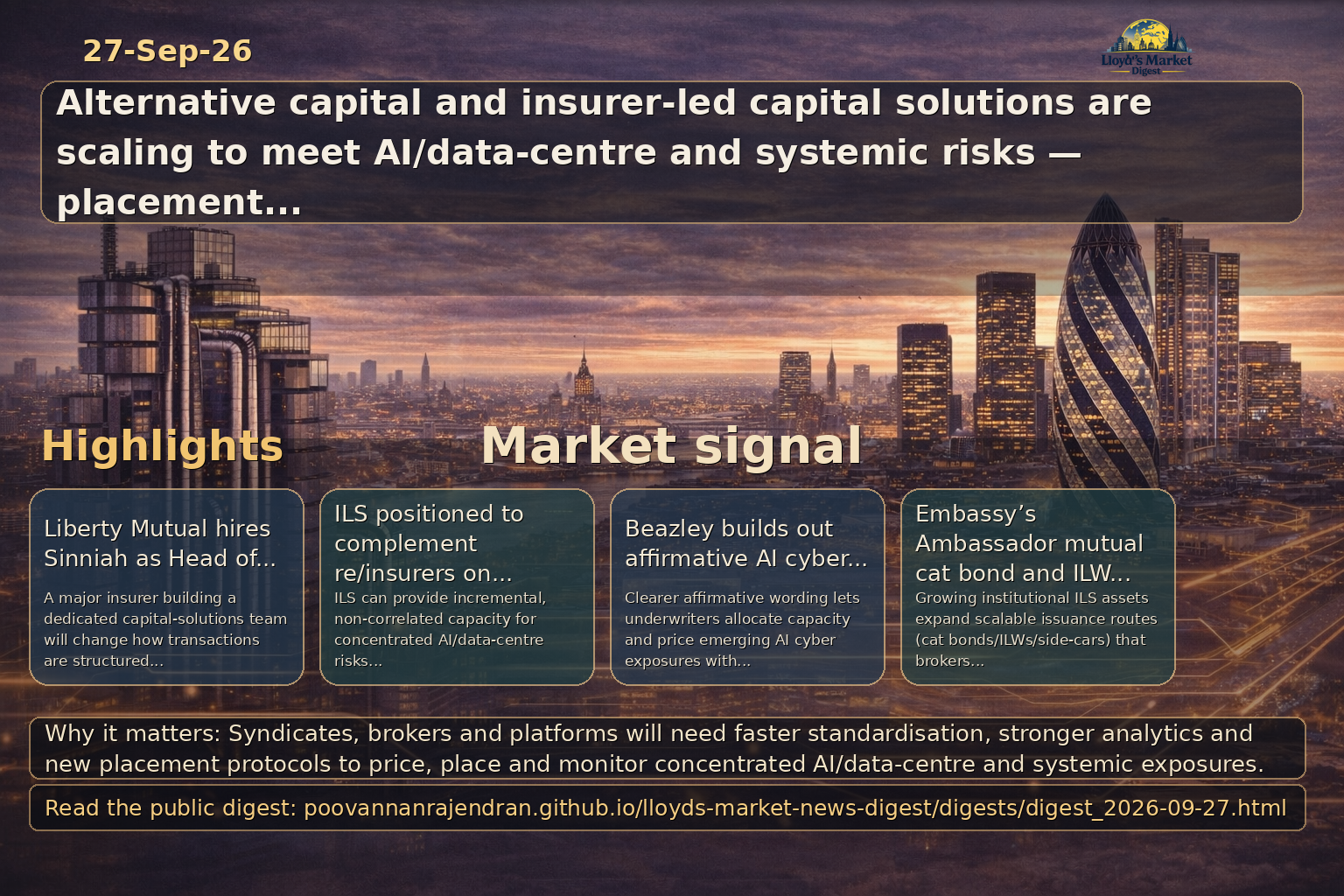
Why it matters: Highlights a clear opportunity for ILS capital to complement traditional re/insurers in underwriting AI infrastructure and data‑centre exposures, a priority for Lloyd’s syndicates and global specialty brokers seeking scalable capacity.
- Data‑centre demand driven by AI creates concentrated catastrophe and operational exposures—ILS can provide incremental, non‑correlated capacity to protect syndicates’ balance sheets.
- Brokers and placement platforms should develop placement protocols and templates to onboard ILS investors quickly while preserving underwriting discipline and aggregation controls.
- Underwriters must invest in bespoke modeling, standardized contract triggers and covenants to make these exposures investible for ILS funds while safeguarding syndicate capital.
Source: artemis.bm
Why it matters: Swiss Re/LSE analysis on interconnected systemic risks reinforces the need to expand diversified ILS capacity and to redesign instruments and stress frameworks to address cross‑sector aggregation risks relevant to Lloyd’s and global specialty markets.
- Interconnected AI, supply‑chain and financial risks increase tail correlations—markets must expand diversified capital sources including ILS to preserve capacity after systemic events.
- Product design needs refined attachment points, multi‑peril triggers and clearer aggregation metrics to prevent hidden accumulation across lines and platforms.
- Placement platforms should enable enterprise‑level aggregation analytics and transparent risk disclosures so brokers and syndicates can quantify and mitigate systemic concentration.
Source: artemis.bm
Why it matters: Embassy’s Ambassador fund reaching near $1bn AUM demonstrates tangible institutionalisation and investor demand for catastrophe bonds/ILS, expanding available capacity that Lloyd’s syndicates and brokers can access through structured placements.
- Rising ILS AUM signals sustainable, scaled capital supply that can relieve pricing stress on specialties but may also compress margins—syndicates should adapt underwriting appetites accordingly.
- Brokers should deepen engagement with fund managers and placement agents to create repeatable issuance pipelines (cat bonds, ILWs, side‑cars) that meet fund liquidity and return profiles.
- Placement platforms must prioritise standardisation, secondary liquidity features and transparent performance metrics to attract additional institutional mandates into specialty treaties and transactions.
Source: newsnow.co.uk
Why it matters: Escalation or recurring India–Pakistan tensions can produce rapid increases in political violence, trade disruption and energy import/export risk—areas that drive demand for war, political risk, marine and trade credit covers relevant to Lloyd's syndicates and global specialty brokers.
- Underwriting: Reassess war, terrorism and political violence wordings, capacity limits and premium adequacy for South Asia exposures; consider tightened aggregation and accumulation monitoring across syndicates.
- Placements & brokers: Ensure enhanced KYC/sanctions screening, clear submission of geographic exposure maps and contingency clauses for supply‑chain interruption to preserve placement certainty.
- Reserving & reinsurance: Stress test treaty and facultative reinsurance for correlated losses (energy, marine, credit) and engage reinsurers early on potential escalation scenarios to secure retrocession capacity.
Source: newsnow.co.uk
Why it matters: Shifts in Russia–Germany relations, particularly where they affect energy flows and political alignments, have direct implications for sanctions exposure, counterparty creditworthiness and concentrated energy/industrial portfolios underwritten by specialty syndicates and brokers.
- Sanctions & compliance: Maintain dynamic sanctions screening on placements and counterparties; platforms must embed real‑time filters and audit trails to avoid inadvertent exposure or decline of capacity.
- Energy & business interruption: Reevaluate modelling assumptions for energy supply shocks that drive marine, property and trade credit losses; communicate scenario impacts to capacity providers and clients.
- Market access & reputation: Brokers and managing agents should coordinate on messaging and documentation for affected clients to manage reputational risk and avoid friction with reinsurers and regulators.
Source: newsnow.co.uk
Why it matters: The absence of acute reporting on incidents like 'Garvaghy Road' can mask latent localized sectarian tensions; for insurers this demands vigilant monitoring because small, concentrated episodes can trigger event, public order and property losses that impact local books of business.
- Localised political violence: Require brokers to flag concentrations in Northern Ireland exposures and confirm presence of appropriate riot/public order and business interruption cover where applicable.
- Claims readiness: Strengthen local claims response plans and delegated authority instructions with managing agents to ensure rapid triage and reserving for cluster events.
- Intelligence & monitoring: Maintain low‑latency feeds and local broker engagement to detect upticks in friction even when national media coverage is limited; use this to inform short‑term underwriting freezes or adjusted terms.
Source: newsnow.co.uk
Why it matters: Issues connected to the 'Orange Order' and associated parades can generate recurring seasonal concentrations of public liability, event cancellation and political‑violence risk—relevant for syndicates underwriting UK event and property portfolios and brokers managing mass‑participation placements.
- Event & liability underwriting: Assess seasonal spikes in public liability and event cancellation exposure; consider conditional underwriting terms, tighter sublimits or additional premiums for parade periods.
- Delegated authority & documentation: Require clear contractual controls for delegated claims handling and ensure placement platforms capture event timing, security arrangements and local authority permits.
- Community & reputational risk: Engage brokers on community relations and PR exposure; calibrate appetite where sustained dispute could create repeated loss cycles impacting combined ratio.