Source: artemis.bm
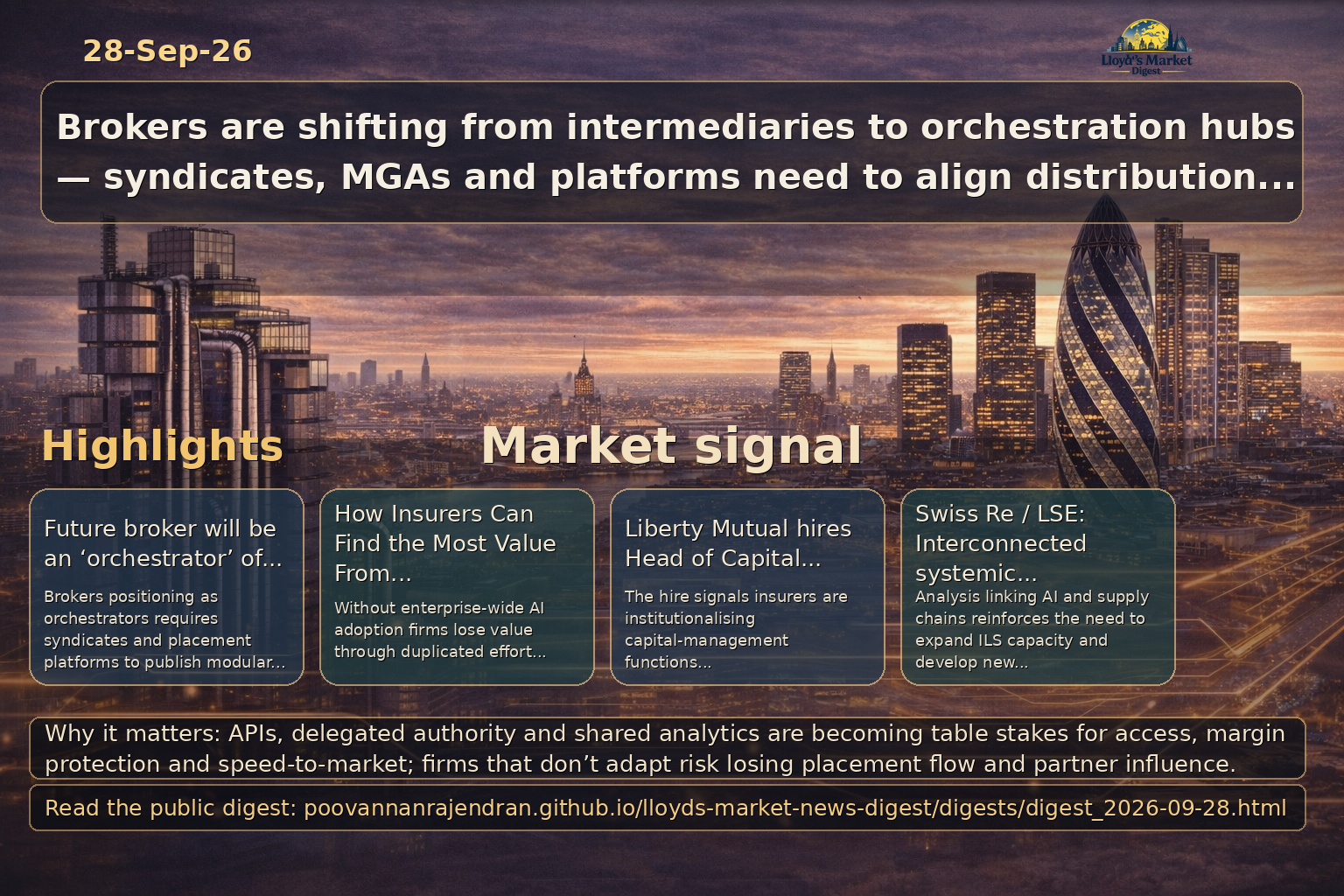
Why it matters: Liberty Mutual’s hire of a Head of Capital Solutions signals insurers are institutionalising capital‑management functions—an important competitive dynamic for syndicates and brokers seeking alternative capital partnerships.
- Monitor insurers’ capital‑solutions capabilities for partnership and capacity‑sourcing opportunities (co‑investment, quota share, fronting).
- Accelerate product innovation (multi‑year structures, collateralised solutions, bespoke retrocession) to meet insurer and investor capital optimisation goals.
- Placement platforms should provide capital‑allocation analytics and scenario tools to demonstrate how alternative structures affect insurer solvency and profitability.
Source: insurancejournal.com
Why it matters: The Accenture insight is directly material to Lloyd's syndicates, global specialty carriers and large broker networks: without enterprise-wide AI adoption, value is lost through duplicated effort, inconsistent risk selection and suboptimal placement flows across platforms.
- Establish market-ready AI governance: define enterprise standards that bind syndicates, managing agents and brokers on model validation, data lineage and ethical use to ensure consistent underwriting decisions.
- Prioritise placement-platform integration: invest in API-first data architectures and common schemas so AI-driven pricing, submission triage and risk scoring flow into broking and MGAs without manual reconciliation.
- Accelerate skills and KPI alignment: implement cross-functional upskilling (underwriting, claims, actuarial, operations) and standardise performance metrics (loss ratio impact, time-to-bind, quote-to-bind conversion) to measure ROI and reallocate capital.
Source: insurancetimes.co.uk
Why it matters: The piece captures a near-term industry inflection: brokers are positioning as orchestrators of partner ecosystems, which directly affects how Lloyd's syndicates, MGAs and placement platforms compete for access to flows, product design influence and margin share.
- Strategic imperative: Syndicates and placement platforms must publish modular product interfaces and commercial templates (APIs, data feeds, delegated authority agreements) to remain accessible to broker-led propositions.
- Commercial execution: Brokers should formalise partner management capabilities — catalogue services, SLAs and revenue splits — to monetise orchestration while preserving underwriting standards and capacity alignment.
- Risk and governance: Market leaders must define interoperable data governance, audit and compliance frameworks so orchestration doesn’t erode underwriting control, regulatory transparency or claims outcomes.
Source: reinsurancene.ws
Why it matters: Aon’s hire reinforces treaty reinsurance capability in Iberia and Latin America, improving placement leverage with Lloyd’s syndicates and global reinsurers.
- Deep Latin America/Iberia market expertise and carrier relationships to improve treaty negotiation and renewals
- Enhances Aon’s ability to source capacity from Lloyd’s and global markets for regional treaty programmes
- Strengthens cross-border treaty placement and advisory services, increasing competitive pressure on regional boutiques
Source: reinsurancene.ws
Why it matters: Prevensure Re’s appointment accelerates its Africa-facing underwriting and placement presence, improving access to regional facultative and treaty capacity.
- Brings proven underwriting experience across African markets and energy facultative placements to support local risk flow
- Improves ability to engage Lloyd’s syndicates and regional reinsurers for tailored facultative and treaty solutions
- Signals intermediary focus on on-the-ground expertise to capture growth and place complex risks efficiently
Source: reinsurancene.ws
Why it matters: Cedar Trace’s senior outwards reinsurance hire strengthens ceded placement capabilities for a Bermuda-based manager, supporting syndicate capital optimisation.
- Ceded placement experience with major carriers enhances retrocession strategy and negotiating leverage
- Improves access to global reinsurers and Lloyd’s capacity for syndicates and MGAs seeking efficient outwards programmes
- Supports optimisation of collateral, term structures and fee income through better managed reinsurance buying
Source: reinsurancene.ws
Why it matters: Gallagher Re’s senior facultative appointment bolsters its capability to place large, complex international property and heavy-industry risks into specialty markets and Lloyd’s.
- Brings technical facultative expertise and market relationships essential for large one-off placements
- Strengthens broker channel for syndicates and placement platforms targeting heavy industry and complex property exposures
- Enhances speed-to-market and bespoke structuring for clients requiring tailored facultative solutions
Source: reinsurancene.ws
Why it matters: Fathom Re’s appointment of a seasoned industry leader supports strategic growth of an independent intermediary serving syndicates, brokers and specialty markets.
- Senior leadership with multi-decade intermediary experience to drive business development and product expansion
- Expected to enhance client relationships and expand treaty and facultative offerings to syndicates and global brokers
- Reinforces competitive landscape for boutique reinsurance intermediaries and alternative placement channels
Source: artemis.bm
Why it matters: LGT’s view that ILS can complement reinsurers for data‑centre exposures highlights a targeted demand vector driven by AI infrastructure and digital asset concentration risk.
- Syndicates should collaborate with ILS managers to co‑design bespoke covers (parametric, layered or private placements) for technology infrastructure risks.
- Brokers must enhance accumulation modelling for data centres and offer standardised underwriting templates to accelerate placement.
- Placement platforms should enable custom structuring, rapid data exchange and parametric triggers tailored to tech and infrastructure portfolios.
Source: artemis.bm
Why it matters: PGGM’s endorsement highlights institutional demand drivers—trust, discipline and transparency—that will unlock more ILS capital relevant to Lloyd’s syndicates and global specialty placements.
- Brokers and syndicates must prioritise governance, independent valuation and transparent reporting to meet institutional due diligence standards.
- Placement platforms should implement standardised performance and risk metrics to reduce friction for large allocators.
- Underwriters should package clearly de‑correlated, investor‑friendly structures and communicate correlation and tail‑risk metrics to support allocation decisions.
Source: artemis.bm
Why it matters: Artemis’ weekly roundup signals market trends—fronting for ILS capital and rising traded limits—indicating evolving distribution channels and renewed liquidity across reinsurance placements.
- Fronting carriers and syndicates can selectively scale fronting solutions to channel third‑party ILS capital into specialty lines.
- Brokers should design placement strategies that exploit traded limit increases (e.g., aggregate XoL) to optimise capacity and pricing.
- Placement platforms need to support secondary trading, limit visibility and lifecycle data to capitalise on improving market liquidity.
Source: artemis.bm
Why it matters: Swiss Re/LSE analysis linking AI and supply chains to increased interconnected systemic risk reinforces the need for expanded ILS capacity and new risk transfer instruments across the Lloyd’s market.
- Syndicates and reinsurers should prioritise product development for systemic and cascade risks (multi‑peril covers, parametrics, layered instruments).
- Brokers must be prepared to structure cross‑risk solutions and advise clients on aggregation exposure and systemic scenario testing.
- Placement platforms should incorporate multi‑risk scenario modelling and investor reporting that captures non‑traditional correlation pathways.