Source: fca.org.uk
Why it matters: FCA warning for greennovahub.com signals an unauthorised actor potentially soliciting UK customers or misrepresenting insurance services. For Lloyd’s market participants this creates risk of client contact (phishing), misdirected premiums and impersonation of legitimate brokers or MGAs on electronic placement channels.
- Immediate containment: block the domain and associated IPs on all placement platforms and internal mail gateways; publish an advisory to underwriting and broking teams to ignore communications from the domain.
- Transaction controls: require dual verification for any change in bank or remittance instructions and suspend automated acceptance of counterparty details originating from unverified web forms or legacy email threads.
- Market coordination: notify syndicate compliance teams and platform partners, log the FCA warning in counterparty screening systems and report any suspected customer harm to FCA and internal incident teams.
Source: fca.org.uk
Why it matters: FCA alert for www.venturoxltd.com denotes another unauthorised operator that may seek to present financial offerings to UK policyholders or intermediaries. The primary concern for specialty brokers and syndicates is the potential for fronting schemes, phishing solicitations and fraudulent placement attempts routing outside authorised channels.
- Platform integrity: enforce stricter third‑party access controls on placement platforms (OAuth scopes, IP allow‑lists, mandatory SSO) and add venturoxltd.com to platform exclusion lists.
- Operational resilience: update broker onboarding checklists to include FCA Warning List screening as a mandatory pre‑trade check and require live confirmation calls for new correspondent brokers.
- Risk reporting: escalate incidents where clients report contact from the domain to Market Intelligence, AML and the Lloyd’s market associations so syndicates can assess exposure and adjust appetite.
Source: fca.org.uk
Why it matters: smarttradefx.live appears on the FCA Warning List and likely represents an unauthorised or scam operation. For the Lloyd’s and global specialty community, the key issues are phishing tied to foreign exchange or payment instruction fraud and attempts to intercept premium flows or sensitive placement data.
- Payments hygiene: mandate that treasury and broking desks verify all FX/payment counterparties through an independent channel prior to executing premium transfers; treat web‑instructed changes as high‑risk.
- Broker education: issue a succinct advisory to all panel brokers and platform users detailing the FCA warning, indicators of compromise, and required escalation steps if contacted by the domain.
- Surveillance and intelligence: integrate the domain into threat feed subscriptions and perform retrospective searches across platform logs and emails for any historical contact or attempted transactions involving smarttradefx.live.
Source: insurancetimes.co.uk
Why it matters: The FCA’s successful bankruptcy order against a broker facing embezzlement charges underlines persistent premium handling, custody and governance risks in distribution chains — a direct counterparty and reputational risk for syndicates and platforms.
- Tighten premium reconciliation, trust account controls and proof‑of‑placement requirements across broker counterparties.
- Increase due diligence cadence on smaller brokers and intermediaries, incorporating forensic checks and monitoring of premium flows.
- Develop coordinated incident response and client remediation frameworks with placement platforms to limit contagion and reputational harm.
Source: businessinsurance.com
Why it matters: Lexington’s launch of a financial institutions practice via LexPro marks targeted expansion into specialist financial institution exposures — a cue for Lloyd’s and global specialty markets to refine offerings for banks, fintech and custodial risks.
- Signals need for dedicated underwriting expertise and tailored wording for financial institution products.
- Brokers should position cross‑sell opportunities (crime, cyber, professional liability) when placing financial institution programs.
- Placement platforms can support streamlined policy assembly and evidence requirements for complex multi‑product placements.
Source: artemis.bm
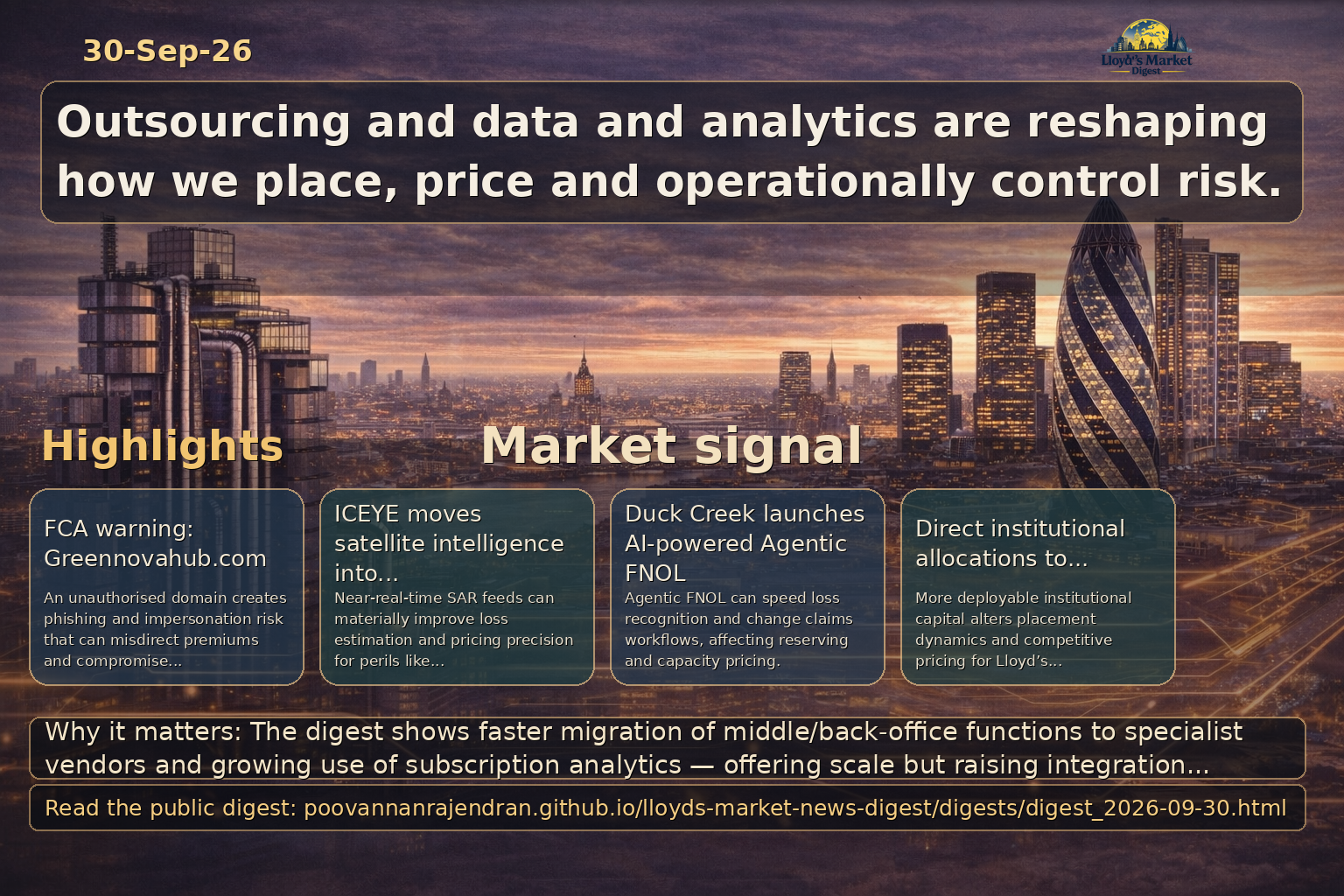
Why it matters: The Marsh Re finding is a market signal that direct institutional investors are increasingly allocating to reinsurance vehicles, expanding the pool of deployable capital that competes with Lloyd’s syndicates and global specialty insurers. This changes placement dynamics, pricing benchmarks and counterparty expectations, and requires brokers and platforms to adapt distribution, reporting and governance to accommodate large institutional stakeholders.
- Strategic underwriting: Syndicates and specialty insurers should prioritise differentiated, hard‑to‑replicate risk appetites and enhanced exposure management to defend margins where capital is abundant and pricing pressure is highest.
- Broker and platform response: Brokers must accelerate electronic placement capabilities, investor‑facing reporting and standardized documentation to facilitate efficient deployment of institutional capital and to win share of bespoke or scaled capacity placements.
- Risk and capital monitoring: Market leaders should track third‑party capital growth, return on capital metrics, collateralisation trends and major loss scenarios; develop contingency plans for volatility in investor risk appetite should significant loss activity re‑price or withdraw alternative capital.
Source: businessinsurance.com
Why it matters: ReSource Pro’s workers’ comp program management offering signals growing outsourcing and platform‑based program administration in core casualty lines — a distribution and underwriting trend relevant to Lloyd’s syndicates, global specialty brokers and placement platforms.
- Accelerates demand for third‑party program administrators and MGAs to manage claims, compliance and centralized pricing.
- Brokers should evaluate partnership and referral arrangements to capture program flows and maintain placement control.
- Syndicates and platforms must assess appetite for delegated authority placements and integrate reporting/oversight protocols.
Source: businessinsurance.com
Why it matters: SiriusPoint’s collaboration with Sutton on NIL coverage demonstrates capacity being built for niche athlete/entertainment exposures — an emergent specialty product that requires bespoke underwriting and broker expertise.
- Creates a template for syndicates to develop appetite for sports, NIL and talent‑related exposures.
- Brokers need to develop advisory capability on contract terms, reputational screening and ancillary liability exposures.
- Placement platforms should support rapid binding and evidence collection for one‑off, event‑driven risks.
Source: businessinsurance.com
Why it matters: A 47% rise in mental‑health claim frequency in workers’ comp elevates loss expectations and influences reserve setting, underwriting appetite and program structures for employers — directly affecting syndicates writing casualty and program administrators.
- Increases pressure on pricing and deductible structures for workers’ compensation portfolios.
- Creates demand for integrated claims‑management, return‑to‑work and mental‑health rehabilitation services that program managers can offer.
- Brokers must advise clients on benefit design, loss mitigation and potential impact on placement strategy across carriers.
Source: businessinsurance.com
Why it matters: Adverse ruling requiring Chubb to pay $30 million in a coal silo collapse dispute underscores litigation exposure from ambiguous policy language and the necessity for contract certainty in large property losses — a critical consideration for specialty property underwriters and brokers.
- Reinforces the need for precise policy wordings, defined perils and clear exclusions in property placements.
- Syndicates should reassess reserving and reinsurance recovery strategies where coverage litigation risk is elevated.
- Brokers must enhance pre‑placement documentation and negotiation on wording to prevent retroactive disputes.
Source: globalreinsurance.com
Why it matters: Howden Re’s Copenhagen office and the hire of Jens Ellborg materially strengthen its Nordic/Baltic distribution, increasing direct access to local cedants and regional specialty risks—shifting broker-syndicate flows and competitive dynamics for Lloyd’s and global specialty placements.
- Direct regional access: A local MD with deep Nordic reinsurance relationships accelerates origination and placement of regional specialty risks, improving lead generation for Lloyd’s syndicates and international capacity providers.
- Competitive pressure and consolidation: Expanded on-the-ground capability raises the bar for other brokers and may prompt further consolidation or strategic hires in the Nordics to retain syndicate access and client mandates.
- Placement and platform implications: Syndicates and placement platforms should pre-empt integration needs (data, documents, compliance checks) to capture increased volume from a strengthened Nordic broker hub and to standardise digital placement workflows.
Source: globalreinsurance.com
Why it matters: ICEYE’s shift from post-event catastrophe intelligence to underwriting and predictive analytics introduces a scalable, near-real-time SAR data feed into risk selection and exposure management—offering syndicates and global specialty underwriters higher-resolution signals for pricing and portfolio optimisation.
- Underwriting precision and portfolio optimisation: SAR-derived analytics can improve loss estimation, refine risk selection (flood, wildfire, other perils) and enable more granular pricing and treaty structuring for Lloyd’s syndicates and specialty carriers.
- Operational integration and placement tech: Effective use requires embedding satellite analytics into underwriting systems and placement platforms (API connectivity, exposure dashboards, model outputs) to inform live quoting and capacity allocation.
- Governance and vendor management: Insurers and syndicates must establish validation, auditability and procurement standards for satellite-derived models, addressing model risk, regulatory expectations and data licensing for use across multiple jurisdictions.
Source: insurancejournal.com
Why it matters: AM Best’s report that U.S. homeowners insurers returned to underwriting profitability signals a shift in rate adequacy and loss cost alignment impacting reinsurance demand, capacity deployment and pricing dynamics relevant to specialty portfolios tied to property and catastrophe.
- Reinsurance & retrocession strategy: anticipate moderated demand for catastrophe capacity from better-funded primary carriers; adjust appetite and pricing models accordingly.
- Product mix and appetite: syndicates should reassess residential and adjacent product offerings, focusing on underwriting discipline and exposure aggregation controls.
- Placement advice for brokers: use improved carrier results to renegotiate terms for facultative and treaty placements, while monitoring rate-softening indicators to preserve margin.
Source: insurancejournal.com
Why it matters: State-attributed sabotage on industrial targets elevates political violence and sabotage risk for property and BI underwriters, with implications for policy wording, sanctions checks and breach of war/terror exclusions—critical for Lloyd’s syndicates and global specialty capacity.
- Coverage wording review: re-examine political violence, sabotage and terrorism exclusions and ensure clarity on state-sponsored acts versus non-state actor triggers.
- Underwriting geographic and supply-chain aggregation: tighten analytics for exposures tied to defense supply chains and critical infrastructure in contested regions.
- Client advisory & parametrics: promote parametric solutions and contingency planning to corporate clients and brokers to manage revenue interruption tied to sabotage events.
Source: insurancejournal.com
Why it matters: Korean insurers’ outbound M&A push—led by large industrial-linked groups—creates partnership and distribution opportunities for Lloyd’s brokers and syndicates seeking Asian expansion, while raising competitive dynamics for global specialty placement.
- Strategic partnerships: pursue collaboration with outbound Korean insurers for distribution, capacity provision and local market access in Asia-Pacific.
- M&A advisory and transactional risk: position syndicates and brokers to provide representations & warranties, tax and transactional risk capacity linked to cross-border deals.
- Competitive landscape: prepare for increased competition from well-capitalized foreign entrants and tailor product offerings to support OEMs, retirement and specialty needs.
Source: insurancejournal.com
Why it matters: A corporate manslaughter conviction tied to an aircraft operator exposes aviation insurers and brokers to heightened liability precedent and potential increases in claims severity and scrutiny around wet-lease/sub-contractor operations—areas of core interest for Lloyd’s aviation syndicates.
- Policy terms and limits: reassess liability limits, exclusion language and retentions for wet-lease and ACMI arrangements in light of legal precedent and punitive fines.
- Operational due diligence: require enhanced audits, maintenance records and contract vetting for third‑party operators before providing hull and liability cover.
- Claims preparedness: coordinate with claims and legal teams to model potential reserve impacts and adjust pricing to reflect elevated juristic risk.
Source: insurancejournal.com
Why it matters: A high-value commodities litigation and insolvency context in Singapore highlights counterparty fraud, judicial intervention and recovery complexity—relevant to trade credit, political risk, financial institutions and D&O lines used by Lloyd’s and specialty markets.
- Exposure screening: increase scrutiny on commodity trading counterparties and require enhanced KYC, escrow and collateral structures for large trading credits.
- Demand for specialty covers: anticipate uptick in trade credit, political risk and fraud insurance placements to protect buyers and lenders in cross-border commodity trades.
- Claims and recovery playbooks: develop coordinated litigation funding, forensic accounting and inter-market cooperation to preserve recovery prospects for insureds and insurers.
Source: insurancetimes.co.uk
Why it matters: AI is materially changing cyber threat vectors faster than traditional underwriting cycles; Lloyd's syndicates and global specialty underwriters face pronounced data, model and wording obsolescence risks that can rapidly shift exposure and pricing.
- Accelerate capture and sharing of near‑real‑time cyber incident and telemetry data with syndicates and reinsurers to reduce model lag.
- Review and modernise cyber wordings to explicitly address AI‑related agentic risks and controls, limiting aggregation uncertainty.
- Establish dedicated underwriting taskforces to stress‑test portfolios for rapid AI adoption scenarios and adjust appetite and reinsurance strategy accordingly.
Source: insurancetimes.co.uk
Why it matters: LLM and AI recommendation engines introduce commercial bias and transparency challenges that could erode trust in digital distribution — a material strategic threat to brokers and syndicates reliant on intermediary credibility.
- Define and disclose clear commission and referral economics for any AI/LLM distribution partnerships; demand contractual transparency from platform providers.
- Invest in proprietary or white‑label recommendation layers that prioritise suitability and placement quality to preserve broker value‑add.
- Establish audit and monitoring protocols for AI recommendations to detect revenue‑driven bias and protect client outcomes and brand trust.
Source: insurancetimes.co.uk
Why it matters: Cogent’s appointment of a chief executive designate signals strategic scale and potential shifts in wholesale broking behaviour—critical for syndicates and placement platforms that rely on wholesale distribution and panel stability.
- Engage early with the new CEO to align on distribution priorities, appetite changes and service level expectations for Lloyd's placements.
- Reassess panel and capacity arrangements to ensure continuity of access during the executive transition period.
- Monitor for strategic initiatives (M&A, platform partnerships) that may affect counterparty concentration and referral flows.
Source: insurancetimes.co.uk
Why it matters: Bridgepoint’s investment in Vipr and appointment of an experienced chair reflect accelerated private capital interest in specialty placement platforms — a vector for faster global expansion, AI capability builds and workflow standardisation across syndicates and brokers.
- Evaluate Vipr and comparable platform capabilities for integration into syndicate and broker workflow to shorten placement cycles and improve data fidelity.
- Prioritise pilots that test platform AI features for underwriting assistance, ensuring model governance and data privacy before broader rollout.
- Map partnership models (SaaS, equity, reseller) to protect underwriting independence while gaining the distribution and efficiency benefits of platform adoption.
Source: reinsurancene.ws
Why it matters: AI-driven FNOL solutions will materially affect syndicate claims workflows and carrier operational costs, with implications for capacity pricing and claims-contingent reserving.
- Assess integration pathways: syndicates and managing agents should evaluate Agentic FNOL and comparable platforms for pilot deployments to reduce FNOL friction and speed loss recognition.
- Reprice claims-adjacent services: brokers should factor reduced claims handling costs and faster information flow into placement negotiations and renewal discussions.
- Governance and data quality: implement controls around AI agent outputs, audit trails and third-party validations to satisfy Lloyd's and insurer governance standards.
Source: reinsurancene.ws
Why it matters: HDI Global's dedicated regional aviation underwriting team underscores continued demand for specialist capacity and local broker relationships across Benelux and Southern Europe.
- Leverage local footprint: global brokers and Lloyd's coverholders should use HDI's regional underwriting to expand placement options for aviation clients in Benelux and Southern Europe.
- Deepen product collaboration: syndicates and MGAs can pursue co-ordinated product offerings (eg. general aviation, charter) leveraging HDI's Centre of Excellence expertise.
- Operational readiness: ensure multilingual broking support, delegated authority agreements and submission standards are aligned to capture regional flow efficiently.
Source: reinsurancene.ws
Why it matters: Willis's RiskIQ Nexus consolidates risk and insurance data, presenting an actionable model for brokers, carriers and placement platforms seeking a single source of truth for program analytics and renewals.
- Adopt unified data layers: brokers and managing agents should prioritise integrating policy, exposure and loss data into central platforms to improve renewal positioning and client advisory.
- Differentiate advisory services: use RiskIQ-style capabilities to offer decision-ready reporting to C-suite clients, converting data consolidation into strategic consulting revenue.
- Insist on interoperability: demand open APIs and standardised ingestion to ensure Lloyd's syndicates and MGAs can plug analytics into existing placement workflows.
Source: reinsurancene.ws
Why it matters: AM Best's report highlighting falling reinsurance prices and a US homeowners market turnaround signals shifting capital costs that will affect primary pricing, capacity placement and syndicate underwriting appetite.
- Reassess capacity strategy: syndicates and Lloyd's-led vehicles should re-evaluate capacity deployment and retrocession purchases given easing reinsurance costs.
- Renewal strategy for brokers: capitalise on softer reinsurance to negotiate improved terms for clients, while monitoring potential short-term rate volatility.
- Underwriting discipline remains essential: maintain rigorous exposure management and catastrophe modelling to avoid re-commoditisation as market softens.
Source: reinsurancene.ws
Why it matters: Howden Re's Copenhagen office indicates targeted broker investment in the Nordic market, improving proximate service for cedants and enhancing access to regional capacity for syndicates.
- Local presence for client retention: brokers should mirror Howden Re's approach where client proximity improves placement velocity and bespoke program structuring.
- Nordic-specialist products: syndicates can develop or syndicate niche offerings tailored to Nordic and Baltic risk profiles, leveraging local analytics.
- Coordinate cross-border distribution: ensure regional offices are integrated with global analytics and capital solutions to deliver consistent terms across territories.
Source: risk.net
Why it matters: Riskquantum-style subscription databases illustrate the growing role of third-party analytics and benchmark data in risk selection, pricing and capital modelling—crucial for specialty lines where external datasets complement limited internal loss histories.
- Augmenting underwriting and portfolio analytics: Subscription databases provide standardized datasets and comparable metrics that support benchmarking, stress-testing and more granular pricing for specialty and Lloyd's lines.
- Integration and commercial access: Enterprise-level access models and institutional logins highlight the need for negotiated licensing, secure integration into in-house models and governance around redistribution and usage within syndicates and broker houses.
- Governance and vendor reliance: C-suite should build procurement, data-governance and contingency plans to manage reliance on paid analytics providers, ensuring continuity of key analytics and compliance with model validation and audit requirements.
Source: newsnow.co.uk
Why it matters: The item is a generic regional headlines feed for Tyne and Wear with no content pertaining to Lloyd’s, syndicates, specialty risks, brokers, or placement platforms. It should be treated as low-priority noise for market intelligence but retained for situational awareness where local retail or regional broker operations could be impacted.
- Deprioritise for Lloyd’s and global specialty intelligence — exclude from syndicate and broker market-alert workflows to reduce analyst noise.
- Retain and tag for local operational risk monitoring — only route to teams with known exposures in Tyne and Wear (local retail brokers, branch offices, regional MGAs, claims units).
- Implement feed-level rules in placement platforms and Triage systems — automatic source tagging, relevancy scoring, and suppression thresholds to improve signal-to-noise for C-suite reporting and underwriting desks.
Source: risk.net
Why it matters: Davy's move to FIS's Post Trade Processing platform demonstrates a fast, vendor-led route to scalable, automated middle- and back-office operations—relevant to brokers, syndicates and platform operators evaluating whether to modernise internally or adopt specialist solutions.
- Operational leverage: Third-party post-trade platforms can deliver rapid efficiency gains and standardized reconciliation, reducing headcount friction and supporting higher volumes without linear cost increases—important for brokers and syndicates handling more complex specialty placements.
- Regulatory and audit readiness: Outsourced platforms typically embed stronger controls, audit trails and reporting capabilities, materially reducing execution risk and time-to-report for regulated entities operating in the Lloyd's and international specialty markets.
- Vendor and integration considerations: C-suite must weigh vendor concentration, contractual SLAs, business continuity and API-level interoperability with placement platforms to avoid downstream friction in policy issuance, claims notifications and premium flow.