Source: fca.org.uk
Why it matters: FCA warning on an unauthorised trading site (musk-trade.org) demonstrates ongoing impersonation and scam activity that can mislead wholesale and retail clients and create contagion risk for intermediaries.
- Immediate action: instruct compliance and broker teams to block or flag the domain across firm channels and include it in counterparty watchlists.
- Client protection: issue targeted advisories to clients and coverholders on recognising unauthorised counterparties and the absence of FSCS or Ombudsman protection.
- Controls: require placement platforms and third-party distribution partners to prove KYC/AML and authorisation checks for counterparties and trading venues before engagement.
Source: fca.org.uk
Why it matters: Wealth Growth (unauthorised) is indicative of firms marketing financial products without FCA authorisation; this creates intermediary liability and undermines trust in regulated brokers and syndicates when market participants are referenced or routed through such entities.
- Due diligence: mandate documented provenance checks for any new introducers or digital distribution partners that reference wealth or investment products.
- Contracting: update broker/supplier contracts to require immediate notification of regulatory warnings and indemnities where introductions originate from unauthorised entities.
- Reputational monitoring: deploy media and watchlist monitoring to detect references linking your brand, syndicate names or managing agents to the unauthorised promoter.
Source: fca.org.uk
Why it matters: Bitnestpips.com (unauthorised) highlights prevalence of forex/crypto-style scams that can affect liquidity providers, custodian relationships and firms offering digital-asset exposures through Lloyd’s or specialty products.
- Risk exposure: map any exposures to crypto/FX trading counterparties in syndicate portfolios and confirm they are FCA-authorised or subject to equivalent controls.
- Platform risk: require placement platforms and brokers to evidence custody arrangements and segregation of client funds for digital asset trades.
- Client advisories: provide syndicate investors and wholesale clients clear guidance on risks of investing through unauthorised execution platforms and loss recovery limitations.
Source: fca.org.uk
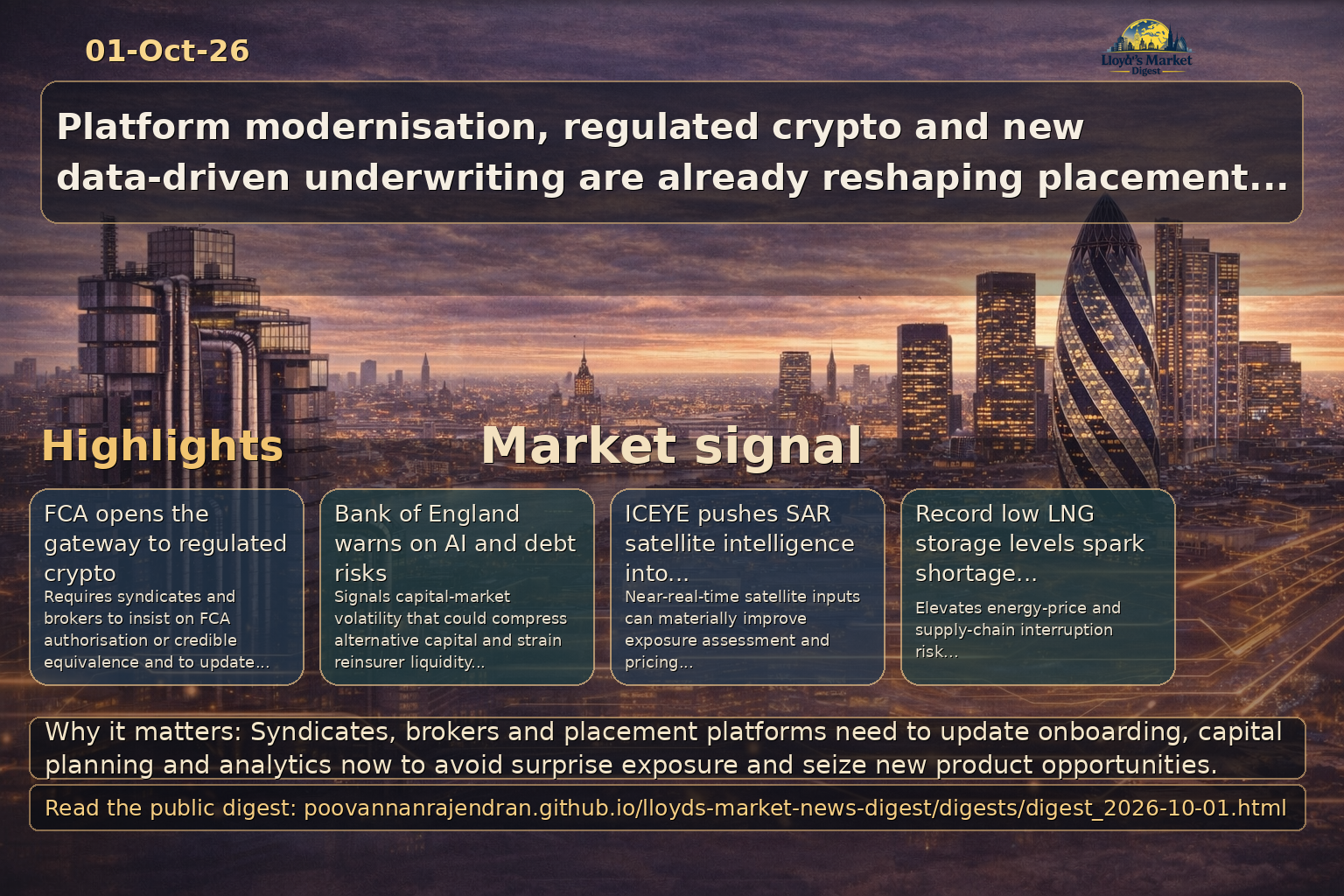
Why it matters: FCA opens the gateway to regulated crypto — a structural regulatory shift enabling crypto firms to seek full UK authorisation. This changes market entry pathways, third-party risk profiles and opportunities for specialty insurers and Lloyd’s to underwrite new products tied to digital assets.
- Strategic planning: establish a cross-functional crypto readiness working group (underwriting, legal, compliance, operations) to assess product, custody and claims implications before 28 Feb 2027.
- Counterparty policy: require proof of FCA authorisation or credible equivalence for crypto counterparties; revise onboarding to capture authorisation status and transitional permissions.
- Product and platform opportunity: evaluate tokenisation of risk, parametric solutions and custody-insurance partnerships, while building standard terms that address crypto-specific custody, loss and insolvency scenarios.
Source: fca.org.uk
Why it matters: FCA board appointments increase institutional focus on governance, corporate conduct and regulatory delivery; new board composition can presage shifts in supervisory priorities relevant to Lloyd’s market participants and platforms.
- Engagement: senior management should proactively engage with FCA liaison teams and trade bodies to surface market-level concerns and clarify enforcement expectations.
- Governance: review board-level oversight of regulatory compliance, outsourcing, market conduct and crypto exposures; document escalation paths and regulatory reporting readiness.
- Scenario planning: refresh regulatory change programs and enforcement response playbooks, reflecting a potentially more interventionist Board view on market integrity and consumer redress.
Source: insurancejournal.com
Why it matters: Bank of England warning on systemic risks from AI and debt highlights capital-market volatility that can compress alternative capital, affect reinsurer liquidity and influence syndicate capital buffers at Lloyd's.
- Stress-test syndicate capital positions against scenarios of sudden yield shifts and AI-driven asset repricing; reassess collateral and margin requirements.
- Evaluate implications for insurance-linked securities and sidecar deployments if alternative capital withdraws or becomes more expensive.
- Advise brokers and clients on potential capacity tightening and the need for early placement to secure terms amid capital-market stress.
Source: reinsurancene.ws
Why it matters: Creation of a dedicated Financial Institutions practice signals growth in specialty solutions for banks, asset managers and broker networks—relevant to Lloyd's and specialty capacity providers.
- Expands distribution channels for tailored FI products via wholesale and Lloyd's platforms
- Creates opportunities for reinsurance and facultative placements on complex balance-sheet risks
- Underlines need for sector-specific underwriting expertise and bespoke wording
Source: businessinsurance.com
Why it matters: Record low LNG storage elevates energy price volatility and supply-chain interruption risk, directly affecting marine, commodity trading, energy liability and BI exposures written by Lloyd's syndicates and specialty brokers.
- Reassess energy-related accumulation across portfolios and stress-test collateral and BI exposures tied to fuel scarcity.
- Adjust underwriting and pricing for cargo, commodity trading and energy infrastructure risks; consider index-linked and parametric triggers.
- Engage brokers and placement platforms to secure flexible facultative/reinsurance capacity and to deploy rapid short-term cover solutions.
Source: businessinsurance.com
Why it matters: Flooding in Bangkok disrupting aviation and logistics highlights regional CAT concentration and business interruption exposures that affect aviation hull, liability and global supply-chain portfolios placed through Lloyd's and specialty brokers.
- Inventory and quantify SE Asia accumulation exposure for aviation, cargo and supply-chain BI; tighten aggregation controls where necessary.
- Advise clients on operational mitigations and conditional cover options; consider targeted endorsements for flood-related exposures.
- Leverage placement platforms and wholesale brokers to source timely capacity and to coordinate facultative reinsurance for exposed accounts.
Source: businessinsurance.com
Why it matters: Howden Re's expansion into Denmark signals intensified reinsurance broking competition and enhanced local treaty/facultative servicing, with implications for treaty flows into Lloyd's and continental specialty markets.
- Syndicates should review cedant relationships and treaty leakage as new broking capabilities can redirect business flows.
- Brokers and MGAs can exploit local presence to deepen primary placements and to structure bespoke facultative solutions.
- Monitor pricing and terms in Nordic markets for spillover effects on European excess layers and retrocession pricing.
Source: businessinsurance.com
Why it matters: A corporate manslaughter conviction for an airline raises potential for elevated liability awards and regulatory scrutiny, increasing severity and defence costs for airline liability policies placed by specialty markets and Lloyd's syndicates.
- Review liability limits, defence-cost provisions and potential exclusionary language for aviation and transport accounts.
- Increase underwriting scrutiny on safety governance and incident-response protocols as pricing drivers.
- Coordinate with brokers to reassess client risk mitigations, D&O exposures and crisis-management service offerings.
Source: businessinsurance.com
Why it matters: Executive-level profiles (e.g., Nandini Mani) provide signals on leadership trends and capability shifts among brokers, carriers and platform providers that can affect distribution, client coverage strategies and alliance opportunities.
- Track senior hires and role changes at major brokers/carriers to anticipate shifts in distribution priorities and product focus.
- Prioritise direct engagement with new leaders to secure placement pathways and co-development opportunities.
- Use leadership movement as an input to counterparty due diligence and strategic partnership planning.
Source: globalreinsurance.com
Why it matters: Ascot’s restructuring and senior appointments reorient underwriting governance and product innovation across UK, US and Bermuda hubs — a direct signal to syndicates, brokers and placement platforms that carrier operating models are being modernised to scale specialty lines and coordinate cross‑border capacity.
- Stronger underwriting coordination: centralising a global underwriting lead increases consistency of product design and capital allocation across Lloyd’s and overseas syndicates, affecting placement strategy and capacity deployment.
- Broker engagement and product innovation: a senior remit on product innovation and underwriting talent creates opportunities for brokers to shape new specialty propositions and for placement platforms to streamline submission workflows for emerging products.
- Execution risk and talent retention: reorganisation can accelerate growth but requires disciplined change management to retain underwriting expertise and avoid disruption to existing distribution relationships.
Source: globalreinsurance.com
Why it matters: Howden Re’s Copenhagen office and appointment strengthen Nordic/Baltic broking capability, improving origination routes into Lloyd’s, London market reinsurers and global specialty syndicates while signalling competitive expansion in a region with distinct treaty and facultative flows.
- Enhanced regional origination: deeper local presence enables more direct placement of Nordic risks into Lloyd’s syndicates and global specialty channels, increasing flow of niche risks and treaty opportunities.
- Strategic distribution lever: having an experienced MD with longstanding regional relationships accelerates trust with cedants and streamlines submissions via placement platforms and broker trading systems.
- Competitive dynamic: local expansion by a global broker increases pressure on incumbent regional brokers and incentivises syndicates and platforms to offer streamlined onboarding, local language service and tailored product solutions.
Source: globalreinsurance.com
Why it matters: ICEYE’s extension of SAR satellite intelligence into underwriting and predictive analytics materially affects risk selection, modelling and loss estimation for catastrophe and non‑cat risks — a capability with direct implication for syndicates, specialty underwriters, brokers and placement platforms that package risk for London market and global capacity.
- Underwriting precision and pricing: near‑real‑time SAR inputs enable improved exposure assessment, event attribution and loss estimation, supporting tighter pricing, differentiated terms and faster appetite calibration for specialty lines.
- Broker value‑add and placement integration: brokers can leverage satellite analytics to strengthen submissions, reduce information asymmetry and accelerate placement decisions on digital platforms and broker portals.
- Governance and validation needs: wider adoption requires robust validation, actuarial integration and vendor due diligence to satisfy Lloyd’s, syndicate audit functions and regulatory expectations on model governance.
Source: insurancejournal.com
Why it matters: A curated international & reinsurance news feed is critical intelligence for brokers, syndicates and placement platforms to anticipate emerging risks, price dynamically and maintain client advisory capability.
- Use the archive as a live input to underwriting committees and appetite matrices to detect regional trend shifts and correlate with claims intelligence.
- Integrate selected feeds into placement-platform dashboards and broker briefings to fast-track market notices and capacity changes.
- Formalise a weekly executive digest drawn from the archive to align syndicate strategy, facultative reinsurance buys and client risk-mitigation advisory.
Source: insurancejournal.com
Why it matters: Investigation at a military-linked airbase with petrol recovered underscores elevated terrorism and sabotage exposures to military-use facilities and associated aviation hull and liability risk for carriers and syndicates.
- Reassess wording and pricing for political violence and terrorism cover for military-adjacent aviation operations and contractors.
- Mandate enhanced due diligence for insureds operating at or supplying military bases, and consider conditional exclusions or sublimits where appropriate.
- Coordinate with brokers to stress-test accounts for hybrid-terror scenarios and update crisis-response clauses to reflect onsite fuel-related ignition hazards.
Source: insurancejournal.com
Why it matters: Rising strategic litigation against journalists signals increased media liability, reputational risk and political-risk exposures relevant to D&O, media error & omission lines and international political-risk products.
- Re-evaluate media E&O and reputational risk appetite in higher-litigation jurisdictions; consider underwriting adjustments and higher retentions.
- Work with brokers to ensure robust legal risk mitigation addenda and crisis PR support provisions in policies for media and communications clients.
- Leverage internal claims analytics to model potential frequency increases in libel/SLAPP-type suits and set reserves and pricing accordingly for affected portfolios.
Source: insurancejournal.com
Why it matters: Apprehension of an alleged ShinyHunters associate highlights persistent systemic cybercrime threats, affecting cyber insurance loss severity, underwriting, and platform security requirements for MGA and placement ecosystems.
- Tighten cyber underwriting controls: mandate multifactor authentication, incident response plans and forensic readiness as conditions precedent for cover.
- Reassess silent cyber exposures, aggregation across portfolios and reinsurance layering; consider market-wide stress tests for large-scale extortion events.
- Require placement platforms and broker portals to demonstrate cyber resilience and incident-management SLAs as part of panel access criteria.
Source: reinsurancene.ws
Why it matters: Archive content provides historical context for loss events, past pricing cycles and prior strategic responses—useful for benchmarking syndicate and broker strategies.
- Source for precedent-setting catastrophe impacts and underwriting responses
- Benchmark historic pricing and combined-ratio outcomes against current cycle
- Reference for due diligence on legacy covers and policy wording evolution
Source: reinsurancene.ws
Why it matters: Stronger UK bulk annuity volumes indicate sustained demand for longevity risk transfer—relevant to syndicates, brokers and platforms arranging reinsurance and retrocession for bulk transactions.
- Elevated transaction volumes increase opportunities for syndicates to provide longevity capacity
- Brokers should position differentiated solutions for large pension de-risking deals
- Potential pricing and capital allocation implications for reinsurers and Lloyd's participants
Source: reinsurancene.ws
Why it matters: Launch of a specialist wildfire underwriting venture underscores the market shift toward focused MGAs and data-driven catastrophe underwriting—material for syndicates seeking controlled, long-term portfolios.
- Signals demand for specialist capacity and disciplined portfolio management in wildfire-exposed geographies
- Opportunity for syndicates and brokers to partner with MGAs offering tech-enabled risk selection
- Highlights need for enhanced modelling, aggregation management and placement terms
Source: reinsurancene.ws
Why it matters: Independent AI-discovery capability materially improves cyber underwriting visibility and risk selection—relevant to cyber cyber capacity providers, Lloyd's cyber syndicates and placement platforms.
- Offers underwriters externally observed intelligence to augment proposal forms and tighten risk selection
- Brokers and platforms can integrate such tooling to streamline cyber placement and pricing
- Raises exposure-management and policy-wording considerations for AI-related usage and aggregation
Source: artemis.bm
Why it matters: Lane Financial’s analysis that the cat bond soft market is not yet at 2017 lows but could persist highlights upside risk to capital supply and continued pressure on spreads absent losses, which matters for pricing, issuance cadence and syndicate capital deployment.
- Prolonged soft conditions may compress issuance economics for sponsors and reduce margin for capital providers; syndicates should stress‑test underwriting and capital allocation assumptions.
- Brokers must manage cedant expectations on timing and pricing of ILS issuance; consider hybrid solutions (reinsurance + ILS) where pricing is dislocated.
- Placement platforms should prepare for potential volatility in secondary pricing and investor redemptions; diversify investor base and focus on product differentiation (triggers, perils, tenor).
Source: bankofengland.co.uk
Why it matters: The PRA's thematic findings on IFRS 9 ECL — especially on data governance, timely recognition of credit risk and climate-related credit drivers — are material to Lloyd's market participants because they affect exposures to broker and premium finance counterparty default, reinsurance recoverable valuation, collateral adequacy and the auditability of provisioning models. The letter signals heightened supervisory and auditor expectations that will influence pricing, capital planning and placement terms across syndicates, managing agents and placement platforms.
- Immediate review of ECL and credit-risk frameworks for premium receivables, broker balances and reinsurance recoverables; validate model assumptions, segmentation and forward-looking scenarios with documented governance and audit trails.
- Strengthen controls for brokers and placement platforms: tighten collateral clauses, premium finance monitoring, onboarding credit assessments and automated data flows to ensure timely identification of credit deterioration and auditable provisioning decisions.
- Incorporate climate-related credit scenarios into ECL models and governance; run targeted stress tests that link expected credit loss outcomes to capital, pricing and counterparty limits, and engage auditors/regulators early to align disclosure and remediation plans
Source: risk.net
Why it matters: XiNG demonstrates how a cloud-native, standards-based execution platform can unify pricing, risk and analytics — a model that syndicates and placement platforms can leverage to accelerate quoting, improve portfolio-level risk visibility and support cross-market distribution.
- Enables faster, standardised quoting and risk aggregation across lines — reducing time-to-bind for brokers and improving syndicate hit-rates.
- Preserves incumbent quant libraries while standardising execution, highlighting the need for integration layers between legacy actuarial models and modern platform APIs.
- Adoption of common standards lowers frictions for placement platforms and third-party data providers, facilitating more efficient distribution and analytics across Lloyd’s and global specialty markets.
Source: risk.net
Why it matters: The Riskquantum database offering illustrates the growing market for centralised risk data and benchmarking — a capability syndicates and brokers can use to enhance underwriting discipline, portfolio analytics and counterparty assessment.
- Centralised risk datasets enable better benchmarking across classes and geographies, improving syndicate pricing and reserve-setting decisions.
- Enterprise-access vendor models create dependency and require firms to evaluate integration, licensing costs and the quality/timeliness of vendor-provided analytics.
- Integration of a central risk database with placement platforms and syndicate analytics can materially improve real-time risk aggregation and support capital optimisation.
Source: artemis.bm
Why it matters: Hurricane Polo demonstrates how parametric cat bond design and trigger geography can materially limit investor exposure while still creating operational and communications requirements for market participants.
- Confirms robustness of well-designed parametric triggers — syndicates and placement teams should emphasise trigger clarity and loss‑allocation modelling in client and investor disclosures.
- Necessitates enhanced real‑time event monitoring and coordinated broker‑syndicate communications to manage counterparty and investor expectations during active perils.
- Reinforces sales narrative for parametric products in Latin America/Caribbean placements, but highlights basis‑risk considerations for cedants and reinsurers.
Source: artemis.bm
Why it matters: Marsh’s Archer platform signals intensified platformisation of reinsurance for life and annuity business, creating alternative distribution and capital structures that can compete with or complement Lloyd’s and special purpose vehicles.
- Creates new conduit for third‑party capital into life and annuity reinsurance — brokers should map distribution and advisory opportunities for sponsor clients and asset managers.
- Presents potential competitive pressure for traditional syndicates and cells; syndicates should assess partnership, white‑labelling or service arrangements to remain relevant.
- Placement platforms and operations teams must consider supporting life/annuity workflows (sidecar, SPI, cell setup) and shared operating infrastructure to capture new mandate flows.
Source: artemis.bm
Why it matters: Acceleration in ILS fund returns, with a strong August, demonstrates the seasonality of performance and short‑term investor appetite that syndicates and brokers can leverage, while remaining mindful of sustainability of flows.
- Short‑term positive returns can attract fresh capital and support near‑term issuance windows; placement teams should time transactions to investor liquidity cycles.
- Seasonality implies capacity concentration around hurricane season; syndicates should balance portfolio pacing to avoid over‑reliance on seasonal issuance.
- Communications to institutional investors should differentiate between cyclical performance and structural spread trends to avoid mispricing future liabilities.
Source: artemis.bm
Why it matters: Euler ILS Partners’ multi‑year adoption of Moody’s catastrophe analytics underscores industry trend toward deeper model integration to support underwriting, pricing and portfolio construction across ILS and specialty lines.
- Adoption of institutionally recognised models strengthens investor confidence — Lloyd’s syndicates and brokers should accelerate validated model use and transparent model governance.
- Improved analytics for natural perils and cyber facilitates more granular risk selection and bespoke structures, enabling differentiated product offerings for clients.
- Placement platforms that integrate or certify third‑party analytics will gain a competitive edge in sourcing capital and reducing due diligence friction.
Source: insurtechnews.com
Why it matters: This record is a raw calendar feed fragment for November 2026. While not content-rich, it is operationally relevant: event calendars drive broker travel and client engagement plans, placement platform release windows, and syndicate underwriting timelines. The noisy HTML indicates a risk of poor data hygiene when third‑party feeds are integrated into broker or platform workflows, which can propagate scheduling errors across the market.
- Validate and reconcile event dates: brokers and syndicates must cross‑check third‑party calendar feeds against primary organisers to avoid misaligned roadshows, capacity offers and submission windows.
- Protect platform integrity: placement platforms and portals should implement ingestion filters and automated sanity checks to strip malformed HTML and prevent erroneous calendar entries from affecting user workflows.
- Leverage calendars for tactical planning: use confirmed market dates to sequence new product launches, delegated authority renewals, and major binding authority cut‑offs so underwriting capacity, reinsurance placement and broker distribution are synchronised.
Source: newsnow.co.uk
Why it matters: Aggregate regional crime feed content (Tennessee Crime) is irrelevant to Lloyd's market underwriting and placement activity; its presence signals noisy ingestion from broad news providers that can dilute specialty-focused intelligence.
- Validate and whitelist sources specific to insurance intelligence (market commentary, regulatory updates, specialty risk reports) to prevent general crime feeds from entering underwriting dashboards.
- Apply taxonomy-driven filters and keyword context to automatically suppress non-market local crime stories unless they indicate a direct counterparty, regulatory, or claims impact for Lloyd’s exposures.
- Escalate to content vendors and placement-platform teams to define SLAs for relevance, set accuracy metrics, and schedule quarterly audits to reduce analyst time wasted on false positives.
Source: newsnow.co.uk
Why it matters: Search result returned no matching content for the query ("Dame Esther Rantzen"); this highlights search-indexing faults or irrelevant query routing in the news feed system that can create blind spots for reputational risk monitoring and executive alerts.
- Audit search-indexing and query-routing logs to confirm whether the empty result is due to indexing lag, query parsing errors, or deliberate suppression; remediate to restore confidence in monitoring feeds.
- Define alerting thresholds for empty or low-signal queries affecting politically exposed persons, senior executives, and named entities relevant to syndicates and brokers to avoid missed reputational signals.
- Implement monitoring dashboards that track relevance hit-rates and false-negative incidents, and require vendors to provide root-cause analyses within SLA windows when search returns no content for expected queries.
Source: risk.net
Why it matters: Davy’s move to FIS’s Post Trade Processing platform illustrates tangible operational gains from outsourcing middle- and back-office functions — a template for brokers, MGAs and syndicates seeking scalability, improved controls and regulatory resilience.
- Demonstrates measurable efficiency and control improvements that reduce settlement errors, shorten reconciliation cycles and lower operational cost per policy or placement.
- Highlights the business case for moving from bespoke legacy systems to vendor platforms to handle growing transaction volumes and regulatory requirements.
- Signals the need for contractual and operational due diligence by carriers and brokers to manage vendor SLAs, exit plans and data portability.