Source: globalreinsurance.com
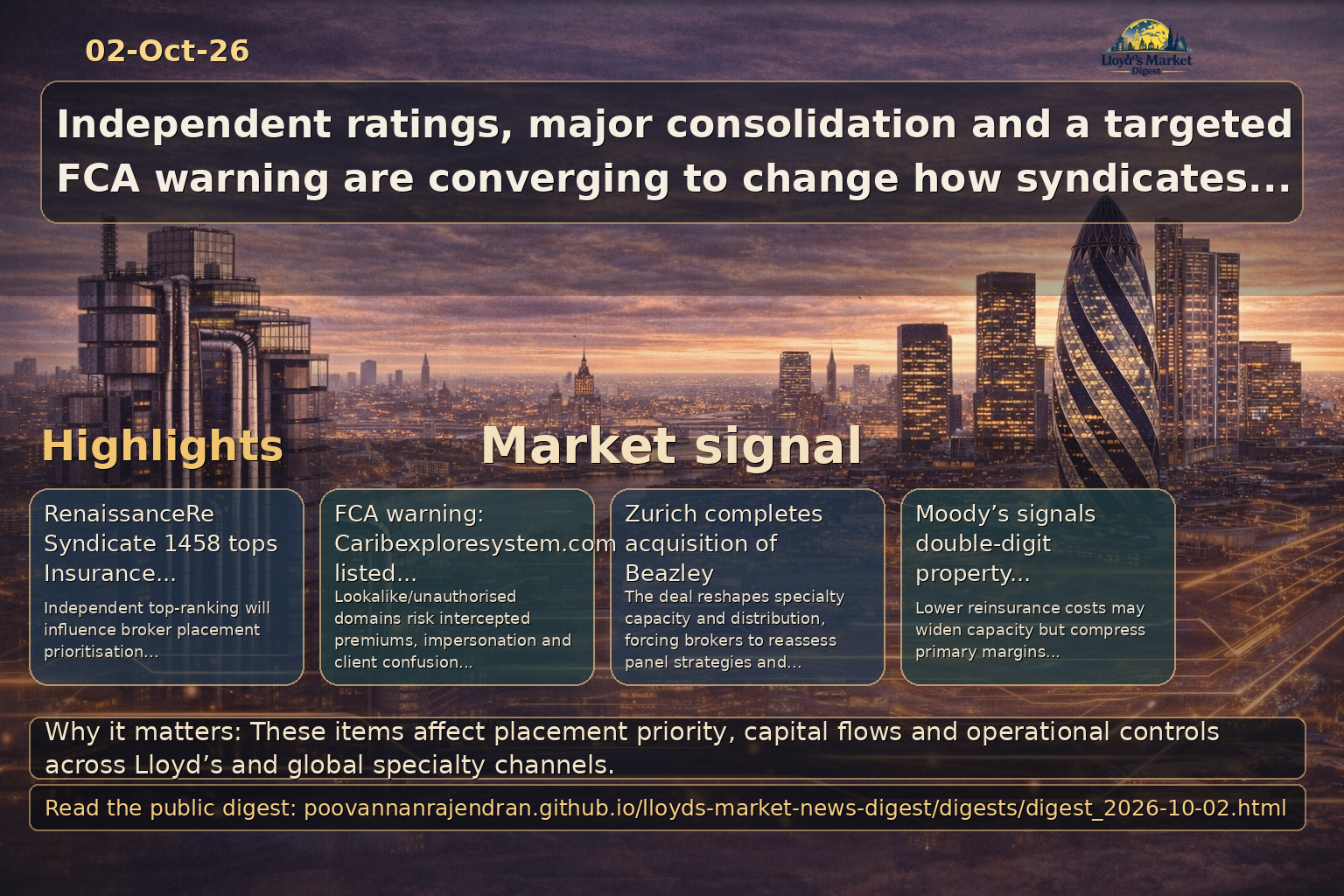
Why it matters: Insurance DataLab's 2026 Lloyd's Underwriting Ratings placing RenaissanceRe-managed Syndicate 1458 first — by a very small margin over Aegis and ahead of Brit — is material for capital providers, brokers and platform operators: it provides an objective, comparative signal of underwriting discipline and multi-year performance that will influence syndicate selection, pricing leverage and capital flows within Lloyd's and the global specialty market.
- Broker placement prioritisation: Brokers and MGAs will increasingly reference independent syndicate scores when steering business, using top-ranked syndicates as selling points on placement platforms and in negotiations over terms and capacity.
- Capital and investor decisions: A quantifiable outperformance score supports syndicate capital retention and new capital attraction; capital providers will demand continued transparency on current-year vs aggregate metrics and stress scenarios.
- Underwriting and strategic response: Competing syndicates should reinforce underwriting discipline, loss mitigation and differentiated product propositions; platforms and reinsurers should integrate rating signals into analytics, appetite guides and placement workflows.
Source: bankofengland.co.uk
Why it matters: The digest consolidates PRA signals that will materially affect captives, accounting for credit risk, and supervisory priorities — areas that drive capital, pricing and distribution choices across Lloyd’s syndicates, global specialty brokers and placement platforms.
- Review captive strategy and placements: CP11/26 outcomes may broaden or tighten the regulatory treatment of captives; syndicates and brokers should model impacts on risk transfer structures, pricing and client advisory propositions and engage with clients and placement platforms on alternative structures.
- Assess capital and reporting volatility from IFRS 9 ECL feedback: thematic findings imply potential changes to ECL assumptions and provisioning practice for reinsurance recoverables and credit exposures; finance and actuarial teams must stress‑test capital, reinsurance credit treatments and counterparty limits and update disclosures and pricing accordingly.
- Prepare for supervisory scrutiny on competitiveness and market efficiency: the PRA’s consultation and annual report signals an active stance on competition and growth; Lloyd’s managing agents, brokers and platform operators should document market conduct, demonstrate efficiency improvements (including platform adoption) and engage proactively with the PRA to shape implementation timelines.
Source: fca.org.uk
Why it matters: caribexploresystem.com is listed by the FCA as unauthorised. In a Lloyd’s and global specialty context this raises heightened risk where regional or specialist names and brokers operate: premiums or instructions could be intercepted, and clients may be misled about protection and claims recourse.
- Validate any incoming instruction or premium flow referencing Caribbean or specialist programs through audited broker/syndicate contacts before actioning.
- Notify distribution partners and platform clients operating in the Caribbean or with specialty lines to beware and to verify counterparty FCA authorisation status.
- Update onboarding and reconciliation controls (KYB/beneficial owner checks, payee confirmation) and ensure IT/cyber teams block and monitor communications linked to the domain.
Source: fca.org.uk
Why it matters: xaiinv.com is flagged as unauthorised. A domain with an investment/AI implication can be used to impersonate financial-solutions providers to reinsurers, capital investors and high-net-worth stakeholders used by Lloyd’s market participants, creating a channel for fraud or misinformation about capital/placement solutions.
- Require out-of-band verification for any investment or capital-related communications and third-party proposals, and route suspicious contact through corporate security and compliance.
- Brief syndicate capital and investor-relations teams to watch for spoofing attempts and to confirm counterparty credentials via FCA register checks and known broker contacts.
- Coordinate with placement platforms to enforce stricter vendor validation for any new analytics, AI or investment service providers and document acceptance criteria.
Source: fca.org.uk
Why it matters: pathfander.com (likely a misspelling of established names) is listed as unauthorised. Misspelled or lookalike domains are commonly used to impersonate brokers or platforms, posing immediate operational risk to electronic placements, premium flows and client onboarding for syndicates and global brokers.
- Alert broker networks and placement-platform users to the specific lookalike domain and instruct control-room verification for any placement or quotation referencing unfamiliar domain names.
- Enhance domain-monitoring and DMARC/DKIM/SPF checks to detect spoofed emails, and ensure automated payment/contract workflows require dual verification for new counterparty endpoints.
- Integrate FCA Warning List checks into third-party screening and training for client-facing staff to reduce the chance of impersonation-driven losses.
Source: reinsurancene.ws
Why it matters: Gallagher’s hires for its PEMA practice demonstrate brokers expanding specialist transactional and private‑equity focused capabilities in Europe — reinforcing broker centrality in deal-driven insurance placement and risk transfer for M&A activity.
- Expanded transaction solutions capability increases broker leverage to capture time‑sensitive deal flows, influencing where transactional capacity is placed among specialty insurers and syndicates.
- Sustained focus on M&A-related risk products (R&W, tax liability, contingent risk) will drive demand for bespoke reinsurance structures and faster binding processes from markets and platforms.
- Brokers with deep transactional expertise will become preferred partners for PE clients, pressuring competitors and placement systems to support accelerated policy issuance and cross-border compliance.
Source: businessinsurance.com
Why it matters: Axa XL creating a dedicated excess & surplus vehicle shifts capacity dynamics that matter to Lloyd’s syndicates, global specialty brokers and placement platforms.
- Adds rated company paper alternative to Lloyd’s and syndicate capacity for large or non-standard risks
- May accelerate direct placement trends through carrier platforms, reducing reliance on syndicated London placements
- Requires brokers to reassess submission strategies and leverage product specialization to preserve margins
Source: businessinsurance.com
Why it matters: Flash flooding and transport disruption are immediate operational and attritional drivers for property, contingency and supply‑chain exposures underwritten by specialty markets and syndicates.
- Short‑term spike in attritional claims and business interruption notifications affecting loss ratios
- Elevation of modeled catastrophe frequency in regional portfolios, pressuring underwriting and reinsurance buying
- Increases demand for granular risk analytics and client continuity planning from brokers and placement platforms
Source: businessinsurance.com
Why it matters: Moody’s forecast of double‑digit property reinsurance rate cuts for 2027 is material to capital planning, retrocession programs and syndicate underwriting discipline at Lloyd’s and global carriers.
- Compressing reinsurance costs could widen underwriting capacity but compress margin if primary pricing softens faster
- Syndicates must revisit program structures and attachment strategies to preserve profitability
- Brokers should prepare to negotiate multi‑year placements and emphasize loss control to counteract rate erosion
Source: businessinsurance.com
Why it matters: Swiss Re’s partnership with Bajaj General signals reinsurer-led market entry and capacity delivery into South Asia — a strategic growth route for global specialty markets and Lloyd’s distribution partners.
- Provides local fronting and capacity that supports underwriting expansion into India’s retail and commercial classes
- Enhances cross‑border product distribution opportunities for brokers and syndicates seeking emerging market exposure
- Strengthens reinsurer‑insurer collaboration models that placement platforms can leverage for faster execution
Source: businessinsurance.com
Why it matters: Executive profiles (Benjamin C. Eggert) highlight talent that can influence broker‑carrier relationships, distribution strategy and specialty underwriting leadership.
- Signals availability of senior expertise that brokers and syndicates may court for market positioning
- Experienced executives often accelerate platform adoption or partnership initiatives
- Talent movement can presage strategic shifts in client coverage, underwriting focus or claims handling
Source: globalreinsurance.com
Why it matters: Lockton Re's commentary that MENA is shifting from resilience to opportunity matters for Lloyd's firms, global reinsurers and brokers seeking diversification and growth. Stronger-than-expected GCC performance amid regional tensions creates a commercial mandate to deploy capital-efficient solutions, develop localized products and expand distribution via brokers and digital placement channels.
- Strategic market entry and expansion: Syndicates and global brokers should prioritise targeted MENA strategies — including local partnerships, tailored covers for energy, construction and political-risk exposures, and dedicated capacity for regional cedants.
- Capital efficiency and balance-sheet optimisation: Demand for retrocession, quota shares and capital-light structures will rise; placement platforms should surface efficient programme designs and analytics that evidence capital relief and return on capital.
- Risk-product innovation and analytics: Insurers and reinsurers must invest in regional risk modelling, geopolitical scenario analysis and product innovation (eg. parametric covers, political violence protection) to capture opportunity while maintaining underwriting discipline.
Source: insurancejournal.com
Why it matters: Motor and rental‑fleet fraud cases demonstrate persistent claims leakage and underwriting vulnerability for specialty and E&S motor products; brokers and underwriters in London and global specialty markets must reinforce verification and fraud‑detection protocols to protect loss ratios and reinsurance recoverability.
- Reinforce inception‑of‑risk controls: require verifiable prior loss history, vehicle inspection evidence and telematics/data logs for high‑value rental fleets and specialty motor placements.
- Integrate claims analytics and fraud scoring into placement workflows to reduce indemnity leakage and inform underwriting appetite at syndicate and carrier level.
- Advise clients on stricter policy warranties and documentation standards; brokers should prepare to negotiate coverage language and premium adjustments for elevated fraud risk.
Source: insurancejournal.com
Why it matters: Ongoing Roundup litigation illustrates tail risk from mass tort and product‑liability exposures that can erode specialty capacity and strain syndicate reserves; the case underscores the need for rigorous reserving, reinsurance strategy and claims‑allocation frameworks across Lloyd’s and global specialty carriers.
- Reassess reserves and stress tests for legacy product liability exposures; ensure actuarial scenarios reflect adverse court outcomes and settlement tail costs.
- Revisit treaty and facultative reinsurance placement terms, including aggregation and clash language, to protect balance sheets from correlated mass tort losses.
- Engage brokers early to structure alternative risk solutions (aggregated program limits, captive reinsurance, settlement funds) for clients facing protracted litigation.
Source: insurancejournal.com
Why it matters: Allegations of fraud and money laundering in commodity trading bring heightened counterparty and financial‑crime risk to trade‑credit, political risk and transactional insurance lines; syndicates, MGAs and brokers must expand due diligence on trading counterparties and payment flow risks tied to placements.
- Enhance KYC and transaction level due diligence for commodity and trade finance risks; require corroborating bank/payment channel documentation before binding coverage.
- Review policy wordings for fraud and concealment clauses, and coordinate with reinsurers on counterparty exclusions and collateral requirements.
- Work with placement platforms to incorporate automated sanctions/Fraud screening and to capture evidentiary documentation during submission to minimize post‑loss disputes.
Source: insurancejournal.com
Why it matters: Zurich’s acquisition of Beazley materially changes Lloyd’s market composition and specialty capacity dynamics; executives should evaluate implications for syndicate access, distribution relationships, product shelf rationalisation and talent retention across London and global specialty channels.
- Model capacity and market share shifts post‑acquisition; determine potential redistribution of syndicate risk appetite and impact on delegated underwriting arrangements and managing agent relationships.
- Assess distributor relationships and product overlap; brokers should identify where consolidated product offerings can simplify client placement or where competition may tighten terms and pricing.
- Prioritise retention strategies for underwriting and claims talent and review integration plans to preserve Beazley’s specialty expertise and broker relationships within the acquiring group.
Source: insurancejournal.com
Why it matters: Senior leadership moves at global insurers often presage strategic shifts in distribution, digital investment and product focus; Allianz’s executive appointments indicate emphasis on digital platforms and mobility/service led solutions relevant to brokers, MGAs and specialty partners.
- Anticipate product and distribution realignment driven by new leadership priorities; brokers should monitor for revised appetite in cyber, mobility and service‑driven specialty products.
- Leverage executive signals to engage on strategic partnerships around digital distribution and customer experience enhancements, aligning broker platform roadmaps with carrier initiatives.
- Ensure contractual flexibility in distribution agreements to accommodate rapid changes in insurer go‑to‑market strategy under new executive leadership.
Source: insurancetimes.co.uk
Why it matters: Regulatory action against Wakam SA highlights jurisdictional divergence and the importance of entity separation for underwriting capacity; Wakam UK’s independence illustrates how market participants can be insulated but also signals due-diligence requirements for brokers and syndicates.
- Entity-level firewalls matter: UK-regulated entities can remain operational despite parent-group restrictions, requiring brokers to verify legal and capital separateness before placement.
- Placement caution: Brokers and platforms should adopt enhanced counterparty checks and contingency plans when placing with groups subject to cross-border regulatory interventions.
- Counterparty and reputation risk: Syndicates and carriers must communicate governance and remediation actions clearly to maintain broker confidence and protect access to distribution channels.
Source: insurancetimes.co.uk
Why it matters: Senior claims leadership at large brokers like Marsh demonstrates the strategic role of claims expertise in client retention, settlement strategy and pricing — a competitive asset for brokers and an influence on carrier loss costs and reserving.
- Claims as client value proposition: Deep claims capability differentiates brokers in commercial placements and influences client loyalty during large losses.
- Influence on underwriting and pricing: Experienced claims consultants can shape settlement approaches that reduce litigation exposure and long-term loss inflation.
- Talent continuity and knowledge transfer: Broker and carrier succession planning for senior claims roles is essential to preserve institutional knowledge and maintain claims-handling standards.
Source: insurancetimes.co.uk
Why it matters: Market debate on AI’s value highlights investor sensitivity to perceived disintermediation risk; brokers and placement platforms must reconcile AI investment with demonstrable advisory value and robust governance to protect valuations and client trust.
- Strategic AI adoption: Insurers and brokers should prioritise AI that augments adviser-client interaction rather than purely automating distribution in order to preserve advisory margins.
- Valuation and investor perception: Clear articulation of use-cases, regulatory compliance and client safeguards is required to avoid market-driven valuation volatility for listed brokers.
- Platform positioning: Placement platforms must demonstrate how AI improves placement outcomes and controls model risk, otherwise incumbents risk losing bargaining power with carriers.
Source: insurancetimes.co.uk
Why it matters: Zurich’s acquisition of Beazley is a landmark consolidation in specialty insurance, altering capacity pools, syndicate economics and broker negotiation dynamics across London and global specialty markets.
- Capacity and pricing dynamics: The deal reduces independent specialty capacity and may shift pricing leverage towards larger, integrated insurers in select lines.
- Syndicate and platform integration risk: Lloyd’s and non-Lloyd’s distribution channels will need to reconcile product, underwriting authority and delegated binding arrangements as the combined entity integrates.
- Broker access and panel management: Brokers must reassess panel strategies and placement leverage as established specialty underwriters integrate into broader group underwriting agendas.
Source: insurancetimes.co.uk
Why it matters: ABI’s appointment to strengthen membership and commercial development matters for industry coordination on regulatory change, professional development and public policy — issues that affect brokers, syndicates and specialty carriers.
- Industry engagement: Enhanced member relations support timely industry feedback on regulation affecting Lloyd’s and global specialty markets.
- Professional development: ABI programming can accelerate capability building in areas such as cyber, fraud prevention and claims-legal integration relevant to brokers and carriers.
- Policy influence: A proactive commercial development function helps align trade-body advocacy with member needs on technology adoption and cross-border regulatory issues.
Source: reinsurancene.ws
Why it matters: Historical market commentary underscores the cyclical nature of reinsurance pricing and capital payback periods — important context for C-suite planning and syndicate strategy as the market transitions.
- Reinforces that pricing cycles can reverse and that capital deployment requires multi-year planning for returns
- Useful context for syndicates weighing risk appetites and reserve strategies as rates soften
- Reminds brokers and placement platforms to stress-test long-tail and pro-cyclical exposures when structuring programmes
Source: reinsurancene.ws
Why it matters: Marsh research identifies a material gap between risk insight and business action in Europe — a core challenge for brokers, syndicates and placement platforms seeking to monetise analytics and advisory services.
- C-suite must prioritise governance to convert scenario analytics into underwriting and capital decisions
- Brokers and Lloyd’s platforms can differentiate by embedding actionable resilience solutions into placements
- Investment in AI/analytics and workflow integration is required to close the insight-to-action gap
Source: reinsurancene.ws
Why it matters: Signals of 10–15% rate declines for 2027 renewals materially affect syndicate pricing strategy, capital allocation and broker negotiation posture for January renewals.
- Syndicates need to preserve underwriting discipline where accumulation and emerging perils remain elevated
- Brokers should prepare structure-focused solutions (terms, exposure management) rather than pure price-driven placements
- Placement platforms and capital providers will reassess portfolio mix and retrocession plans in response to easing rates
Source: reinsurancene.ws
Why it matters: Bermuda’s decade of Solvency II equivalence cements its role as a strategic capital hub for European cedants and impacts capacity sourcing and group supervision considerations for Lloyd’s and global specialty markets.
- Maintains Bermuda as a preferred domicile for Europe-facing reinsurance capacity and cross-border transactions
- Influences broker placement strategies where equivalence reduces regulatory friction for EEA clients
- Supports syndicate and platform discussions on capital structuring and access to non-EU capacity
Source: newsnow.co.uk
Why it matters: Developments involving New York State leadership can presage regulatory, fiscal and legislative shifts that materially affect admitted and surplus lines, D&O exposures, and market conduct expectations for carriers and brokers operating in the US market.
- Regulatory impact: potential changes in licensing, surplus lines rules, or consumer protection measures that affect Lloyd’s syndicates writing US risks.
- Underwriting implication: increased scrutiny on public-sector, municipal and D&O risks; adjust appetite and pricing for exposures tied to state policy shifts.
- Broker/placement action: ensure NY-specific compliance in platform workflows and contract wordings; pre-position market notices for clients exposed to state legislative change.
Source: newsnow.co.uk
Why it matters: High-profile activity by a state Attorney General increases litigation and enforcement risk for insureds across financial services, real estate and corporate sectors—feeding D&O, professional indemnity and reputational-loss exposures relevant to Lloyd’s and specialty markets.
- Claims and litigation: elevated risk of regulatory investigations and civil suits that drive D&O and entity-level claims frequency and severity.
- Underwriting due diligence: need for enhanced disclosure requirements, warranties and exclusions where AG enforcement risk is material.
- Broker/placement response: tighten placement documentation, consider side-letter protections and work with placement platforms to evidence enhanced KYC and diligence.
Source: newsnow.co.uk
Why it matters: Ongoing protests in France create immediate political violence, business interruption and property-damage exposures for multinational programmes, increasing aggregation risk across EU portfolios and stressing crisis-response capabilities.
- Risk accumulation: elevated property and BI aggregation in urban concentrations; syndicates must re-evaluate exposure maps and credit/reinsurance arrangements.
- Coverage and pricing: review political violence endorsements, BI triggers and sub-limits for France and neighbouring regions.
- Broker/platform strategy: deploy rapid-placement capabilities and coordinated wording amendments on platforms to secure capacity and expedite claims handling for impacted clients.
Source: newsnow.co.uk
Why it matters: Shifts in India–Russia relations can affect trade flows, sanctions exposure and geopolitical risk, with downstream consequences for sanctions screening, trade-credit, energy and political-risk underwriting in the Lloyd’s and specialty marketplace.
- Compliance exposure: potential for new sanctions, licences or trade restrictions that increase counterparty and claims risk; heightened need for sanctions screening.
- Underwriting reassessment: review political risk, trade credit and commodity-related exposures where supply chains or counterparties involve sanctioned jurisdictions.
- Broker/placement action: ensure platform-level sanctions controls, enhanced KYC, and contingency clauses to manage sudden de-risking or capacity withdrawal.
Source: newsnow.co.uk
Why it matters: UK housing-market movements influence residential property values, mortgage-related exposures and personal-lines loss trends; these dynamics affect pricing, accumulation modelling (flood/subsidence) and distribution strategies in the Lloyd’s and global specialist markets.
- Exposure modelling: adjust catastrophe and accumulation models to reflect changing residential concentrations, rebuild costs and flood/subsidence vulnerability.
- Profitability and pricing: anticipate pressure on personal-lines rates and claims frequency; syndicates should review expense and re-rate assumptions.
- Distribution implications: brokers and MGAs to explore product innovation and digital placement platforms to improve risk selection and reduce distribution friction.