Source: globalreinsurance.com
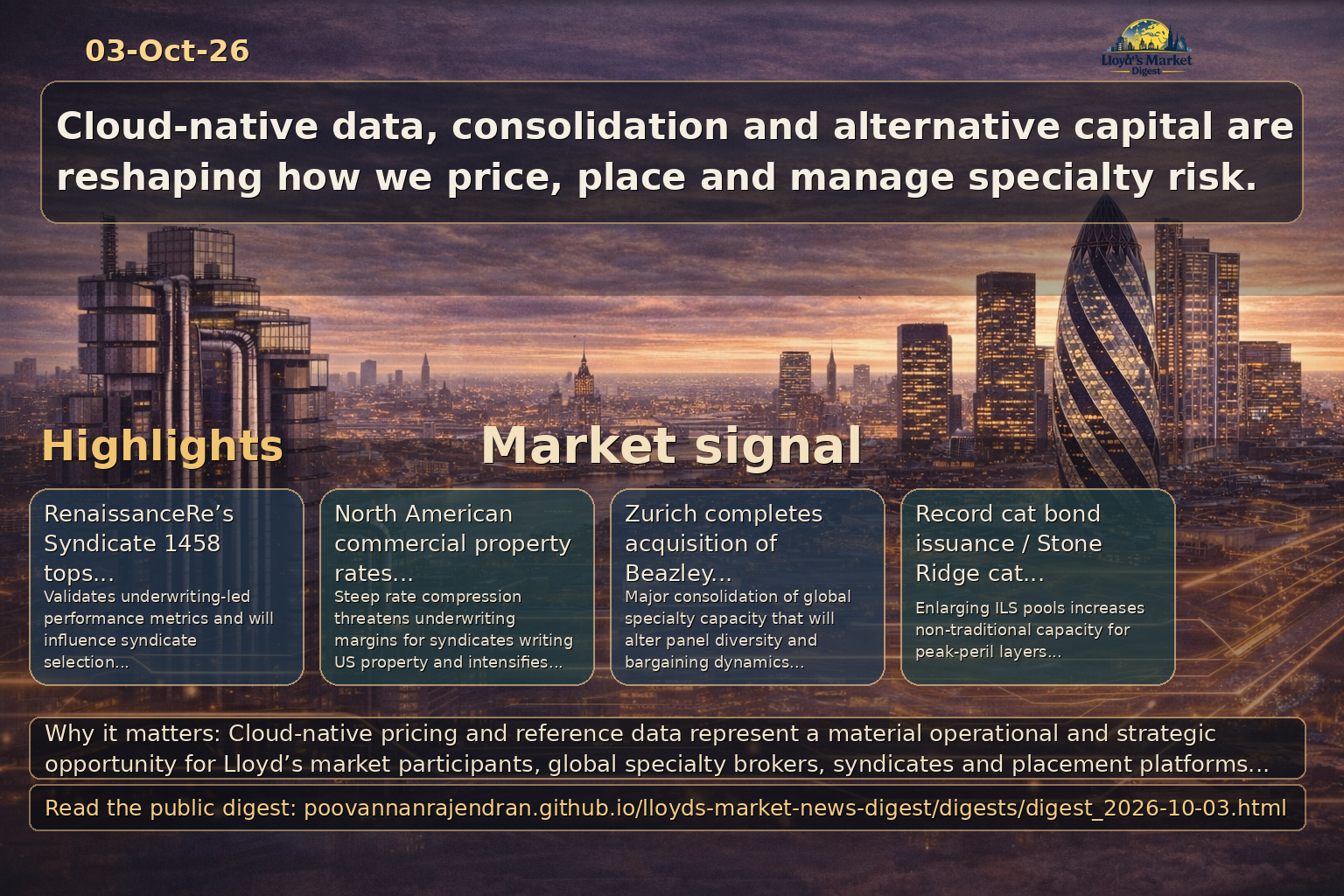
Why it matters: RenaissanceRe-managed Syndicate 1458 topping Insurance DataLab’s 2026 Lloyd’s rankings is a signal event for capital allocators, brokers and Lloyd’s platform managers — it validates underwriting-led performance metrics and will influence syndicate selection, rate negotiation and distribution strategies.
- Reinforces value of measurable underwriting discipline: demonstrated current-year and multi-year performance will increase investor and corporate capital interest in high-scoring syndicates and influence syndicate capacity deployment.
- Broker advisory and placement implications: brokers should integrate these ratings into syndicate shortlists, negotiating leverage and client placement strategies, emphasizing syndicates with consistent combined underwriting strength.
- Market and platform response: underwriters and platforms will highlight data-driven performance in marketing and capital raising; competitors may accelerate underwriting governance, analytics and product focus to close the performance gap.
Source: fca.org.uk
Why it matters: FCA warning for glassertradecap.com highlights an unauthorised trading/investment operation that can be used to impersonate brokers or marketplaces; creates direct client credit and claims risk for syndicates and intermediaries.
- Immediate: Check distribution logs and broker correspondences for any interaction patterns or referrals to the domain; notify brokers and platform partners to block engagement.
- Controls: Require placement platforms and digital intermediaries to prove FCA authorisation or appropriate equivalence and include indemnity/representations for third‑party referrals.
- Monitoring: Add this domain to automated watchlists; ensure Legal and Compliance have escalation playbooks to notify the market and assist impacted clients.
Source: fca.org.uk
Why it matters: deepearmining.com appears on the FCA Warning List as an unauthorised operator; crypto/mining themes can attract wholesale and retail clients and complicate coverage determinations for specialty lines.
- Immediate: Confirm whether brokers or placement platforms have circulated or accepted business linked to the domain and freeze premium flows pending review.
- Controls: Update placement questionnaires and vendor due‑diligence templates to capture exposure to crypto/mining platforms and unauthorised entities.
- Monitoring: Coordinate with fraud/claims teams to look for emergent patterns (payment diversions, impersonation) and prepare client messaging templates.
Source: fca.org.uk
Why it matters: Verdantam.com listed as unauthorised increases the risk of misdirected client funds and fraudulent procurement of insurance or reinsurance capacity via spoofed intermediaries.
- Immediate: Audit incoming placements for payment instructions or premium transfers referencing the domain; instruct treasury to confirm beneficiary details by phone.
- Controls: Mandatory verification of new intermediary domains and electronic payment accounts before premium settlement; require dual authorization for outbound transfers.
- Monitoring: Include Verdantam.com in marketplace threat intelligence and share findings with Lloyd’s Market Services and broker compliance leads.
Source: fca.org.uk
Why it matters: FCA survey showing rising firm confidence and understanding of Consumer Duty is material to Lloyd’s market: it sets expectations for how brokers and platforms must protect customers and demonstrate governance over distribution chains.
- Immediate: Use the FCA findings to benchmark market practices; ask brokers and platform partners for evidence of Consumer Duty alignment in placement processes.
- Controls: Embed Consumer Duty and FCA expectations into vendor contracts, SLAs and audit criteria for third‑party platforms.
- Monitoring: Report annually to board/syndicate committees on Consumer Duty compliance across placement channels and use FCA metrics to prioritise remediation.
Source: fca.org.uk
Why it matters: caribexploresystem.com appears as an unauthorised actor; regional or niche‑branded sites can target specialty clients and create localised fraud that impacts regional brokers and syndicates underwriting emerging risks.
- Immediate: Validate any regional distribution agreements or lead generation feeds that could route business to this domain; suspend intake from suspect sources.
- Controls: Require regional brokers to provide provenance for client leads and implement enhanced KYC for markets with recent scam activity.
- Monitoring: Leverage regional compliance officers and broker network intelligence to detect similar spoofed domains and coordinate takedown requests.
Source: artemis.bm
Why it matters: Willis reporting the steepest decade-on-decade decline in North American commercial property rates signals a pronounced reversal from the multi-year hard market. For Lloyd's syndicates and global specialty underwriters writing US property, sustained rate compression implies near-term erosion of underwriting margins and heightened competition for large, complex accounts; brokers will face increased pressure to secure capacity and optimise placement mix.
- Underwriting response: Revisit appetite and structural terms for large and layered property placements, emphasising attachment points, limits management and stricter exposure aggregation controls to protect portfolio economics.
- Broker strategy: Leverage analytics, loss-control services and multi-carrier placement strategies (including Lloyd's syndicates, Bermuda carriers and ILS) to preserve client coverage while maximising premium and placement efficiency.
- Platform imperative: Enhance quoting velocity, comparative capabilities and data exchange standards to manage increased competition and volatility in submissions; streamline bind workflows and support multi-channel distribution to capture renewed volume shifts.
Source: businessinsurance.com
Why it matters: Carrier exit or divestment of retail operations reallocates distribution flows and can shift placement volumes toward brokers and wholesale/syndicate capacity, affecting Lloyd's global specialty appetite in that territory.
- Potential reallocation of premiums and risks to wholesale brokers and Lloyd's syndicates as Everest withdraws from Canadian retail, creating short-term placement demand and renewal risk-transfer opportunities.
- Brokers should reassess local client servicing and placement partnerships to capture displaced business while monitoring regulatory approvals and transitional continuity plans.
- Syndicates and capacity providers must evaluate exposure concentrations and pricing adequacy in Canadian lines that may see redistribution or repricing following the exit.
Source: businessinsurance.com
Why it matters: Willis taking full ownership of its UAE joint venture signals strategic consolidation of broker operations in a high-growth regional market, with implications for placement control, local licensing and relationships with syndicates and MGAs.
- Consolidation enhances Willis's ability to control distribution and placement strategy in the Middle East — syndicates should review appetite for direct placements versus broker-led programs in the region.
- Local licensing and compliance changes may alter broker access to ceded reinsurance and retrocession structures; placement platforms should ensure connectivity and contractual alignment.
- Competitors and regional brokers may respond with strategic partnerships or targeted product launches, impacting capacity allocation and commission structures for specialty lines.
Source: businessinsurance.com
Why it matters: Record cat bond issuance demonstrates persistent growth of alternative capital into catastrophe-exposed reinsurance — a structural dynamic that affects pricing, capacity and the role of traditional reinsurers and syndicates.
- Increased ILS supply expands capacity for peak perils, pressuring rate adequacy for primary syndicates but also offering cedants faster placement options and potentially improved pricing.
- Placement platforms and brokers should integrate ILS channels into program design, presenting hybrid solutions that combine treaty, facultative and capital-market coverage.
- Syndicates need to differentiate via underwriting expertise and service (claims, accumulation management) as non-traditional capital targets commoditized catastrophe risks.
Source: businessinsurance.com
Why it matters: Zurich's acquisition of Beazley and appointment of a specialty CEO represents a major consolidation in global specialty capacity, with direct implications for competitive dynamics among carriers, syndicates and broker placement strategies.
- Consolidation increases concentration among lead-capacity providers for specialty classes, prompting brokers and MGAs to reassess market access, panel diversity and potential conflicts of interest.
- Syndicates at Lloyd's should monitor competitive displacement risks and the potential for tightened capacity or differentiated appetite in lines formerly written by Beazley.
- Clients and brokers may seek expanded placement options or improved terms leveraging platform competition; placement platforms must articulate value propositions beyond pure capacity (e.g., advisory, data/analytics).
Source: businessinsurance.com
Why it matters: A legal ruling freeing a Zurich unit from an NFL concussion settlement underscores evolving judicial interpretations of policy scope and aggregation — a precedent relevant to syndicates and specialty carriers facing large, long-tail injury claims.
- Court decisions that limit carrier exposure can materially affect reserving and accumulation assessments for syndicates exposed to mass tort or group injury classes.
- Brokers should revisit policy wordings, aggregation clauses and reinsurance recoveries for long-tail casualty exposures to reduce ambiguity and litigation risk.
- Placement platforms and underwriters need enhanced legal and claims analytics to price latent injury risks accurately and to structure protective reinsurance or retrocession layers.
Source: globalreinsurance.com
Why it matters: Lockton Re’s assessment that MENA is moving from resilience to opportunity signals a strategic pivot for reinsurers, Lloyd’s syndicates and brokers: resilient Gulf economies combined with heightened demand for capital-efficient solutions create targeted growth corridors for specialty and treaty capacity.
- Opportunity for capital-efficient product innovation: demand for balance-sheet optimisation and protection against emerging risks (political, cyber, climate) creates space for tailored treaty structures, parametric solutions and specialty facultative offerings.
- Placement and distribution strategy: brokers should position Lloyd’s and specialty capacity as solutions for local cedants, leveraging placement platforms and tailored documentation to expedite local market access and capital deployment.
- Risk and capacity management: syndicates and reinsurers must calibrate appetite and pricing for increased MENA exposure, balancing growth with disciplined underwriting and capital stress testing given geopolitical volatility.
Source: insurancetimes.co.uk
Why it matters: An experienced HNW executive moving to an MGA signals MGAs scaling private client and specialty personal lines capabilities that compete for wholesale capacity and broker distribution.
- Elevates MGA credibility with brokers and capacity providers, improving access to delegated underwriting facilities.
- Increases competition for syndicate and insurer capacity in specialist personal lines; underwriters should reassess appetite and terms.
- Brokers should position placement strategies to exploit bespoke private client offerings and negotiate data/reporting requirements.
Source: insurancetimes.co.uk
Why it matters: Senior appointments at wholesale and national brokers reflect consolidation momentum and executive repositioning that will influence market access and negotiating power with syndicates and carriers.
- New leadership at wholesale brokers presages strategic shifts in distribution, M&A readiness and scale-driven product pushes.
- Syndicates and insurers should monitor broker partner strategies for changes in panels, delegated arrangements and placement volumes.
- Placement platforms must anticipate integration requests and strengthen API/data interoperability to retain high-volume broker relationships.
Source: insurancetimes.co.uk
Why it matters: Evidence of a cyber skills gap and soft market dynamics means brokers are struggling to convert demand into placements; this affects underwriting performance and attachment rates across specialty markets.
- Broker education and value-led advisory are required to increase cyber uptake; plain-worded modular products and risk services will help.
- Underwriters should couple capacity with pre-bind risk mitigation and faster binding workflows to reduce friction and adverse selection.
- Placement platforms can differentiate by embedding assessments and remediation tools to raise confidence and conversion.
Source: insurancetimes.co.uk
Why it matters: Leadership departure at Beazley following Zurich's acquisition points to integration and strategic realignment risks within the global specialty franchise that affect counterparties and distribution continuity.
- Executive turnover may signal product repricing, portfolio rationalization or a shift in underwriting authority under Zurich governance.
- Brokers should seek early engagement on continuity, policy terms and placement protocols to avoid client disruption.
- Syndicates and co-underwriters must reassess exposure concentration and partnership terms with the restructured entity.
Source: insurancetimes.co.uk
Why it matters: Zurich completing its acquisition of Beazley materially alters the global specialty landscape, consolidating capacity and shifting bargaining dynamics across placement channels.
- Consolidation reduces the number of independent specialty carriers, with potential implications for capacity diversity and pricing leverage.
- May accelerate redistribution of reinsurance and facultative placements across remaining specialty providers and Lloyd's syndicates.
- Brokers and placement platforms should update market access strategies and contingency panels to preserve competitive quoting.
Source: reinsurancene.ws
Why it matters: Historic archive content provides context on pricing cycles and catastrophe impacts—essential input for scenario analysis and strategic planning in a cyclical specialty market.
- Leverage historical cycle data to stress-test syndicate portfolios and capital models under plausible catastrophe and pricing scenarios.
- Use archived market commentary to inform renewal strategy timing and negotiation tactics with global brokers and platforms.
- Maintain an intelligence function that maps past cycle triggers to current exposures to improve proactive capacity management.
Source: reinsurancene.ws
Why it matters: Willis' report of sharp rate declines for large and layered property programmes highlights a broader softening that will affect Lloyd's syndicates, global specialty carriers and brokers' negotiating dynamics.
- Reassess pricing and attachment strategies for layered placements; syndicates should tighten underwriting disciplines on large accounts.
- Brokers must shift value messaging toward risk engineering, claims performance and programme design to preserve commissions and client outcomes.
- Placement platforms should offer analytics demonstrating blended programme economics to support structured placements and margin protection.
Source: reinsurancene.ws
Why it matters: The $5.8bn Lincoln Financial reinsurance transfer exemplifies continued demand for capital-efficient legacy solutions and demonstrates market capacity for large life and annuity block transfers.
- Syndicates and reinsurers should assess appetite for legacy and longevity transactions, and develop SPV or coinsurance structures to attract institutional capital.
- Brokers to proactively market legacy-block opportunities to specialist investors and structure contingent reinsurance solutions.
- Update capital modeling to quantify impacts of large block transfers on retrocession needs and corridor exposure.
Source: reinsurancene.ws
Why it matters: Lockton's view of strong capacity and buyer flexibility underlines increased competition and the need for brokers and syndicates to deliver differentiated technical value beyond price.
- Brokers should broaden programme reviews to encompass capital optimisation, aggregation risk and non-price terms (eg. reinstatements, W&P).
- Syndicates must invest in underwriting specialization, loss-control services and claims responsiveness to maintain premium adequacy.
- Placement platforms to enhance transparency and speed of quoting to capture business in a buyer-favourable market.
Source: reinsurancene.ws
Why it matters: Enact's 35% quota-share ceded to a panel of rated reinsurers demonstrates active use of quota-share arrangements as a CRT tool—relevant to syndicates, reinsurers and platforms managing capacity allocation.
- Evaluate participation in quota-share panels to scale portfolio growth while controlling capital volatility.
- Negotiate clear collateral, settlement and reporting mechanics to protect balance-sheet and rating outcomes when entering quota-share deals.
- Placement platforms should support transparent cession tracking and provide standardised documentation to speed execution.
Source: artemis.bm
Why it matters: Stone Ridge reaching $5bn in its cat bond fund demonstrates material, continuing inflows of institutional capital into insurance-linked securities. For Lloyd's syndicates, global specialty carriers and brokers this enlarges the investible capacity set for catastrophe risk, alters pricing dynamics for retrocession and quota share, and increases demand for standardised, platform-friendly structures that enable direct institutional access.
- Market implication: Growing ILS pools increase non-traditional, price-sensitive capacity for peak-peril layers and vintage exposures, pressuring syndicate reinsurance demand and margin on commoditised catastrophe lines.
- Broker action: Expand ILS advisory capabilities within brokerage suites to originate, structure and place ILS solutions alongside traditional reinsurance, and present integrated options during renewals.
- Platform opportunity: Prioritise connectivity and templated documentation to support ILS investors and managers, enabling faster access, transparent investor reporting and the creation of hybrid placement workflows combining broker access and direct ILS issuance.
Source: newsnow.co.uk
Why it matters: Tel Aviv’s profile as Israel’s economic and technology centre matters to Lloyd’s and global specialty markets for three linked reasons: it concentrates cyber and tech-sector exposures that create aggregation and systemic loss potential; it is a fertile source of insurtech partnerships and distribution innovation relevant to syndicates and placement platforms; and its geopolitical/security environment drives demand for political violence, contingency and trade credit solutions.
- Insurtech and distribution opportunity — Tel Aviv’s startup ecosystem is a pipeline for insurtech pilots, MGAs and API-driven placement models. Syndicates and brokers should prioritise strategic partnerships and scalable API integrations to capture distribution and data advantages.
- Cyber concentration & aggregation modelling — High density of technology firms increases cyber accumulation risk. Underwriters and reinsurers must update exposure analytics, share intelligence via platforms and impose prudent aggregation limits or layered structures.
- Political/security and contingency demand — Regional security tensions elevate demand for political violence, kidnap & ransom, trade disruption and property/business interruption covers. Syndicates need tailored wordings, rapid-capacity mechanisms and broker workflows for expedited placements.
Source: newsnow.co.uk
Why it matters: The extension of London’s ULEZ reshapes motor and fleet risk economics and distribution dynamics across Greater London. For Lloyd’s syndicates, global specialty brokers and platform operators, this regulatory change will affect claims frequency and severity, residual values, product offerings (retrofit and compliance policies) and accelerate telematics and data-driven pricing integration.
- Fleet underwriting and pricing impact — Removal of older, higher‑emitting vehicles changes exposure profiles and claim patterns. Underwriters must reassess frequency/severity assumptions, residual values and corridor pricing for urban fleets and logistics operators.
- Product innovation and ancillary covers — Opportunity for new products: retrofit/upgrade warranties, short‑term compliance permits, EV transition cover and gap/residual value products. Syndicates can develop niche coverages to capture available premium pools.
- Distribution, telematics and platform integration — Brokers, MGAs and placement platforms need to ingest ULEZ compliance data and telematics feeds to refine risk segmentation and enable real‑time pricing. Digital placement workflows will be essential to manage high-volume, regulatory-driven policy changes.
Source: risk.net
Why it matters: This LSEG guide frames the shift from cloud adoption to operational advantage—directly relevant to Lloyd’s syndicates, global specialty brokers and placement platforms seeking to accelerate pricing, placement and analytics without proliferating ad hoc data copies.
- Reduce engineering and operational overhead by centralising pricing and reference datasets in cloud-native services, lowering reconciliation and manual data stitching for brokers and syndicates.
- Enable machine-ready data to support AI/ML pricing models and automated placement rules, improving quote velocity and underwriting consistency across syndicates and MGA workflows.
- Adopt robust data governance, access controls and auditability to satisfy Lloyd’s market reporting, insurer capital models and platform-level compliance while preserving data lineage for actuarial and reserving uses.