Source: insurancejournal.com
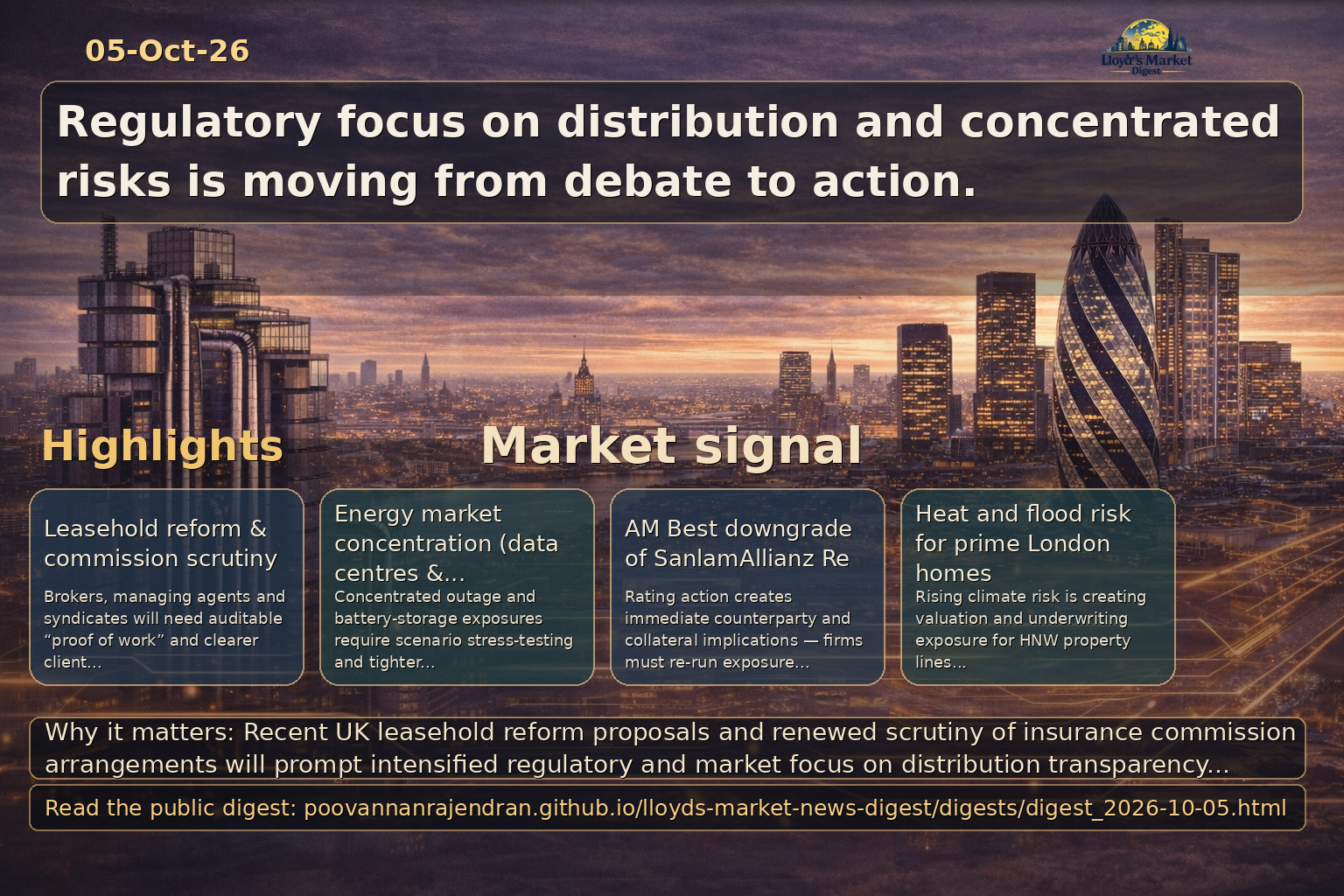
Why it matters: The Energy Market Playbook flags concentrated, evolving risks (data centers, battery storage) and anticipates a pricing correction — directly material to Lloyd's syndicates writing energy property, global specialty energy facilities and brokers placing complex outage and storage risks.
- Reassess portfolio concentration: run scenario stress tests for data-center outage and clustered battery-storage losses across syndicates; require placement platforms to produce aggregated exposure dashboards before committing capacity.
- Update underwriting and policy terms: adopt battery-specific warranties/maintenance schedules, thermal-runaway exclusion clauses where appropriate, and expand outage/contingent BI wordings to reflect complex interdependencies (power, telecom, supply-chain).
- Adjust pricing and reinsurance strategy: prepare for a 2027 pricing correction by tightening capacity limits, increasing attachment points on reinsurance programs, and piloting parametric outage products via placement platforms to transfer non-accumulating outage risk.
Source: insurancejournal.com
Why it matters: Rising heat and flood risk in prime London homes creates valuation, underwriting and reputational exposure for HNW property lines commonly underwritten by Lloyd's syndicates and surplus carriers — brokers must advise clients on mitigation and placement strategies.
- Implement climate-adjusted valuations and underwriting overlays: require location-level climate stress testing and condition surveys for high-value homes; embed valuation downgrades into renewal considerations where adaptation is insufficient.
- Product and risk-mitigation incentives: develop endorsement packages that encourage flood-proofing and heat mitigation (e.g., elevated services, cooling resilience), and consider conditional pricing or premium credits tied to verified retrofits.
- Distribution and placement actions: instruct brokers and delegated authorities to flag at-placement elevation of climate concentration, restrict appetite where systemic reputational risk exists, and use placement platforms to source multi-carrier capacity for bespoke HNW placements.
Source: insurancejournal.com
Why it matters: Insurance Journal West's surplus lines and wholesale focus signals shifting rate dynamics, regulatory initiatives and marketplace structures — all relevant to Lloyd's capacity allocation, wholesale brokers and placement-platform integration strategies.
- Monitor rate moderation impact on profitability: quantify the effect of the reported commercial-rate moderation on syndicate loss ratios and adjust underwriting guidelines or appetite for marginal accounts accordingly.
- Strengthen distribution and digital placement connectivity: accelerate investments in placement-platform integrations (IVANS, MGAs, delegated authority systems) to preserve margin in wholesale channels and improve submission-to-bind efficiency.
- Track regulatory and disclosure changes: review policy wordings and compliance processes in light of emerging statutes (e.g., smoke-damage presumptions, disclosures) and coordinate with brokers to ensure consistent client communications and placement documentation.
Source: insurancetimes.co.uk
Why it matters: Leasehold reform-driven attention to insurance commissions directly affects brokers, managing agents and carriers active in property and related specialty lines; it requires proof that commission levels reflect demonstrable services and creates obligations for placement platforms and syndicates to record and justify remuneration flows.
- Immediate compliance actions: conduct a rapid review of broker and managing-agent commission-sharing agreements, update client disclosures, and assemble documented ‘proof of work’ for property placements to withstand regulatory audit.
- Platform and systems upgrades: ensure electronic placement platforms and agency agreements capture commission splits, service descriptions and time-stamped evidence of advisory activity to create an auditable trail for FCA-style inquiries.
- Commercial and governance response: assess the financial impact of potential migration from commission to explicit fee models, renegotiate remuneration clauses where necessary, and implement board-level oversight and reserves for reputational or enforcement contingencies.
Source: reinsurancene.ws
Why it matters: AXA XL's appointment of a senior Chief Client & Distribution Officer for APAC and Europe signals a strategic push to sharpen distribution, deepen broker relationships and differentiate placement approaches across key markets.
- Brokers should anticipate more targeted, account-led engagement from a global specialty carrier—opportunities for preferred supplier relationships and differentiated access to capacity.
- Syndicates and wholesale partners must review placement protocols and data-sharing expectations as carriers push for client-first, metrics-driven distribution.
- Placement platforms should prioritise integration capabilities that surface client metrics and support bespoke placement workflows to capture enhanced distribution mandates.
Source: reinsurancene.ws
Why it matters: AM Best's downgrade of SanlamAllianz Re highlights ongoing capital and governance vulnerabilities among reinsurers, creating immediate counterparty and collateral considerations for cedants, brokers and syndicates.
- Immediate operational impact: brokers and cedants should re-run counterparty exposure analyses, confirm collateral arrangements and update credit terms where ratings changes trigger protections.
- Market pricing and capacity dynamics: downgrades can prompt repricing, reduced retrocession capacity or tightened terms—syndicates should stress-test portfolios for concentration and counterparty risk.
- Placement platforms and underwriting teams must embed rating-change triggers in placement workflows and compliance checks to avoid distribution to materially weakened counterparties.
Source: reinsurancene.ws
Why it matters: Hiscox's CEO joining the IDF Steering Committee reflects a heightened industry commitment to public-private climate resilience initiatives, with direct relevance for product development, sovereign risk solutions and regulatory engagement.
- Product and capacity opportunities: brokers and syndicates can develop or scale sovereign and parametric solutions aligned with IDF frameworks, opening new capacity pools and premium streams.
- Underwriting and modelling expectations will tighten—underwriters should prepare for enhanced climate-risk disclosure, model validation demands and collaboration with public-sector partners.
- Strategic positioning: placement platforms and carriers should publicise climate governance and engagement credentials to win mandates from governments, multilaterals and risk-averse cedants.
Source: newsnow.co.uk
Why it matters: Coverage of Milorad Dodik signals elevated Balkan political risk and potential sanctions/tension that can affect underwriting, local broker networks and placement stability for European and specialty portfolios.
- Elevated political and territorial risk increases probability of political violence and war exclusions being triggered; syndicates should re-evaluate exposures and pricing for SE Europe.
- Sanctions and counterparty screening become material — tighten compliance controls, transaction monitoring and escalation procedures for affected placements.
- Brokers and placement platforms must verify local intermediary integrity and contractual protections; consider contingency plans for sudden market exits or asset freezes.
Source: newsnow.co.uk
Why it matters: Tucker Carlson remains an influential media figure whose commentary can rapidly shape public sentiment, trigger reputational losses and drive demand for media liability, D&O and crisis-management coverages relevant to specialty carriers and syndicates.
- Media amplification can create fast-moving reputational exposures for insureds and intermediaries — test crisis-response clauses and PR coordination in BOLI/D&O/Media Liab policies.
- Expect heightened demand and claims activity in media liability and reputation protection products; reassess limits, retentions and exclusions.
- Placement platforms and brokers should apply enhanced reputational due diligence on high-profile media clients and ensure syndicate appetite is documented for politically sensitive accounts.
Source: newsnow.co.uk
Why it matters: Coverage referencing Jacob Rees-Mogg highlights UK domestic political conversation that can presage regulatory or fiscal policy changes impacting the Lloyd’s market, taxation, market access and insurer operating assumptions.
- UK political developments may precede regulatory shifts affecting capital, consumer protection or taxation — maintain active regulatory horizon-scanning and scenario modelling.
- Policy rhetoric can influence market sentiment and underwriting appetite for UK exposures; brokers should coordinate with syndicates on re-underwriting strategies.
- Syndicates should engage with placement platforms to stress-test operational impacts of rapid regulatory change and plan communications for broker and client channels.
Source: newsnow.co.uk
Why it matters: Global poverty headlines point to macro demand shifts and affordability pressures that affect product design, social inflation trends and the opportunity set for microinsurance and public-private partnerships in specialty markets.
- Rising poverty alters demand curves for retail protection and microinsurance — evaluate product simplification, lower-premium offerings and distribution partnerships.
- Socioeconomic stress can exacerbate social inflation and claims frequency in certain lines; incorporate this into reserving and pricing assumptions.
- Brokers and placement platforms should prioritise scalable distribution models and partnerships (including NGO and government) to capture underserved markets while managing moral hazard.
Source: newsnow.co.uk
Why it matters: UK-specific poverty metrics are a near-term regulatory and reputational concern for Lloyd’s syndicates writing personal lines, household and social-protection business in the UK — implications for pricing, consumer protection and political scrutiny.
- UK poverty trends increase likelihood of regulatory interventions on affordability and fair treatment; syndicates should review UK retail pricing governance and complaint handling.
- Shifts in household financial resilience may change loss patterns for household, motor and credit lines — update stress tests and loss projections accordingly.
- Brokers and platforms should develop product and payment flexibility (instalments, micro-premiums) and document consumer protection measures to mitigate regulatory risk.