Source: fca.org.uk
Why it matters: A missing FCA page indicates link rot or content reorganisation that can obscure regulatory guidance and warnings. For Lloyd’s market participants, reliance on stale or broken regulatory links increases legal and operational risk, undermines client advisories and weakens remediation timelines.
- Governance: designate a regulatory monitoring owner to maintain live FCA feeds, flag removed content and provide verified alternatives to brokers and clients.
- Systems: implement automated link-validation and archival of cited regulator pages within placement platforms, compliance libraries and client advisories.
- Communications: formalise escalation and client-notification protocols when regulator content changes to avoid misinformation during placements, renewals and claims handling.
Source: fca.org.uk
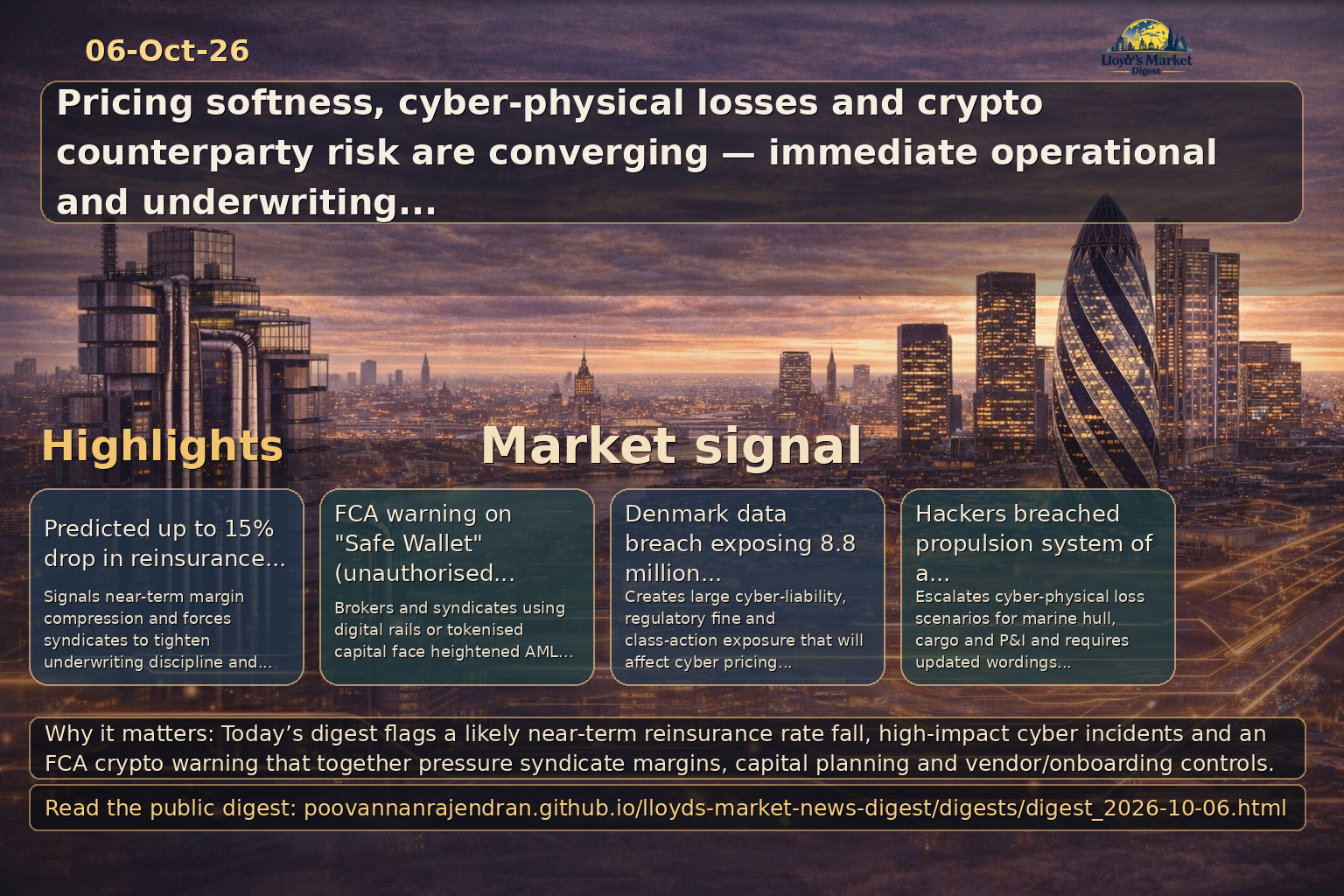
Why it matters: FCA warning on 'Safe Wallet' illustrates ongoing unauthorised crypto-related firms targeting UK customers. Brokers and syndicates using digital payment rails, tokenised capital or crypto custody face heightened AML, custody and reputational risk if counterparties are unauthorised or fraudulent.
- Onboarding: tighten KYC/AML and vendor-authority checks for any counterparty or wallet provider; require proof of FCA authorisation or equivalent oversight for UK-facing services.
- Placement platform risk controls: restrict integrations to audited, authorised custodians and payment providers; enforce contractually bound security and incident-response SLAs.
- Strategic planning: review product wordings and capital-acceptance policies for crypto exposures; develop a position on accepting tokenised capital and define compliance guardrails before adoption.
Source: fca.org.uk
Why it matters: The FCA alert on 'Mymoneyclaim.org' demonstrates fraudsters posing as claims or recovery services. This threatens client outcomes, can generate regulatory complaints, and may expose brokers and syndicates to reputational and legal risk if third-party referrals are inadequately vetted.
- Client protection: proactively publish and circulate FCA Warning List guidance to clients and insist on use of approved, verified claims handlers and recovery agents.
- Third‑party management: incorporate continuous monitoring of referral partners into vendor risk frameworks and terminate relationships with any unauthorised or suspicious operators.
- Contractual safeguards: include audit, indemnity and notification clauses in panel agreements to mitigate exposure arising from third‑party misconduct affecting placements or claims.
Source: fca.org.uk
Why it matters: The FCA speech on reforming UK capital markets signals regulatory support for making markets more competitive and for innovation such as tokenisation. For Lloyd’s, this opens paths to alternative capital, more efficient placement and secondary liquidity — but requires compliance, custody and market‑structure adaptations.
- Capital strategy: evaluate tokenised capital structures and alternative funding channels for syndicates to improve capacity and liquidity management while stress-testing legal and governance implications.
- Platform alignment: prioritise integration pilots with regulated exchanges and custody providers, ensuring settlement, reporting and AML frameworks meet evolving FCA expectations.
- Regulatory engagement: engage early with FCA pilots and industry consultations to shape rules, secure regulatory comfort for market‑wide placement innovations and reduce execution risk.
Source: businessinsurance.com
Why it matters: Regional insurer expansion into Japan cyber illustrates intensifying competition for cyber capacity and distribution in Asia — critical for syndicates, brokers and placement platforms.
- Increases regional cyber capacity and pricing competition; syndicates should reassess appetite and differentiation strategies.
- Requires brokers and placement platforms to enhance local-market flow and specialist distribution partnerships.
- Prompt for Lloyd’s and global specialty underwriters to review Japan-specific cyber wordings, incident response expectations and aggregation models.
Source: businessinsurance.com
Why it matters: A predicted up to 15% drop in reinsurance rates at 1/1 signals near-term margin compression and potential reallocation of capital across specialty lines.
- Syndicates and reinsurers must tighten underwriting discipline and re-evaluate portfolio mix to preserve ROE.
- Creates opportunities to selectively deploy capital into higher-margin niche products or geographies.
- Brokers need to manage client expectations and leverage placement platforms to secure competitive treaty terms and capacity.
Source: businessinsurance.com
Why it matters: Strategic JV investment by Allianz with a major local partner demonstrates the value of distribution partnerships for market entry and scale in large emerging markets.
- Enhances local distribution channels — syndicates and Lloyd’s market participants should pursue strategic partnerships to access retail flows.
- JVs alter placement patterns; brokers must adapt submission strategies and refine go-to-market positioning.
- C-suite should evaluate alliance models as a faster route to market penetration versus organic expansion.
Source: businessinsurance.com
Why it matters: Overlapping APAC cyber regulations increase insured loss potential via fines and expose carriers to complex cross-jurisdictional liabilities.
- Raises the need for standardized policy language and clear coverage boundaries for regulatory fines and obligations.
- Placement platforms should integrate regulatory-check capabilities and advisory services for cross-border cyber programs.
- Underwriters must stress-test cyber portfolios for regulatory-driven losses and update pricing models accordingly.
Source: businessinsurance.com
Why it matters: A concentrated flood loss to motor inventory highlights flood exposure aggregation and the relevance of physical climate risk to specialty portfolios and supply-chain exposures.
- Signals increasing frequency and severity of flood-related property losses — syndicates must refine catastrophe modelling and exposure concentration controls.
- Brokers should proactively advise corporate clients on mitigation, valuation and alternative placement structures.
- Opportunity for placement platforms to offer rapid submission triage and parametric or hybrid products to address liquidity needs.
Source: globalreinsurance.com
Why it matters: Arch’s appointment of an experienced cyber underwriter to lead Italy signals targeted growth in European cyber, tech E&O and media E&O offerings — expanding capacity and product availability for cedants and brokers operating in Italy and Southern Europe.
- Strengthens Arch’s local underwriting capability and distribution in Italy, increasing competition for Lloyd’s syndicates on cyber placements.
- Senior hire from Chubb/Sompo underscores market scarcity for experienced cyber underwriters and potential upward pressure on pricing/terms in specialty cyber lines.
- Brokers and placement platforms should prepare for increased primary and excess cyber submissions — ensure platform support for cyber wordings, aggregation analytics and flexible placement workflows.
Source: globalreinsurance.com
Why it matters: Dominic Collins stepping to president emeritus reflects governance and succession planning consistent with a broker preparing for its next growth phase and potential IPO; this has implications for distribution scale, strategic M&A and how large brokers interact with Lloyd’s and other specialty capital providers.
- Signifies institutionalisation of governance and leadership succession — key for investor confidence ahead of a potential public listing and for large-scale strategic partnerships with syndicates.
- May accelerate Howden’s ability to aggregate risk and place more complex, large-volume business, increasing competition among brokers for Lloyd’s capacity and placement platform partnerships.
- Placement platforms and syndicates should anticipate larger, standardized flows from consolidated brokers and consider strategic integrations, capacity allocations and delegated authority arrangements.
Source: globalreinsurance.com
Why it matters: Willis Re’s appointment of a senior Munich Re executive to lead German operations marks a deliberate push to establish a local reinsurance footprint in Germany, enhancing access to DACH cedants and influencing treaty and facultative placement dynamics involving Lloyd’s capital and other global reinsurers.
- Establishes Willis Re as a localized reinsurance intermediary in Germany, improving cedant access to global specialty capacity and potentially redirecting placements away from incumbent channels.
- Signals intensified competition for senior reinsurance talent and for relationships with German cedants — relevant to syndicates seeking distribution in the DACH market.
- Placement platforms must support German-language, local regulatory compliance and treaty structuring; syndicates should assess strategic partnerships or regional representation to maintain market share.
Source: insurancejournal.com
Why it matters: The emergence of eMaxx’s risk-managed, captive-centric commercial programme highlights a shift toward bespoke capital solutions and distribution models that affect Lloyd’s appetite for delegated business and relationships with MGAs and wholesale brokers.
- Assess syndicate appetite for quota-share or capacity support for captive-backed programmes and define actuarial corridors for admitted vs. London-placed layers.
- Ensure placement platforms and brokers implement enhanced due-diligence workflows for captive sponsors, including capital adequacy, governance and risk mitigation protocols.
- Adapt binding authority and oversight frameworks to manage moral hazard and aggregation where captives assume primary retention and syndicates take layered excess risk.
Source: insurancejournal.com
Why it matters: A cyber intrusion into a tanker’s propulsion system escalates concerns about cyber-physical loss scenarios in marine hull & machinery, cargo, and protection & indemnity lines — a domain where London market syndicates provide significant specialty capacity.
- Update marine cyber wordings and limits, clarifying coverage for cyber-physical control system breaches and related business interruption for shipowners and charterers.
- Enhance aggregation modelling for correlated cyber-physical exposures across fleets and ports; consider stricter accumulation limits or super-sublimits.
- Coordinate with brokers and placement platforms to demand shipboard cyber-risk controls as a condition precedent to bind and to price for control failures.
Source: insurancejournal.com
Why it matters: Central bank warnings that exogenous events (war, cyber, tech failure) can precipitate financial crises underline systemic tail risks that influence reinsurer capital, collateral terms for syndicates and stress testing for placement platforms.
- Incorporate macro scenario stress testing (geopolitical escalation, widescale cyber disruption) into syndicate solvency and capital planning exercises.
- Revisit collateral and security provisions in reinsurance and retrocession contracts to anticipate sudden rating or liquidity stresses.
- Communicate with corporate cedants and brokers about contingency plans for capacity withdrawal, pro-rata placement failure and alternative capital activation.
Source: insurancejournal.com
Why it matters: A nation-state-scale data breach with PII from a central population register creates potential for vast cyber-liability exposures, regulatory fines and multi-jurisdictional class actions — areas of rising relevance for cyber product wording and capacity allocation in London.
- Price for long-tail PD/PI aggregation and defence costs; consider layered structures with specialist reinsurers and retrocession to manage volatility.
- Standardise incident response timelines, notification triggers and fines coverage exclusions across placements to limit post-event disputes.
- Work with placement platforms to track exposure concentrations by geography and client type to prevent silent cyber accumulation within syndicate portfolios.
Source: insurancejournal.com
Why it matters: Regulatory directives for finance-sector security inspections signal faster supervisory intervention after breaches — increasing compulsory remediation costs and potential loss of business for insured financial institutions, impacting cyber & financial lines appetite.
- Anticipate demands for minimum cyber-control baselines from regulators; require proof of compliance as part of binding conditions for financial institutions.
- Model potential first-party remediation spend and third-party liabilities separately when underwriting financial institutions exposed to regulatory enforcement.
- Engage broker networks and placement platforms to develop rapid-response facultative capacity for regulated clients undergoing mandated security upgrades.
Source: reinsurancene.ws
Why it matters: Historical precedent showing early parametric deployment and Lloyd's product planning adjustments — useful context for strategy and product-risk timing decisions.
- Demonstrates early market adoption of parametric solutions relevant to current climate-related product demand and syndicate appetite.
- Highlights how Lloyd's strategic product roll-outs can be delayed by broader political or market priorities — instructive for timing new placements.
- Serves as a benchmark for broker and placement platform planning when designing multi-year or index-linked solutions.
Source: reinsurancene.ws
Why it matters: Illustrates a Lloyd's-led specialist cargo proposition integrating underwriting with technology and coverholder capacity — a model for targeted specialty solutions.
- Shows how syndicates (via Chaucer) and Lloyd's coverholders (Indemni) can combine to underwrite bespoke strategic-theft exposures.
- Highlights the role of tech (driver verification, tracking) in risk mitigation that underpins underwriting appetite and pricing.
- Signals broker opportunity to package technology-enabled endorsements and route complex transit risks through Lloyd's placement platforms.
Source: reinsurancene.ws
Why it matters: AI-native cyber risk management tools influence underwriting precision and loss prevention — altering product delivery and broker servicing models in specialty cyber.
- Platforms like Cowbell OMNI that deliver individualized Risk Advisors can materially improve risk selection and reduce claims severity for syndicates.
- Brokers can leverage AI-driven evidence to demonstrate risk reduction to capacity providers, supporting pricing and capacity expansion.
- Integration of decision intelligence into MGA/insurer workflows accelerates straight-through processing on placement platforms for SME cyber business.
Source: reinsurancene.ws
Why it matters: Calls to bridge the mismatch between annual insurance cycles and multi-year corporate planning challenge brokers and syndicates to redesign product and placement approaches.
- Creates demand for multi-year, parametric and programme-based solutions which require different underwriting and capital modelling by syndicates.
- Compels brokers and platforms to develop client engagement and renewal mechanics that support 3–5 year operational plans.
- Encourages syndicates to adapt portfolio and reserving frameworks to accommodate longer-tenor exposures and multi-year pricing commitments.
Source: reinsurancene.ws
Why it matters: Acquisition of a London Market specialist broker and MGA enhances wholesale distribution and Lloyd's access for complex risks.
- Strengthens broker capability to place intricate specialty risks into Lloyd's and adjacent company markets via established MGA infrastructure.
- Improves negotiating leverage with syndicates through scale and specialist underwriting resources.
- Creates cross-sell and platform-integration opportunities that can streamline placement workflows for wholesale partners.
Source: artemis.bm
Why it matters: The Artemis "Best of" digest aggregates the week’s most-read analysis on reinsurance pricing, ILS and catastrophe developments — content that directly informs pricing, capital allocation and placement decisions across Lloyd’s syndicates, global specialty carriers, brokers and placement platforms.
- Price‑cycle signal: Jefferies’ view that reinsurance rates may continue to soften through 2028 (with a soft‑market floor potentially not until 2030) requires syndicates and specialty carriers to stress‑test underwriting assumptions, revise 2027–2029 capital plans and align broker placement strategies to preserve margin.
- Terms & conditions focus: As pricing pressure intensifies, the market will shift emphasis to policy wordings, exclusions and aggregation language; brokers and placement teams must prioritise proactive T&C negotiation, legal review and bespoke wording solutions to protect carrier and client exposures.
- ILS and catastrophe intelligence: The roundup’s emphasis on catastrophe bonds, ILS activity and recent landfalls highlights the need for coordinated deployment of alternative capital, enhanced catastrophe modelling and tighter accumulation controls across syndicates and platform-led placements.
Source: newsnow.co.uk
Why it matters: Book publishing news is a proxy for concentrated media exposures: publishers, imprints and high‑profile authors generate intellectual property, defamation and reputational liabilities that specialty markets at Lloyd’s can underwrite or reinsure.
- Review and refresh media liability / E&O wordings to address digital publishing, global distribution and jurisdictional defamation risk.
- Engage brokers with bespoke packages for publishers and imprints including cyber, IP infringement, publication liability and contingent BI for printing/distribution failures.
- Leverage placement platforms to streamline small‑publisher submissions and rating, enabling scale while preserving underwriting scrutiny for high‑value author accounts.
Source: newsnow.co.uk
Why it matters: Ongoing reporting about plague and other infectious diseases signals persistent public‑health exposures that affect life, health, travel, commodity supply chains and contingent business interruption — relevant to global specialty and pandemic capacity planning.
- Reassess BI and event cancellation wording exclusions and triggers; consider parametric or index‑based products to cover epidemic/pandemic business interruption gaps.
- Coordinate with reinsurers and capital providers to stress‑test capital models for low‑frequency, high‑severity infectious events and update accumulations protocols.
- Brief brokers and risk managers on underwriting guidance for industries with heightened zoonotic exposure (agriculture, FMCG logistics, travel) and expand surveillance data feeds into underwriting systems.
Source: newsnow.co.uk
Why it matters: A search for “Tanker” — even if returning no results — highlights two priorities: (1) marine and energy shipping exposures (hull, cargo, P&I, war/sanction risks) remain central to specialty markets; (2) gaps in searchable intelligence can blind brokers and underwriters to emerging incidents.
- Ensure marine underwriting frameworks incorporate sanctions screening, diversion controls and enhanced due diligence for energy cargoes and charterers.
- Invest in AIS, satellite and trade‑flow data integrations on placement platforms to reduce blind spots and enable near‑real‑time exposure aggregation.
- Develop rapid response placement workflows for hull/cargo incidents, including delegated authority appetite statements for standardised quick quotes.
Source: newsnow.co.uk
Why it matters: High‑profile individuals and authors drive reputational and personal liability exposures that sit within specialty personal lines and media liability classes; celebrity news items are signals for potential defamation, privacy and IP claims.
- Expand high‑net‑worth / celebrity coverage options within specialty units to include libel, privacy, image rights and event cancellation protections.
- Partner with brokers to offer proactive reputation risk advisory and pre‑claim mitigation services as value‑add to underwriting packages.
- Monitor press cycles for concentration risk and use placement platform alerts to flag accounts requiring elevated review or panel referrals.
Source: newsnow.co.uk
Why it matters: News on authors indicates a persistent market of individual creators and small publishers with specific liability needs (defamation, IP, event cancellation, E&O). These are addressable by scaled products and digital placement workflows.
- Design modular, price‑tiered media liability products for authors and independent publishers that bundle cyber, E&O and event coverages.
- Enable digital self‑service placement pathways on broker platforms for standardised risks, reserving manual syndicate placement for complex or high‑limit accounts.
- Train broker networks on appetite and evidence requirements for author-related risks to accelerate conversion and reduce submission friction.
Source: risk.net
Why it matters: Intraday fixed-income pricing pressures traditional end-of-day valuation conventions that Lloyd’s syndicates and specialty carriers rely on for capital, solvency and collateral calculations; brokers and placement platforms will need to adapt workflows and connectivity to support higher-frequency valuation inputs.
- Balance-sheet and capital impact: Intraday marks increase volatility in reported NAVs and regulatory capital measures for syndicates; treasury and actuarial teams must update stress and liquidity planning to reflect more frequent swings.
- Collateral and counterparty risk: More frequent price discovery can trigger intraday margining or collateral calls for reinsurance, ILS and retrocession arrangements — contractual terms and operational processes must be reviewed.
- Platform and data integration: Brokers and placement platforms will need low-latency price feeds, automated reconciliation and versioned valuations to support real-time negotiations and reporting to underwriting and risk committees.
Source: risk.net
Why it matters: AI is accelerating capability across underwriting, claims and enterprise risk management in ways that can materially change placement speed and loss selection for global specialty lines; however, model risk, explainability and third-party vendor governance are immediate priorities for Lloyd’s participants and brokers.
- Underwriting and pricing uplift: AI-enabled models can improve risk selection, predictive pricing and portfolio optimisation for specialty lines, but require validation, monitoring and conservative deployment roadmaps to avoid unintended risk concentration.
- Claims and operational efficiency: Automation and ML-driven triage improve claims throughput and fraud detection, reducing loss adjustment expense — governance, audit trails and human-in-the-loop controls are essential for complex or high-severity claims.
- Governance and vendor risk: Widespread AI use increases dependency on external data vendors and model providers; firms must strengthen model governance, explainability, SLAs and regulatory compliance (PRA/FCA expectations) across syndicates, MGAs and broking platforms.